Suzhou City in east China's Jiangsu Province is positioning itself as a hub for next-generation optical communications, building a seamless link between laboratories and industry.
By aligning universities, research institutes and leading companies, the city is accelerating the rollout of fiber-based technologies into real-world applications, with a full innovation chain that connects laboratory breakthroughs with market adoption, creating new scenarios for high-speed data transmission.
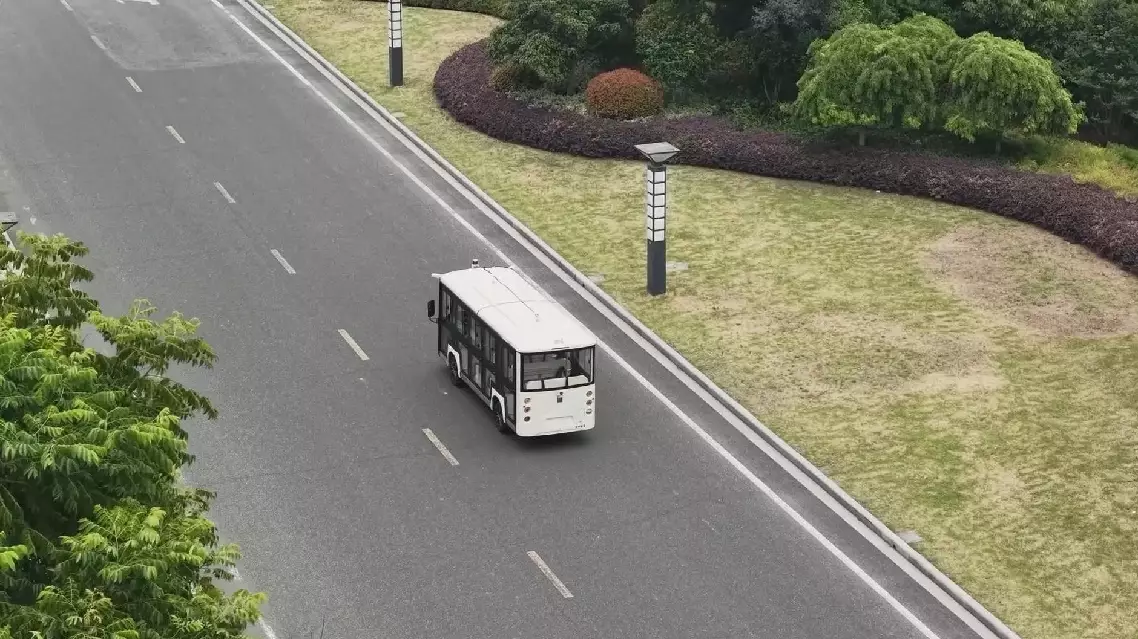
One example is autonomous driving. At a technology park in Wujiang District, a fiber-equipped sightseeing vehicle has undergone simulation tests.
Lighter and faster than copper wiring, optical fibers deliver high bandwidth and low latency, enabling smart cars to process data from cameras and laser radar in real time and detect obstacles more precisely.
Industry leaders and research institutes are joining forces to explore this new frontier and prepare for the next phase of industrial growth.
"We have made early deployments in some new applications and research areas. For optical fiber, this is a two-way feedback loop: intelligent vehicles need fiber to be installed, while fiber, once applied to vehicles, expands its application scope and drives the development of smart driving," said Xuan Chuanwu, deputy general manager of Jiangsu Hengtong Optoelectronics.
At the renowned Soochow University, researchers are working with industry partners on projects ranging from nuclear safety monitoring to subsea communications, extending into other frontier fields.
Optical fibers, which are radiation-resistant, are being tested for monitoring personnel and radiation levels in nuclear facilities, according to Shen Gangxiang, director of the university's School of Electronic Information.
"This part concerns sensing. We plan to apply the system in nuclear power plants to monitor personnel movement and radiation in nuclear environments. The greatest advantage of optical fiber in such settings is its strong resistance to radiation," Shen said.
Last month, the university and enterprises jointly launched a transformation center to accelerate the commercialization of breakthroughs in optical communications.
Local authorities said the city's innovation model is shifting from small, segmented alliances to large integrated networks that connect the entire industry chain.
"In this area, industry-academia-research partnership is evolving from small, specialized consortia and limited coordination toward large alliances that integrate the entire chain. For example, through the photonics mega-consortium network, innovation resources across the upstream, midstream, and downstream of the industry can be coordinated, which promotes deep cross-sector collaboration from materials to chips, devices, systems, and computing applications," said Zhang Tingxiu, deputy director of the Science and Technology Bureau in Suzhou.
The combined efforts have paid off. Now, Suzhou's optical communications industry has formed a cluster worth hundreds of billions of yuan, with more than 50 innovation consortia established.
In the first quarter of this year, the sector's output grew by over 60 percent, underscoring the city's role as a driver of China's future in optical communications.
Enhanced industry-academia-research ties promotes Suzhou's optical communications industry