Drones are transforming the transport of agricultural products in southwest China's Sichuan Province, speeding deliveries of cherries and timber from mountain areas while cutting costs and reducing losses.
In Hanyuan County, famed as China's "hometown of sweet cherries," the delicate fruit now reaches consumers far faster, preserving its mountain freshness.
"We used to transport everything down the mountain by motorcycle. The shaking would damage the cherries even though the road might look flat. The loss rate was around 10 to 15 percent," said Cheng Xiaoyi, a cherry grower.
The use of drones have become a game‑changer for cherry growers. Instead of jolting down mountain roads, the fruit is now flown straight out of the orchards, which is faster, steadier and minimizes damage.
"Low-altitude drone transport helps reduce logistics costs and provides a smoother delivery process. It can also lower fruit damage rates to around 3 percent," said Zhang Wei, director of the Hanyuan Highway Transportation Management Office.
"We adapted to Hanyuan's high-altitude, complex terrain, where vehicles often struggle to pass and built a stable aerial transport corridor. Now, a one-way drone delivery takes about 10 minutes. Efficiency has improved by 90 percent. For major cities, delivery can be as fast as the next day," said Xian Yinli, team manager of JD Logistics' cherry project in the Sichuan-Xizang region.
The CGTN team placed a small bouquet of flowers inside one of the drone cargo boxes. The next morning, after traveling more than 230 kilometers to Chengdu, the flowers were still intact and fresh, just like the cherries.
In Yingjing County, the south gateway to the Giant Panda National Park, farmers once hauled timber by hand or along twisting mountain roads. Now drones lift it out efficiently, cutting labor and speeding delivery.
"If we had to move everything by hand, there would be almost no profit. A drone can do in one day what takes people ten," said Wang Shuhua, a local farmer.
Villages are increasingly opting to fly goods out by drone rather than build new mountain roads, cutting costs and avoiding environmental damage.
"Without drones, transporting these logs simply wouldn't be worth it. Labor costs would be higher than the timber itself. Now farmers can earn around 200 yuan per ton. And one drone can transport more than 200 tons a month," said Wang Haojie, hoisting operations manager at Sichuan Changfei Smart Agriculture Technology.
The impact extends beyond efficiency as drones reduce the need for new roads, helping protect the environment while keeping mountain industries running.
"Opening up private paths for timber transportation could damage farmland, but with drones, they don't need to do that. At first, many farmers thought it would be too expensive. Now the village has over 1,000 households, and about one third of them have already started using drone transport," said Tong Chuan, Party branch secretary of Dali Village in Yingjing's Huatan Town.
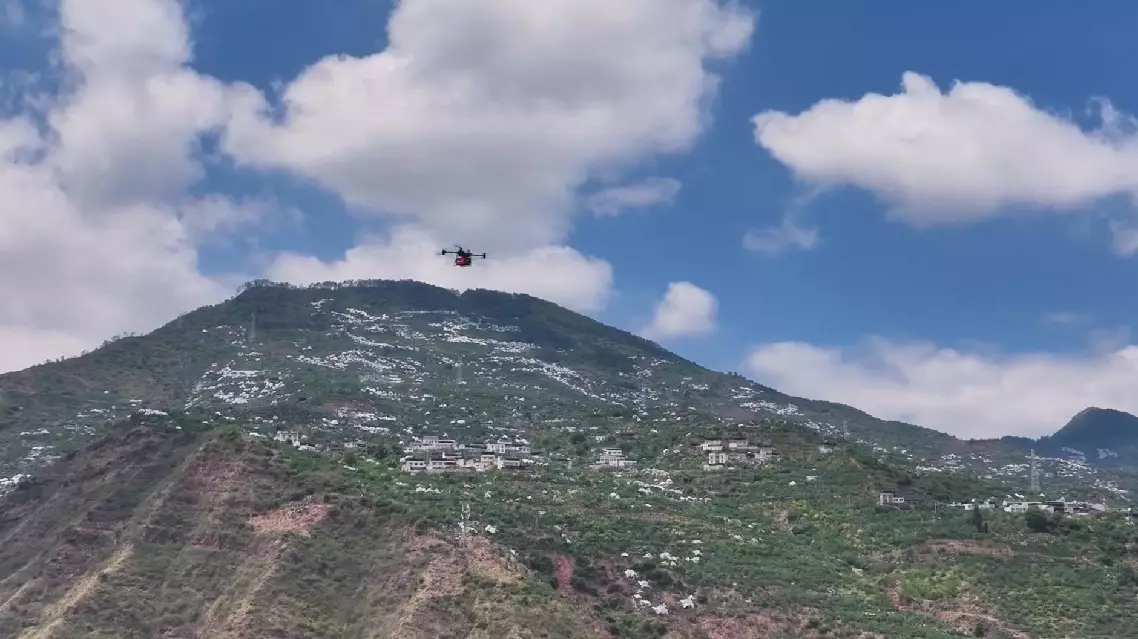
Drones revolutionize agricultural product transportation in mountainous areas in Sichuan