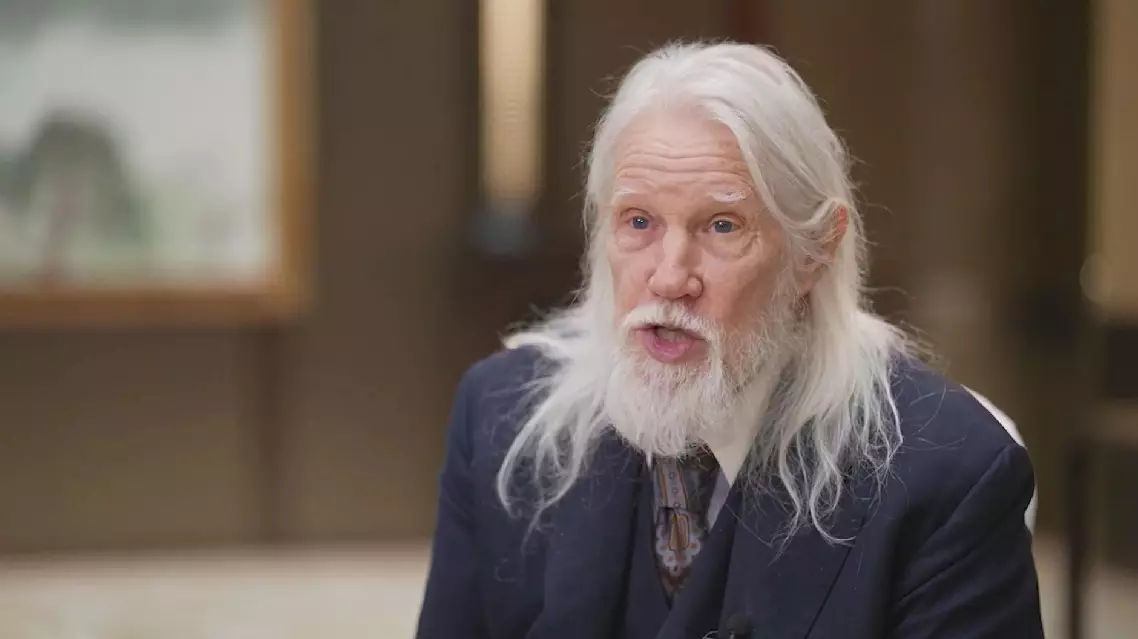
Three Laws of Robotics proposed by science-fiction writer Isaac Asimov in 1942 are not sufficient to address today's challenges in the artificial intelligence (AI) field, said Whitfield Diffie, a Turing Award laureate and public-key cryptography pioneer.
In an interview with China Global Television Network (CGTN), Diffie noted that current discussions around AI safety focus too heavily on regulating what systems produce, rather than on protecting human rights, highlighting that humans shouldn't allow AI to make decisions on their behalf.
Although the first law stipulates that a robot can't hurt a person, modern autonomous drones already raise concerns about machines making lethal decisions, said Diffie.
"One thing is how little that describes -- that's 90 years old, those notions -- and how little they describe what we're doing today. But the first one said a robot can't hurt a person. That's principle one and as you will note in the drones that go out and kill people, I mean, people argue about whether drones should kill people autonomously, and I don't know whether they do or don't yet, but certainly that's something nobody sees that or it's not widely seen as an absolute objection," he said.
As for the second law, which says robots should obey people, Diffie said it is being tested by "guardrails" that allow AI to refuse certain requests.
"The second one was robots should obey people and that's exactly what guardrails are against. And to say robots should obey people is to say robots should not be allowed to be a tool of the competition between people. We use machines as the major tool by which one group of people controls another. Surveillance systems are a major example, traffic gates. All sorts of things are largely to control people," he said.
Diffie further questioned the third law, saying it's unclear how such a principle can be applied in practice.
"Now that third one was, to my mind was a little strange, said a robot should protect itself unless it violates the first two laws. And one of the things that strikes me there are anecdotes keep coming up in the news about large language models that did something we don't find very much to our interest but they found it to their interest and they needed to do something so they deleted all our files so they'd have enough memory to do what they wanted to do," he said.
Asimov's Robotics Laws not sufficient to address today's AI challenges: expert