China-Europe cooperation has brought steer-by-wire (SBW) technology into mass production in China, marking a breakthrough for smarter autonomous driving solutions.
The advancing system-equipped cars look no different from the conventional models and can be well controlled by conventional drivers.
But when a turn comes up, the driver no longer needs to crank the wheel as far.
Instead of relying on a traditional mechanical shaft, the driver's steering action is converted into electronic signals sent to a control unit. The system then interprets those signals to guide the wheels, while feedback mechanisms simulate the steering response. For safety, backup systems ensure the car stays controllable even if one fails.
"Steer-by-wire technology supports intelligent driving. In terms of autonomous driving, there will be no intermediate shaft, allowing full decoupling. Decoupling can enhance the active safety of intelligent driving. Traditional automakers, including domestic ones, joint ventures, and new EV players, are all actively promoting steer-by-wire," said Zhao Yu, a tech expert at Bosch Hasco Steering.
Pavel Jagja, general manager of operations at Bosch Hasco Steering, said China's autonomous driving boom is fueling demand, and global cooperation makes the product competitive for local carmakers.
"We have a lot of experience with Western or European car manufacturers and American car manufacturers. Meanwhile, we changed and successfully transformed our company to be able to serve Chinese car manufacturers, especially the newcomers on the market. With our speed, local R and D capability, and power in the market as a leader of the steering business in China, we are able to provide all the required technology to the market," said Jagja.
The firm now produces more than 7.5 million steering system units annually. Many are already used by domestic brands, with some exported overseas in finished vehicles.
The company says expanding its overseas market is its next business objective.
"Our idea is definitely to serve our customers globally. We have the mindset of 'develop in China, for China and global.' We know, as the market conditions change, the innovation power also moves from some applications from Europe to China. We would like to leverage it together with customers," Jagja said.
In May, a survey released by the EU Chamber of Commerce in China showed that 17 percent of respondents said they were optimistic about their two-year profitability outlook, up 5 percentage points year on year. One-third of the firms will strengthen their local expansion.
The steer-by-wire technology stayed in focus at the third edition of the China International Supply Chain Expo (CISCE), held in July 2025 in Beijing. It is expected to shine again at the upcoming fourth edition of the expo, scheduled for June 22 to 26 in Beijing.
Hosted by the China Council for the Promotion of International Trade (CCPIT), CISCE is the world's first national‑level exhibition dedicated specifically to global supply chains.
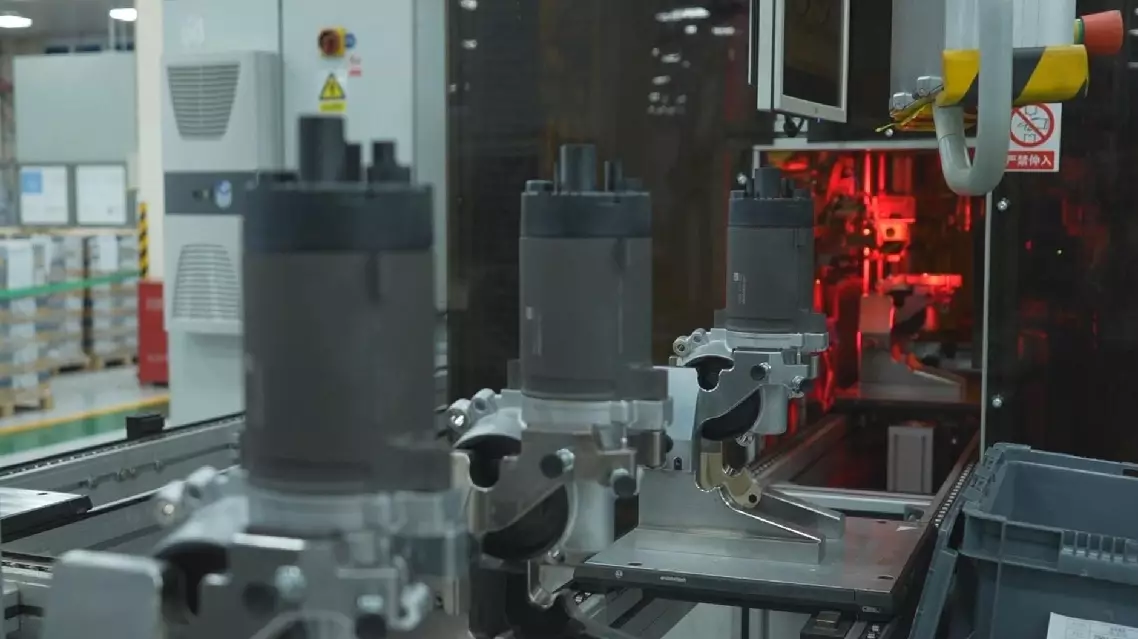
China-Europe venture drives steer-by-wire technology into mass production