MANILA, Philippines (AP) — Russia has freed 24 Filipinos who were detained for months without charges in a Siberian city, after Philippine President Ferdinand Marcos Jr. raised concern for them in a meeting with President Vladimir Putin, Philippine officials said Saturday.
The 24 arrived in Manila aboard two flights early Sunday, and the first batch was welcomed by Philippine Foreign Secretary Theresa Lazaro, who accompanied Marcos in his talks with Putin on Wednesday in the Russian city of Kazan, the Department of Foreign Affairs in Manila said.
Migrant Workers Secretary Hans Cacdac welcomed the final batch of freed workers before dawn. His agency provided unspecified aid to the workers, who were detained in a Russian region known for its extreme winter temperatures.
Marcos, who currently holds the rotating presidency of the Association of Southeast Asian Nations, led leaders of the 11-nation bloc in commemorating the 35th anniversary of ASEAN’s diplomatic relations with Russia. Marcos held a bilateral meeting with Putin on the sidelines of the summit in Kazan.
The release of the Filipinos was relatively swift after Marcos raised his concern on Wednesday. The Philippines is a key treaty ally of the United States in Asia and was among the majority of ASEAN members who voted for a U.N. General Assembly resolution condemning Russia’s 2022 full-scale invasion of Ukraine.
Singapore was the only ASEAN member to impose sanctions on Russia. Singapore Prime Minister Lawrence Wong joined the Kazan summit.
After his bilateral meeting with Putin, Marcos told reporters that he raised his concern over the Filipinos who were detained for about nine months in the city of Yakutsk in eastern Siberia without charges. He said the Philippines has no other information about their condition.
There were reports that the Filipinos may have been victims of illegal job recruitment and taken into custody in Russia due to possible violations of immigration laws, Philippine officials said.
Putin told Marcos that he was unaware of the problem but promised to look into it. Over dinner on Wednesday, the Russian president told Marcos that the Filipinos had not been charged with any wrongdoing, Marcos said. “Don’t worry, we will find a way to fix this problem,” Marcos quoted Putin as saying.
The Philippine delegation was eventually notified by Russian officials that the Filipinos would immediately be deported back to Manila, Marcos said.
About 15,000 Filipinos live and work across Russia, according to Philippine Ambassador to Moscow Igor Bailen.

Russian President Vladimir Putin, left, and Philippine President Ferdinand Marcos Jr. pose for a photo on the sidelines of the Russia-ASEAN summit in Kazan, Russia, Wednesday, June 17, 2026. (Mikhail Metzel/Sputnik, Kremlin Pool Photo via AP)
College football will expand its playoff to 24 teams beginning next year in a move that resets decades of tradition surrounding a once all-important regular season and dumps conference championship showdowns that used to be among the sport's marquee events.
The announcement from the College Football Playoff and ESPN on Monday made official a deal that's been in the works for months. The network reported it would pay an additional $1.7 billion over five years on top of the original $7.8 billion contract that runs through the 2031 season.
The new format will grant the Power Four conference champions automatic spots and give one more to the best team from the Group of Six. But that slot and the other 19 will be decided by a selection committee that will serve as the latest set of decision makers in college football's long history of polls and opinions having lasting impacts on teams' fates.
Beginning next year, around 30% of college football's 68 power-conference schools will have a chance to play for the title, drawing the CFP closer to the NFL, which allows 43% of its teams into the playoffs. It leaves behind the last vestiges of yesteryear, when between four and eight teams entered December with a legitimate shot to win it all.
It's a seismic shift that even ESPN conceded comes with some question marks. The network pays billions to televise regular-season games that might — or might not — have more meaning under the new system.
“In all honesty, it's impossible to know for sure,” ESPN senior vice president Nick Dawson said in a conference call.
The revenue generated from the playoff expansion will presumably make up for the estimated $345 million the Power Four conferences generated in TV money for their title games. ESPN would then not be on the hook for $140 million of the extra money due to cancellation of the title games, the network reported.
The top eight seeds will receive first-round byes in the new format and the playoff will start on the second weekend in December, with the first two rounds of games on campus. The traditional Army-Navy game will be played on the first weekend in December, which used to be reserved for conference title games.
Both the Southeastern and Big Ten conferences, whose approval was needed to adopt this change, and their Power Four brethren — the Big 12 and Atlantic Coast Conference — are banking that most of the additional spots will go to their members so their second-tier teams will have new motivation to keep spending big in an era of NIL payments and $50 million football rosters.
“I think it will be healthy for teams like our current situation, building to try to get to that point,” said coach Barry Odom, who is trying to rebuild at Purdue.
The first final for the 24-team playoff remains set for Jan. 24, 2028, in New Orleans. Traditional bowl games will still host the quarterfinal and semifinal rounds.
As for the rest of the bowls, most of them operated or televised by ESPN: “No decisions have been made at this time,” Dawson said.
As part of the expansion, the CFP is requiring Power Four teams to play at least 10 regular-season games against conference foes, other Power Four opponents and Notre Dame. Group of Six teams will have to play 10 games against conference opponents.
In theory, these requirements will keep everyone in the same ballpark when it comes to strength of schedule, which figures to play a huge role in the selection committee's considerations.
Notre Dame didn't receive any guarantees, the way it did this year when, if it’s ranked in the top 12 by the CFP for what will be the last year of the 12-team postseason, it will get a spot.
Coach Marcus Freeman said he looks at the change as a net positive, in part because a team like his can now presumably afford more than one loss, and in part because of the new scheduling requirements. Notre Dame is one of only two independents left in major college football.
“I don’t want this to be like March Madness and have 60-something teams making the playoff,” he said. “But the more opportunities we have to make the playoff, it helps us.”
The new schedule also guarantees two off weeks during a regular season that will begin the week before Labor Day.
The move to 24 teams marks the second expansion of the playoff since it began in 2014 as a four-team affair. Right after it moved to 12 in 2024, most thought it would eventually max out at 16, which was the SEC’s preference.
But the Big Ten wanted to go bigger, while the SEC balked at that, concerned about the league title game — a property it invented in 1992 and made billions from over the decades — along with the marketability of CFP games featuring third- and fourth-place finishers in power conferences.
ESPN took care of the money problem. Now, the question is whether fans will embrace an NFL-style free-for-all that could include about one-third of the Power Four’s 68 teams, depending on what happens with Group of Six schools whose role in these big-money power grabs seems to diminish with every move.
It's the latest change for a sport that, for decades, built its distinct character and generated controversy by leaning on media and coaching polls to hand out national titles.
Like then, critics see a risk in giving more power to a selection committee that hasn’t really mastered four- or 12-team brackets. The exclusion of Florida State in 2023 and Notre Dame last season stand out as the best examples, and the first rankings this season left people scratching their heads again.
Skeptics also view the expanded playoff as another dilution of what is largely seen as one of the most important regular seasons in sports, replacing potential matchups between, say, Alabama and Georgia in an SEC title game with a 13 seed vs. 20 seed game that would pit, say, Kentucky and South Carolina.
Fan reaction “certainly weighed into the decision,” Dawson said.
“Ultimately, we just need to make a spectacular playoff,” he said. “The CFP has a responsibility to our fans, they're the lifeblood of college football. We owe them to make this great. That really is our intent.”
As Big Ten commissioner Tony Petitti argued from the beginning, a postseason that gives bubble teams hope and keeps others vying for home-field advantage or byes will bring more eyes — not fewer — to the end of a regular season that sometimes boils down to only three or four traditional rivalry games with meaning.
Of course, nobody can be certain how things will play out. The only sure thing is that college football will never look quite the same.
“If they think it’s a good thing for college football, then I’ve got to believe that this is the route we’re headed,” Wisconsin coach Luke Fickell said, “and we’re going to make it a great thing for college football.”
This story has been corrected to show the Purdue coach's name is Barry Odom.
AP Sports Writers Mike Marot, Steve Megargee, Will Graves, Aaron Beard, Brett Martel and Jim Vertuno contributed to this report.
Sign up for Top 25 poll alerts here, visit the Top 25 here and see AP’s full college football coverage here
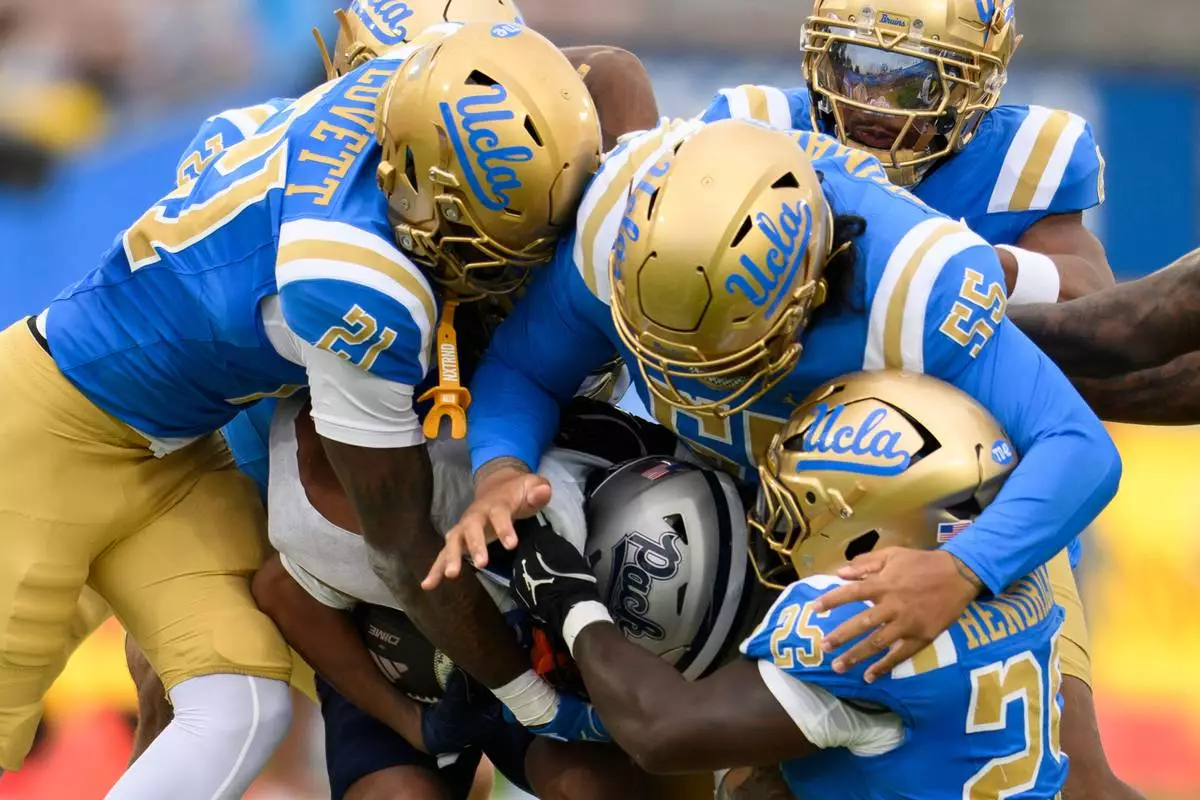
UCLA defenders tackle Nevada wide receiver Perrion Williams, center bottom, during the second half of an NCAA college football game Saturday, Oct. 31, 2026, in Pasadena, Calif. (AP Photo/Kyusung Gong)
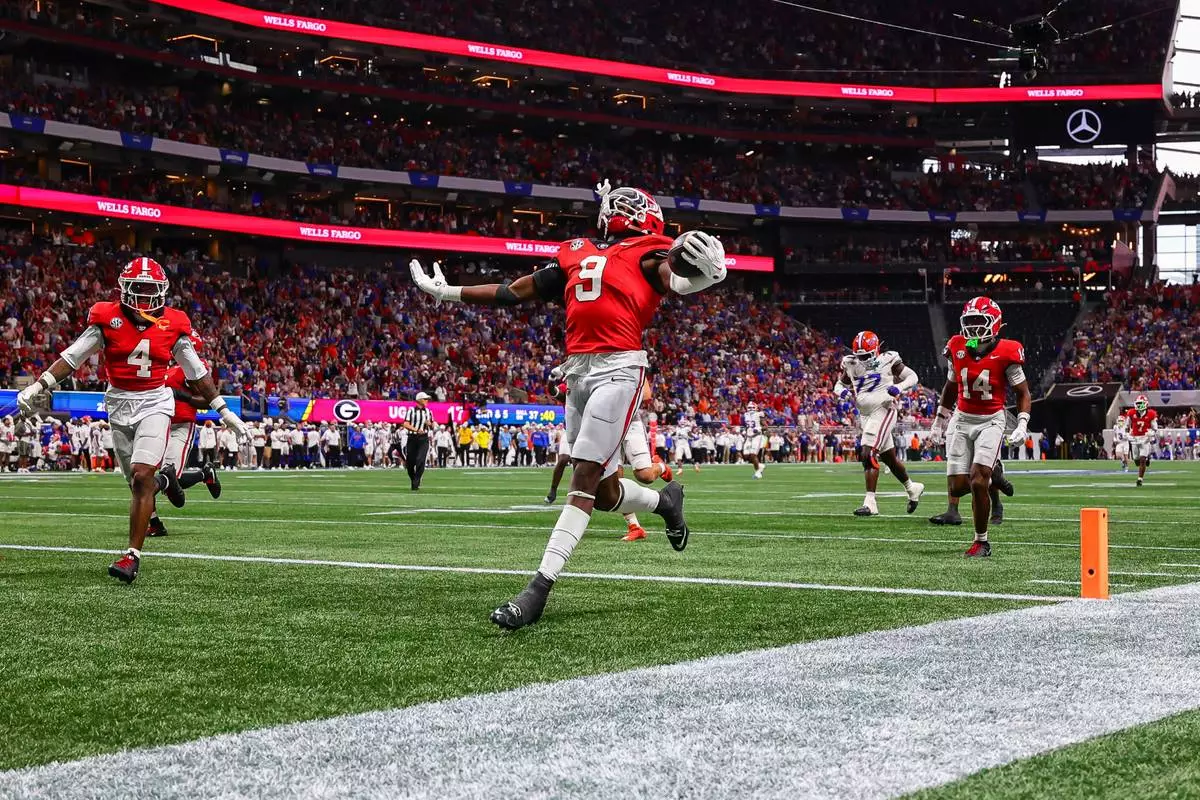
Georgia linebacker Chris Cole (9) scores a touchdown during the first half of an NCAA college football game against Florida, Saturday, Oct. 31, 2026, in Atlanta. (AP Photo/Colin Hubbard)
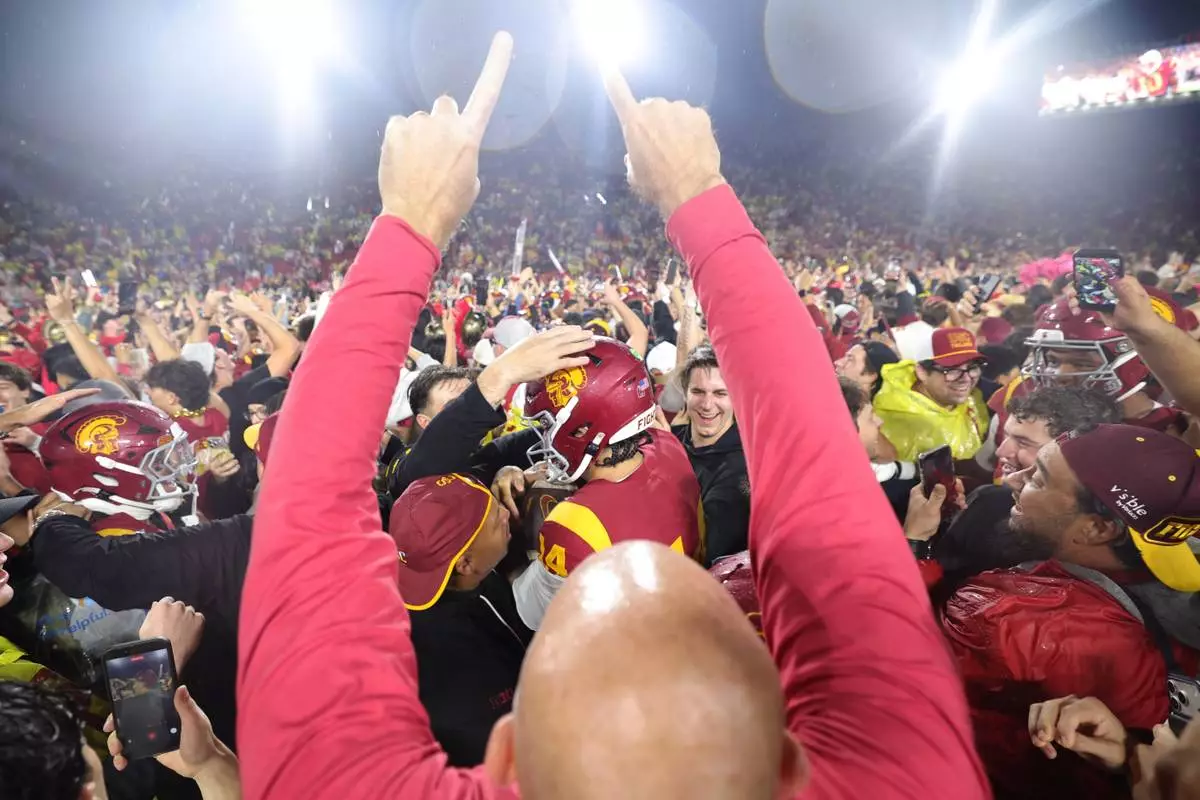
Fans storm the field after an NCAA college football game between Southern California and Ohio State, Saturday, Oct. 31, 2026, in Los Angeles. (AP Photo/Ryan Sun)