The three astronauts aboard China's Shenzhou-23 spaceship have been busy over the past week, conducting scientific experiments, in-orbit training and health management tasks.
Over the past week, the trio, namely Zhu Yangzhu, Zhang Zhiyuan and Li Jiaying, or Lai Ka-ying in Cantonese, conducted experiments using a space Raman spectrometer, a device that identifies molecular compositions by shining a laser on a sample, to study gut microbiota and nutritional metabolism.
By analyzing metabolic components in urine samples, they explored changes in gut microbiota and their effects on nutritional metabolism under long-term spaceflight conditions.
The astronauts also carried out behavioral experiments on visual motion processing and microgravity intuitive physics, aiming to investigate how gravity affects visual motion information processing, as well as the impact of long-duration spaceflight on intuitive physical representation and its recovery mechanisms.
In addition, the crew conducted in-orbit emotional recognition and evaluation research, along with emergency decision-making ability assessments, to study the patterns of emotional state changes and emergency response capabilities.
The crew replaced experimental samples in the fluid experiment cabinet, disassembled and reassembled two-phase experiment cabinet modules, installed an infrared thermal imager, and processed downlink samples from experiments on typical aquatic plant and animal symbiosis and in-orbit processing technologies.
Over the past week, the crew also carried out their first in-orbit medical rescue training since entering the space station in late May, helping them get familiar with rescue operations and force application in a microgravity environment.
For station maintenance, the crew measured in-cabin airflow speed, temperature and air cleanliness. They also collected microbial samples, inspected and maintained regenerative life support system equipment, checked low-temperature storage devices, and replaced the soft door of the core module's sleeping area.
In terms of health management, the crew carried out eye checks including vision, pressure and fundus tests, used a flywheel-based device to counter bone loss through mechanical stimulation, and kept up their regular exercise schedule.
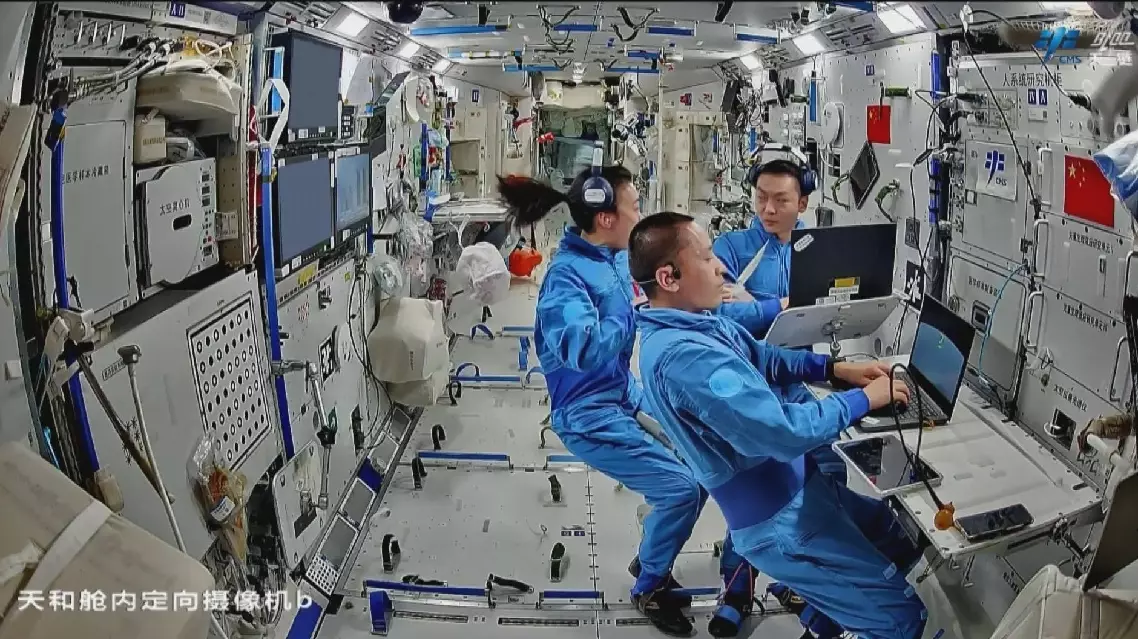
Shenzhou-23 crew busy with week of science experiments, maintenance work, training in orbit