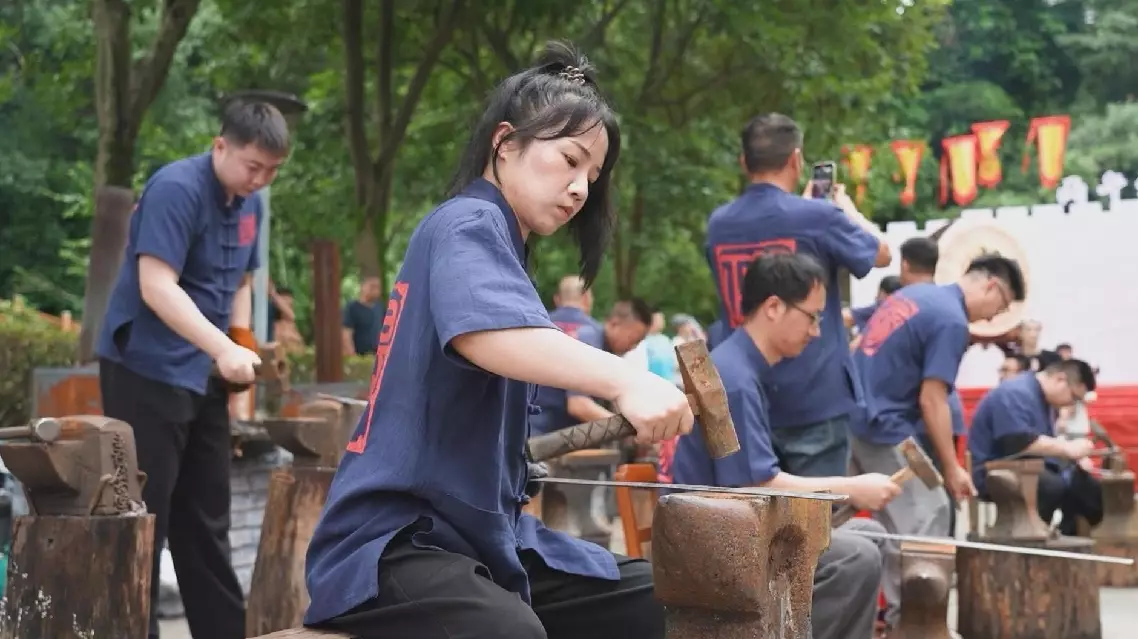
While most people across China celebrated the Duanwu Festival with dragon boat races and zongzi during the festival holiday, which began on Friday, a group of craftspeople in east China's Zhejiang Province upheld a tradition of their own.
They revived the 2,000-year-old traditional forging techniques of Longquan swords.
On Friday, more than 100 craftspeople gathered at the Jianhu Archaeological Site Park in Longquan to forge swords together. Artisans raised their hammers in unison as sword blanks were placed into furnaces for high-temperature forging. Each strike required steady precision, with the force carefully controlled.
"In every sword, we forge a soul. We temper our own will and carry on the spirit of our nation, a spirit of devotion and resilience. Our pursuit of excellence is passed down from generation to generation, keeping the Chinese cultural legacy alive and thriving. That is the true meaning of what we are doing," said Zheng Guorong, a sword craftsman.
Longquan swords date back to the Spring and Autumn Period (770 B.C.-476 B.C.) and the Warring States Period (475 BC-221 BC) in ancient China, with a history of more than 2,500 years.
The forging technique has been inscribed on China's national list of intangible cultural heritage.
From raw materials to finished products, the process involves five core procedures, including hammering, filing, polishing, inlaying and quenching, each demanding exceptional eyesight, feel and experience from the craftspeople. Many young people also took part in the event.
"By learning the traditional sword-forging techniques, we hope to help more people learn about Longquan swords through our efforts," said Zou Qi, a sword craftswoman.
Craftspeople revive ancient forging tradition in east China's province
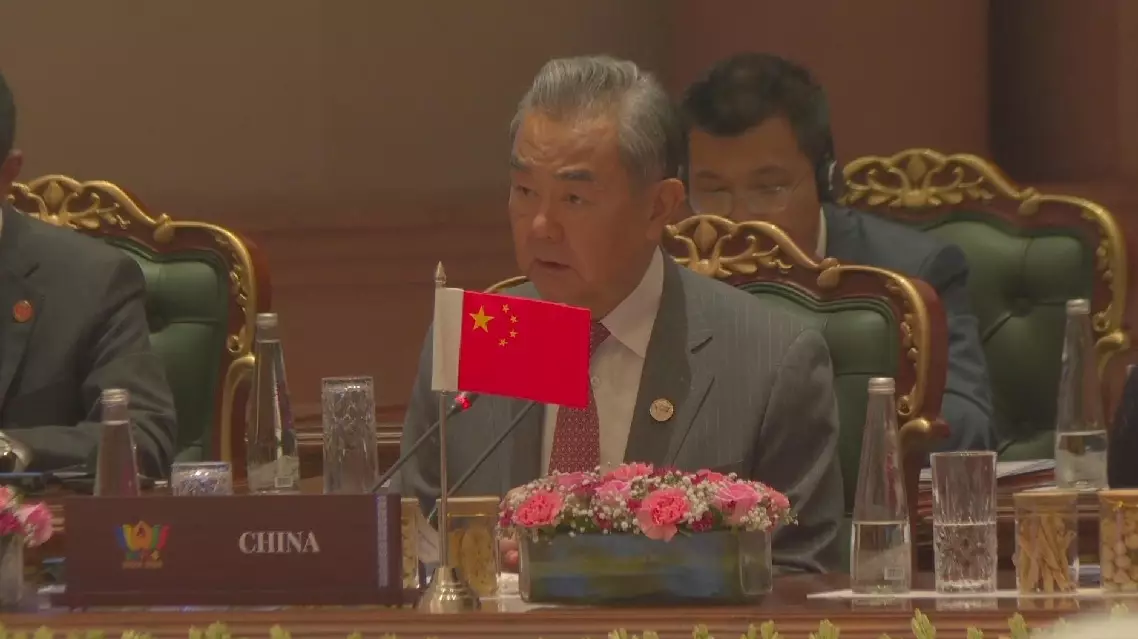
China's top diplomat Wang Yi on Tuesday emphasized the importance of upholding international rules, saying that the conflict between the United States and Iran, which has lasted for over a hundred days, has severely impacted the regional and international situation.
Wang, a member of the Political Bureau of the Communist Party of China Central Committee and director of the Office of the Central Commission for Foreign Affairs, made the remarks during the 16th Meeting of BRICS National Security Advisors and High Representatives on National Security held in New Delhi, India.
He said that the recent signing of the first phase of the U.S.-Iran Memorandum of Understanding, along with the conflict, has made many things clear to us.
The first is the importance of upholding international rules, Wang said at Tuesday's conference.
"The settlement of any international and regional hotspot issues should be based on abiding by international rules. The law of the jungle may succeed for a while, but it is not sustainable," he said.
The second is the importance of respecting national sovereignty, Wang said, adding that territorial integrity shall not be violated and a country's internal affairs shall not be interfered with. This is the most basic bottom line of international justice, he noted.
The third point is the importance of establishing a new vision of security, Wang said.
"Countries are increasingly becoming a community with a shared future. The practice of seeking absolute security of oneself at the expense of others will only backfire," he said.
The Chinese top diplomat said that the fourth is to understand the significance of new forms of war. Unconventional warfare, such as information warfare and cyber warfare, has become more visible in recent conflicts. Facing interwoven traditional and non-traditional security threats, it is the right time for BRICS countries to enhance dialogue and cooperation on security affairs.
China's top diplomat stresses int'l rules at BRICS meeting