WASHINGTON (AP) — The Senate passed a bipartisan housing bill on Monday that aims to reduce federal regulations and expand local control, one of the most sweeping efforts in recent decades to increase supply and bring down prices.
The bill, which passed 85-5 and now heads to the House, has been the focus of intense negotiations in recent weeks as lawmakers in both parties try to address housing costs in an election year. The final version of the legislation bans corporate investors from buying single-family homes but doesn’t include a Senate provision that would have required investors to sell newly constructed homes within seven years.
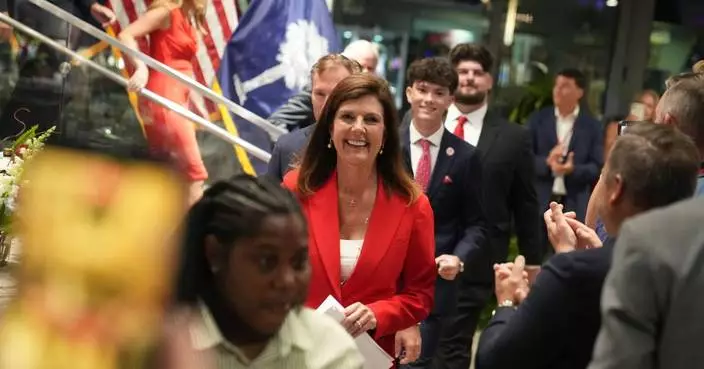
The measure was the result of years of work to “lower costs, expand housing supply, cut red tape, protect taxpayers, and help more Americans achieve the dream of homeownership," said Senate Banking Committee Chairman Tim Scott, R-S.C., who worked with Democrats to get the bill passed.
Massachusetts Sen. Elizabeth Warren, the top Democrat on the banking panel, said it is the most significant housing bill to pass Congress since 1990, when the average home in America was sold for $150,000. Now it costs more than $500,000, she said.
The bill “acknowledges that the federal government has a role to play in lowering housing prices,” Warren told The Associated Press. "For the first time ever, private equity will be blocked from buying up single-family homes and trying to turn housing into one more Wall Street investment.”
Senate passage of the bill shapes up as a rare bipartisan legislative achievement when much of Republicans' agenda has stalled. The House is expected to give final approval later this week and send the bill to President Donald Trump, who has signaled his support.
Democratic Rep. Maxine Waters of California, who helped negotiate the legislation, said it was a “huge step toward finally addressing the affordable housing and homelessness crises in this country.”
Republicans and Democrats have embraced the bill as a way to show they are addressing the nation’s affordability crisis, driven in part by rising home prices due to a shortage of affordable housing. The U.S. housing market has been in a slump dating back to 2022, when mortgage rates began to climb from pandemic-era lows.
Sales of previously occupied U.S. homes have been hovering close to a 4-million annual pace going back to 2023 — well short of the 5.2-million annual pace that’s historically been the norm. Sales slowed last year to a 30-year low and have remained sluggish so far this year, declining in January and February versus a year earlier.
The Economic Report of the President in April found a shortage of 10 million homes, while a report this month from the Joint Center For Housing Studies at Harvard University found sales of existing homes were at three-decade lows and inventories were rising due to high home buying costs. “Cost burdens for both renters and owners continue to climb, while assistance remains profoundly underfunded,” the report said.
While the median U.S. monthly rent has been declining for nearly three years, it was still 17.2% higher in May than it was before the pandemic, according to data from Realtor.com.
To increase the supply of housing, the bill would streamline environmental reviews and speed up the construction process.
It would offer funding to local governments that build more housing, including Community Development Block Grant money to places exceeding the median rate of homebuilding. It would also provide new dollars for communities to turn abandoned infrastructure into housing, and offers a framework for communities that want to reform outdated zoning regulations, which often limit larger housing developments.
The legislation would allow banks to invest more in affordable housing and raise limits on the number of public housing units that can receive private financing through Section 8 funding to rehabilitate properties. And it would remove outdated requirements and expand federal financing to make manufactured homes more affordable.
“Manufactured housing produces some of the most cost-effective housing in America, but access to financing has been tightly restricted,” Warren said. “This creates the opportunity for more manufactured housing and, at the same time, creates a structure for people living in manufactured housing communities to organize and protect their investment in their homes.”
One of the sticking points between the two chambers was over a federal disaster recovery program.
An earlier Senate bill had permanently authorized block grant recovery funds, a change intended to ensure that funding requests aren't needed after every disaster. House lawmakers opposed that provision because of concerns over how the program was run, so they agreed on a three-year authorization instead.
The final bill has received widespread support in the housing community, both from organizations representing landlords and large property owners as well as groups that advocate for tenants and low-income renters.
“There is no magic wand that will fix this crisis overnight, and no single piece of legislation is perfect,” said David Dworkin, chief executive of the National Housing Conference, the nation’s oldest housing coalition.
“Compromise demands that. But this bill is a significant down payment on a long-term effort to make housing more affordable for all Americans.”

The U.S. Capitol is seen in the background of the ferris wheel as preparation continues for the Great American State Fair on the National Mall, Sunday, June 21, 2026, in Washington. (AP Photo/Jon Elswick
BOGOTA, Colombia (AP) — Eccentric, ostentatious and artistic, Abelardo de la Espriella is also a political neophyte who is poised to become Colombia’s next president after leaning into everything that makes him different from the conventional politician to win people’s support.
The businessman and lawyer, whose ventures include a clothing line, wine and rum brands, and a restaurant, earned U.S. President Donald Trump’s endorsement despite never having run for office and on Monday led the presidential runoff race by 1 percentage point, or nearly 251,000 votes, with all but a fraction of the votes counted.
De la Espriella’s victory, which electoral authorities are expected to declare this week, will add Colombia to a growing list of countries that have turned to political outsiders in search for solutions to complex social, security and economic challenges.
The self-proclaimed representative of “the never-before-seen” promised voters fearful of renewed internal conflict to combat violent crime with an iron fist, pledging a strategy that includes ending outgoing President Gustavo Petro’s attempts to establish dialogue with multiple armed groups — an effort that has largely failed — and building mega-prisons, emulating those of Salvadoran President Nayib Bukele.
Progressive candidate Iván Cepeda, Petro’s protégé, is challenging the results.
“I don’t like either of them, but I’m terrified of continuity,” retiree María del Rosario Villaveces, 66, said after voting Sunday in the capital, Bogota.
Villaveces, 66, added she is concerned that de la Espriella “has no idea about politics,” but she said that his running mate, former finance minister José Manuel Restrepo, gives her “a little peace of mind” because “he does know (politics) and is well organized.”
More than 26 million people voted in the runoff. Of those, over 426,000 people chose a third, no-name option on the ballot that allows voters to express dislike of both candidates. About 29,000 people cast blank ballots.
Will Freeman, a fellow for Latin American Studies at the Council on Foreign Relations, said most voters do not perceive lack of political experience as a risk even though plenty of outsiders have failed to get much done.
“They wanted a candidate who would decisively break with Petro and the left,” he said. “Part of the country was voting as much against Petro and the left as for de la Espriella, associating the left with erosion of security, economic stagnation, etc., whether or not that’s fair.”
De la Espriella, nicknamed “The Tiger,” told thousands of supporters that he will “govern for all Colombians.” But as he spoke behind a bulletproof glass Sunday night, he also echoed the frustration of many eager to see the end of Petro's presidency.
“Pack your bags and prepare to become the opposition,” he told Petro's camp. “Make no mistake, Mr. Cepeda. You already know how fiercely the tiger roars.”
Cepeda on Monday responded to the remarks, warning de la Espriella against threats, veiled or otherwise.
“Don’t come threatening us," Cepeda said in the capital, Bogota. "Neither your roars nor your screams frighten us.”
He also asked supporters to remain calm and maintain “exemplary behavior.” Hours earlier, people in the western city of Cali took to the streets, damaging a public bus, several surveillance cameras and an ATM.
Sunday’s winner will begin a four-year term Aug. 7.
The candidates pitched voters widely different strategies to prevent the South American country from the nonstop violence, such as car bombs, kidnappings, disappearances and forced displacements, that Colombians lived with in previous decades.
Yolanda Hernández, who recycles trash for a living, voted for Petro in 2022 but cast her ballot for de la Espriella this time. While she acknowledged that Petro was unable to deliver on promises meant to help the poor because of congressional gridlock, she said Colombia cannot afford another four years under his vision for the country.
“We want change in Colombia because it’s always the same violence, always the same thing,” Hernández, 49, said. “(Petro) said he was going to lower the cost of services, that he was going to lower the price of food, and everything is more expensive.”
Last year, authorities recorded 14,780 homicides, the most since at least 2015, driven by clashes among illegal armed groups. Among those killed was conservative presidential hopeful Miguel Uribe. Colombia’s illegal groups have more than 27,000 members.
De la Espriella, 47, pitched a heavy-handed approach to crime-fighting, including drug trafficking, with tactics that draw from Bukele's playbook. Those tactics have lowered homicide rates in the Central American country but have fueled accusations of human rights abuses.
De la Espriella managed to defeat more experienced conservative politicians in May's first-round vote, including Sen. Paloma Valencia, who represented the party of the influential former President Álvaro Uribe. For Yann Basset, a professor of Political Science at the University of Rosario, De la Espriella's feat marks a “ new stage for the Colombian right. ”
“There is perhaps a weariness among political figures that contributes to the success of this outsider populism against the political class,” Basset said.
In Latin America, several presidents have achieved electoral victories with little political experience.
In Argentina, Javier Milei, a television commentator, formed a party, rose to fame and served as a congressman shortly before becoming president. In Ecuador, Daniel Noboa, an heir to a fortune built on the banana trade, entered a snap election with only months of experience as a National Assembly member and won.
De la Espriella holds dual Colombian and U.S. citizenship. He’s a Trump supporter and a member of the Republican Party.
“Congratulations to “El Tigre” (THE TIGER!) Abelardo de la Espriella, the new President of Colombia!" Trump said Monday on Truth Social. “It was my Great Honor to endorse him, and I look forward to working together to build a powerful relationship between Colombia and the United States of America, which will bring new levels of Greatness for both of our Countries!”
Follow AP’s coverage of Latin America and the Caribbean at https://apnews.com/hub/latin-america

Sen. Ivan Cepeda, presidential candidate with the ruling Historic Pact Coalition, gives a press conference the day after the presidential election runoff in Bogota, Colombia, Monday, June 22, 2026. (AP Photo/Fernando Vergara)

Sen. Ivan Cepeda, presidential candidate with the ruling Historic Pact Coalition, gives a press conference the day after the presidential election runoff in Bogota, Colombia, Monday, June 22, 2026. (AP Photo/Fernando Vergara)

Sen. Ivan Cepeda, presidential candidate with the ruling Historic Pact Coalition, arrives to give a press conference the day after the presidential election runoff in Bogota, Colombia, Monday, June 22, 2026. (AP Photo/Fernando Vergara)

Presidential candidate Abelardo de la Espriella of the opposition Defenders of the Motherland movement addresses supporters at a rally after runoff election results showed him leading in Barranquilla, Colombia, Sunday, June 21, 2026. (AP Photo/Rodrigo Abd)

Presidential candidate Ivan Cepeda of the ruling Historic Pact coalition embraces his vice-presidential running mate, Aida Quilcue, during an election night appearance after election results showed him trailing in Bogota, Colombia, Sunday, June 21, 2026. (AP Photo/Fernando Vergara)
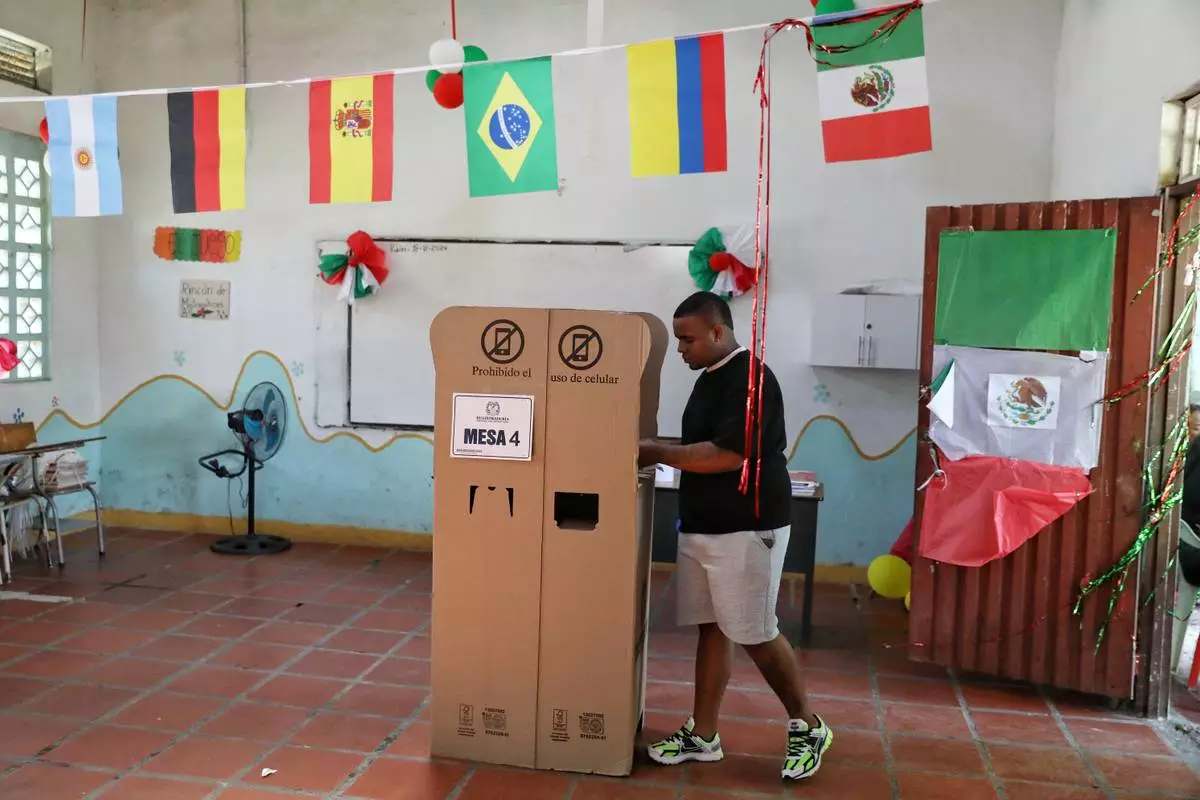
A voter marks his ballot in a classroom decorated with flags of countries participating in the World Cup serving as a polling station during the presidential runoff election in Santander de Quilichao, Colombia, Sunday, June 21, 2026. (AP Photo/Santiago Saldarriaga)

A supporter of presidential candidate Abelardo de la Espriella of the opposition Defenders of the Motherland movement light a flare at a celebration rally after polls closed in the runoff election in Barranquilla, Colombia, Sunday, June 21, 2026. (AP Photo/Rodrigo Abd)

Presidential candidate Abelardo de la Espriella of the opposition Defenders of the Motherland movement and his vice-presidential running mate, Jose Manuel Restrepo, ride in a bulletproof booth toward a celebration rally after election results showed him leading in Barranquilla, Colombia, Sunday, June 21, 2026. (AP Photo/Rodrigo Abd)

Presidential candidate Abelardo de la Espriella of the opposition Defenders of the Motherland movement arrives to vote with his family during the runoff election in Barranquilla, Colombia, Sunday, June 21, 2026. (AP Photo/Ivan Valencia)