JUNEAU, Alaska (AP) — A man with the same name and party affiliation as Alaska Republican U.S. Sen. Dan Sullivan on Monday challenged a decision by a top state elections official to disqualify his candidacy and remove him from the August primary ballot.
A court filing, on behalf of the challenger Sullivan by his attorneys, said the decision by Division of Elections Director Carol Beecher disqualifying him violates state and federal law. It asks that he be placed on the ballot. Sullivan, a retired teacher from the small fishing community of Petersburg, has maintained that he's a qualified candidate for U.S. Senate and that election officials lacked a legal basis to boot him from the ballot.
The U.S. Constitution lays out three exclusive qualifications for U.S. Senate, addressing age, citizenship and residency, his attorneys wrote.
“Nothing in Alaska law regulates in any way the private motivations that draw individuals to declare or campaign for office,” the filing by attorneys Jeffrey Robinson, Bryn Pallesen and Zoe Eisberg states.
Sullivan's entrance into the race, days before the June 1 filing deadline, drew condemnation from Sen. Sullivan and the National Republican Senatorial Committee. They called the challenger a sham candidate and alleged he was working with Democrats to boost Democratic former U.S. Rep. Mary Peltola’s chances in the race. Peltola’s campaign and state Democrats have denied the allegation, as has the challenger.
Sen. Sullivan and Peltola are the highest-profile contenders in a race with more than a dozen candidates. It's one of the most prominent U.S. Senate races in this year's midterm elections — one both parties consider crucial to their efforts to control the chamber.
Steve Kirch, a spokesperson for the division, said the agency had no comment and does not discuss “ongoing reviews, investigations or related proceedings.” Beecher has previously noted that ballots are due to be printed on Sunday.
On June 15, a week after Republican Lt. Gov. Nancy Dahlstrom announced an investigation into the challenger Sullivan’s run, Beecher disqualified him. She concluded that his declaration of candidacy “was not filed in order to declare an actual good-faith candidacy for the office of United States Senator, but was instead filed with a purpose to confuse or mislead and to thereby compromise the ballot’s fairness or neutrality.”
In announcing an investigation, Dahlstrom cited “credible allegations” that Sullivan declared his candidacy “in coordination with another candidate and campaign” with an intent to confuse and “manipulate” voters. But in removing the challenger from the ballot, Beecher did not mention finding any evidence of alleged coordination with Peltola or Democratic Party officials.
The challenger Sullivan, when asked in an interview with The Associated Press earlier this month if he'd had any contact with Peltola's campaign, responded ”zero, none, zilch.”
Beecher said she based her decision on factors including that he had registered to vote as Daniel J. Sullivan Jr. and in conjunction with his candidacy changed his party affiliation to Republican. She cited similarities between his campaign website and the senator’s, and his work with a consultant whose clients have included some Democrats.
The form congressional candidates in Alaska complete asks them how they would like to be referred to on the ballot and their preferred party affiliation.
Beecher said she acted in line with a regulation that says a candidate's name may not appear on a ballot with academic or professional titles or “in a manner that is confusing or misleading to voters or compromises the fairness or neutrality of the ballot.”
In response to questions from Democratic state Rep. Andrew Gray, legislative attorney Andrew Dunmire last week said the regulation cited by Beecher does not forbid placing Sullivan's name on the ballot. He said the elections division could comply with it by designing the ballot in a way that allows voters to distinguish between both Sullivans.
It’s a position echoed by the attorneys for the challenger Sullivan.
The challenger initially had been certified and listed on the state’s candidate list as Dan J. Sullivan. The senator was listed as Dan S. Sullivan and denoted as the incumbent.
Alaska has open primaries in which the top four vote-getters, regardless of party affiliation, advance to the ranked-choice general election.
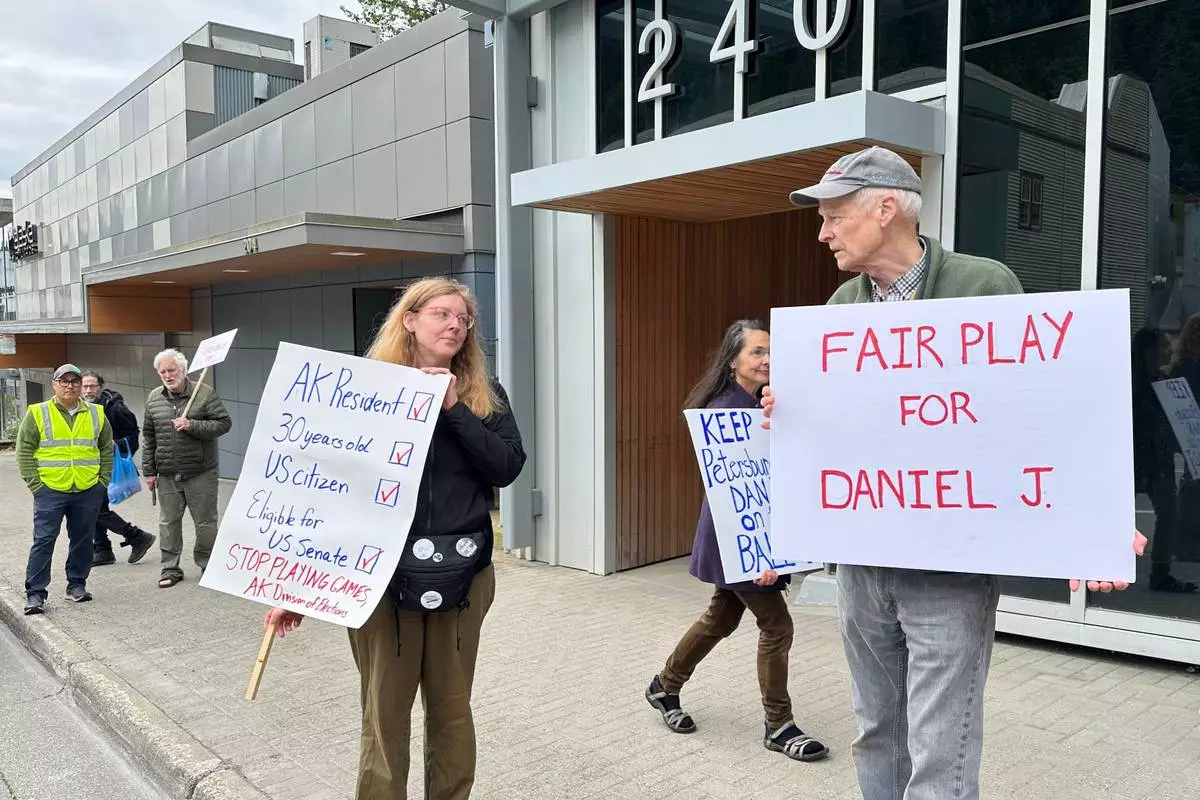
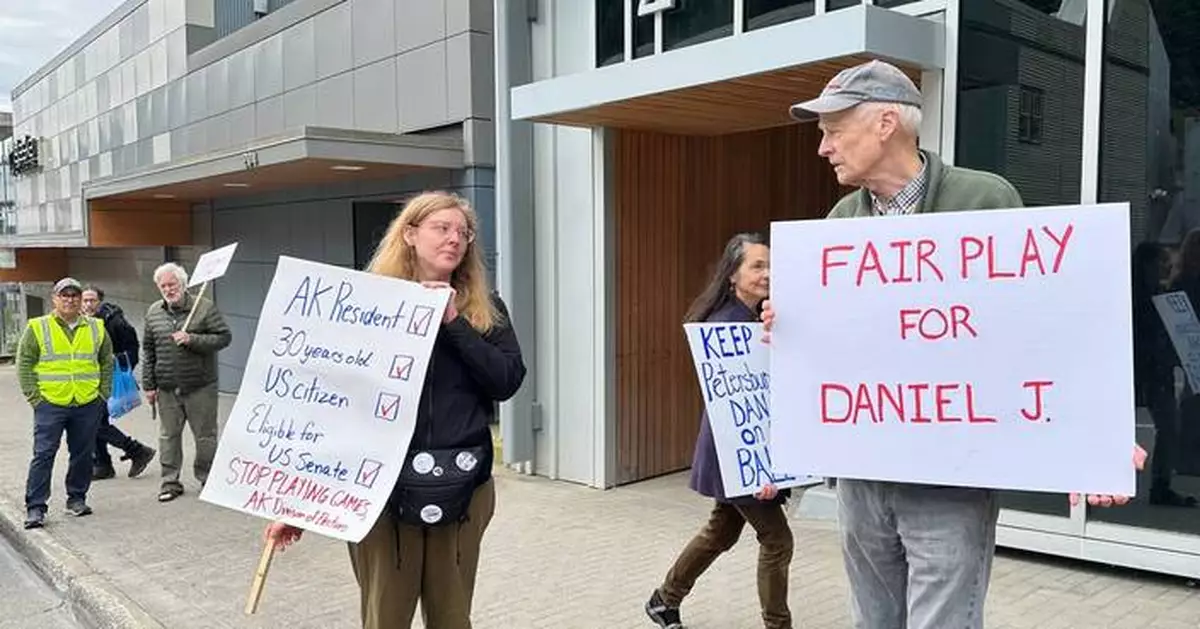
Anjuli Grantham, left, and Ben Muse protest with others outside the Alaska Division of Elections office on Friday, June 12, 2026, in Juneau, Alaska, opposing efforts to block from the ballot a U.S. Senate candidate who shares the same name and party affiliation as the incumbent Republican Dan Sullivan. (AP Photo/Becky Bohrer)
Vice President JD Vance said Monday peace talks with Iran created a “good foundation for a successful final deal” to end the war that began at the end of February.
Vance’s comments came after he and Iran’s parliamentary speaker Mohammad Bagher Qalibaf wrapped up a lengthy round of initial talks aimed at solidifying a permanent end to the war between the countries.
Also, President Donald Trump on Saturday lashed out at Italian Prime Minister Giorgia Meloni, insisting she asked “over and over” for a photo with him at the recent Group of Seven summit and criticizing what he said was Italy’s lack of cooperation during the Iran war. The remarks deepen the spat that began this week, which ultimately led Italy’s foreign minister to cancel a planned trip to the United States.
Here's the latest:
When Trump proclaimed that there was “a lot of oil pouring out” of the strait, Energy Secretary Chris Wright suggested that oil and natural gas were flowing through at “pre-crisis levels.”
“We could get to above that, we will get above that,” Wright added. Trump then suggested that “two days ago” there had been a record in terms of oil being taken out of the strait.
Neither of those statements were true.
According to data and analytics firm Kpler, there were 71 confirmed transits over the weekend, with a peak of 35 crossings on Saturday.
About 100 to 130 vessels passed through the strait each day before the war.
The president backed the conservative political outsider Abelardo de la Espriella, who is nicknamed “The Tiger” and held a narrow lead Monday in Colombia’s polarized presidential runoff.
Trump repeatedly referred to him as “El Tigre” on Monday and said that he’d said nice things about him and the U.S. in their phone call.
“You know, when people like me, I like them. It’s very simple,” Trump said.
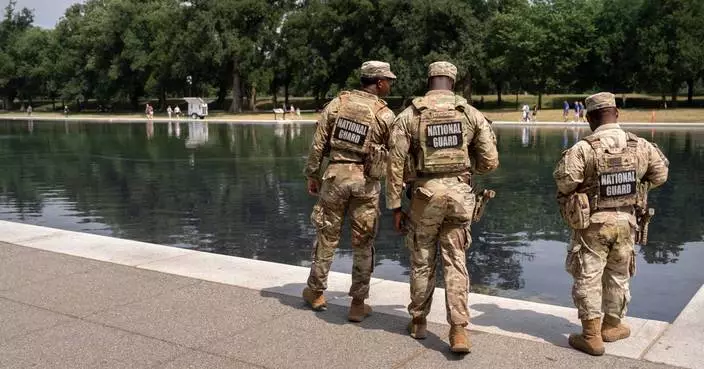
The president continued to blame vandalism for the problems that have plagued his costly renovation of Washington’s Reflective Pool — suggesting that someone cut a slit measuring up to 300-feet in the body of water near the Lincoln Memorial.
Trump said whoever did it perhaps used a box cutter or “knife of some kind” to carve a long slit in the newly renovated pool.
“It’s not a lot of damage,” Trump said before adding “We’ll probably have to let the water out and fix it.”
Asked if he could release photographs of such damage since visitors to the area had trouble finding it, Trump suggested they’d be released in future court cases.
When reporters wondered how such extensive damage was possible given the heavy police presence by the Reflector Pool, Trump said authorities were dispatched after vandalism began.
A federal judge on Monday ruled that a recently revamped version of a federal tool central to the Trump administration’s election integrity strategy is unlawful and can no longer be used.
U.S. District Court Judge Sparkle L. Sooknanan sided with advocacy groups that argued the recent upgrades to the program, called Systematic Alien Verification for Entitlements, or SAVE, aggregated Americans’ sensitive personal data in a way that could result in voters being wrongly purged from voter rolls.
“All in all, the federal government has knowingly trampled on the privacy rights of American citizens in a manner that threatens the sacred right to vote,” Sooknanan said in an order explaining the decision. “This Court cannot stand idly by while that happens.”
The decision is a major legal setback for President Donald Trump in his efforts to use federal agencies to encourage a nationwide crackdown on noncitizens illegally on state voter rolls.
▶ Read more
During an executive order signing on quantum computing in the Oval Office, Energy Secretary Chris Wright was attempting to make a point about Albert Einstein but struggled with the historical dates.
“Nobody cares,” Trump finally said to laughs.
“Good point! Good Point!” Wright exclaimed.
But the president wasn’t finished. He suggested that if facts weren’t exactly correct, “Usually they won’t catch you.”
When Wright finally continued, he offered an anecdote attempting to tie Eistein’s work to that of Trump’s uncle, John G. Trump, who was an MIT professor who died in 1985.
Trump later asked one of the experts assembled to discuss his executive orders, “Did you know my uncle,” drawing an awkward, “No.”
The president raised one of his longstanding grievances with energy policy and the U.K. in particular when asked about the British Prime Minster Keir Starmer: the use of wind turbine for power.
He said that he conveyed to Starmer, “You’re really messing up energy. You have windmills all over the place.”
Trump also cited British immigration policies as a weakness of Starmer’s.
But he called Starmer a “lovely man” and “sort of a friend of mine.” He said he wishes him well.
One of the orders President Donald Trump is signing Monday calls for developing by 2028 the “first-ever quantum computer powerful enough for scientific research,” said Michael Kratsios, director of the White House’s Office of Science and Technology Policy.
The second order seeks to bolster the nation’s cybersecurity, anticipating a time when such powerful computers will be able to break the best encryption.
Trump’s directives mark the latest attempts to tap into the strange behavior of subatomic particles to build machines that could perform calculations at far higher speeds than conventional supercomputers.
Building commercially viable quantum computers has long proved difficult.
The U.S. is already more than seven years into a 10-year quantum initiative passed by Congress and signed into law by Trump in 2018.
Shortly before leaving office, President Joe Biden also signed an executive order requiring federal agencies to improve cybersecurity to protect against the threat posed by quantum computers.
“We left a lot of our team. The Iranians left a lot of their team at the resort there to keep on working at it,” Vance told reporters just before he got on Air Force Two for the return flight to the U.S.
Vance did not give details on which U.S. negotiators are staying in Switzerland to continue to work out details of the interim agreement with Iran.
Turkish President Recep Tayyip Erdogan on Monday welcomed the agreement reached between Iran and the United States during a telephone call with his Iranian counterpart and pledged Turkey’s continued support for the process to conclude peacefully.
A statement from the Turkish president’s office said that during his conversation with Masoud Pezeshkian, Erdogan also urged vigilance “against those who want to sabotage the negotiations” — in an apparent reference to Israel.
Turkish officials have constantly accused Israel of wanting to derail the negotiations.
Tilak Pokharel, a spokesperson for the U.N. peacekeeping force in southern Lebanon known as UNIFIL, said Monday evening that a ceasefire between Israel and Hezbollah appears to be holding.
“We have not detected trajectories from either side since yesterday,” he said. “We have also not seen airstrikes,” although he added that peacekeepers “continue to observe air(space) violations and IDF ground movements.”
An Associated Press photographer in the area of Nabatiyeh, which saw intense strikes and fighting in the days before the new truce took hold over the weekend, described complete calm in the area Monday. Few displaced people had returned to the heavily damaged city of Nabatiyeh, he said, but many entered surrounding villages as soon as bulldozers finished clearing the roads.
According to data and analytics firm Kpler, there were 71 confirmed transits over the weekend, with a peak of 35 crossings Saturday. About 100 to 130 vessels passed through the strait each day before the war.
The main central route of the Strait of Hormuz is still mined and is closed. But ships have been passing through the smaller northern route, which goes through Iranian waters, and the southern route, which goes through Omani waters.
The S&P 500 slipped 0.3%, coming off its 11th winning week in the last 12, and pulled 1.7% below its all-time high set early this month. The Dow Jones Industrial Average was up 131 points, or 0.3%, as of 10:45 a.m. Eastern time, and the Nasdaq composite was 1% lower.
In the oil market, prices eased following talks over the weekend between the United States and Iran on their war. Vice President JD Vance said they created a “good foundation for a successful final deal.”
The price for a barrel of Brent crude oil fell 2.8% to $78.29, closer to its roughly $70 price from before the war. Benchmark U.S. crude oil fell 2.3% to $74.14 per barrel.
▶ Read more
U.S. Secretary of State Marco Rubio will travel to the United Arab Emirates, Kuwait and Bahrain this week as the Trump administration has stepped up efforts to end the war with Iran while Gulf countries remain uneasy about a proposed deal.
The State Department announced Monday that Rubio would visit the three countries for bilateral meetings with leaders to discuss the memorandum of understanding reached last week between the U.S. and Iran, weekend talks in Switzerland between senior Iranian and U.S. officials as well as security for American allies and partners in the Middle East, including the status of the Strait of Hormuz.
Rubio will discuss “regional priorities,” “efforts to secure full and free safe transit through the Strait of Hormuz, and the importance of peace and stability in the region,” the department said in a statement.
While in Bahrain, Rubio will also meet with Gulf Cooperation Council officials “to discuss shared priorities.”
The license authorizes the production, delivery and sale of Iranian oil. It will last through Aug. 21.
The license emerged Monday as U.S. Vice President JD Vance said his lengthy talks with senior Iranian officials in Switzerland created a “good foundation for a successful final deal.” Negotiators are seeking a permanent end to the war the U.S. and Israel began in late February.
The talks were jolted by statements from Trump, who, from thousands of miles away, fired off comments that offended the Iranians.
Iranian state media said talks had paused after the “publication of an insulting message by the U.S. President.” The negotiations later continued.
Vance pushed back against the notion that Trump’s threats complicated the talks.
“No, they didn’t throw a wrench in the system,” Vance said. He added, “Yes, they did threaten to walk out, or at least there were social media threats that they would walk out. But we were negotiating well past one in the morning yesterday, so they didn’t walk out.”
Vance also said the U.S. was not imposing the deal on the region, even though the negotiations include provisions about the conflict between Israel and Hezbollah, without representatives from Israel or Lebanon.
“This is a deal that the region has desperately asked the United States to put in place,” Vance said. “This region has been a basket case for a very long time.”
Vance touted that Iran had agreed to invite International Atomic Energy Agency inspectors back into the country. However, Iran did not acknowledge that and it was not immediately clear how big a shift that would be.
Since the 12-day war between Israel and Iran in 2025, inspectors have visited the Islamic Republic.
However, Tehran has refused inspectors access to the enrichment sites in the country bombed by the U.S., where Iran’s highly enriched uranium is believed to be buried.
Vance said that he was returning to Washington, but he said that talks would continue between the American and Iranian “technical teams.”
“We wanted to set up a structure for that so that you could have proper political oversight, but obviously, as much as this place is very beautiful, I can’t stay here for the next 60 days,” Vance told reporters.
The vice president said that the negotiating teams would have the proper oversight in DC as they waded into an array of issues including how to monitor and address the nuclear material in Iran.
Vance said negotiators had been in constant contact with Netanyahu as well as other countries in the region throughout the negotiations in Switzerland. Some hard-liners in Israel’s government have criticized Netanyahu for being sidelined in the negotiations.
Vance said Monday that the U.S. and Iran have made progress on four key points in initial negotiations in Switzerland, listing them as:
Establishing a mechanism for keeping the Strait of Hormuz open
Coordination for the ceasefire between Israel and Hezbollah in Lebanon
An agreement on IAEA inspection
A process for the technical negotiations that remain
The vice president said that Jared Kushner, the son-in-law of Trump and one of the lead U.S. negotiators, came up with the idea with officials from Qatar.
Vance said that Qatar would have approval over the process, but Iranian money that would be accessible as sanctions were lifted “would actually go to buy American soy, American corn and American wheat for the benefit of the Iranian people.”
Iran has not acknowledged this measure and does not currently have demand for U.S. crops.
Vance said that Iranian negotiators “did threaten to walk out” on peace talks, as he defended social media posts by Trump that criticized Iran.
“What we told the Iranians yesterday is when you guys engage in what us millennials might call ‘trash talk,’ you can’t expect the president of the United States not to respond and not to correct the record,” Vance said.
Vance noted that Iran’s team continued to negotiate and did not leave the talks, adding that the country’s team of technical experts had stayed in Switzerland.
“So, yes, there was a little bit of threatening, there was a little bit of whining,” Vance said. “But at the end of the day, the talks continued and we made great progress.”
Vice President JD Vance said that peace talks with Iran had created a “good foundation for a successful final deal” to end the war that began at the end of February.
“The final deal is the house,” Vance told reporters. “We set the foundation. We haven’t built the house, but we’ve laid a successful foundation to get to a good place for the American people.”
The vice president noted that Iran’s team did threaten to walk out of the talks, but he defended social media posts by Trump that had caused Iranian officials to feel offended.
“What we told the Iranians yesterday is when you guys engage in what us millennials might call ‘trash talk,’ you can’t expect the president of the United States not to respond and not to correct the record,” Vance said.
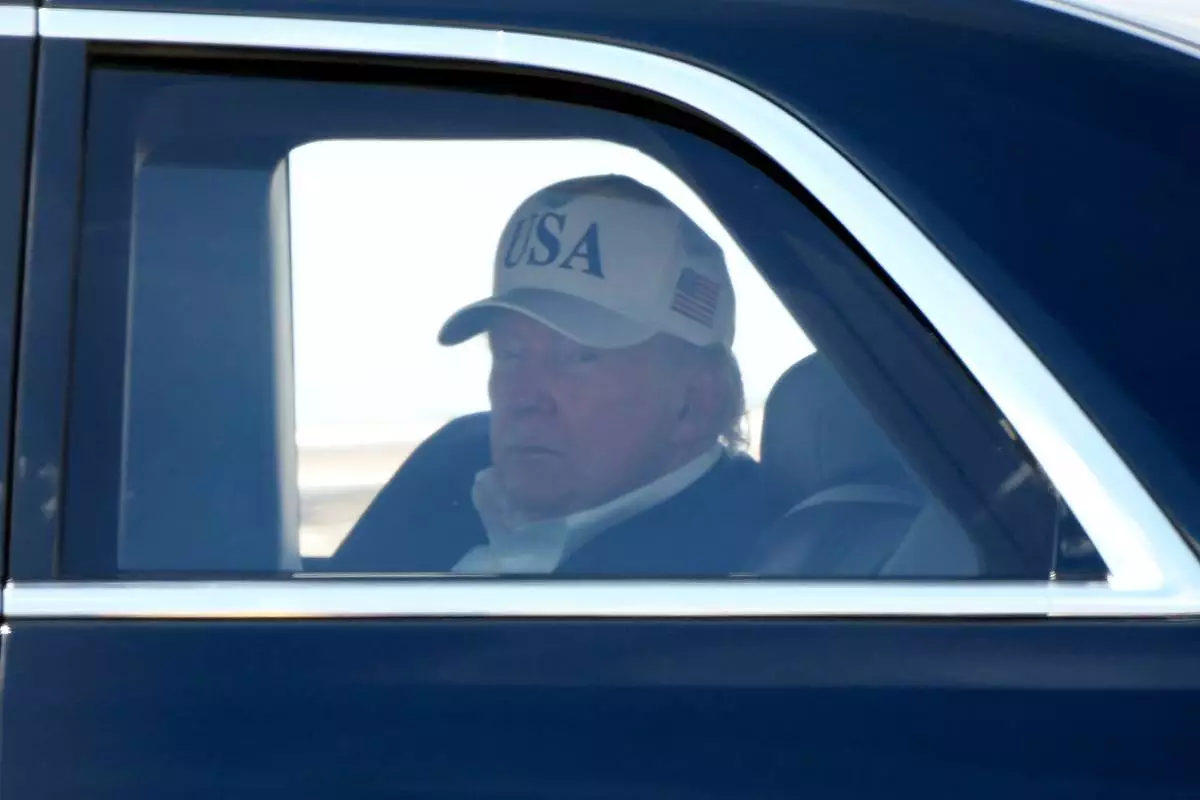
President Donald Trump sits in his limousine, known as The Beast, after arriving on Marine One at Joint Base Andrews, Md., Sunday, June 21, 2026, following a trip to Camp David. (AP Photo/Mark Schiefelbein)
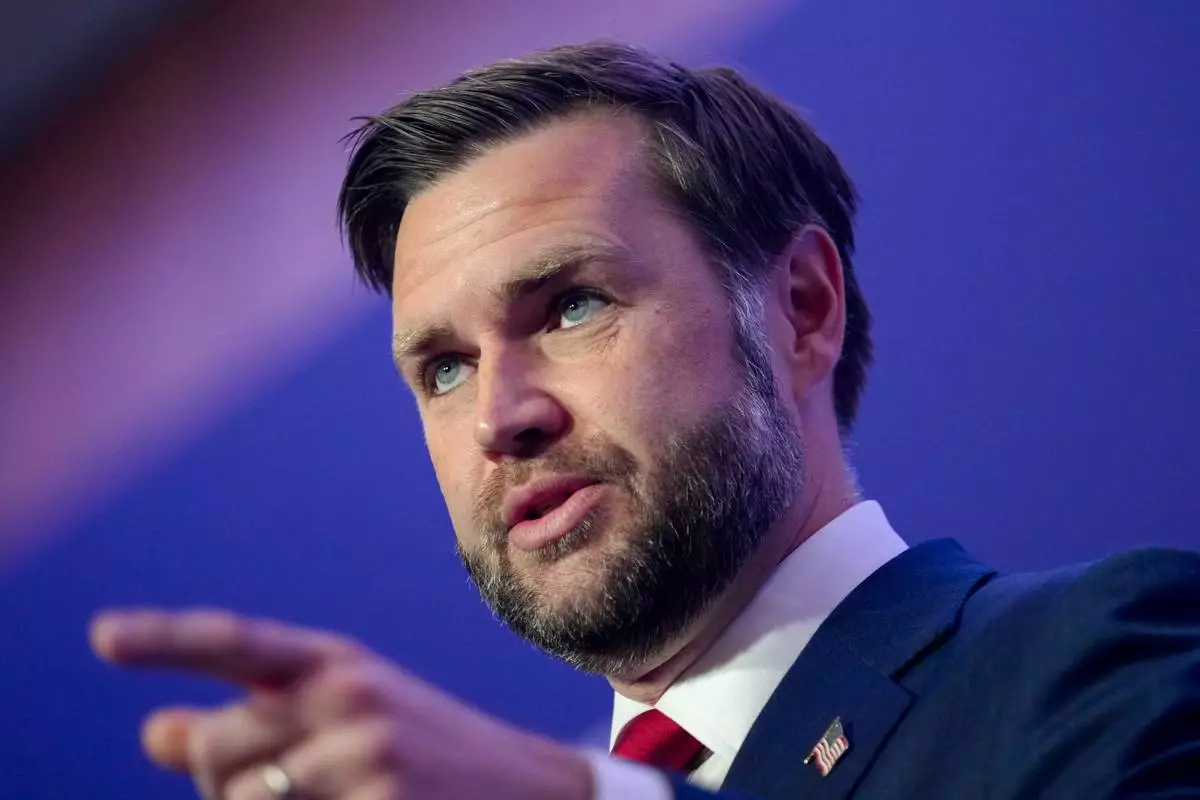
Vice President JD Vance speaks to members of the media after the U.S. and Iran held high-level talks at the Bürgenstock Resort in Obbuergen, near Lucerne, in Switzerland, Monday, June 22, 2026. (Nathan Howard/Pool Photo via AP)
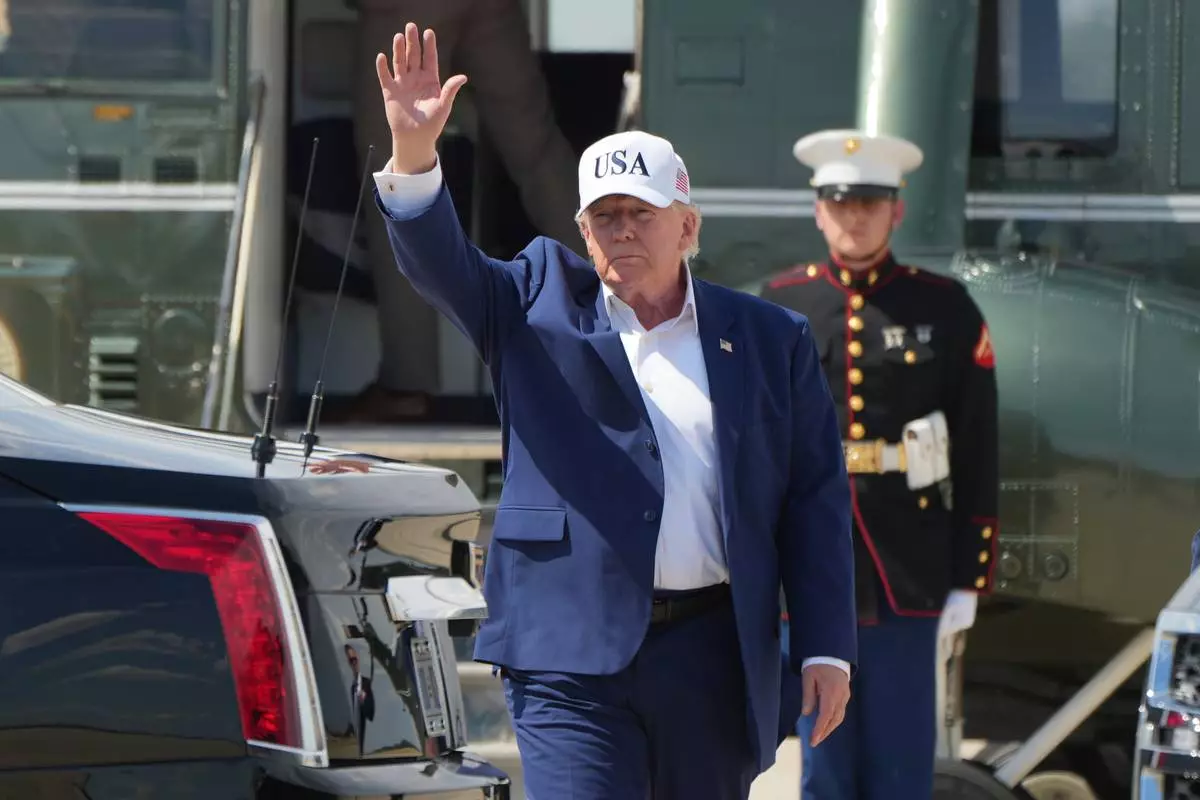
President Donald Trump waves as he arrives on Marine One at Joint Base Andrews, Md., Sunday, June 21, 2026, following a trip to Camp David. (AP Photo/Mark Schiefelbein)