Skip to Content Facebook Feature Image

Kotoba Technologies Raises $10 Million in Seed Funding to Expand Real-Time Voice AI Platform Across East Asia

Business

Kotoba Technologies Raises $10 Million in Seed Funding to Expand Real-Time Voice AI Platform Across East Asia
Business

Business

Kotoba Technologies Raises $10 Million in Seed Funding to Expand Real-Time Voice AI Platform Across East Asia

2026-06-25 00:01 Last Updated At:00:10

SAN FRANCISCO & TOKYO--(BUSINESS WIRE)--Jun 24, 2026--

Kotoba Technologies, a developer of real-time speech models optimized for East Asian languages, today announced an additional USD 10 million in seed funding. The financing was led by Kindred Ventures, with participation from Salesforce Ventures and Sony Innovation Fund. The round brings the company’s total funding to date to USD 23 million.

This press release features multimedia. View the full release here: https://www.businesswire.com/news/home/20260624276012/en/

The Technology

Kotoba’s proprietary model, Koto, is purpose-built for real-time speech applications such as AI agents, smart hardware devices, and simultaneous speech translation, with industry-leading performance in Japanese, Korean, and Chinese.

Koto offers flexible deployment options depending on the use case:

Prospects

Kotoba will direct the new funding toward three priorities at the core of its speech AI platform in East Asia:

Kotoba’s API / SDK Release

Koto is already in production with leading global organizations, including Fortune Global 500 companies and high-growth AI-native startups. In these deployments, the technology powers AI voice agents, voice interfaces for contact centers, wearable devices, and AI-powered simultaneous translation.

To broaden developer access, Kotoba has released an alpha version of its API and an easy-to-use Python SDK. Its S2S simultaneous translation models and ultra-low-latency speech-to-text and text-to-speech models are now available via API, and on-device models can also be tested via the API/SDK. Kotoba is committed to further expanding its API/SDK ecosystem. See the API announcement for details.

“Kotoba” Translation App Is Growing Rapidly

Koto is widely used by prosumers and enterprise users across East Asia through Kotoba’s proprietary app, “Kotoba” (同時通訳). Built on Kotoba’s proprietary model, the app delivers seamless, flagship-quality simultaneous translation, note-taking, and AI summaries. It empowers users with real-time multilingual communication across 21 languages (with five primary target languages) — in business settings as well as entertainment, tourism, and a wide variety of other scenes. In June, Kotoba shipped a major update introducing 11 new features alongside significant UI/UX improvements. The company is also deepening its enterprise support, with a meeting-agent experience for remote conferences planned for release in July. The Kotoba app has now surpassed 180,000 users, with daily downloads continuing to grow.

Investor Perspectives

Steve Jang, Founder & Managing Partner, Kindred Ventures

Asia is home to nearly 5 billion people, and to start, East Asian countries represent 1.6B of that continental population. Roughly half of the world's knowledge workers speak an Asian language as their first native tongue. The complexities of getting the unique aspects of Asian languages requires a unique training strategy and learning loop approach with a deep understanding of each language and market.

The Kotoba research team brings extreme focus and depth to developing the world's fastest and most genuine speech models for both high-controllability pipelines for agents, or incredibly fast and accurate native speech-to-speech models for realtime communication and translation. On both recognition and synthesis, their Koto family of models - TTS, STT, and Speech-to-Speech - models performed better than existing models developed by American and European research labs. We're thrilled to support Kotoba's mission to bring state-of-the-art speech models, multimodal agents, voice-centric wearables, physical AI hardware, and the holy grail of realtime translation to the entire world.

Ken Asada, Partner / Sho Yamanaka, Principal, Salesforce Ventures

“Under a co-founding team that combines exceptional research capabilities with strong business execution, Kotoba Technologies is developing world-class voice AI and steadily advancing its real-world implementation. In addition to their high technical capabilities, we see immense potential in their focus on driving implementation in business environments. We look forward to leveraging Salesforce's global network and expertise to support the company's further business growth.”

Austin Noronha, Managing Director,Sony Ventures-US

“Real-time voice communication remains one of the most technically challenging AI frontiers. Kotoba has demonstrated impressive real-world results in both translation quality and latency, outperforming many existing approaches in speech-to-speech translation. With encouraging early product-market fit and growing adoption among enterprise customers, Kotoba is building more than a translation application, it is creating a voice AI infrastructure platform with potential applications across enterprise, telecom, electronics, and consumer markets.”

About Kotoba Technologies

Founded in 2023 by Cornell and University of Washington PhDs Noriyuki Kojima (CEO) and Jungo Kasai (CTO), Kotoba Technologies develops state-of-the-art real-time speech AI models for East Asia.

Headquarters: Kotoba Technologies, Inc. — Levi’s Plaza, 1160 Battery St, Suite 100, San Francisco, CA 94111, USA

Japan Office: Kotoba Technologies Japan, K.K. — Otemachi Bldg. 6F, 1-6-1 Otemachi, Chiyoda-ku, Tokyo 100-0004, Japan

X:@kotoba_tech

Web:https://site.kotoba.tech

Kotoba Technologies' "Kotoba – Voice Translation" app, powered by its proprietary "Koto" voice AI model, delivers real-time, speech-to-speech interpretation on a single smartphone between East Asian languages and English, including Japanese, Korean and Chinese. (Graphic: Kotoba Technologies, Inc.)

Kotoba Technologies' "Kotoba – Voice Translation" app, powered by its proprietary "Koto" voice AI model, delivers real-time, speech-to-speech interpretation on a single smartphone between East Asian languages and English, including Japanese, Korean and Chinese. (Graphic: Kotoba Technologies, Inc.)
NEW YORK (AP) — Stocks rose on Wall Street Wednesday as falling bond yields and lower oil prices helped ease pressure on the market.

The S&P 500 climbed 0.6%. The Dow Jones Industrial Average added 486 points, or 0.9%, as of 11:58 a.m. Eastern. The Nasdaq composite rose 0.7%.

Technology stocks were gaining ground after two days of losses that weighed on the market. That helped push indexes higher as gains broadened out to other sectors, including retailers and industrial companies.

Apple rose 1.7%, Amazon jumped 3.3% and Caterpillar rose 1.8%.

Nvidia rose 0.5% following a 4.1% drop on Tuesday. Micron Technology, which reports its latest results later Wednesday, fell 0.8% following its 13.2% plunge on Tuesday.

Google's parent company Alphabet rose 1.2%. The company is replacing Verizon in the Dow on Monday. Alphabet will become the fifth Magnificent 7 company to join the index. The others are Apple, Amazon, Microsoft and Nvidia.

Big Tech companies, especially those focused on artificial intelligence, have pricey values that give them more sway over the market's broader direction. That was the case on Tuesday when sharp losses for a few valuable tech companies pulled the market lower.

Oil prices continued slipping as the U.S. and Iran negotiate a possible end to their war. Brent crude, the international standard, fell 3.6% to $74 a barrel. It has been trading below $80 in recent days but is still above the roughly $70 per barrel it was trading at in late February before the war began. U.S. crude prices fell 3.9% to $70.37 a barrel.

Oil companies lagged the market. Exxon Mobil fell 2.8% and Chevron lost 2.9%.

Some of the bigger winners on Wall Street included homebuilders following approval of legislation beneficial to the industry. KB Home surged 16.8% and D.R. Horton jumped 7.3%.

Treasury yields mostly fell, removing more pressure from stocks. The yield on the 10-year Treasury fell to 4.40% from 4.50% late Tuesday. The yield on the 2-year Treasury eased to 4.15% from 4.16%.

Treasury yields are still elevated from earlier in the year, especially the 2-year Treasury, which more closely tracks anticipated action from the Federal Reserve. The central bank has signaled that it is considering raising its benchmark interest rate by the end of the year. Wall Street is forecasting at least one hike to interest rates by December, according to data from CME Group.

The Fed is worried about stubborn inflation, which had been rising throughout the year as tariffs raised the costs for a wide range of goods. A shock to energy prices because of the U.S. war with Iran worsened inflation. Gasoline prices surged and shipping costs rose. The impact is expected to linger even as oil and gasoline prices fall.

The central bank will get a fresh update on inflation Thursday, when its preferred measure for prices is released. Economists expect the Personal Consumption Expenditures price index, or PCE, to show that prices rose 4.1% in May. That would be the highest level in three years.

“Thursday’s PCE is set to take on greater importance for markets, especially since Federal Reserve Chair (Kevin) Warsh was emphatic in last week’s meeting about the central bank’s desire to achieve price stability,” wrote Rick Gardner, chief investment officer at RGA Investments, in a research note.

Gold prices fell 2.9%, and at one point slipped below $4,000 an ounce. Gold was above $5,000 an ounce earlier in the year. The precious metal is often seen as a barometer of the appetite for risk among investors, with more buying at times of increased anxiety and more selling as anxiety eases.

Markets were mixed in Europe and Asia.

AP Business Writers Chan Ho-him and Matt Ott contributed to this report.

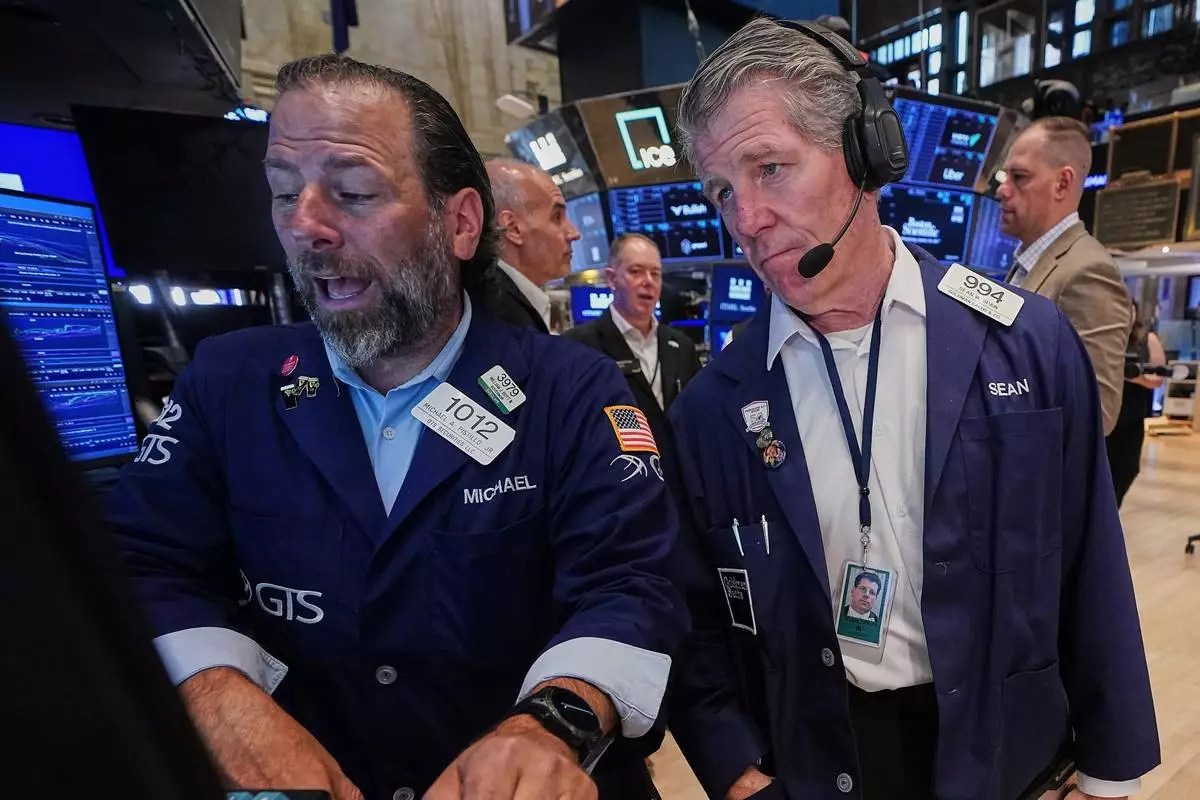
Specialist Michael Pistillo, left, and trader Sean Spain work on the floor of the New York Stock Exchange, Tuesday, June 16, 2026. (AP Photo/Richard Drew)

Specialist Michael Pistillo, left, and trader Sean Spain work on the floor of the New York Stock Exchange, Tuesday, June 16, 2026. (AP Photo/Richard Drew)

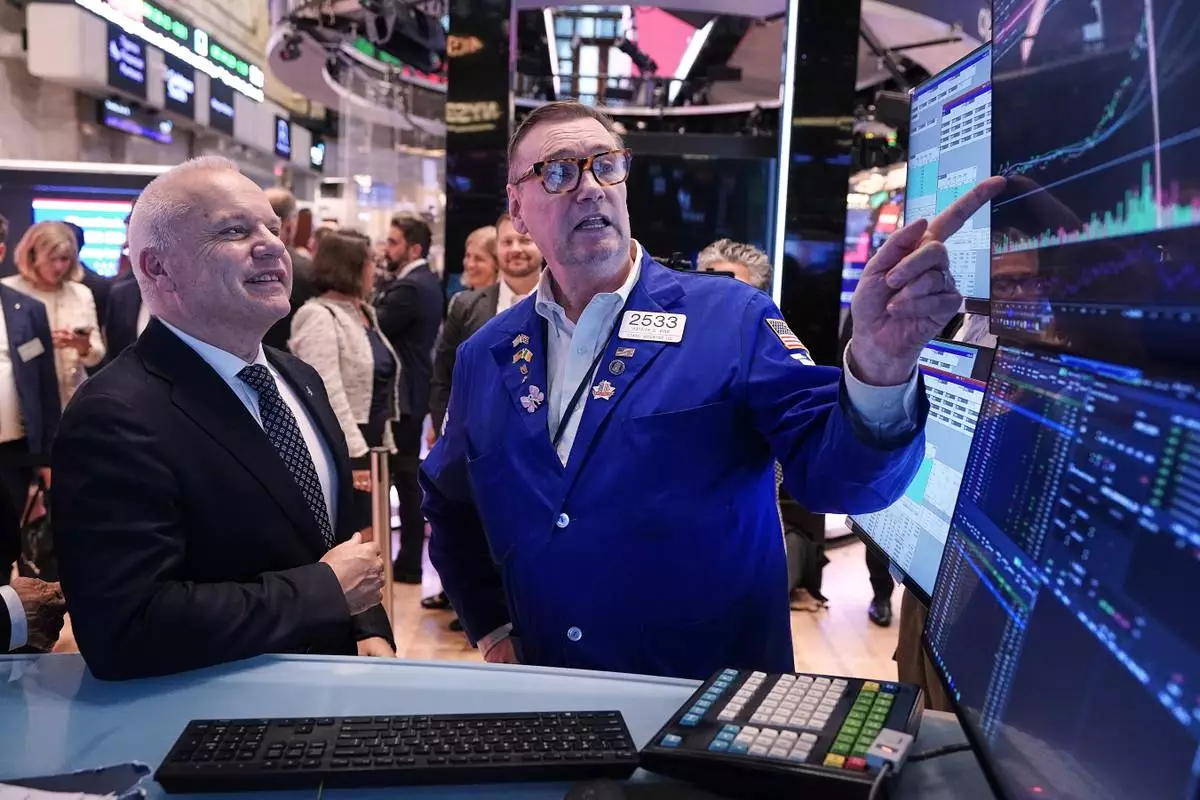
Anders Opedal, President and CEO of Norway's Equinor, left, meets with specialist Patrick King on the floor of the New York Stock Exchange, after he rang the closing bell, Tuesday, June 16, 2026. (AP Photo/Richard Drew)

Anders Opedal, President and CEO of Norway's Equinor, left, meets with specialist Patrick King on the floor of the New York Stock Exchange, after he rang the closing bell, Tuesday, June 16, 2026. (AP Photo/Richard Drew)

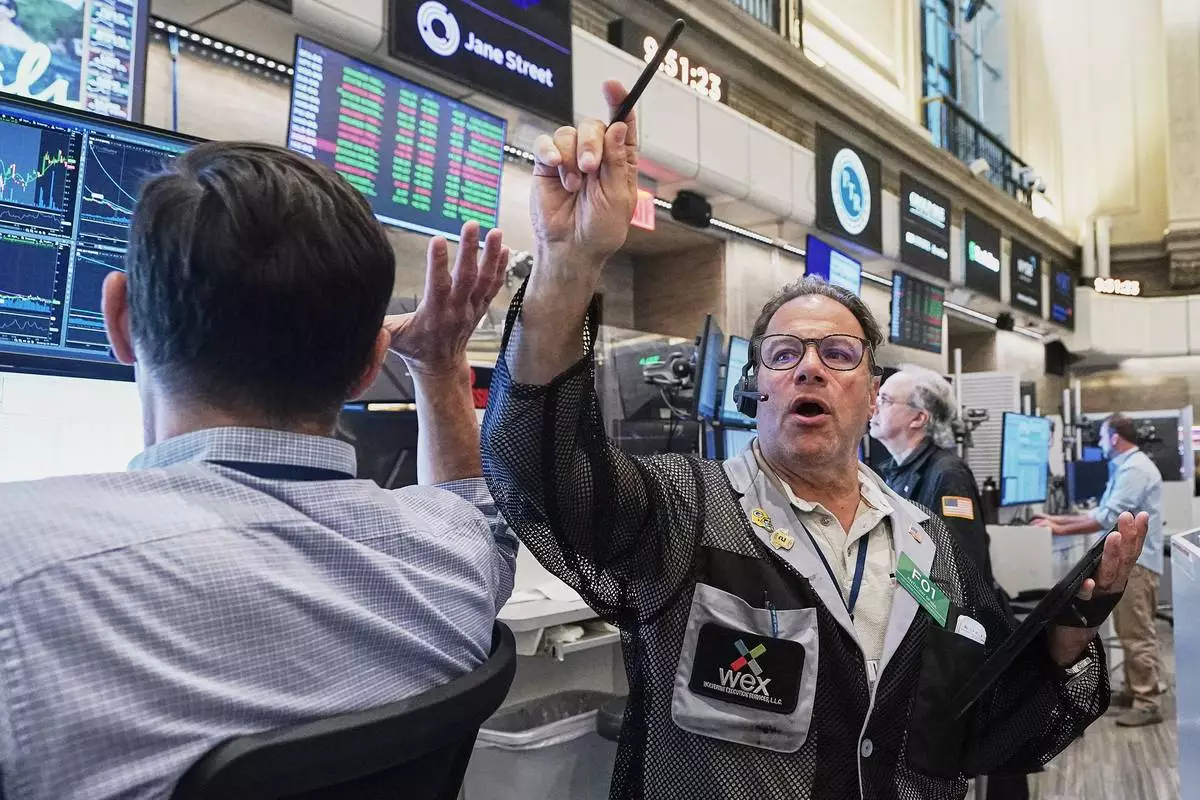
Options trader Anthony Spina, center, works on the floor of the New York Stock Exchange, Tuesday, June 16, 2026. (AP Photo/Richard Drew)

Options trader Anthony Spina, center, works on the floor of the New York Stock Exchange, Tuesday, June 16, 2026. (AP Photo/Richard Drew)

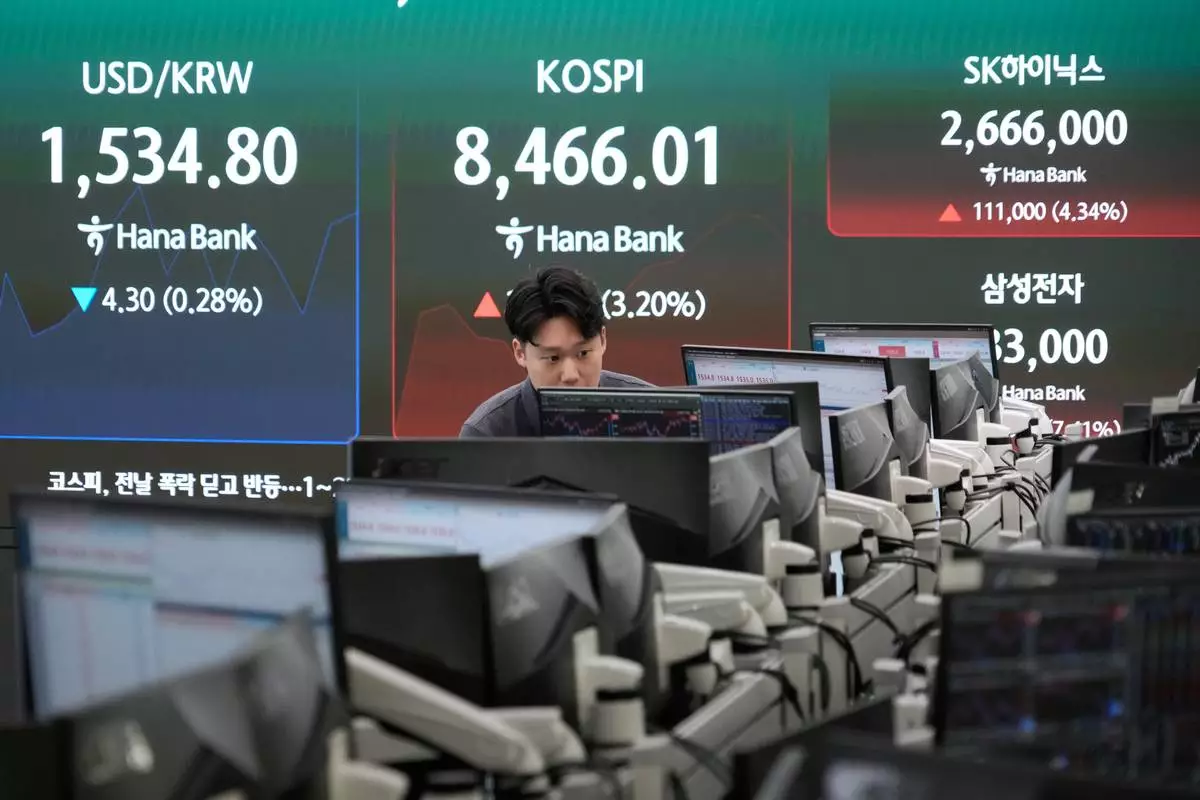
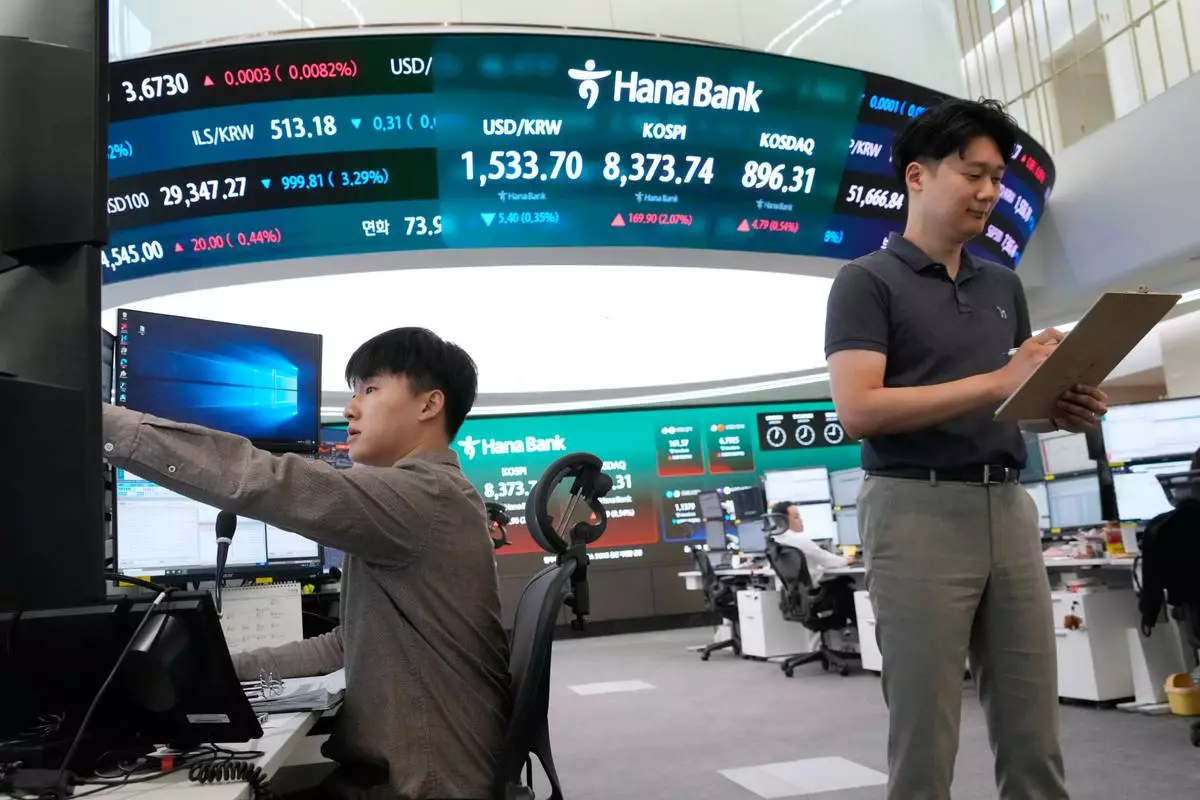
A currency trader watches monitors near a screen showing the Korea Composite Stock Price Index (KOSPI) and the foreign exchange rate between U.S. dollar and South Korean won at the foreign exchange dealing room of the Hana Bank headquarters in Seoul, South Korea, Wednesday, June 24, 2026. (AP Photo/Ahn Young-joon)

A currency trader watches monitors near a screen showing the Korea Composite Stock Price Index (KOSPI) and the foreign exchange rate between U.S. dollar and South Korean won at the foreign exchange dealing room of the Hana Bank headquarters in Seoul, South Korea, Wednesday, June 24, 2026. (AP Photo/Ahn Young-joon)

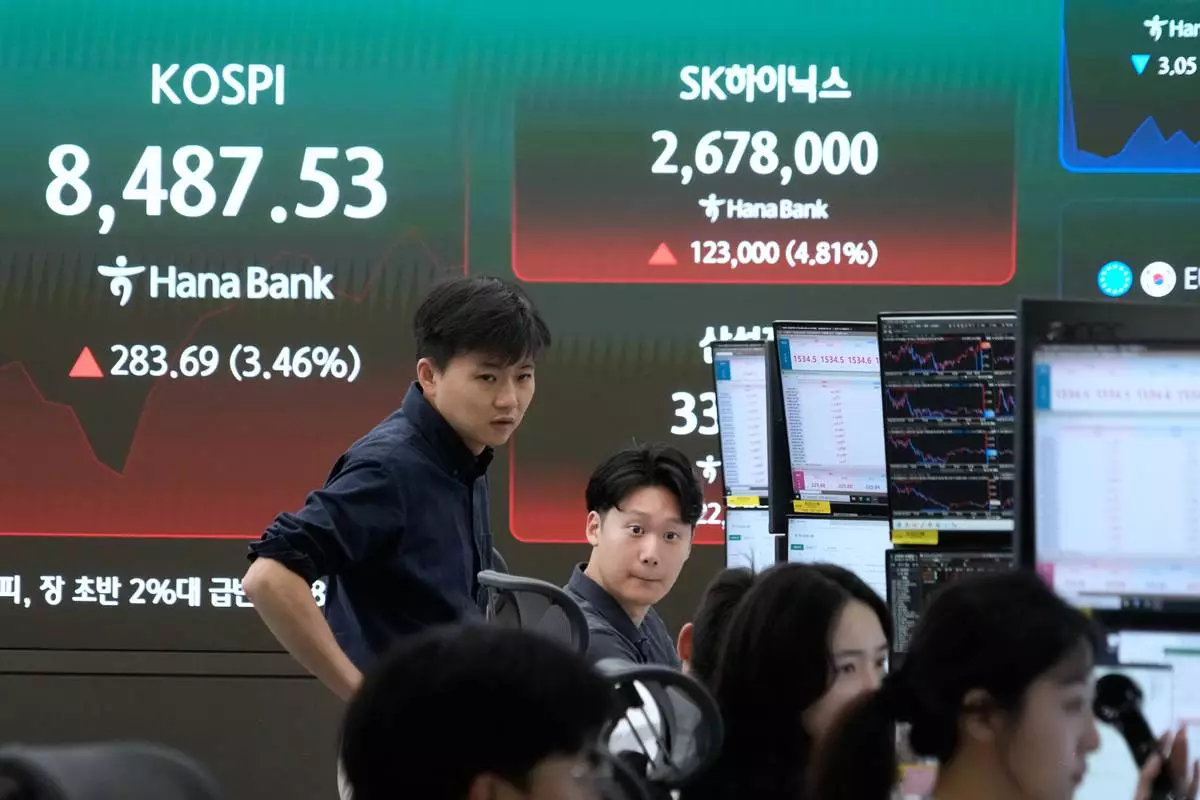
Currency traders work near a screen showing the Korea Composite Stock Price Index (KOSPI) at the foreign exchange dealing room of the Hana Bank headquarters in Seoul, South Korea, Wednesday, June 24, 2026. (AP Photo/Ahn Young-joon)

Currency traders work near a screen showing the Korea Composite Stock Price Index (KOSPI) at the foreign exchange dealing room of the Hana Bank headquarters in Seoul, South Korea, Wednesday, June 24, 2026. (AP Photo/Ahn Young-joon)

A currency trader watches monitors near a screen showing the Korea Composite Stock Price Index (KOSPI) and the foreign exchange rate between U.S. dollar and South Korean won at the foreign exchange dealing room of the Hana Bank headquarters in Seoul, South Korea, Wednesday, June 24, 2026. (AP Photo/Ahn Young-joon)

A currency trader watches monitors near a screen showing the Korea Composite Stock Price Index (KOSPI) and the foreign exchange rate between U.S. dollar and South Korean won at the foreign exchange dealing room of the Hana Bank headquarters in Seoul, South Korea, Wednesday, June 24, 2026. (AP Photo/Ahn Young-joon)

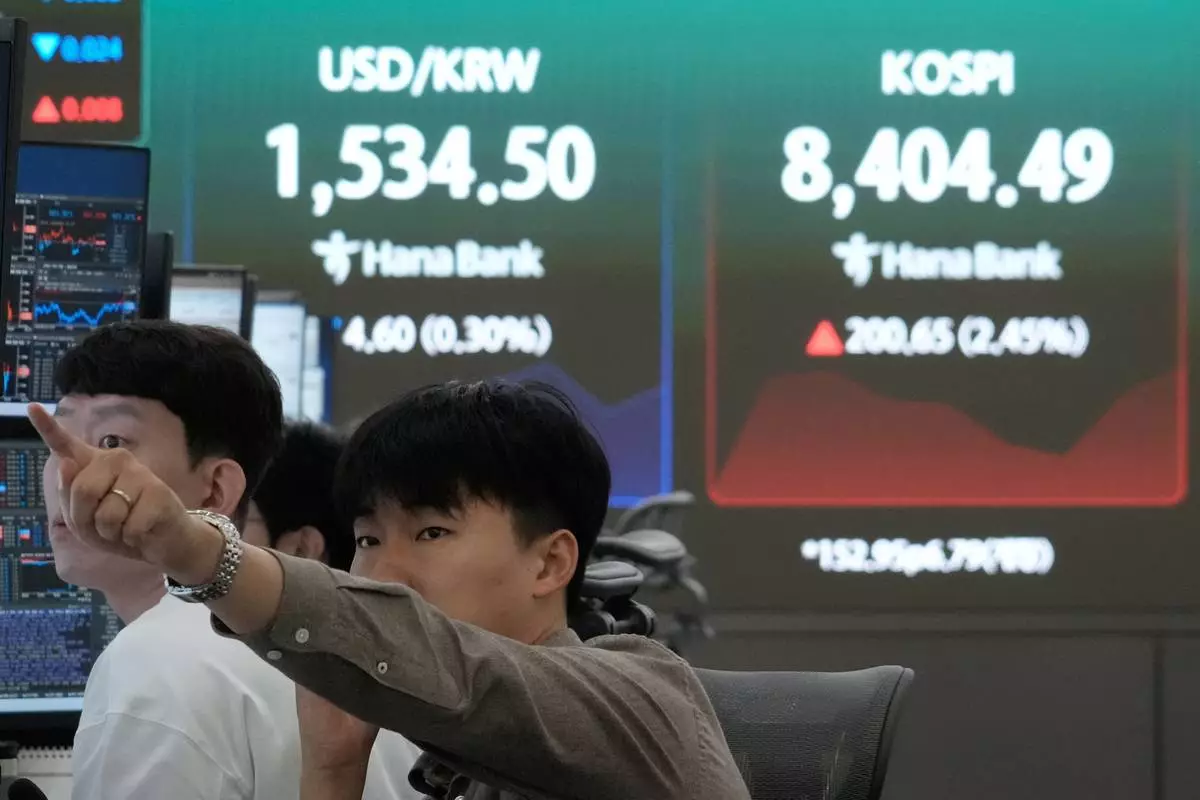
Currency traders work near a screen showing the Korea Composite Stock Price Index (KOSPI) and the foreign exchange rate between U.S. dollar and South Korean won at the foreign exchange dealing room of the Hana Bank headquarters in Seoul, South Korea, Wednesday, June 24, 2026. (AP Photo/Ahn Young-joon)

Currency traders work near a screen showing the Korea Composite Stock Price Index (KOSPI) and the foreign exchange rate between U.S. dollar and South Korean won at the foreign exchange dealing room of the Hana Bank headquarters in Seoul, South Korea, Wednesday, June 24, 2026. (AP Photo/Ahn Young-joon)

Recommended Articles