WASHINGTON (AP) — The White House has formally requested $87.6 billion mostly to replenish the Pentagon after the U.S. war against Iran, submitting the request to Congress at a politically difficult time as Republican and Democratic lawmakers have objected to any further military action.
The Office of Management and Budget sent the supplemental spending request on Wednesday. It arrived just hours after President Donald Trump assailed Republican senators during a private lunch — engaging in a shouting match with one — over their votes to approve a war powers resolution that would halt further hostilities.
The request is mostly for expenses incurred by the Defense Department as part of Operation Epic Fury, the U.S.-led attack on Iran. But it also includes a range of other items, including $11.1 billion toward economic assistance for American farmers, $1.4 billion for the Ebola virus outbreak in Central Africa and $500 million to support ongoing efforts “to complete restoration and construction projects in and around Washington, D.C.”
“I urge the Congress to take action on these important and urgent requests as soon as possible,” said OMB Director Russ Vought in a letter to House Speaker Mike Johnson.
Senate Democratic Leader Chuck Schumer said, “President Trump is asking taxpayers to clean up his messes, to the tune of $87.6 billion.”
“After dragging America into a reckless war, he now wants Congress to hand him tens of billions more to paper over the damage — while families are still paying higher prices.”
It’s unclear how quickly the House and Senate could act on the White House’s request, or if Congress takes up the matter at all. The funding faces a difficult path because many lawmakers could view any votes as a reflection of test of their support for the war effort.
Defense Secretary Pete Hegseth returned to Capitol Hill on Wednesday briefing House GOP lawmakers from the conservative Republican Study Committee on the Pentagon’s budgetary needs. The White House is seeking as much as $1.5 trillion in defense spending in this year’s budget, a nearly 50% increase over previous levels.
But many lawmakers have complained they have yet to receive any formal briefing from the administration on the Iran war, nearly four months after it was launched, and as Trump’s team is now working to secure a fragile ceasefire and bring an end to the conflict.
Washington Sen. Patty Murray, the lead Democrat on the Senate Appropriations Committee, said the request is not merely to pay for “the president’s disastrous war, but an attempt to secure tens of billions of additional dollars for unrelated Pentagon priorities.”
Murray said she would review to ensure servicemembers are taken care of, “but I will not rubberstamp tens of billions more for this disastrous war of choice.”
Yet the White House was clear to include provisions to interest lawmakers from various regions, including $1 billion to assist “the final design and construction of a modernized Penn Station in New York City,” which would be of interest to Schumer and House Democratic Leader Hakeem Jeffries, both of New York.
Rep. Tom Cole, R-Okla., the chairman of the House Appropriations Committee, and Rep. Ken Calvert, R-Ca., who chairs the panel’s subcommittee on Defense, said in a joint statement, "President Trump’s request reflects the reality that our defense strength must be maintained, not merely demonstrated.”
The bulk of the request, $67 billion, is to replenish the Pentagon from the Iran war. The largest portion of that defense funding, $21 billion, would go to weapons and munitions, with another $17.3 billion for operational costs and $12.1 billion for other classified programs. Funds are also requested to cover fuel costs, drone manufacturing and cybersecurity.
The money for farmers would provide $10 billion in economic assistance to row and specialty crop farmers and $1.1 billion specifically to Florida agriculture producers who suffered losses from this past year’s winter storms.
The package also includes a collection of policy proposals that the administration strongly supports, and which are certain to raise interest among lawmakers.
Among them, the package proposes revisions to federal regulations of hemp products that have long been in dispute, changes to the year-round sales of renewable fuels and lifting of restrictions around federal investment support in Venezuela.
The administration is also requesting $550 million to prevent and detect the Ebola virus in Congo, where an outbreak has killed more than 250 people. Another $800 million would go to provide humanitarian assistance to the region.
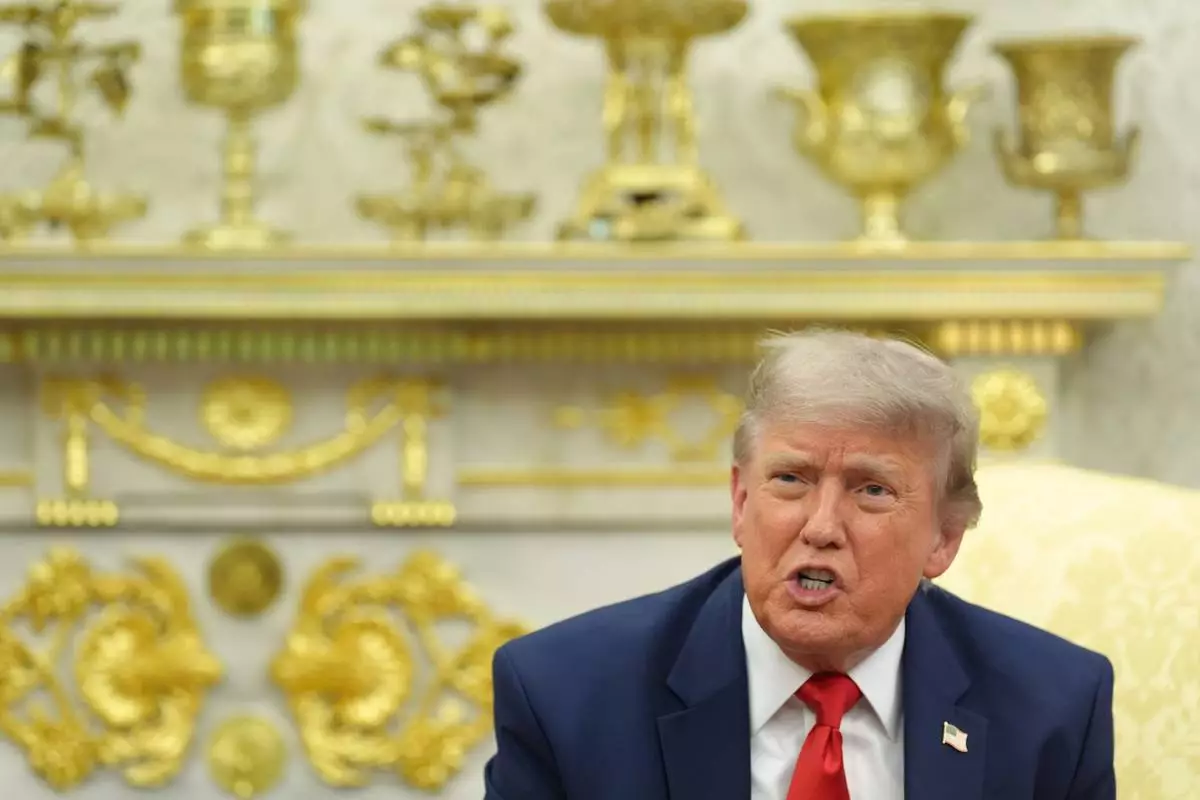
President Donald Trump speaks as he meets with NATO Secretary General Mark Rutte in the Oval Office at the White House, Wednesday, June 24, 2026, in Washington. (AP Photo/Jacquelyn Martin)
WASHINGTON (AP) — President Donald Trump berated Senate Republicans face to face on Wednesday for allowing a vote to block his war in Iran, further escalating a feud that has diverted GOP efforts to focus on election-year affordability issues and brought much of the chamber’s business to a halt.
Invited by Florida Sen. Rick Scott to speak at a GOP luncheon in the Capitol, Trump had signaled ahead of time that he would use the closed-door meeting to push senators to pass his proof-of-citizenship voting bill. But the conversation was more focused on Tuesday's vote to approve the war powers resolution, a mostly symbolic measure that allows Congress to rebuke the administration's military actions. The House passed its own version of the resolution earlier this month.
Trump had particular words for the four Republican senators who voted with Democrats on the measure — Republicans Lisa Murkowski of Alaska, Susan Collins of Maine, Rand Paul of Kentucky and Bill Cassidy of Louisiana — after calling them “losers” on social media.
Most Republicans stayed quiet. But Cassidy, who lost re-election in his primary last month after Trump endorsed an opponent, stood up and defended his vote.
“I stood and said, ‘You have not told the American people what’s going on,’” Cassidy told reporters after the meeting. “This was supposed to last four weeks, it’s lasted four months. Our original objectives have not been achieved.”
The two men “went back and forth,” Cassidy said, and he “matched his tone and volume." Cassidy said that he eventually de-escalated, but he did not want to be bullied.
“I am voting for war powers until I get a briefing,” he said afterward.
Trump repeatedly told Cassidy to sit down, according to a person familiar with the private meeting who was not authorized to discuss it. At one point, the president called the senator a “lunatic."
Publicly, Trump said afterward that they had “a really great meeting." But he hinted at the discord.
“We like everyone in the room," Trump told reporters on his way out. "I don’t like a few people, but that’s OK.”
The luncheon capped weeks of friction between Trump and Senate Republicans and added a new layer of frustration as Tuesday's vote was the first time the Senate had adopted a war powers resolution on the Iran war. Trump made clear he was in no mood to compromise before it even started, calling off a scheduled signing ceremony on a housing bill that passed both chambers overwhelmingly this week and that GOP lawmakers were touting as an election-year achievement.
Republican senators were eager for a conciliatory meeting with the president after escalating tensions in recent weeks. But Trump upended their plans when he declared on social media just beforehand that he wouldn't sign the legislation until they send him the SAVE America Act, his bill to require proof of citizenship for all voters.
North Carolina Sen. Thom Tillis said he doesn't know why Trump is holding the housing bill “hostage” for the voting bill that “will never pass in this Congress.”
“It makes no sense to me,” Tillis said as he walked into the luncheon.
Senate Majority Leader John Thune, R-S.D., said the housing legislation, which aims to lower costs, is "an affordability issue,” Thune said, "and eventually I hope he finds a way to sign it.”
It's unclear if Trump might veto the legislation. But by rejecting a public bill signing, Republicans worry that Trump is indicating a level of indifference to voters’ affordability concerns heading into November’s midterm elections.
Trump's move on the housing bill is his latest reversal after weeks of being at odds with Senate Republicans.
Trump has blocked the Senate from confirming one of his own nominees, asked them to fund parts of his White House ballroom project despite opposition and forced them to defend the Iran war even as they question the strategy and endgame.
Trump has also helped whittle down his own support in the Senate after endorsing primary challengers to two GOP incumbents who were previously reliable votes for his agenda — Cassidy and Texas Sen. John Cornyn. Both men have become more critical of Trump since losing re-election.
“If we’re going to win the midterm elections, we need to get on the same page,” Cornyn said ahead of the meeting. “We’re not on the same page now, and that I think is dangerous.”
The lunch meeting didn't appear to bring the two sides any closer together. “It was kind of a one sided conversation,” Thune said afterward.
Trump has pressed Republicans for months to kill the Senate filibuster and focus on the proof-of-citizenship voting bill, even though Thune has repeatedly told him that neither has the votes.
While Thune remains popular in his conference and cordial with the president, he has spent much of his time lately telling Trump what he doesn’t want to hear. Thune said Tuesday that while Trump and some in their conference want to see the voting bill pass, “it’s just not realistic.”
Trump has also demanded that they add a ban on mail-in ballots to the bill as well as unrelated provisions to block sex reassignment surgeries on some minors and prevent transgender women from playing in women’s sports.
Thune devoted weeks of floor time to the voting bill earlier this year and has said he supports it. But he has repeatedly said there aren’t enough votes to scrap the filibuster that triggers a 60-vote threshold to pass most bills in the 53-47 Senate. And Democrats are uniformly opposed to the bill.
“Those are just hard realities,” Thune said. “And I think people at some point have to come to grips with that.“
Scott did not give Thune a heads up before inviting Trump to the Wednesday luncheon, which he runs. Scott, who ran against Thune for leader two years ago, said Trump responded on the spot to his invitation while the two were talking last week and said he would come.
House Speaker Mike Johnson, R-La., said Wednesday that he had talked through a different approach on his call with Trump — putting the voting bill on a budget reconciliation measure that would only need a simple majority to pass. He has proposed a federal grant program that would provide funding to states if they implement various SAVE Act provisions.
But the process is long and complicated, and Republicans are divided over how to proceed.
A handful of senators are also still pushing the bill. Republican Sen. Mike Lee of Utah has amassed a large following on X with daily posts about how they should kill the filibuster and pass the bill, echoing Trump's claims that Republicans need it to win in this year's midterms, even after sweeping victories in 2024.
Scott said Trump spelled out during the meeting the various options the Senate could pursue is passing the SAVE Act.
“He really believes its the key to this fall," Scott said of Trump.
Associated Press writers Josh Boak and Kevin Freking contributed to this report.
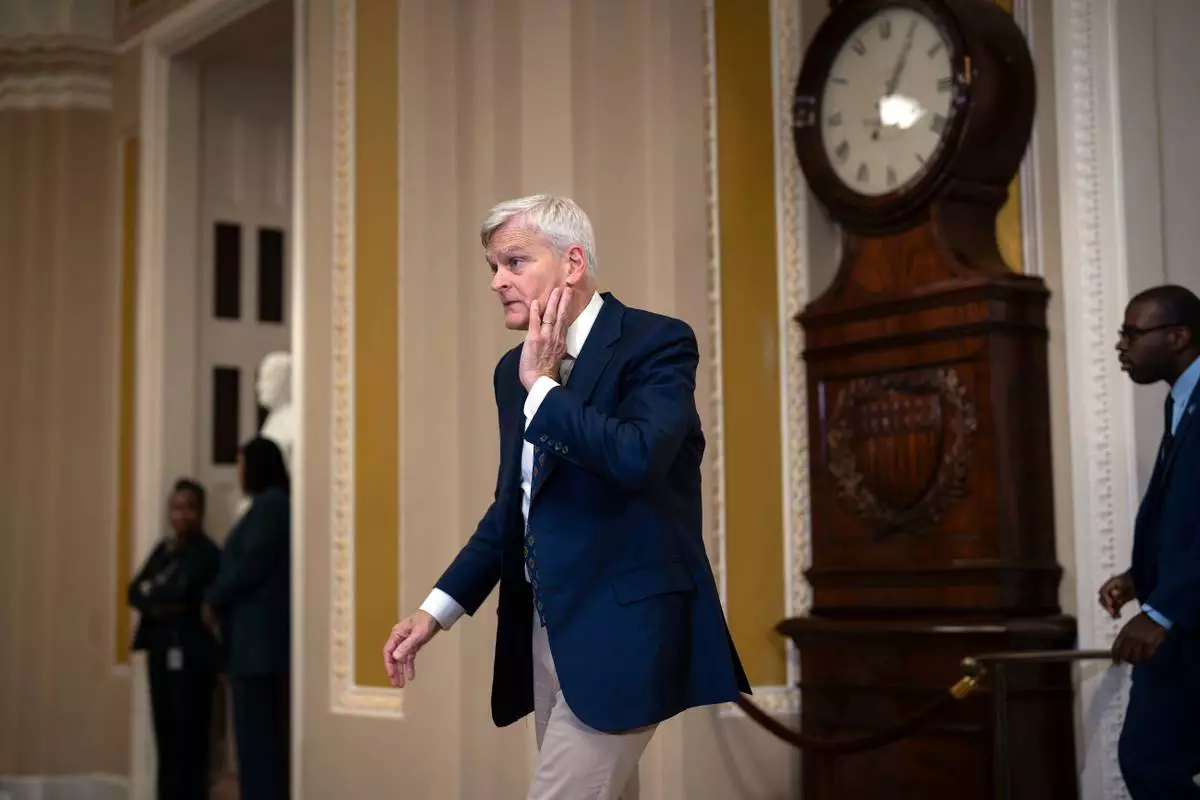
Sen. Bill Cassidy, R-La., leaves a closed-door meeting with President Donald Trump and Republican senators, at the Capitol in Washington, Wednesday, June 24, 2026. (AP Photo/J. Scott Applewhite)
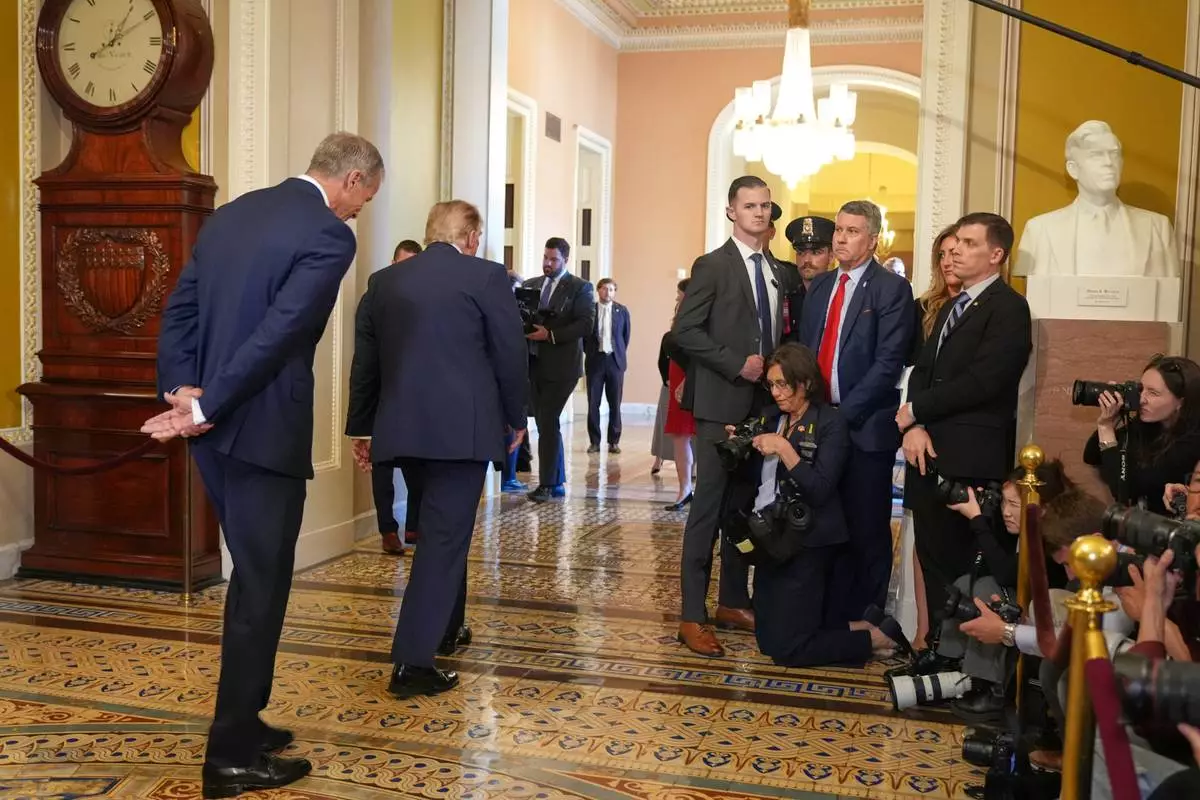
President Donald Trump walks away after speaking to reporters with Senate Majority Leader John Thune, R-S.D., at the Ohio Clock on Capitol Hill, Wednesday, June 24, 2026, in Washington. (AP Photo/Jacquelyn Martin)
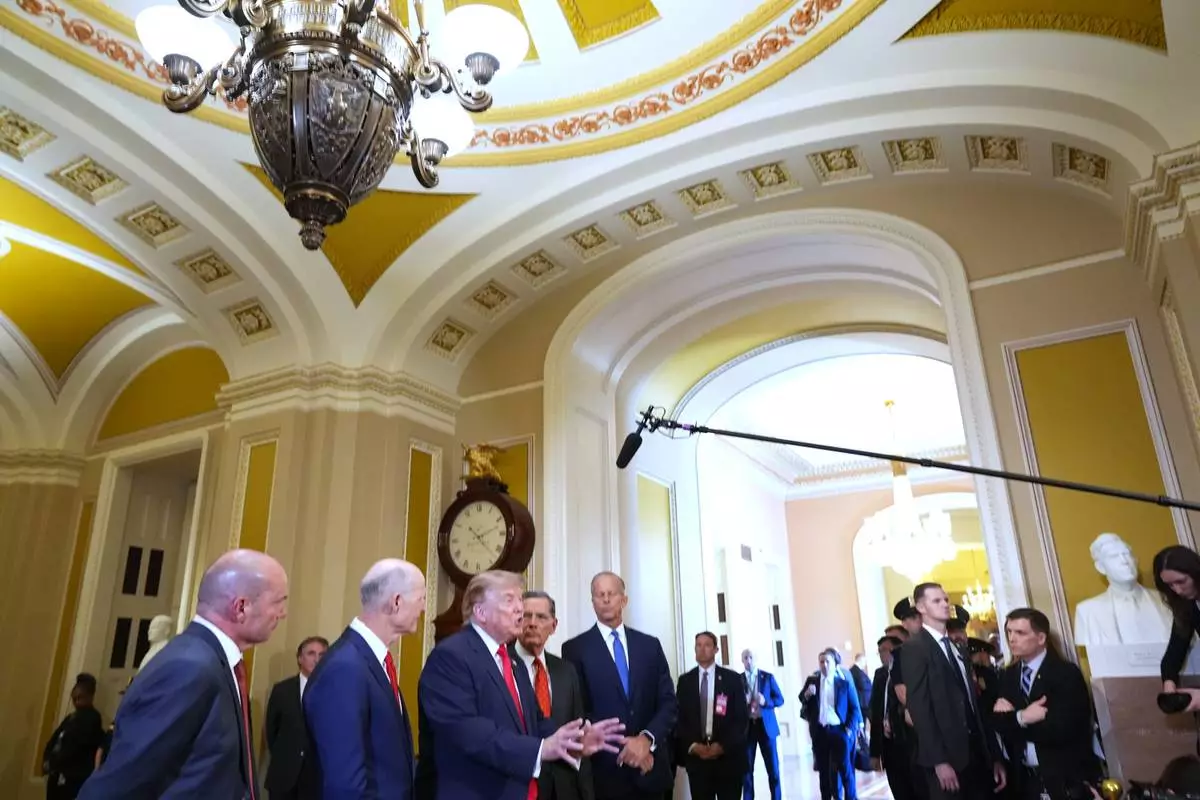
President Donald Trump speaks with reporters after meeting with Senate Republicans on Capitol Hill, Wednesday, June 24, 2026, in Washington. (AP Photo/Jacquelyn Martin)
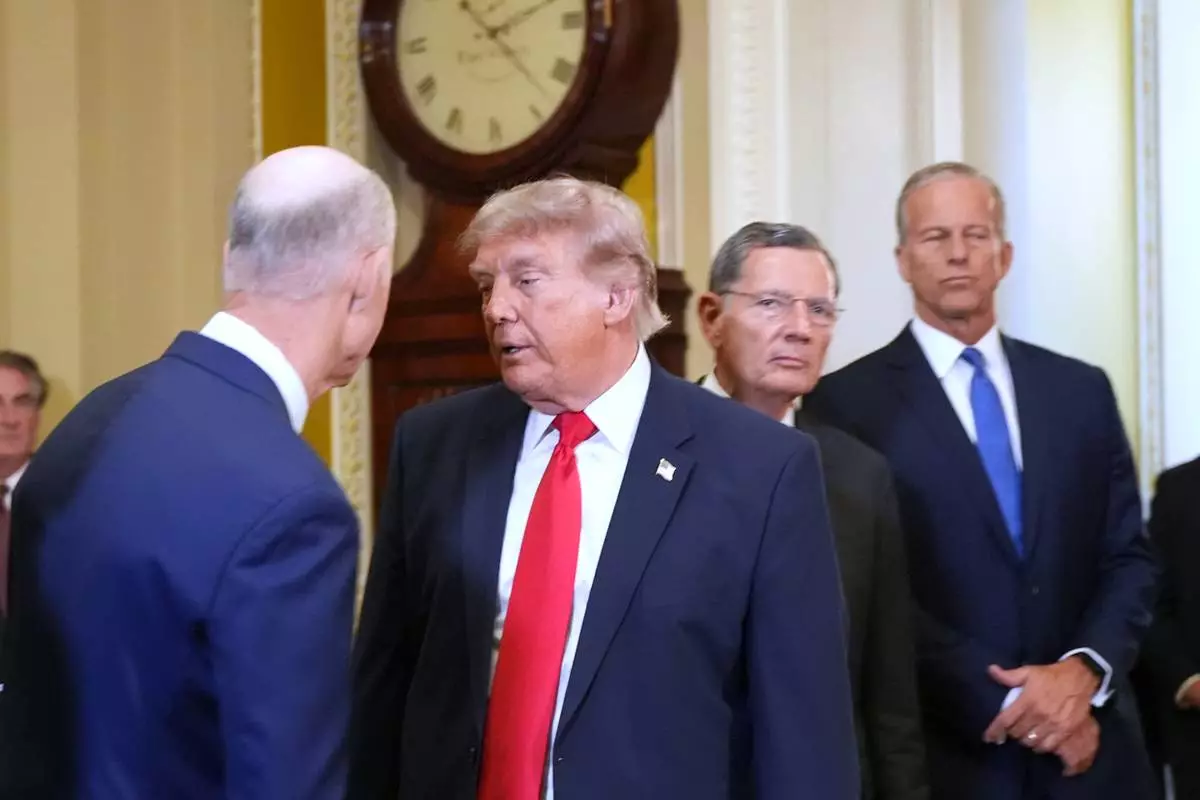
President Donald Trump turns to depart after speaking with reporters as Sen. Rick Scott, R-Fla., from left, Sen. John Barrasso, R-Wyo., and Senate Majority Leader John Thune, R-S.D., listen on Capitol Hill, Wednesday, June 24, 2026, in Washington. (AP Photo/Jacquelyn Martin)
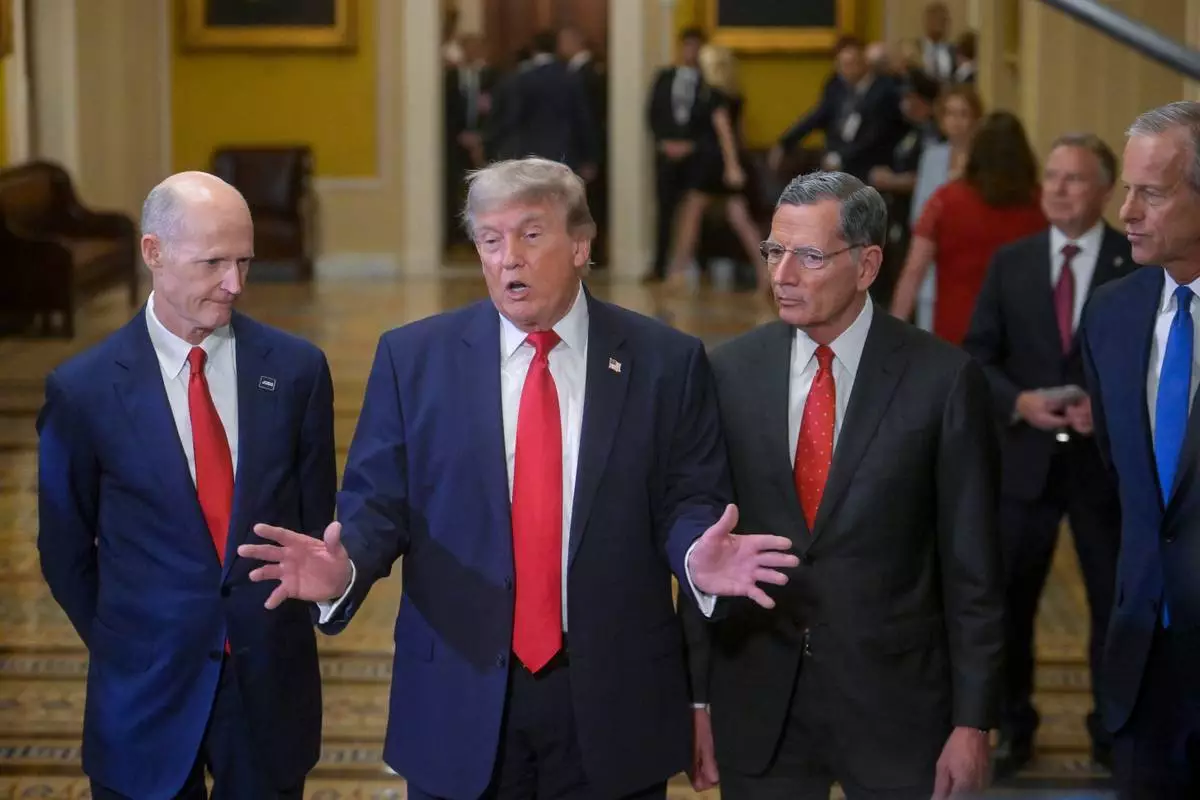
President Donald Trump is joined by from left: Sen. Rick Scott, R-Fla., Sen. John Barrasso, R-Wyo., and Senate Majority Leader John Thune, of S.D., as he departs the Senate Steering Committee Lunch at the U.S. Capitol, Wednesday, June 24, 2026, in Washington. (AP Photo/Rod Lamkey, Jr.)
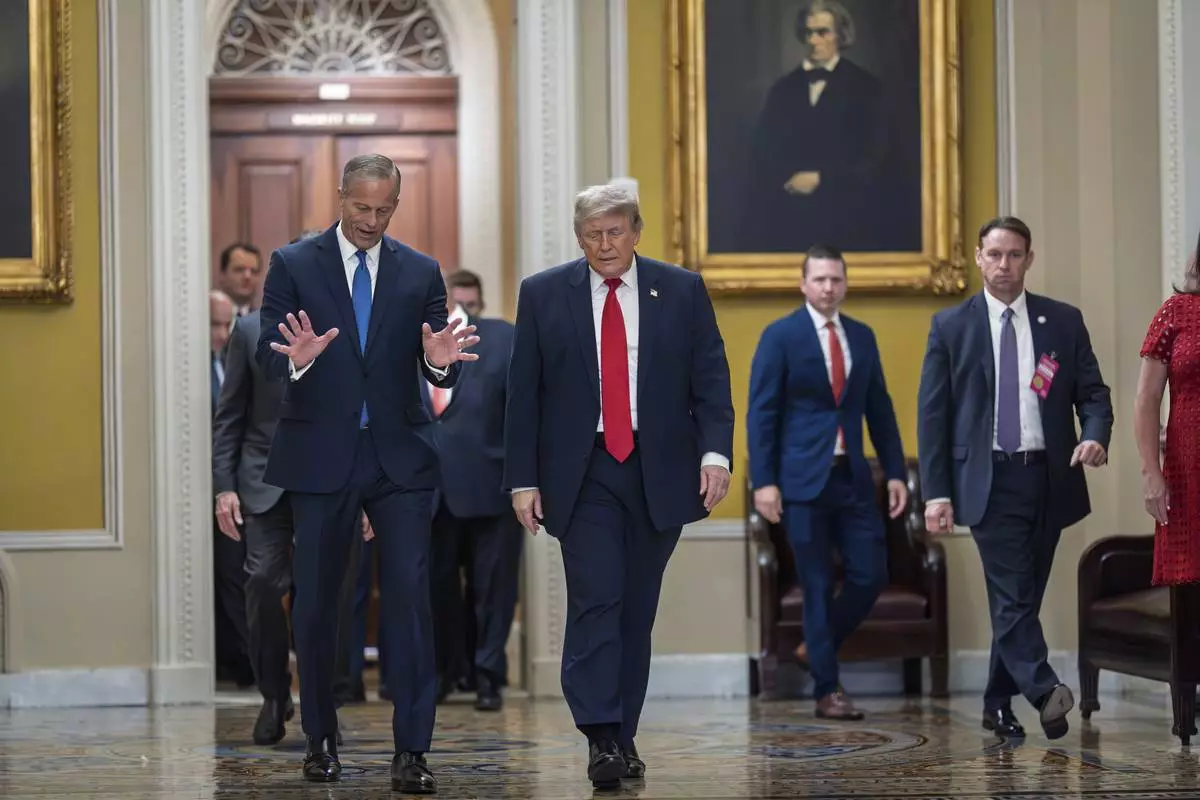
President Donald Trump, escorted by Senate Majority Leader John Thune, R-S.D., heads to a meeting with Senate Republicans at the Capitol in Washington, Wednesday, June 24, 2026. (AP Photo/J. Scott Applewhite)
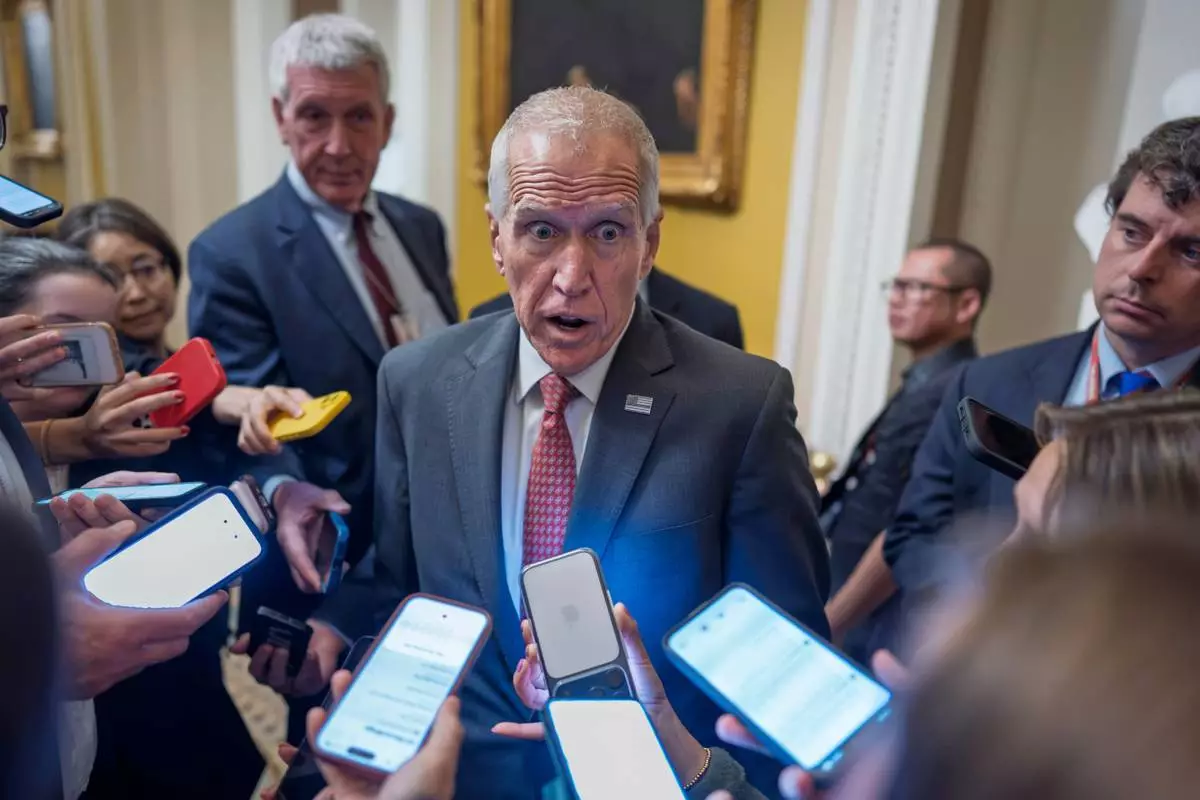
Sen. Thom Tillis, R-N.C., speaks to reporters as Republican senators arrive for a closed-door lunch at the Capitol in Washington, Tuesday, June 23, 2026, to prepare for a meeting with President Donald Trump Wednesday. (AP Photo/J. Scott Applewhite)
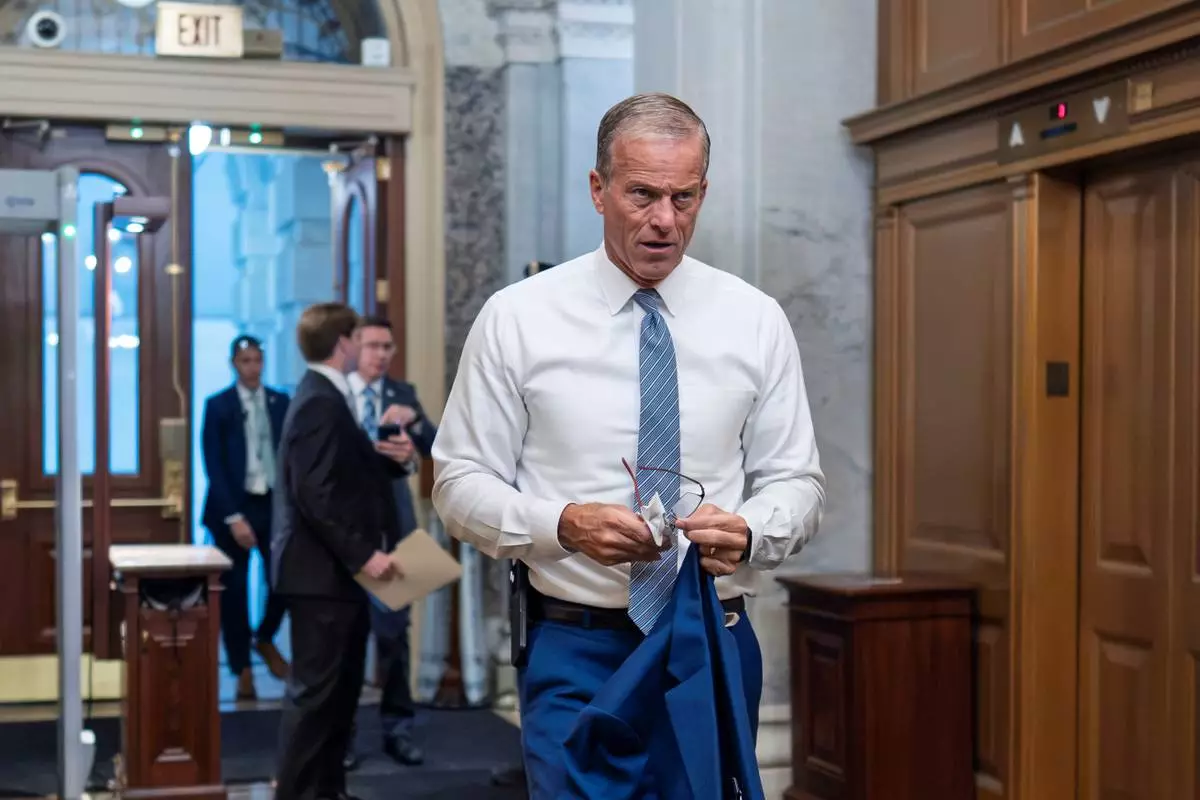
Senate Majority Leader John Thune, R-S.D., arrives at the Capitol in Washington, Tuesday, June 23, 2026, as he prepares for a meeting with President Donald Trump. (AP Photo/J. Scott Applewhite)