WASHINGTON (AP) — Most Americans are inundated with scam attempts on a daily basis — and about 3 in 10 have personally lost money or personal information to scams, according to a new AP-NORC survey.
The poll, conducted by The Associated Press-NORC Center for Public Affairs Research in February, highlights the obstacle course that U.S. adults navigate daily as they screen calls, ignore messages or try to puzzle out if that urgent request from their cellphone provider is legitimate.
A separate survey conducted by Gallup and the Stop Scams Alliance that was provided exclusively to the AP found that last year alone, about 1 in 10 U.S. adults said they or someone else from their household was deceived by a scammer into losing money or providing access to a financial account, with nearly half saying they lost more than $500.
That leaves many Americans feeling like they’re constantly at risk of falling for a scam, often without a sense of recourse. In both surveys, few victims said they reported the scam to the federal government or local law enforcement. Many victims didn't report the scam, Gallup found, because they didn't think it would make a difference in getting money back.
“You've got to be pretty sophisticated these days,” said Adam Pratter, 42. He has run into problems on dating apps — and once ended up sending money to a person who claimed they were overseas because of a military deployment and needed money to buy food. He realized it was a scam when the requests didn't stop.
Pratter thinks banks and social media companies have a responsibility to help people who have been scammed, but also believes the government needs to do more.
“If federal regulation wanted to step in and make deals with these companies to get these people their money back, they could,” he said.
Americans are flooded with scam attempts, according to both surveys. More than half, 58%, of U.S. adults in the AP-NORC poll said they receive daily text messages, phone calls, emails, online messages or online advertisements that they suspect are scams, while the Gallup survey found last year that about 4 in 10 experienced attempted scams on a daily basis.
Porschel Smith, 22, gets multiple scam calls every day, and receives even more scam emails. Some of the scams are easy for her to identify. “They mention different types of programs that I know are nonexistent,” she said.
But sometimes she ends up engaging with the scammer before realizing that something is wrong. “Some of them hack your account and pretend as if they're someone that you know,” she said. “But then I get to asking questions and realize they're scams.”
Older people are more likely to say they receive scam attempts daily, according to the AP-NORC poll. About 7 in 10 U.S. adults ages 60 and older say they are contacted by a suspected scammer at least once a day, compared to about 4 in 10 Americans under 30.
Among those who have received suspected scam attempts, the AP-NORC poll found that outreach involving package shipments or banking were among the most common methods. About 4 in 10 people who were contacted by scammers say at least one of the attempts they received over the past few years were through Facebook or Facebook Messenger, while about 2 in 10 said they were on WhatsApp, and a similar share said they were on Instagram.
The impact of scams is far-reaching. About half, 51%, of U.S. adults know someone personally — such as a friend or family member — who has ever lost money as the result of a scam, the AP-NORC poll found, while about 3 in 10 U.S. adults say they have personally been scammed into giving away money or personal information.
The Gallup survey found that about 1 in 10 U.S. adults said they or a member of their household was scammed out of money in 2025, with 6% saying they had been personally scammed.
About half of people whose household experienced scams last year reported losing between $125 and $2,000, according to Gallup.
About 1 in 10 U.S. adults have been scammed multiple times, Gallup found.
“It's not easy. They know what they're doing," said Towonna Harris, 50. Her son was once contacted by scammers who promised to give him money for tuition if he authorized a nominal credit card charge, which quickly spiraled into a much bigger set of charges.
She's experienced other kinds of scams on a smaller scale, too. “I ordered some stuff. I never got it,” she said. “I thought it was a legitimate company. And then I saw all these reviews saying it was a scam.”
Virtually all U.S. adults believe that scams pose a “major” or “minor” threat to individuals in the U.S., but few think the government is doing enough to solve the problem. About 8 in 10 Americans say the government is “definitely” or “probably” doing too little to prevent scams, according to the Gallup survey, including large majorities of Republicans and Democrats.
When people are scammed, both surveys found that victims are much likelier to reach out to financial institutions than the federal government or local law enforcement. About half, 55%, of people who were scammed last year reported to a bank, credit union or other financial institution, the Gallup poll found, but only 18% contacted state or local law enforcement, while 13% reported to either federal law enforcement or the Federal Trade Commission.
Many victims don't make a report because they don't think it will help, or don't know where to go, Gallup found. Among people who were scammed in 2025, 75% said they didn't report because they thought it wouldn't make a difference in getting their money back, while 58% were uncertain where to report.
More broadly, Americans express very low confidence that they'd know how to report a scam to the government if they needed to. According to the AP-NORC poll, most Americans, 55%, say they are “extremely” or “very” confident that if they were scammed, they’d know how to report it to banks or credit card companies, but only about one-quarter are similarly confident that they’d know how to report to federal or state law enforcement.
Only about one-third of U.S. adults said they would know where to make a report if they lost $5,000 in a scam today, Gallup found.
Max Anderson, 23, said that his parents are small business owners who were the victims of a costly and complex scam. “A scammer successfully imitated one of their employees and changed their direct deposit information. This went on for about 3 months. It went to $15,000,” he said.
Eventually, Anderson's father got help from the FBI, he said.
“I do like that the government stepped in with my parents, and I feel like that's the way it should be,” he said. “It's a big enough problem at this point that it falls to the government and companies to do something about it.”
Associated Press reporters Mary Rajkumar, Juliet Linderman and Erika Kinetz contributed to this report. Northwestern University Medill School of Journalism student Molly Wallace contributed to this report.
The AP-NORC poll of 1,133 adults was conducted Feb. 19-23 using a sample drawn from NORC’s probability-based AmeriSpeak Panel, which is designed to be representative of the U.S. population. The margin of sampling error for adults overall is plus or minus 4.0 percentage points.
The Stop Scams Alliance-Gallup poll of 5,173 adults was conducted Jan. 8-Feb. 18 using a sample drawn from Gallup's probability-based Gallup Panel. The margin of sampling error for adults overall is plus or minus 1.4 percentage points.
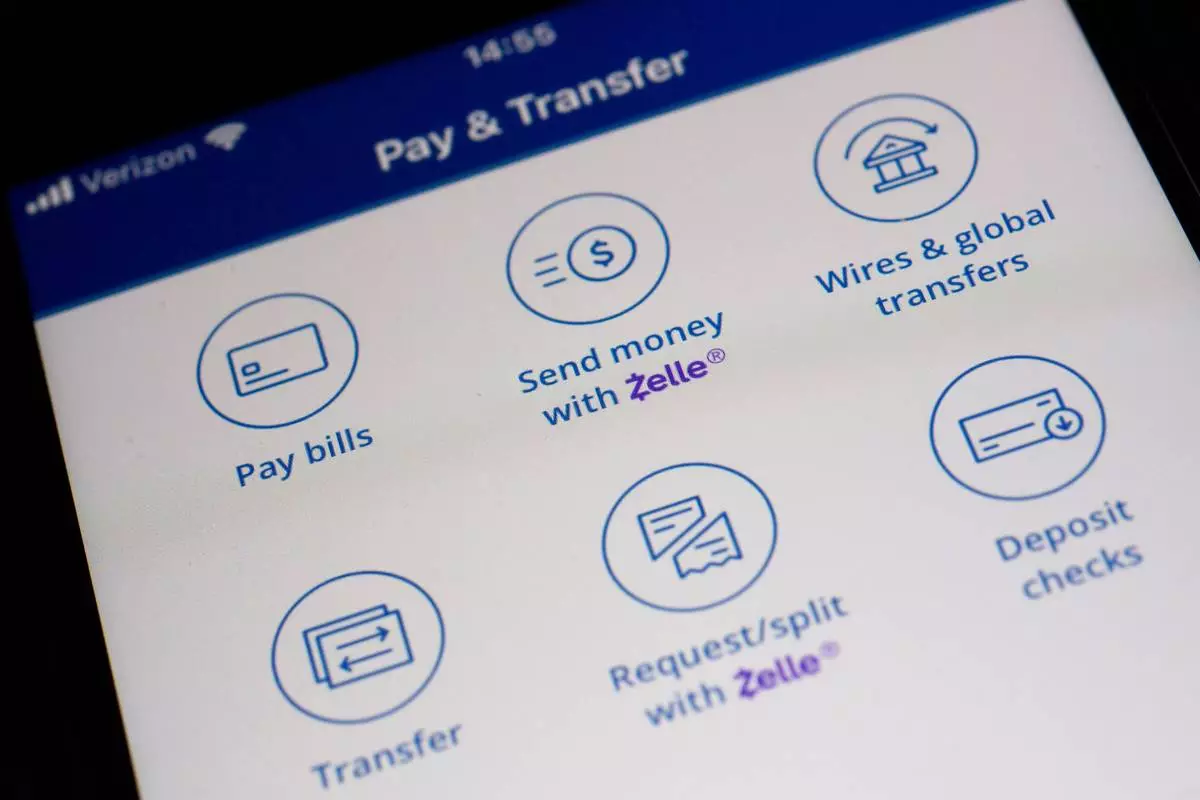
FILE - Options to use the Zelle payments network are seen on a mobile banking app in New York, Dec. 20, 2024. (AP Photo/Patrick Sison, File)
WASHINGTON (AP) — Senate Republicans who were berated by President Donald Trump on Wednesday over opposition to his war in Iran held a late-night vote to try to appease him, voting down a war powers resolution a day after a similar measure passed.
Trump harangued GOP senators face to face earlier in the day for allowing a vote to block his war in Iran on Tuesday, further escalating a feud that has diverted GOP efforts to focus on election-year affordability issues and brought much of the chamber’s business to a halt. He exchanged particularly harsh words with Louisiana Sen. Bill Cassidy, one of four Republicans who had voted with Democrats on the measure.
Hours later, though, Cassidy received a personal briefing on the war at the White House from Vice President JD Vance and envoy Steve Witkoff and returned to the Capitol to vote against a separate war powers resolution. Kentucky Sen. Rand Paul, a Republican who has repeatedly voted with Democrats to halt the war, voted present this time “to give the President more space and leverage to negotiate a lasting peace,” he said on X. The measure failed 47-50-1.
“I want to thank Vice President Vance and Special Envoy Witkoff for the thorough briefing this afternoon on Iran. I appreciate the quick invitation to the White House to address many of my concerns,” said Cassidy, who lost reelection last month after Trump endorsed his opponent, in a post on X.
It's unclear whether the move will be enough to appease Trump, who had called the Republicans “losers" for voting against his war and had called Cassidy a “lunatic” at the lunch after their tense exchange. But the vote was a clear signal to the president from Republican senators who still want to placate him, despite increasing tensions in recent weeks and his decision Wednesday morning to reverse himself and delay signing a housing bill that received overwhelming bipartisan support.
Senate Majority Leader John Thune, R-S.D., and a small group of his Senate GOP colleagues called Trump after the vote. Thune said the president was “pleased with the outcome."
Trump later thanked Thune in a social media post and noted that Cassidy and Paul had switched their votes. “This vote puts Iran on notice!” he wrote.
Invited by Florida Sen. Rick Scott to speak at a GOP luncheon in the Capitol, Trump had signaled ahead of time that he would use the closed-door meeting to push senators to pass his proof-of-citizenship voting bill. But the conversation was more focused on Tuesday’s vote on war powers, a mostly symbolic measure that allows Congress to rebuke the administration’s military actions. The House had passed its own version of the resolution earlier this month.
Most Republicans stayed quiet. But Cassidy, who lost reelection in his primary last month after Trump endorsed an opponent, stood up and defended his vote.
“I stood and said, ‘You have not told the American people what’s going on,’” Cassidy told reporters after the meeting. “This was supposed to last four weeks, it’s lasted four months. Our original objectives have not been achieved.”
The two men “went back and forth,” Cassidy said, and he “matched his tone and volume." Cassidy said that he eventually de-escalated, but he did not want to be bullied.
“I am voting for war powers until I get a briefing,” he said afterward.
Trump repeatedly told Cassidy to sit down, according to a person familiar with the private meeting who was not authorized to discuss it. At one point, the president called the senator a “lunatic."
Publicly, Trump said afterward that they had “a really great meeting." But he hinted at the discord.
“We like everyone in the room," Trump told reporters on his way out. "I don’t like a few people, but that’s OK.”
The luncheon capped weeks of friction between Trump and Senate Republicans and added a new layer of frustration as Tuesday's vote was the first time the Senate had adopted a war powers resolution on the Iran war. Trump made clear he was in no mood to compromise before it even started, calling off a scheduled signing ceremony on a housing bill that passed both chambers overwhelmingly this week and that GOP lawmakers were touting as an election-year achievement.
Republican senators were eager for a conciliatory meeting with the president after escalating tensions in recent weeks. But Trump upended their plans when he declared on social media just beforehand that he wouldn't sign the legislation until they send him the SAVE America Act, his bill to require proof of citizenship for all voters.
North Carolina Sen. Thom Tillis said he doesn't know why Trump is holding the housing bill “hostage” for the voting bill that “will never pass in this Congress.”
“It makes no sense to me,” Tillis said as he walked into the luncheon.
Thune said the housing legislation, which aims to lower costs, is “an affordability issue,” and that ”eventually I hope he finds a way to sign it.”
It's unclear if Trump might veto the legislation or if the late Wednesday night vote will change his outlook. But by rejecting a public bill signing, Republicans worry that Trump is indicating a level of indifference to voters’ affordability concerns heading into November’s midterm elections.
Trump's move on the housing bill is his latest reversal after weeks of being at odds with Senate Republicans.
Trump has blocked the Senate from confirming one of his own nominees, asked them to fund parts of his White House ballroom project despite opposition and forced them to defend the Iran war even as they question the strategy and endgame.
Trump has also helped whittle down his own support in the Senate after endorsing primary challengers to two GOP incumbents who were previously reliable votes for his agenda — Cassidy and Texas Sen. John Cornyn. Both men have become more critical of Trump since losing reelection.
“If we’re going to win the midterm elections, we need to get on the same page,” Cornyn said ahead of the meeting. “We’re not on the same page now, and that I think is dangerous.”
Trump has pressed Republicans for months to kill the Senate filibuster and focus on the proof-of-citizenship voting bill, even though Thune has repeatedly told him that neither has the votes.
While Thune remains popular in his conference and cordial with the president, he has spent much of his time lately telling Trump what he doesn’t want to hear. Thune said Tuesday that while Trump and some in their conference want to see the voting bill pass, “it’s just not realistic.”
Thune devoted weeks of floor time to the voting bill earlier this year and has said he supports it. But he has repeatedly said there aren’t enough votes to scrap the filibuster that triggers a 60-vote threshold to pass most bills in the 53-47 Senate. And Democrats are uniformly opposed to the bill.
“I think people at some point have to come to grips with that,” Thune said.
Associated Press writers Josh Boak and Kevin Freking contributed to this report.
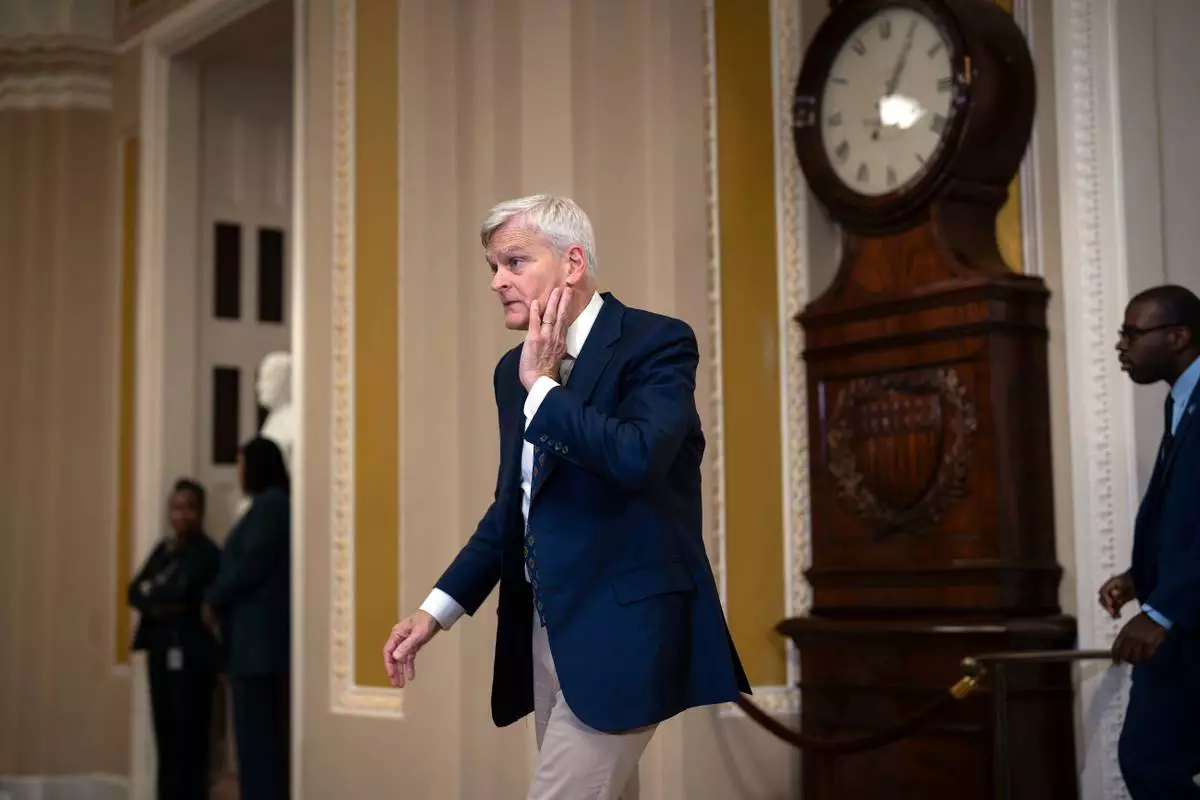
Sen. Bill Cassidy, R-La., leaves a closed-door meeting with President Donald Trump and Republican senators, at the Capitol in Washington, Wednesday, June 24, 2026. (AP Photo/J. Scott Applewhite)
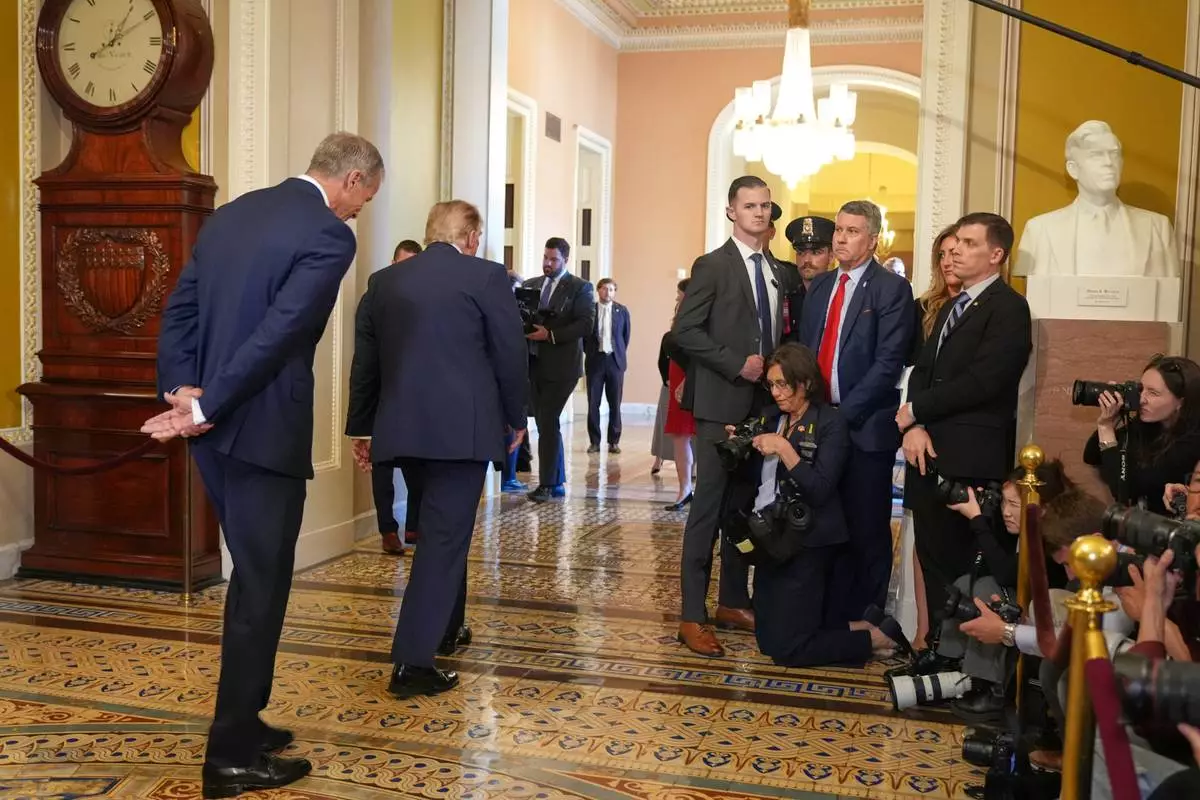
President Donald Trump walks away after speaking to reporters with Senate Majority Leader John Thune, R-S.D., at the Ohio Clock on Capitol Hill, Wednesday, June 24, 2026, in Washington. (AP Photo/Jacquelyn Martin)
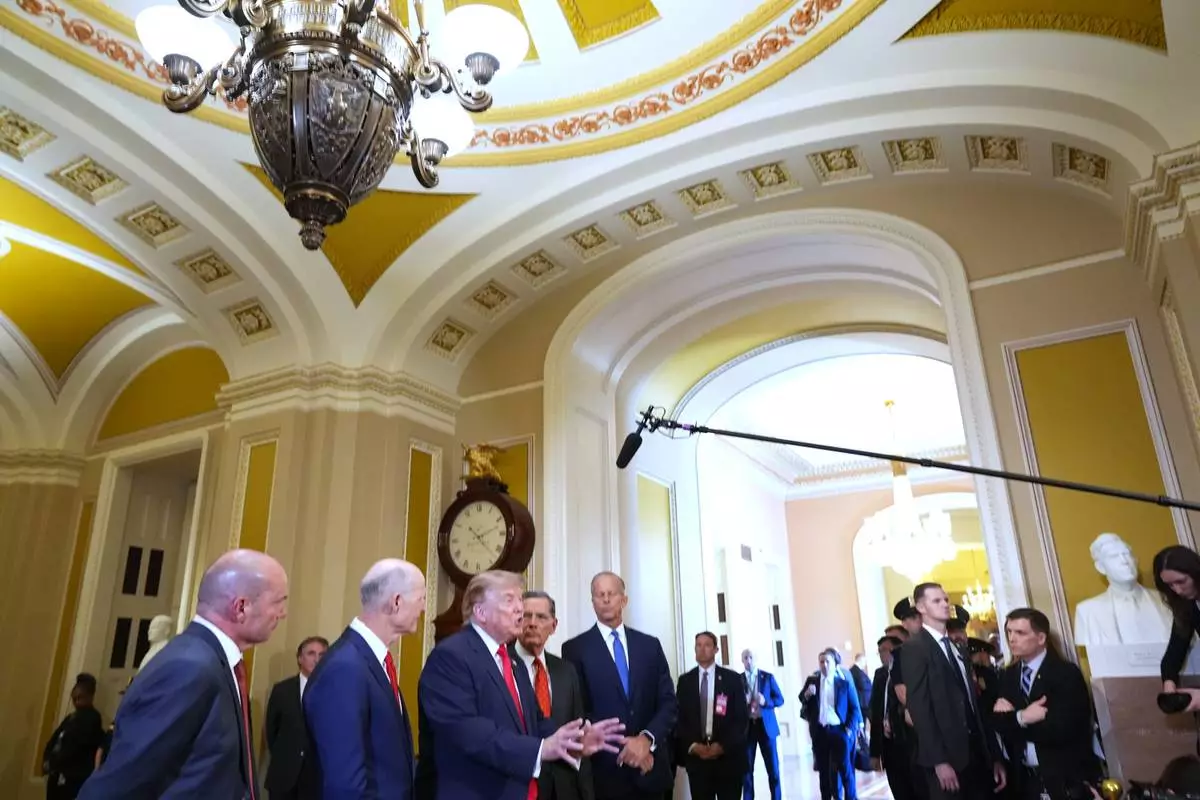
President Donald Trump speaks with reporters after meeting with Senate Republicans on Capitol Hill, Wednesday, June 24, 2026, in Washington. (AP Photo/Jacquelyn Martin)
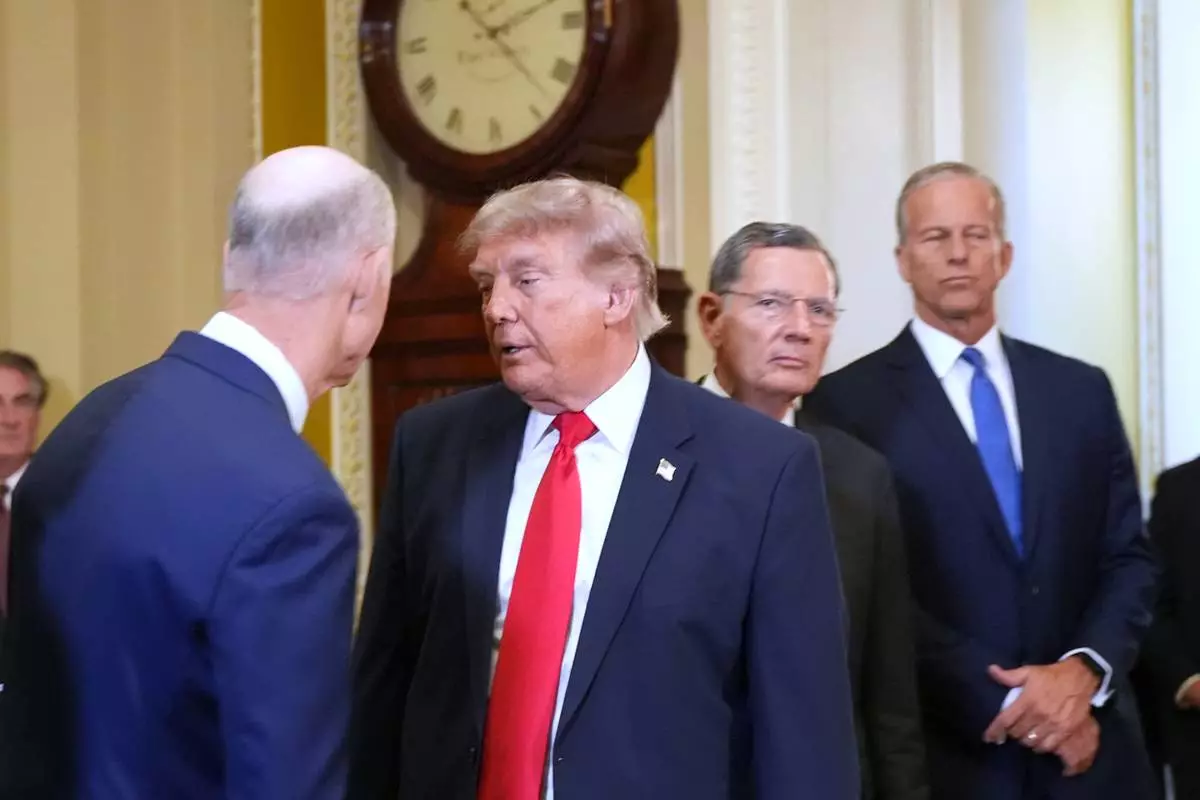
President Donald Trump turns to depart after speaking with reporters as Sen. Rick Scott, R-Fla., from left, Sen. John Barrasso, R-Wyo., and Senate Majority Leader John Thune, R-S.D., listen on Capitol Hill, Wednesday, June 24, 2026, in Washington. (AP Photo/Jacquelyn Martin)
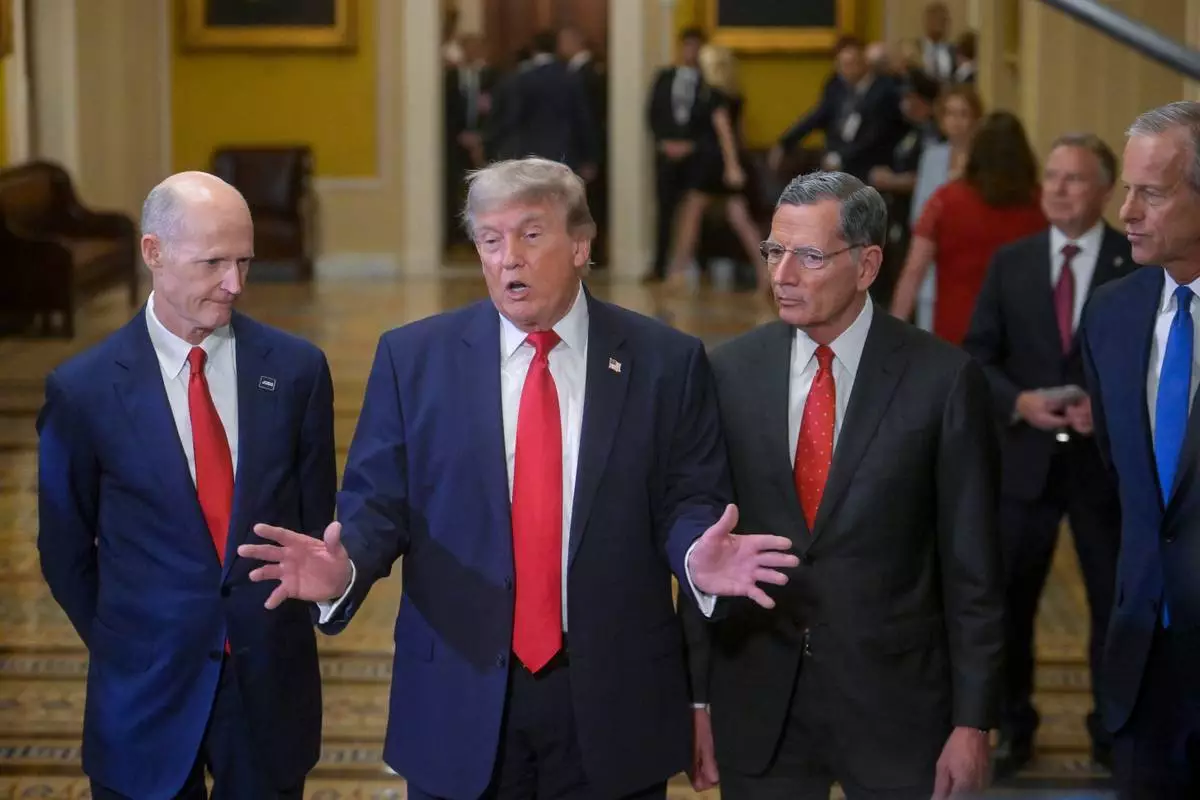
President Donald Trump is joined by from left: Sen. Rick Scott, R-Fla., Sen. John Barrasso, R-Wyo., and Senate Majority Leader John Thune, of S.D., as he departs the Senate Steering Committee Lunch at the U.S. Capitol, Wednesday, June 24, 2026, in Washington. (AP Photo/Rod Lamkey, Jr.)
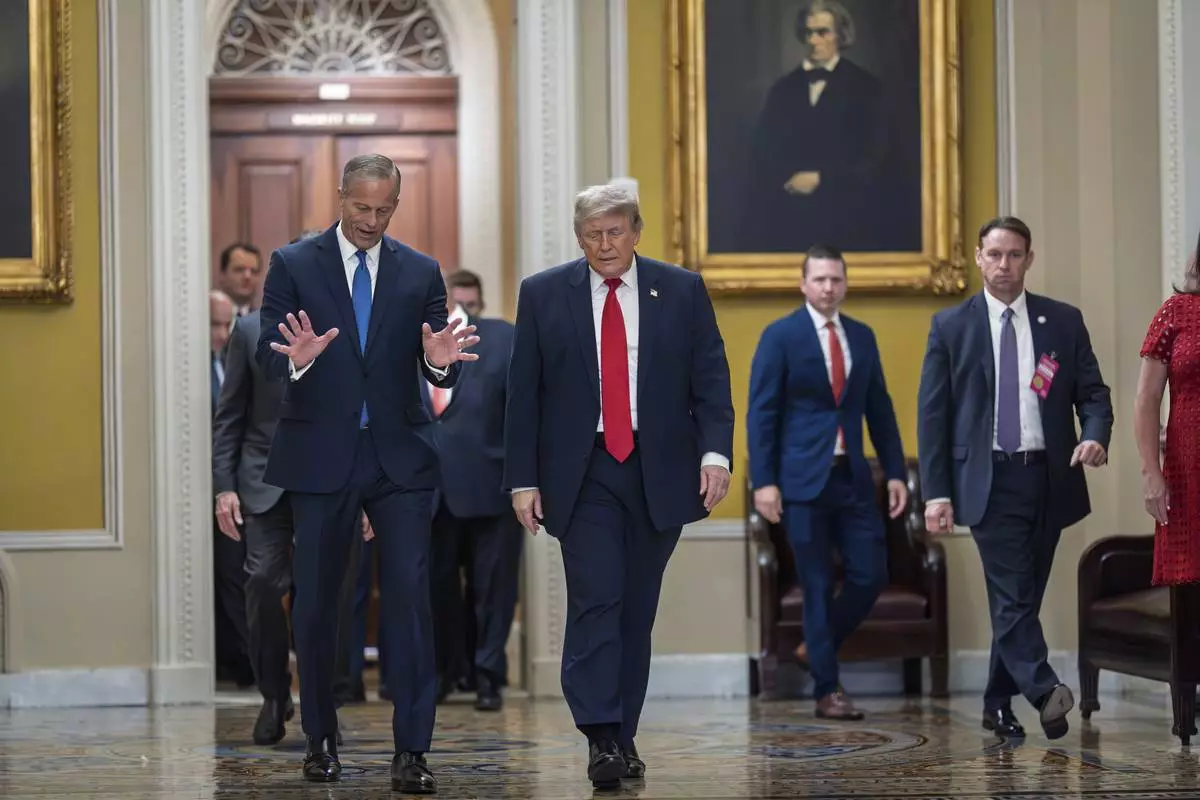
President Donald Trump, escorted by Senate Majority Leader John Thune, R-S.D., heads to a meeting with Senate Republicans at the Capitol in Washington, Wednesday, June 24, 2026. (AP Photo/J. Scott Applewhite)
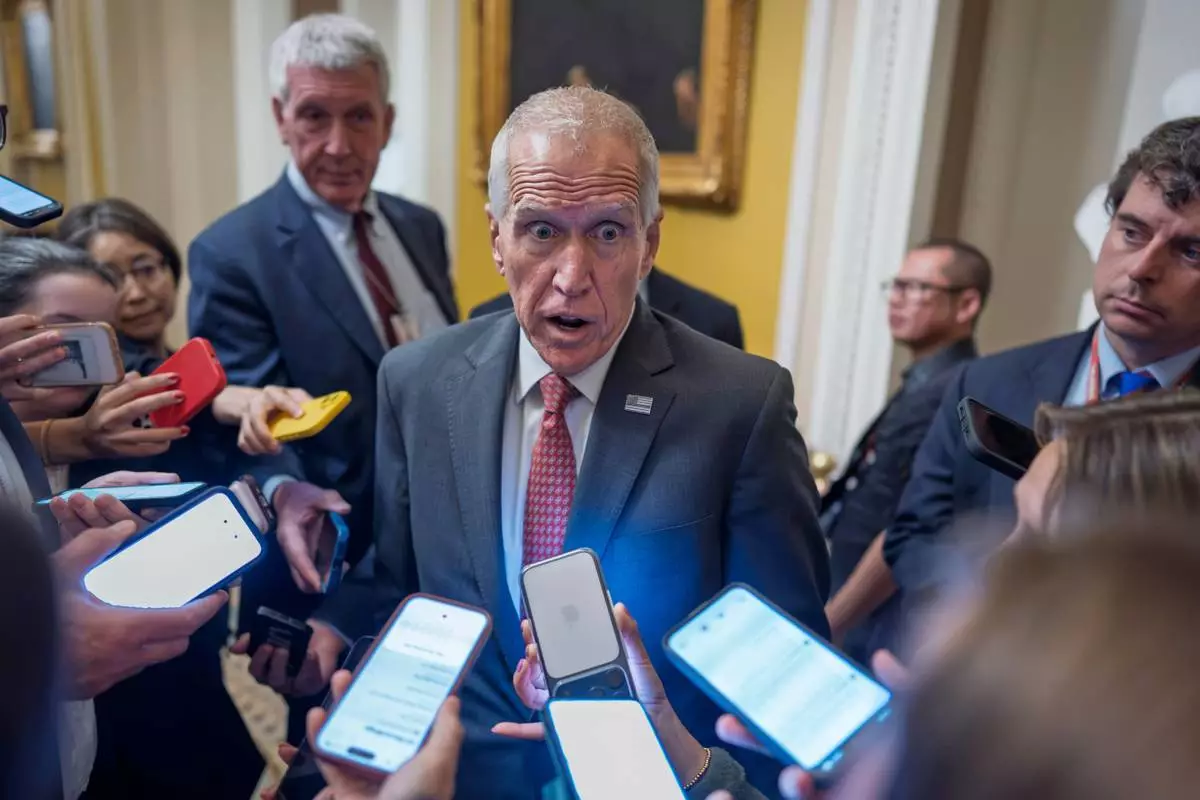
Sen. Thom Tillis, R-N.C., speaks to reporters as Republican senators arrive for a closed-door lunch at the Capitol in Washington, Tuesday, June 23, 2026, to prepare for a meeting with President Donald Trump Wednesday. (AP Photo/J. Scott Applewhite)
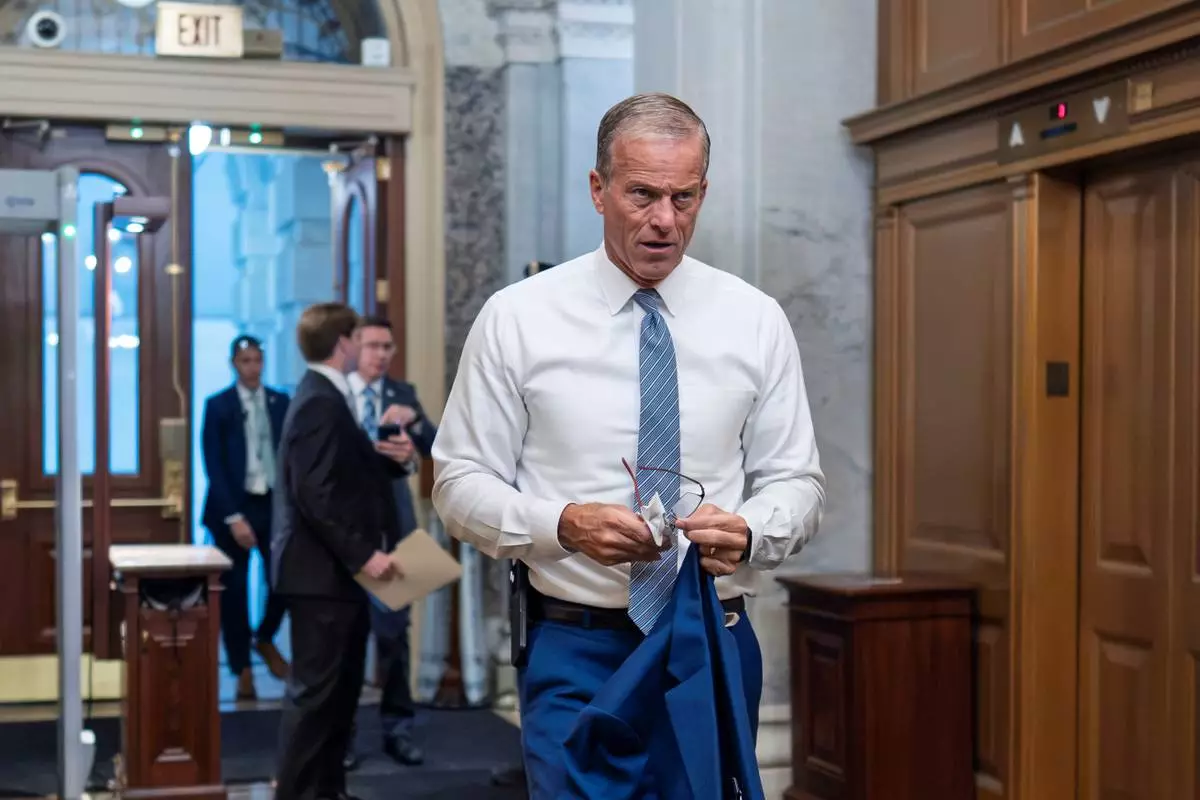
Senate Majority Leader John Thune, R-S.D., arrives at the Capitol in Washington, Tuesday, June 23, 2026, as he prepares for a meeting with President Donald Trump. (AP Photo/J. Scott Applewhite)