Two powerful earthquakes struck Venezuela in quick succession on Wednesday evening, both causing strong tremors in the capital of Caracas.
Venezuela has declared a state of emergency following strong earthquakes, with acting President Delcy Rodriguez announcing the closure of Maiquetia airport due to earthquake damage, and extending condolences to the families of the victims, according to media reports.
A correspondent from China Central Television (CCTV) in Caracas reported damage to several residential buildings. According to the correspondent, many residents were seen gathering on the streets, staying in open areas to avoid potential building or wall collapses. Though shocked by the tremors, they remained generally calm.
According to media reports, the earthquakes have caused casualties.
Three people have died in Baruta district in Caracas after two buildings collapsed, the mayor of the district has said on X. Official numbers of casualties have been slow to trickle in.
Colombian media also reported the quake was felt strongly in several cities in neighboring Colombia.
The U.S. Geological Survey (USGS) reported a magnitude 7.1 quake at 2204 GMT on Wednesday, followed just one minute later by an even stronger magnitude 7.5 tremor. Both struck near the coastal town of Moron, about 160 km west of Caracas.
The quakes were shallow, occurring at a depth of 10 km, which could intensify their destructive impact.
The USGS said the two quakes are likely to result in high casualties and extensive damage.

Two powerful quakes hit Venezuela, strong shaking felt in Caracas

Two powerful quakes hit Venezuela, strong shaking felt in Caracas
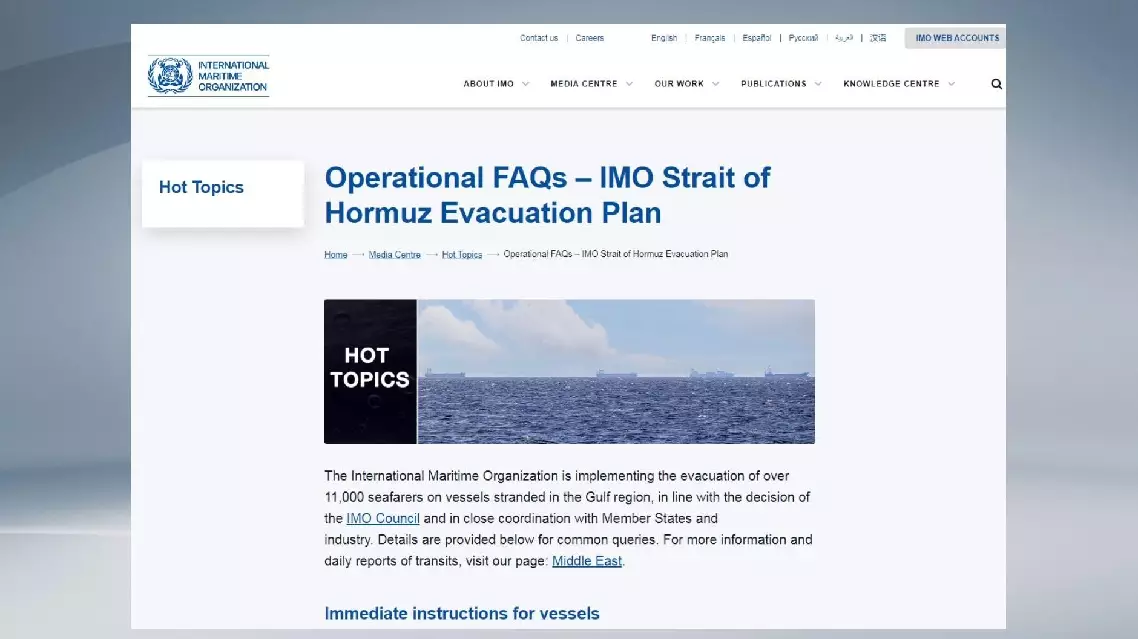
The International Maritime Organization (IMO) on Wednesday released the operational details of a large-scale evacuation plan for seafarers stranded around the Strait of Hormuz, as the closure of the strait has left around 1,200 cargo ships stranded with goods worth 125 billion U.S. dollars.
According to the IMO, more than 11,000 seafarers remain stranded in the Gulf region.
Under the plan, vessels are required to remain in their current positions and await instructions rather than moving independently toward the strait or designated waiting areas. The organization said the measure is intended to prevent congestion and reduce risks associated with mines and degraded navigation conditions.
The United Kingdom Maritime Trade Operations (UKMTO) Center and the Maritime Information Cooperation and Awareness Center will contact vessels directly, and instruct them to proceed to designated waiting areas.
After conducting their own independent risk assessment, vessels are free to choose either the southern or northern route to leave the Strait, according to the IMO.
The evacuation scheme establishes two temporary transit routes through the Strait of Hormuz. One runs through Iranian waters, while the other passes through waters coordinated by Oman and the United States.
The IMO said traffic management and navigational coordination would be handled by coastal states, while the UN agency oversees the overall framework and phased implementation.
Meanwhile, insurance firm Allianz Commercial on Wednesday published its Safety and Shipping Review for 2026, highlighting that the conflict in the Middle East paralyzed the Strait of Hormuz, a critical global oil trade route.
As of June 15, around 1,150 cargo-carrying ships with an estimated vessel and cargo value of 125 billion U.S. dollars were operating within Gulf waters after the closure of the Hormuz Strait, the report said.
Marine insurers have supported the shipping industry throughout the conflict with continuity of insurance cover, albeit at increased hull and cargo premiums. However, for shipowners, the issue has been more about the risk to the crew and the vessel of transiting a conflict zone, rather than insurance considerations, according to the report.
Even if the relevant ceasefire can be maintained and lead to the reopening of the Strait of Hormuz, it will still take time for shipping operations to return to normal, the report said.
Thomas Lillelund, CEO of Allianz Commercial, said the shipping industry is transitioning toward a new equilibrium defined by higher volatility and uncertainty, which will necessitate a greater strategic emphasis on resilience over pure cost efficiency.
Strait of Hormuz evacuation plan detailed as 1,200 cargo ships stranded