HAMBURG, Germany--(BUSINESS WIRE)--Jun 25, 2026--
KAYTUS, a leading provider in AI infrastructure and liquid cooling solutions, unveiled two core solutions at ISC 2026, designed for next-generation AI data centers: a gigawatt-scale, fully prefabricated containerized liquid-cooled data center solution and KSManage Ultra, an intelligent operations management platform for AI Factories. Together, the solutions target the escalating efficiency, performance, scalability, and reliability requirements of AI-era infrastructure, enabling faster deployment, optimized thermal management, and unified operations across large-scale AI computing environments.
Click to Gallery
KAYTUS prefabricated containerized liquid cooled data center solution
This press release features multimedia. View the full release here: https://www.businesswire.com/news/home/20260625809392/en/
The KAYTUS gigawatt-scale solution is built around a 3MW base delivery unit and scales flexibly to 1GW, reducing deployment timelines by up to 60% compared with conventional data center construction. KSManage Ultra provides full-stack visibility and proactive operations management across GPU, rack, and data center layers, helping improve resource utilization, fault detection, and operational efficiency.
At ISC 2026, KAYTUS also showcased its broader full-stack AI infrastructure portfolio, spanning compute, storage, networking, liquid cooling, intelligent operations, and performance optimization. Together, these capabilities provide European customers with end-to-end support for deploying scalable, high-density, and energy-efficient next-generation AI infrastructure.
Key Challenges Facing European AI Infrastructure Operators
As demand for AI training and inference, scientific computing, and industrial simulation workloads accelerates, cloud service providers, supercomputing centers, research institutions, and enterprises across Europe are facing increasingly complex and tangible infrastructure challenges:
KAYTUS directly addresses these challenges through its latest AI data center infrastructure and intelligent management solutions, redefining both how AI facilities are deployed and how they are operated. By combining factory-prefabricated infrastructure, modular scalability, and unified proactive operations, KAYTUS enables faster deployment, flexible capacity expansion, and more efficient management of complex, high-density AI environments.
Fully Prefabricated, Gigawatt-Scale Data Center Solutions
KAYTUS’ gigawatt-scale containerized liquid-cooled data center solution standardizes the full infrastructure stack into three factory-prefabricated container modules: IT Cube, Power Cube, and Cooling Cube. Unlike approaches that prefabricate only IT racks or cooling subsystems, KAYTUS factory-builds the complete data center infrastructure as a fully integrated system. The architecture scales incrementally from a 3MW base unit to 15MW, 100MW, and ultimately 1GW, providing cloud providers, AI service providers, and supercomputing platforms with a reliable, energy-efficient, and rapidly deployable foundation for large-scale AI infrastructure.
Together, the three Cube modules deliver four core customer outcomes: accelerated time to revenue, turnkey single-vendor delivery, consistent factory-controlled build quality, and flexible incremental scaling. A 3MW delivery unit can be brought online within one month of arrival on site, while providing a clear, modular roadmap for expansion to gigawatt-scale AI infrastructure.
KSManage Ultra: Intelligent Management for AI Factory
KAYTUS also introduced KSManage Ultra, its next-generation intelligent infrastructure management platform purpose-built for AI Factory environments. KSManage Ultra delivers full-stack visibility across GPU, rack, and data center layers by integrating in-band and out-of-band system telemetry, to identify performance bottlenecks and enable coordinated, system-level operations management. The platform helps customers move beyond fragmented, component-level monitoring toward unified operational control of large-scale AI infrastructure.
Darren Cox, General Manager of KAYTUS Europe, said: "KAYTUS brings a differentiated combination of vertically integrated solutions and deep engineering expertise — spanning hardware, cluster infrastructure, management platforms, and code-level services. Underpinned by our 4D engineering expertise — Design, Develop, Deploy, and DC Operations — we can bring a 30MW large-scale data center live in as little than six months. We are committed to the European market for the long term and look forward to working with local ecosystem partners to help customers in cloud, research, manufacturing, and beyond build and scale their AI and HPC infrastructure efficiently and with confidence."
KAYTUS has deployed more than 200MW of liquid-cooled AI data center infrastructure across Europe, the United States, Japan, Southeast Asia, and other global markets. In Europe, KAYTUS delivered a hundred-rack, high-density liquid-cooled AI data center for a European infrastructure unicorn in just four months, reducing deployment time by 80% compared with conventional construction timelines. Through professional on-site tuning and system validation services, KAYTUS also achieved a 20% improvement in overall system performance, enabling a stable, efficient launch of the customer’s AI workloads.
About KAYTUS
KAYTUS is a leading provider of AI infrastructure and liquid cooling solutions, delivering a diverse range of innovative, open, and eco-friendly products for cloud, AI, edge computing, and other emerging applications. With a customer-centric approach, KAYTUS is agile and responsive to user needs through its adaptable business model. Discover more at KAYTUS.com and follow us on LinkedIn and X

KAYTUS@ISC26

KAYTUS@ISC26

KAYTUS@ISC26

KAYTUS prefabricated containerized liquid cooled data center solution
CARACAS, Venezuela (AP) — Powerful back-to-back earthquakes that struck Venezuela on Wednesday evening killed at least 32 people and injured at least 700, the nation's acting president said, as communities across the South American country sustained damage.
Acting President Delcy Rodríguez warned the toll was expected to rise as rescuers search collapsed buildings and emergency crews reach devastated areas after the 7.2 and 7.5 magnitude earthquakes that struck shortly after 6 p.m.
Rodríguez declared a state of emergency in an address to the nation late Wednesday and said the quakes caused damage in several states. The casualty figures released early Thursday excluded the state of La Guaira, which Rodríguez described as a “disaster zone” and the area hardest hit.
“Dozens of buildings have collapsed there, about 30 kilometers (19 miles) north of Caracas, and we are currently carrying out intensive rescue operations to save lives,” she said.
The earthquakes, among the strongest to strike Venezuela in more than a century, roiled the region, with buildings evacuated in cities and areas impacted as far as Brazil’s Amazon about 1,700 kilometers (1,050 miles) from Venezuela's capital Caracas.
Venezuela’s state-run VTV showed footage early Thursday of three children, covered in dust but alive, being pulled from the rubble in hard-hit La Guaira. The broadcaster also said a hospital in the city of Tucacas, about 200 kilometers (120 miles) northwest of Caracas, suffered damage and showed images of dozens of people in what seemed like medical garb in front of the building.
The earthquakes damaged and closed Simón Bolívar International Airport near Caracas, the country’s main airport, Rodríguez said, adding that subway and natural gas services in Caracas were canceled. She urged Venezuelans to report any damages through a government app.
Rodríguez said school classes would be canceled for several days. The Ministry of Education said some school buildings would be used as shelters and donation centers.
“We urge our population to remain calm,” said Rodríguez, who asked health care professionals to report to hospitals to assist the injured. “We urge unity.”
The U.S. Geological Survey initially said the first earthquake had a magnitude of 7.1, later revising that to 7.2. Its epicenter was west of Morón on the country’s Caribbean coast about 168 kilometers (104 miles) west of Caracas. The quake had a depth of 22 kilometers (13.6 miles).
The USGS reported an even larger 7.5-magnitude earthquake just a minute later. The second quake had a depth of 10 kilometers (6.2 miles) with an epicenter 16 kilometers (10 miles) southwest of Morón.
In the coastal state of Falcon, Gov. Víctor Clark said 32 people had been hospitalized and there were 15 people trapped in the hours after the earthquake.
Offers of help were made by various governments including the United States, Argentina, Bolivia, Brazil, Chile, Ecuador, El Salvador, Mexico, Panama and Uruguay.
U.S. Secretary of State Rubio said in a post on X early Thursday that the United States is “immediately deploying search and rescue teams, medical resources, and humanitarian assistance to Venezuela.”
Rodríguez said later in an X post that she spoke with Rubio by phone but did not share details of the discussion. She also expressed thanks to the leaders of various nations who have sent messages of support.
Jeremy P. Lewin, the U.S. undersecretary of state for foreign assistance, said the State Department had mobilized a disaster assistance team and task force to coordinate aid in coordination with Venezuela's interim government.
Rodríguez said Thursday that Qatar had already sent rescuers who were expected in Venezuela the next day, along with rescue personnel from Mexico and El Salvador.
El Salvador President Nayib Bukele, once diametrically opposed to Venezuela’s government, said in a post on X Wednesday night that he had offered aid.
“We send you all our solidarity and our prayers. Stay strong, Venezuela,” Bukele wrote.
Ecuadorian President Daniel Noboa said he had ordered the immediate delivery of humanitarian aid to help respond to the emergency.
“Ecuador will respond with the speed and commitment this moment demands because, despite our enormous differences, humanity must always guide the actions of a leader,” Noboa wrote.
Bolivian President Rodrigo Paz, who less than a week ago declared a state of emergency in his country following weeks of anti-government protests, said his country stood ready to provide any needed assistance.
The administration of Brazil President Luiz Inácio da Silva expressed solidarity and said no Brazilians reported being injured.
Television broadcasts Thursday showed images of rescue workers using power tools on collapsed structures.
During the quakes, people evacuated swaying buildings in Caracas, many visibly shocked as they saw collapsed walls that left furniture visible from the street. Dust columns could be seen in two capital neighborhoods with typically busy restaurants and other businesses.
People remained on the streets for hours, some sitting on the ground hugging pets as dust gathered around them. Collapsed buildings, toppled electric poles and debris blocked streets. Parts of the capital lost power and cellphone signal.
“It started off gently and then gradually grew, and in the end, we all had to leave our houses, go outside and gather together,” Caracas resident Hector Ricci said.
Roberto Gamas, another Caracas resident, said the building he was in “really shook from side to side. Unreal. The force was incredibly strong.”
The lack of cellphone signal in parts of Venezuela deepened the distress of many families, particularly those among the more than 7.7 million people who have left the country during its protracted crisis.
Venezuela opposition leader María Corina Machado, in exile after leaving Venezuela in December, took to X to send prayers and wish strength to Venezuelans.
“May strength, serenity, and solidarity prevail among us in the face of this difficult time,” she said on X.
Venezuela Interior Minister Diosdado Cabello said the quake could be felt in several states and asked motorists to give way to ambulances and other emergency vehicles.
“We understand that some people may be desperate, but we are acting according to protocols to activate aid and rescue efforts to help those who need it most,” Cabello said, urging people to remain outside as aftershocks could further damage structures. “Be very careful with children and the elderly. Call each other and check that no one has been harmed.”
Buildings in Manaus, Belem and Macapá in Brazil's Amazon were evacuated, according to reports on TV Globo. The quakes also were felt in Colombia’s Caribbean and northeast regions, but there were no reports of damages or injuries.
The U.S. Pacific Tsunami Warning Center issued several tsumani alerts in the wake of the earthquakes that were quickly lifted.
Strong earthquakes are unusual in Venezuela. While the country sits near multiple fault lines, its position straddling the South American and Caribbean plates make earthquakes much less common than in other parts of Latin America.
Earthquakes are frequent along the Pacific coast, including in Mexico and Chile, which both sit along the seismically active tectonic belt known as the Ring of Fire, an area that the USGS said is responsible for 90% of earthquakes.
Garcia Cano reported from Bogota, Colombia. Associated Press writers Clara Preve in Buenos Aires, Astrid Suarez in Bogota, Colombia, Mauricio Savarese in Sao Paulo and Anna-Catherine Brigida, Megan Janetsky and India Grant in Mexico City, Cristina Fuentes in Madrid and Maria Teresa Hernandez in Beijing contributed to this report.

People sleep outside their homes following an earthquake in Caracas, Venezuela, Thursday, June 25, 2026 (AP Photo/Pedro Mattey)
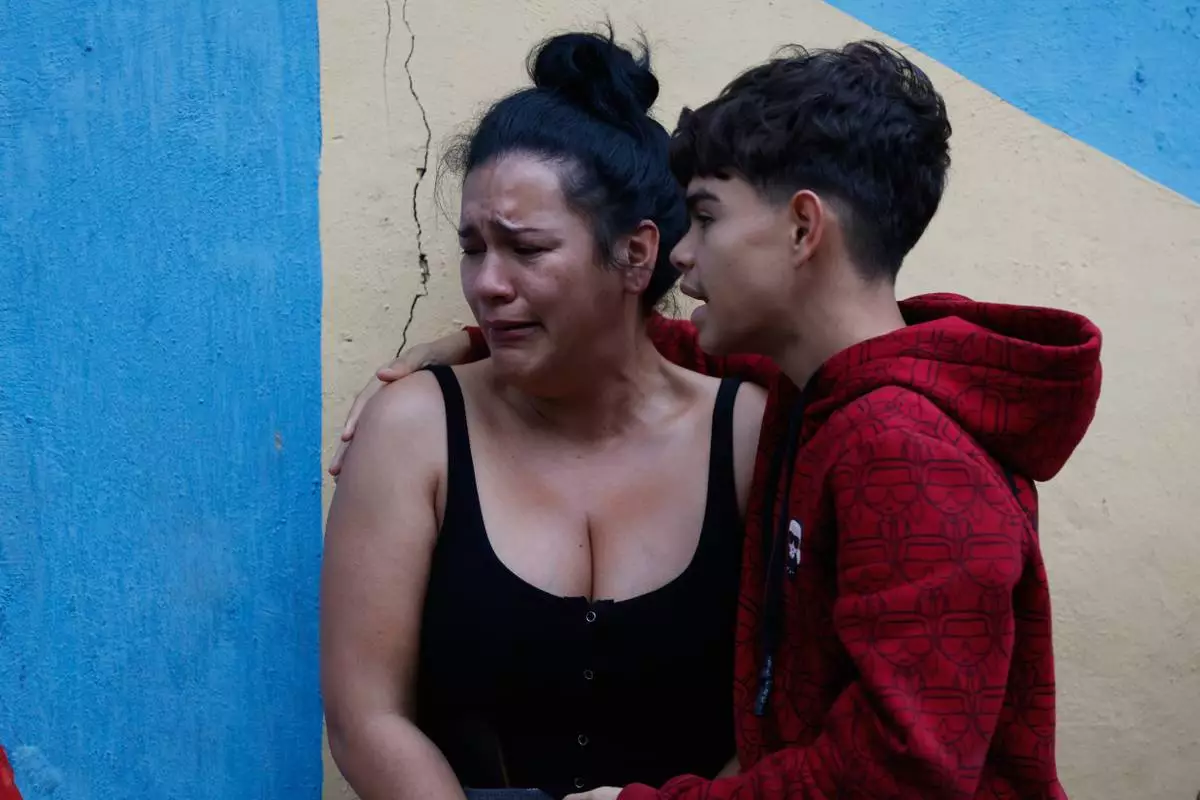
A boy comforts his mother after an earthquake in Caracas, Venezuela, Wednesday, June 24, 2026. (AP Photo/Pedro Mattey)
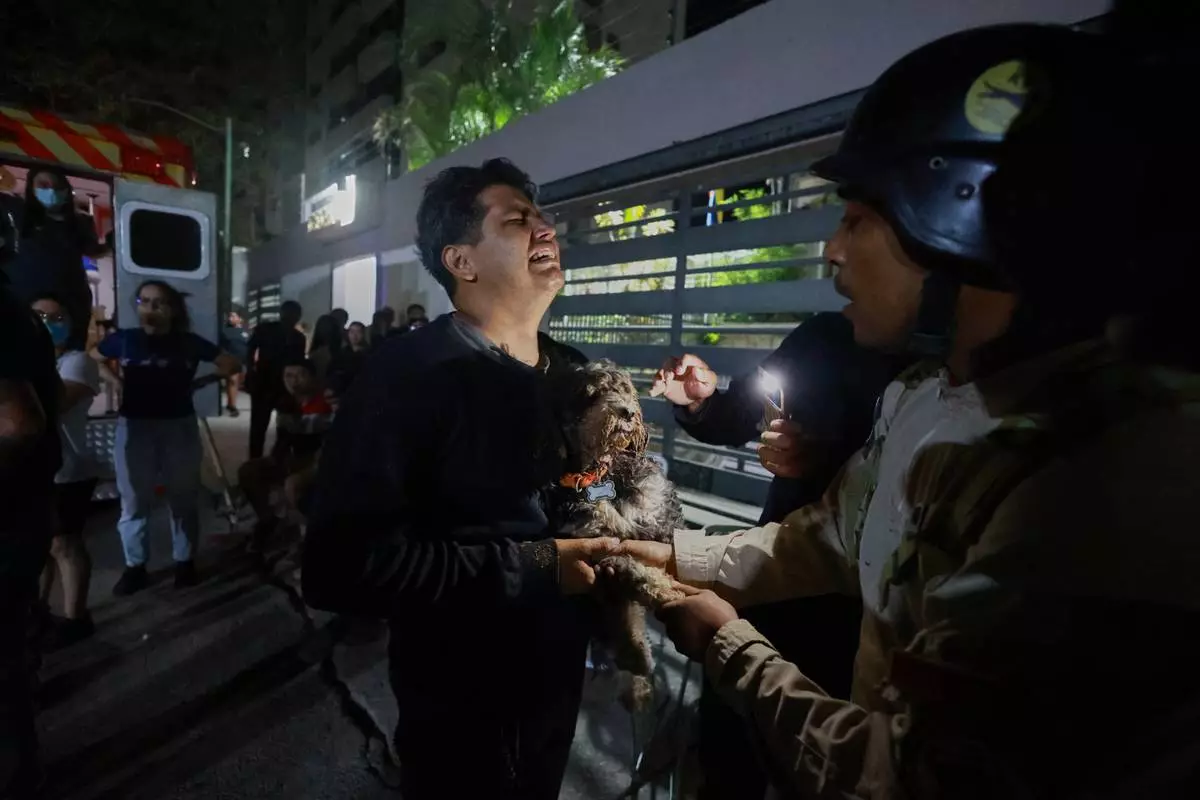
A man holding a dog cries after an earthquake in Caracas, Venezuela, Wednesday, June 24, 2026. (AP Photo/Javier Campos)
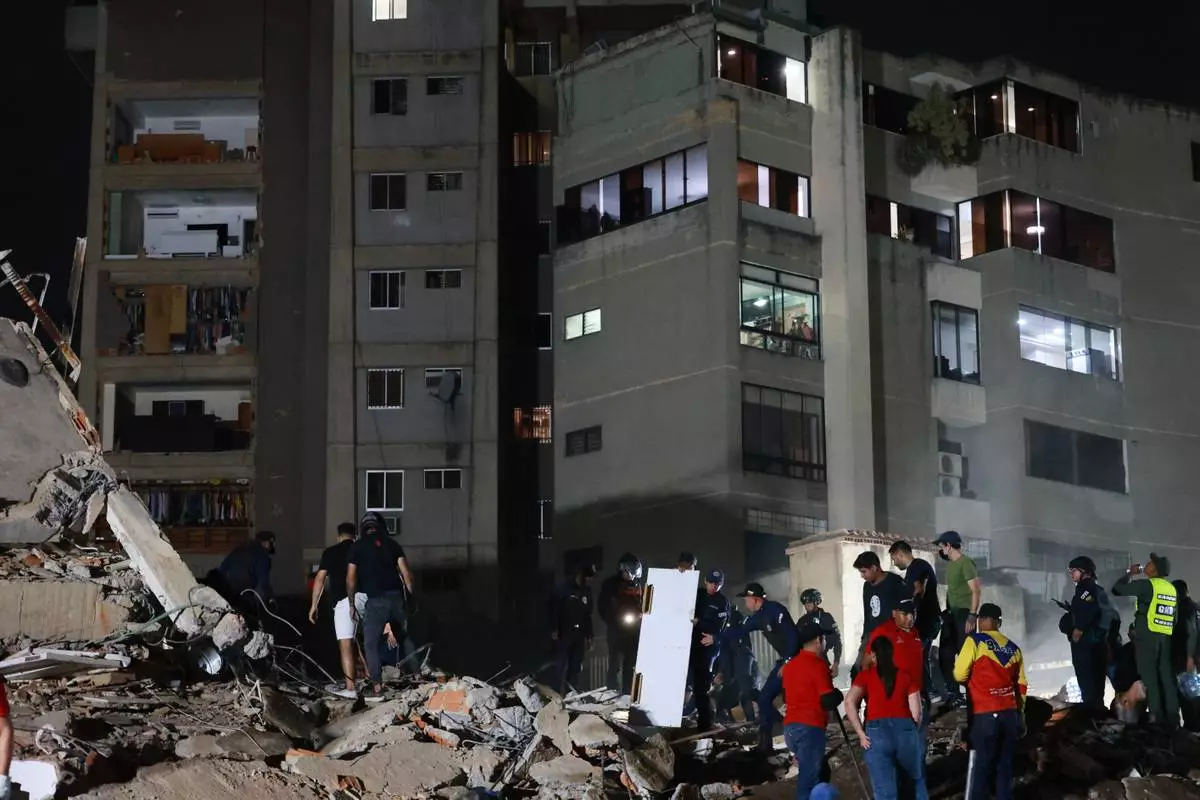
Rescue workers search through the rubble after an earthquake in Caracas, Venezuela, Wednesday, June 24, 2026.(AP Photo/Javier Campos)
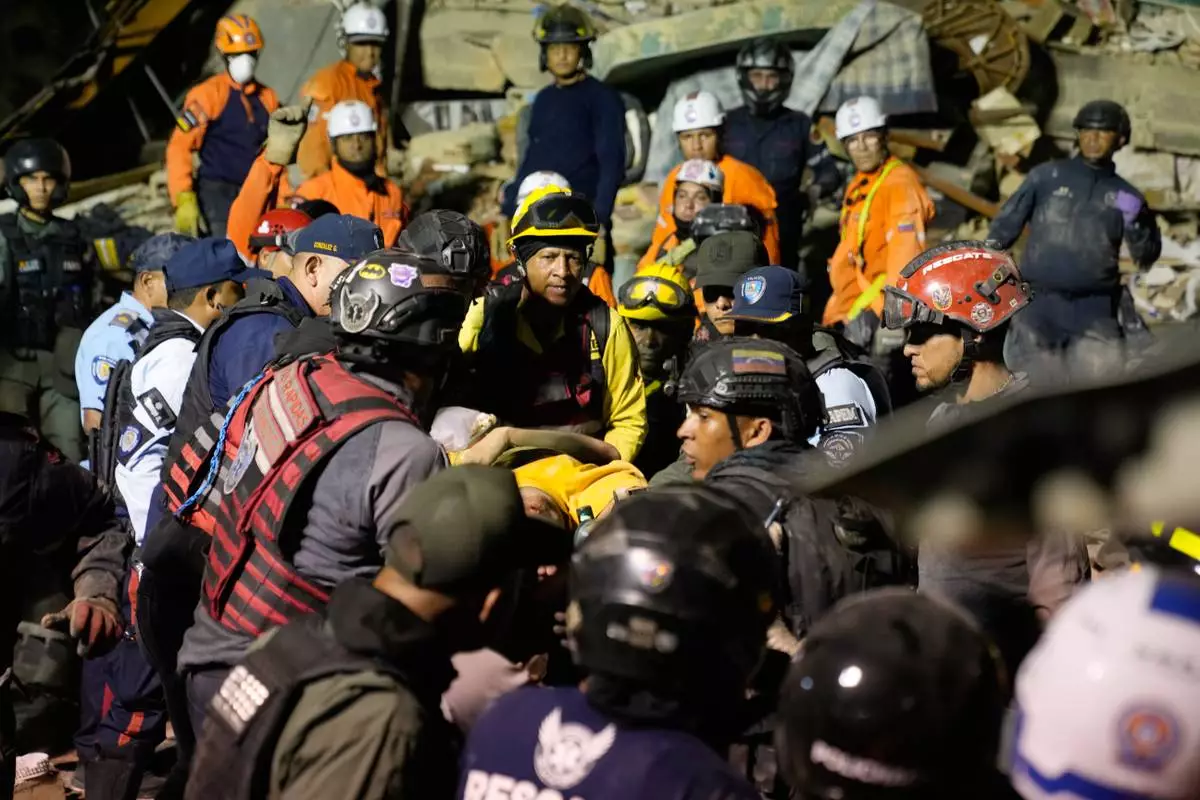
Rescue workers search through the rubble of a collapsed building after earthquake in Caracas, Venezuela, Wednesday, June 24, 2026. (AP Photo/Ariana Cubillos)
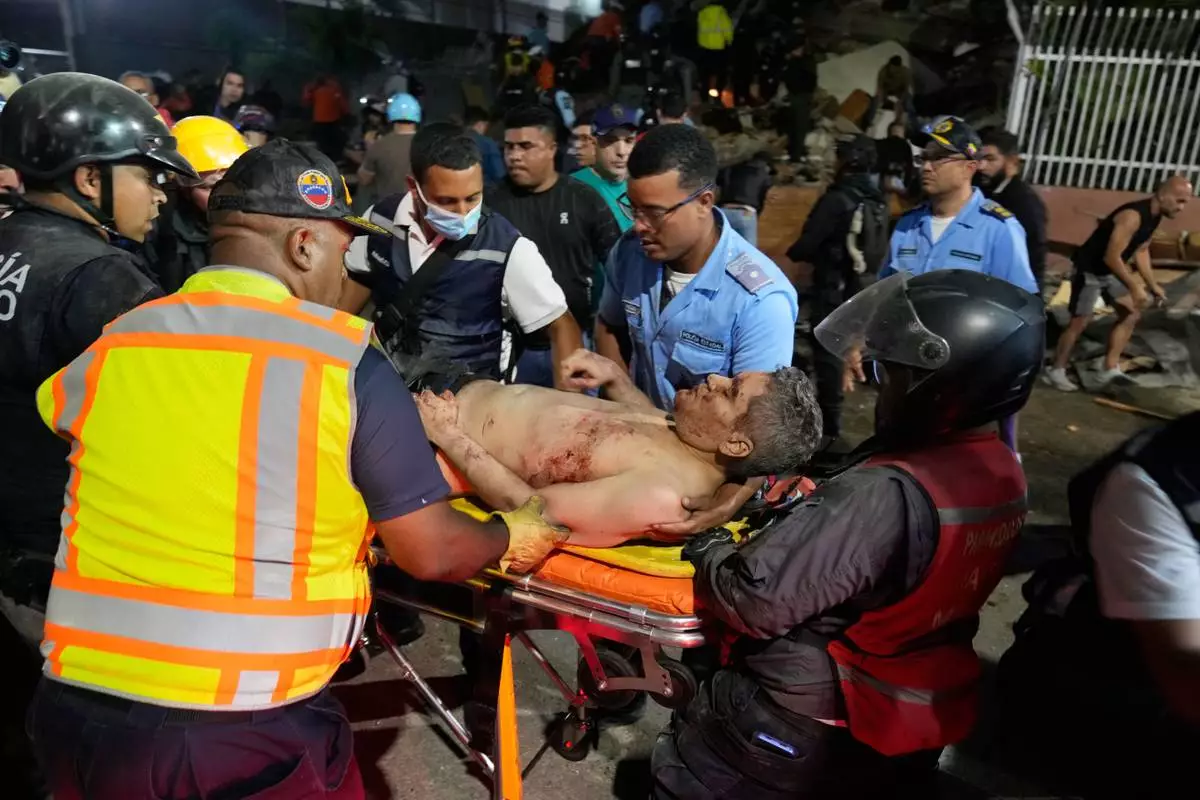
Rescue worker carry an injured man after an earthquake in Caracas, Venezuela, Wednesday, June 24, 2026. (AP Photo/Ariana Cubillos)