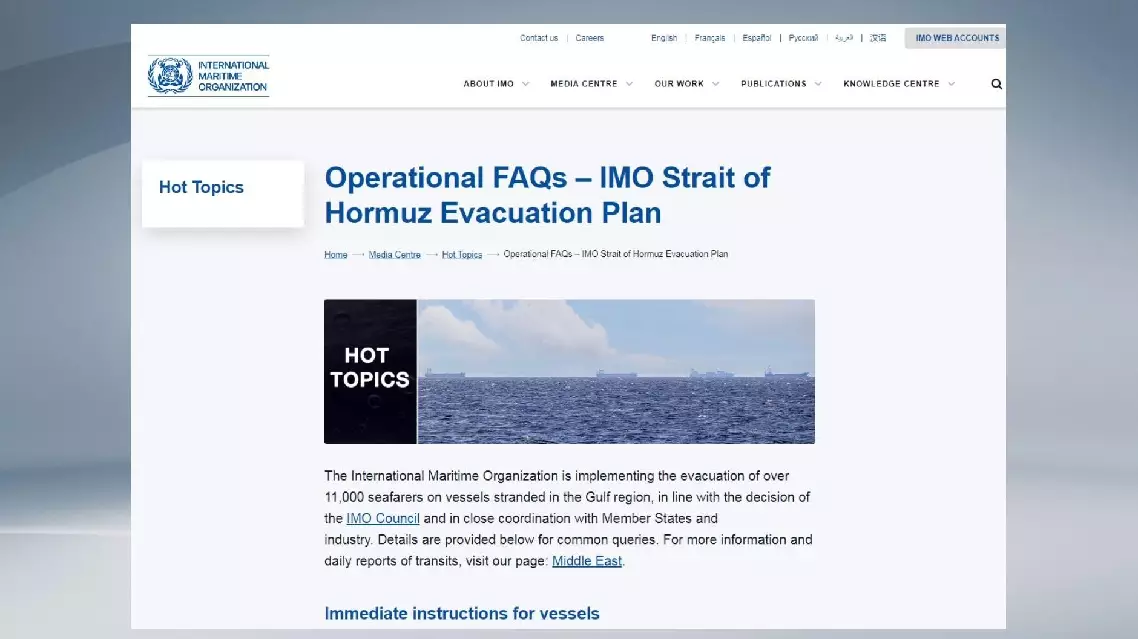
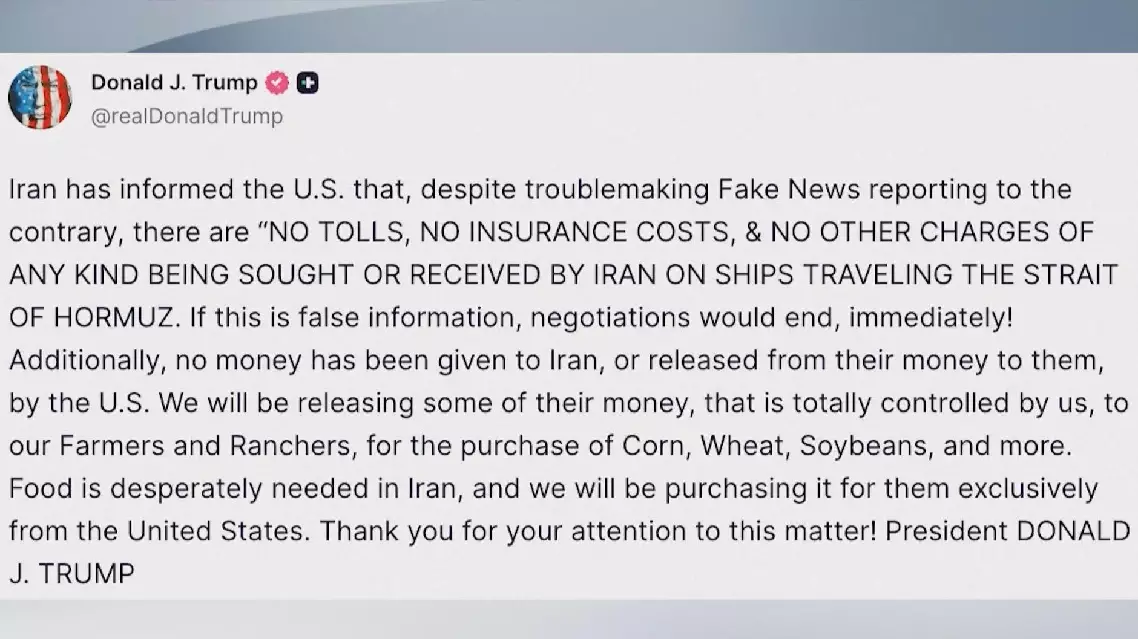
U.S. President Donald Trump said Wednesday that Iran had assured Washington it is not seeking tolls, insurance fees, or other charges from ships transiting the Strait of Hormuz, warning that negotiations between the two sides would end immediately if the information proved false.
"Iran has informed the U.S. that, despite troublemaking Fake News reporting to the contrary, there are 'NO TOLLS, NO INSURANCE COSTS, and NO OTHER CHARGES OF ANY KIND BEING SOUGHT OR RECEIVED BY IRAN ON SHIPS TRAVELING THE STRAIT OF HORMUZ,'" Trump wrote on his Truth Social.
"If this is false information, negotiations would end, immediately!" Trump warned.
Trump also dismissed speculation that Washington had released money directly to Tehran.
"Additionally, no money has been given to Iran, or released from their money to them, by the U.S.," Trump wrote.
However, the president said the White House could release a portion of Iranian assets under U.S. control for the purchase of agricultural products, including corn, wheat and soybeans, only from American farmers.
"We will be releasing some of their money, that is totally controlled by us, to our Farmers and Ranchers, for the purchase of Corn, Wheat, Soybeans, and more," Trump said, adding "we will be purchasing it for them exclusively from the United States."
Trump's remarks came one day after Iran and Oman issued a joint statement affirming their commitment to ensuring safe passage through the Strait of Hormuz and agreeing to continue their discussions to reach an understanding on the future management of navigation in the strait and the related charging service "costs."
Iran's semi-official Fars news agency reported Tuesday that only a limited number of vessels are allowed to pass through the strait each day based on coordination with the Navy of Iran's Islamic Revolution Guard Corps.
According to Fars, the strait had been closed for days following Israel's "hostile" actions against Lebanon and the U.S. "violations" of its commitments under the recently signed U.S.-Iran memorandum of understanding (MoU), which led to a 60-day roadmap toward a final peace agreement.
Iranian Foreign Ministry spokesman Esmaeil Baghaei on Wednesday called on the U.S. government to refrain from making interpretations that are "completely in contradiction" with the MoU.
He made the remarks in a post on the social media platform X, slamming "contradictory" statements made by U.S. officials regarding the MoU's provisions.
He said the remarks on ending the war will not help reduce Iranians' "accumulated distrust" and will merely serve as a reminder of past breaches of promises.
Baghaei emphasized that the U.S. government has never shown any sincerity in its conduct toward the Iranian nation, adding that, despite having reason to distrust it, Iran entered the diplomatic process with the United States in good faith and signed the MoU.
Iranians know that the "enemy's" animosity will not end by signing an MoU, bearing in mind the experiences of the past five decades, especially the developments of the preceding 18 months, he said.
On June 18, Iran and the United States signed the MoU to end the war in the region on all fronts, including Lebanon.
Under the MoU, the two countries agreed to 60 days of negotiations, which are already underway, toward a final agreement mainly on Iran's nuclear program and the removal of sanctions against the country.
U.S. Secretary of State Marco Rubio said Wednesday that U.S.-Iran technical talks are expected to resume next week, likely on June 29 or 30 in Switzerland.
On Sunday, Iranian and U.S. delegations held high-level consultations on the implementation of the MoU in Switzerland, mediated by Pakistan and Qatar. Technical talks followed on Monday.
Trump threatens to end talks if Iran charges ships in Hormuz, Iran slams U.S. for contradicting MoU text