Brazil is expected to become the first-ever Latin American country to issue panda bonds as its Ministry of Finance delivered a letter of intent to China's National Association of Financial Market Institutional Investors on Thursday, according to the People's Bank of China (PBOC), the country's central bank.
Officials from both sides, including Governor of the PBOC Pan Gongsheng and Brazilian Finance Minister Dario Durigan, attended the delivery ceremony in Beijing.
At the delivery ceremony, Pan emphasized the need to deepen investment and financing cooperation between the two countries, promote the use of local currencies on both sides, advance the interconnection of financial infrastructure, ensure that the fruits of cooperation benefit enterprises and people of both countries, and inject strong impetus into global economic development and financial stability
To further promote the connectivity of financial markets, the two sides have agreed to support the China-Brazil Cooperation Fund for the Expansion of Productive Capacity for Sustainable Development in playing a greater role, and lay out projects in key areas such as climate change and clean energy to achieve mutual benefit and win-win results in economic and social benefits.
Both sides also agreed to enhance macroeconomic policy coordination under mechanisms such as the Group of 20 (G20), BRICS and the International Monetary Fund, and jointly speak up for developing countries.

Brazil delivers letter of intent for panda bond issuance to China

Brazil delivers letter of intent for panda bond issuance to China
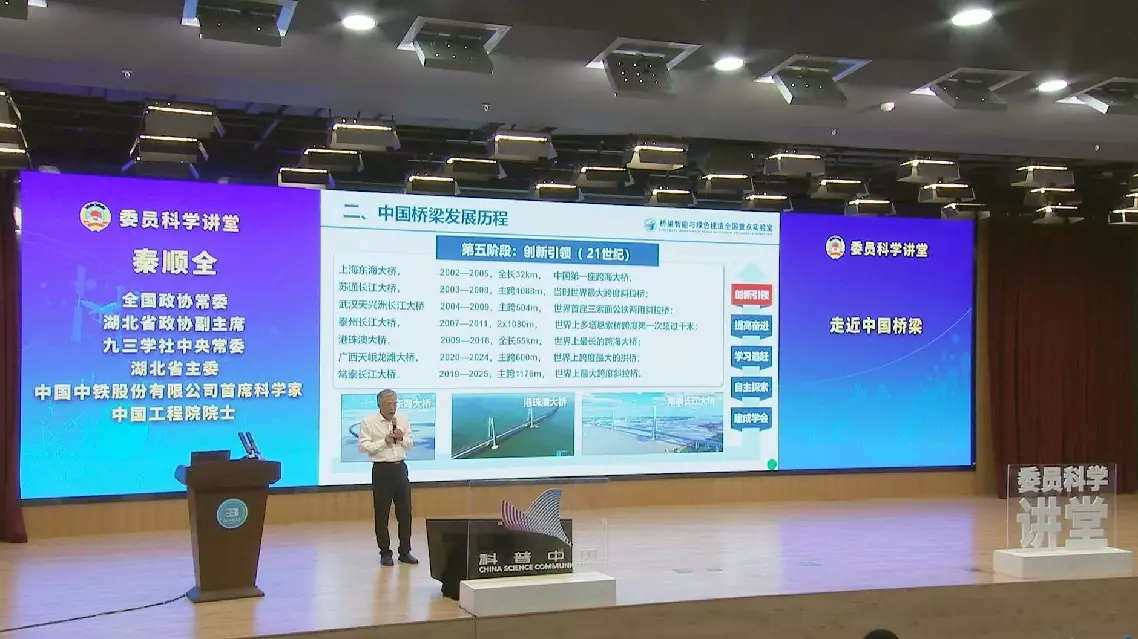
A member of the National Committee of the Chinese People's Political Consultative Conference (CPPCC) gave a popular science lecture on China's bridge development at Beijing University of Technology on Thursday as part of the CPPCC member lecture event held across various sci-tech sectors.
Qin Shunquan, a member of the Standing Committee of the CPPCC National Committee and an academician of the Chinese Academy of Engineering, introduced the current achievements and innovation status of bridge construction technology in China from discussing the basic bridge structure to outlining the development process.
Qin also presented the new demands facing bridge construction in the new era and their corresponding solutions, outlined the cutting-edge trends and transformative approaches in China's bridge development, and engaged in an interactive Q&A session with the audience.
Attendees said they benefited a lot from the exchange of ideas with Qin.
"Academician Qin answered my questions from three aspects. I will consider pursuing a degree in bridge engineering," said Zhou Hang, an undergraduate student majoring in transportation engineering at Beijing University of Technology
"As researchers, we should write our papers on the land of our motherland, making our own small contributions to the country," said Xiu Zhao, a PhD student in civil engineering and hydraulic engineering at Beijing University of Technology.
More than 400 people, including some CPPCC members, university and middle school students, and science and technology workers, attended the lecture.
CPPCC member gives popular science lecture on Chinese bridges in university