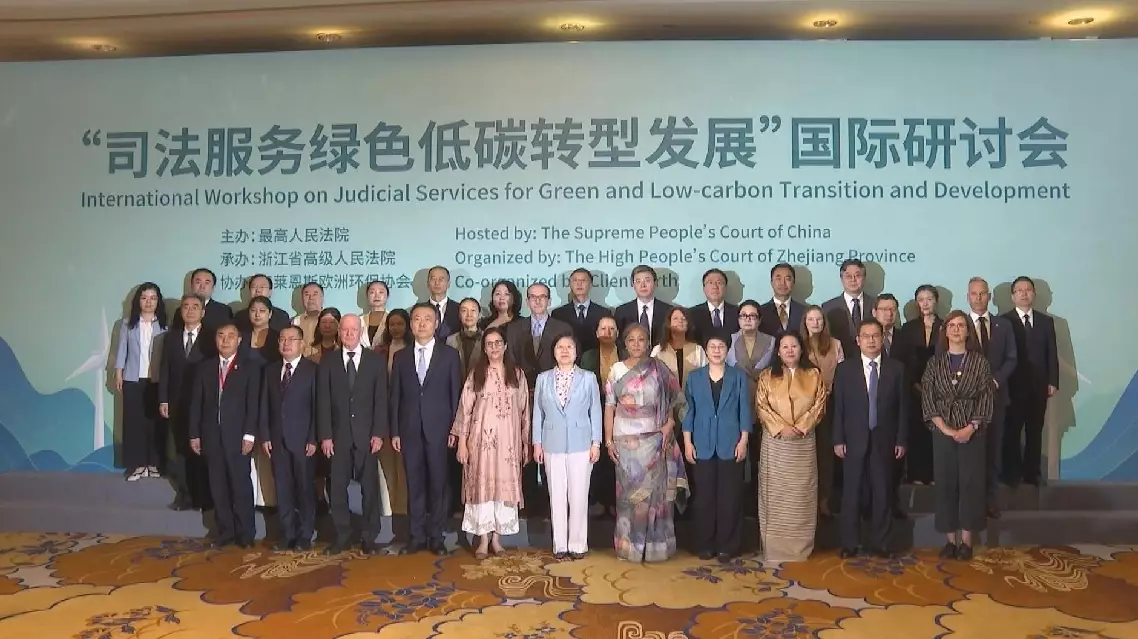
Top judges and legal experts from around the world convened Wednesday in Hangzhou, east China’s Zhejiang Province, for a high-level symposium on how courts can drive the green, low‑carbon transition amid mounting environmental challenges.
Hosted by China’s Supreme People’s Court, the "International Workshop on Judicial Services for Green and Low‑Carbon Transition and Development" centered on how judicial systems can actively promote sustainable change. Many participants praised Chinese courts for their specialized environmental trial mechanisms and growing role in global ecological governance.
"We have a very good experience with China in terms of how they adjudicate environmental cases. There is also a lot of collaboration with the UN Environment Programme. China sends practical cases to the UN Environment Programme, and we share this with countries in Africa, in Southeast Asia, in Central Asia," said Dechen Tsering, Regional Office director for Asia and the Pacific, United Nations Environment Programme.
Delegates stressed that no country can defeat the "triple crisis" of climate change, biodiversity loss, and pollution alone.
"What I expect after this symposium is really the implementation and enforcement of the law and more cooperation, more discussions, more exchanges, like the one today," said Anais Berthier, head of Brussels Office, ClientEarth.
A major talking point at the symposium was the official enactment in March of China's groundbreaking Ecological and Environmental Code, set to take full effect in August. Crucially, it breaks down the old wall between economic development and environmental protection.
"It's an important achievement to combine different environmental regulations into one environmental code. It represents the importance of environmental issues," said Tuomas Kuokkanen, justice of the Supreme Administrative Court of Finland.
"I've gone back knowing pollution is the least of your problems. The issues that you're dealing with low carbon emission that is the way forward. And again, in fact, I was just texting a friend of mine who works in the energy sector and said you need to visit China, you need to understand how they're moving ahead," said Ayesha Malik, justice of the Supreme Court of Pakistan.
Experts said that navigating vastly different global legal systems and conflicting policy priorities remains a major hurdle.
"Thinking about opportunities in other countries to follow a similar approach of trying to harmonize different legal approaches, different parts of the law seems like something that we should try to explore to consider and to learn from China as China implements the code over the coming years," said Christophe Courchesne, associate dean and director of Environmental Law Center, Vermont Law and Graduate School.
China hosts global judicial forum on low‑carbon future