About 2,500 seafarers aboard 115 vessels have been evacuated from the Strait of Hormuz since the International Maritime Organization (IMO) launched an evacuation operation for stranded seafarers on Tuesday, IMO Secretary-General Arsenio Dominguez said on Friday.
Speaking at an online press conference, Dominguez said the preliminary figures covered the first three and a half days of the evacuation operation.
The IMO on Tuesday announced the evacuation framework, recommending the use of a northern route communicated by Iran and a southern route communicated by Oman.
On Thursday, however, the UN maritime body suspended the evacuation after a vessel was attacked in the Gulf of Oman, saying it needed to further assess whether the security guarantees underpinning the operation remained in place.
Shipping data showed that some vessels continued to transit the Strait of Hormuz after the suspension of the IMO operation.
Responding to a reporter's question, Dominguez said Iran was still maintaining operations on the northern route, while the United States continued to assist shipping on the southern route.
"What is important for the vessels is to carry out the risk assessment before they make any final decision," he said, urging shipowners and operators to carefully assess the risks.
He added that the IMO would only resume the evacuation operation once it had sufficient assurances that commercial vessels would not come under attack.

UN evacuates 2,500 seafarers from Strait of Hormuz
A pair of protected common kestrels have turned an abandoned magpie nest on a telecom tower in Beijing's suburban Changping District into an unlikely nursery, offering a rare glimpse of birds of prey raising chicks in a built-up area.
The kestrels, a wild animal species under the second-class state protection in China, settled on the 30-meter-high tower, drawing birdwatchers and residents in the past few days.
Footage filmed by birdwatchers earlier showed an adult kestrel returning from a hunt and landing near the nest, where several fluffy chicks stretched their necks and flapped their wings as they waited to be fed.
The chicks have since shed their gray down and developed brown streaks and markings. They are now practicing flying.
"I basically come here every day now. It is very interesting to watch kestrels raise their chicks. The male bird is responsible for going out to hunt. Upon returning, he hands the food to the female, who feeds the chicks," said birdwatcher Si Shoujun.
"These are the two parent birds. The one on the left is the male, and the one on this side is the female. Today, I captured both of them in the same frame because the male returned to the nest without food. When the female saw that he came back with nothing, she tried to force him to go out and look for food, because there are still three chicks in the nest waiting for feed," Si explained.
Common kestrels are a relatively common raptor species in Beijing and are often seen in green spaces where vegetation is abundant. But nesting and raising chicks in the city's built-up areas is less common.
Beijing is now home to 531 recorded bird species, according to local authorities.
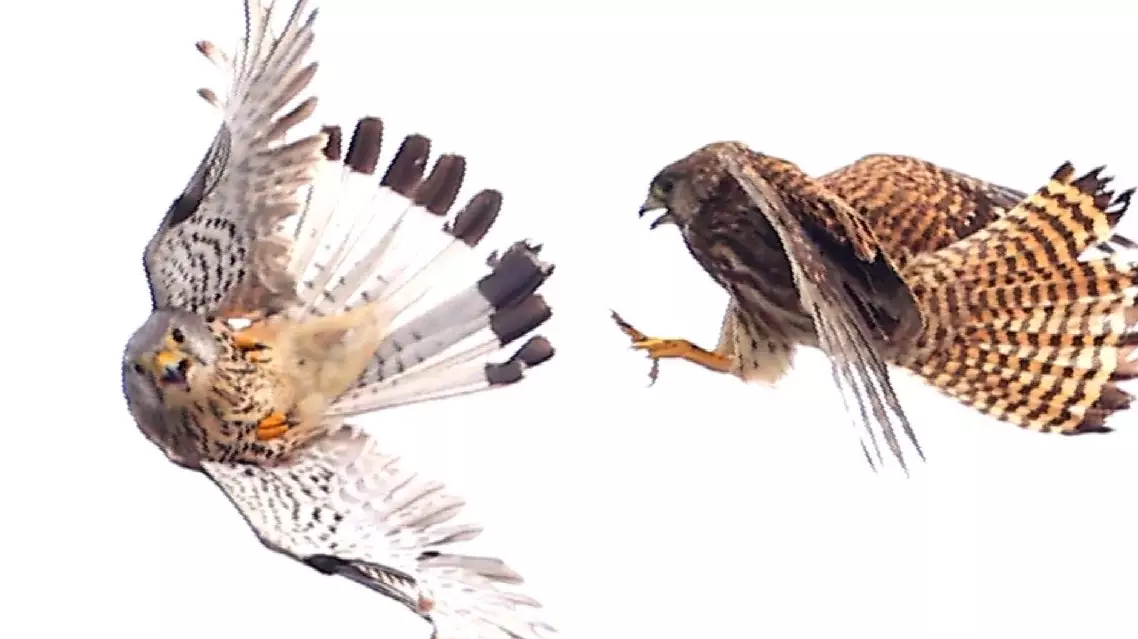
Protected kestrels turn Beijing telecom tower into unlikely nursery