The U.S. consumer sentiment has improved in June as gas prices moderated, but the sentiment index remains in unfavorable territory, at 13 percent below February 2026 or prior to the start of the Iran conflict, and nearly 20 percent below a year ago.
The U.S. Consumer Sentiment Index released Friday by the University of Michigan (UM) Surveys of Consumers rose to 49.5 in the June 2026 survey, up from 44.8 in May but below last June's 60.7.
The Current Index rose to 47.7, up from 45.8 in May but below last June's 64.8. The Expectations Index rose to 50.7, up from 44.1 in May and below last June's 58.1.
The head of the survey said that U.S. public concern regarding the long-term impact of Middle East conflicts has gradually eased, with the outlook for business conditions over the next five years surging by 16 percent. However, the Current Index remains 13 percent below the level recorded in February of this year and has fallen by nearly 20 percent compared to the same period last year.
The University of Michigan Consumer Sentiment Index is a key monthly indicator measuring U.S. household confidence regarding the economy, personal finances, business conditions, and purchasing conditions; preliminary figures are released around the second week of the month, with final figures published at the end of the month.

US consumer sentiment improves, but still below pre-Iran conflict readings
A pair of protected common kestrels have turned an abandoned magpie nest on a telecom tower in Beijing's suburban Changping District into an unlikely nursery, offering a rare glimpse of birds of prey raising chicks in a built-up area.
The kestrels, a wild animal species under the second-class state protection in China, settled on the 30-meter-high tower, drawing birdwatchers and residents in the past few days.
Footage filmed by birdwatchers earlier showed an adult kestrel returning from a hunt and landing near the nest, where several fluffy chicks stretched their necks and flapped their wings as they waited to be fed.
The chicks have since shed their gray down and developed brown streaks and markings. They are now practicing flying.
"I basically come here every day now. It is very interesting to watch kestrels raise their chicks. The male bird is responsible for going out to hunt. Upon returning, he hands the food to the female, who feeds the chicks," said birdwatcher Si Shoujun.
"These are the two parent birds. The one on the left is the male, and the one on this side is the female. Today, I captured both of them in the same frame because the male returned to the nest without food. When the female saw that he came back with nothing, she tried to force him to go out and look for food, because there are still three chicks in the nest waiting for feed," Si explained.
Common kestrels are a relatively common raptor species in Beijing and are often seen in green spaces where vegetation is abundant. But nesting and raising chicks in the city's built-up areas is less common.
Beijing is now home to 531 recorded bird species, according to local authorities.
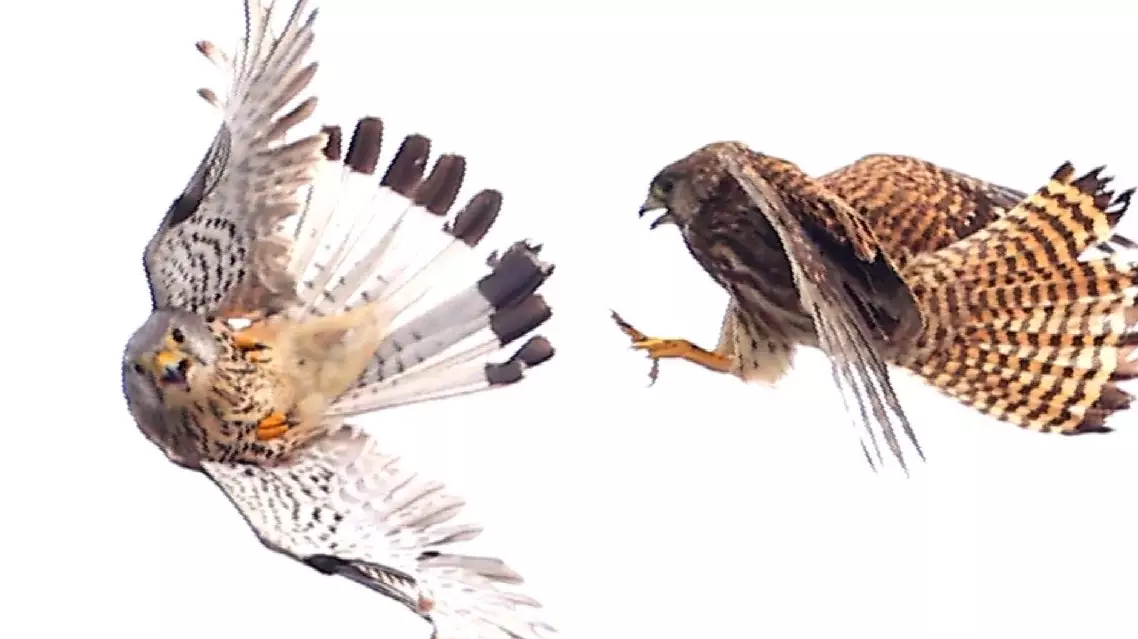
Protected kestrels turn Beijing telecom tower into unlikely nursery