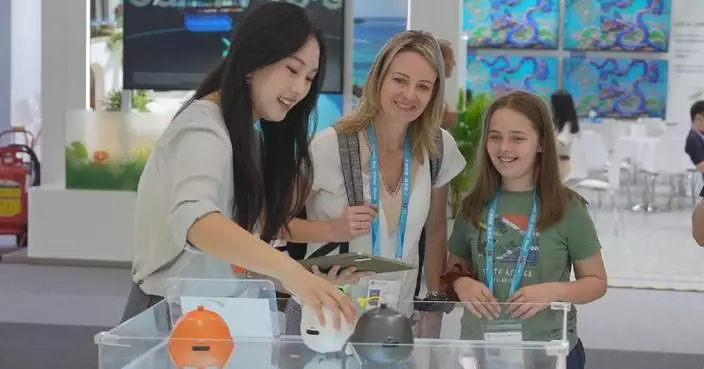
Students from leading Chinese and British universities explored what future cities might look like during a tour of a smart factory in Guangzhou, southern China’s Guangdong Province.
Flying cars, humanoid robots and autonomous vehicles often dominate the headlines, but inside the exhibition hall of XPENG, a Chinese technology company known for electric vehicles and robotics, the students found that the real conversation about tomorrow’s cities goes far beyond these high‑tech products.
The visit was part of a summer camp held for Chinese and British college students, which started on Monday in Guangzhou. Over 21 days, students from leading institutions on both countries are traveling through Guangzhou, Shenzhen, Hangzhou, Shanghai and Beijing, to explore how technological innovation intertwines with urban development, social governance and cultural heritage.
For many visiting students, the factory tour was their first up-close look at China's rapidly evolving innovation landscape. What they saw, from advanced robotics and electric vehicles to smart manufacturing systems, challenged preconceptions.
"I didn't realize flying cars were beyond the sort of concept stage. So that was really cool. You could bring in flying cars or robots into shops and that completely changes the city's dynamic, and also, what people do in the city. I think that's an interesting new question. Like, what's the place of the person versus what's the place of automation," said Sophie Collingham, a student from the Lucy Cavendish College of the University of Cambridge.
Artificial intelligence (AI) emerged as a central theme of discussion, with students weighing both its transformative potential and its risks.
"It's been quite nice to have conversations about both its use cases and the risks. China is like a massive power within AI. So, I hope to learn more about what can be done about those risks," said Sara El Khamlichi, a student from the St. John's College of the University of Cambridge.
For other students, future cities also bring new questions about governance.
"I think there will be more automation in the future, and for me, what I'm interested in is probably the governance of those technologies, in terms of like how should we protect the people, how should we protect these technologies, for example, copyright, patents and everything," said Lam Chen-jun, a student from the Jesus College of the University of Cambridge.
For the educators accompanying the group, visits like this matter because today's students will be among the people tackling some of the biggest challenges of the 21st century.
"I think what's good for the students is they get to see such a range of contemporary China. And the other is to interact with students from China, from academics here, and for that cross-culture dialogue and exchange," said Liam Saddington, a teaching associate of the Lucy Cavendish College.
"Things like AI, aging populations, our relationship with the environment, the insights that many different societies and many different cultures can have onto these fundamental questions that we all share, I think that's really, really valuable to learn from each other," said Ashley Walters, an academic registrar of the New College of the University of Oxford.
Over the next few weeks, they'll travel across five cities, meeting entrepreneurs, researchers and engineers, and seeing how new technologies are finding their way into everyday life.
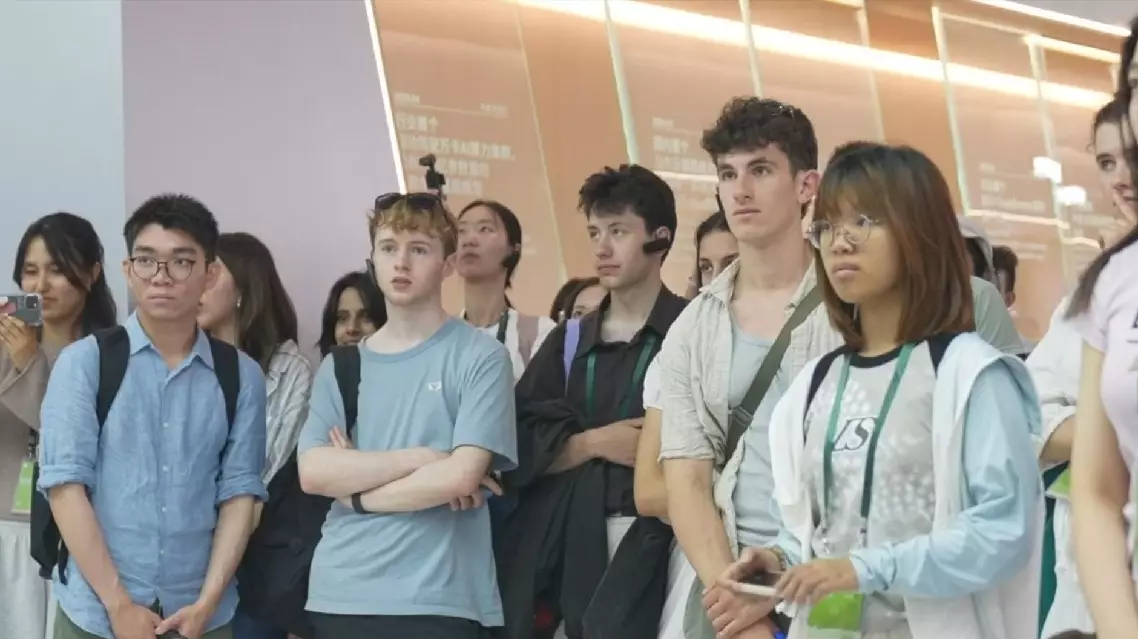
Chinese, UK students explore future cities at Guangzhou smart factory