SINGAPORE, June 29, 2026 /PRNewswire/ -- Malaysian families are approaching the mid-year school holidays with a more flexible travel mindset, balancing convenient domestic breaks with growing interest in regional destinations across Asia, according to Agoda accommodation searches.
Based on Agoda accommodation searches that included at least one child, made between 1 January and 30 April 2026 for stays between 22 May and 7 June 2026, Malaysia ranked first among the top destination countries searched by Malaysian travellers, recording a 60% year-on-year increase. Regional destinations also saw search growth, with Vietnam up 85%, China up 51%, Singapore up 43% and Japan up 43%.
Regional city destinations also remained part of Malaysian families' school holiday plans. Tokyo recorded a 53% year-on-year increase in family travel search interest, while Phuket grew 44%, Singapore 43%, Bangkok 33% and Osaka 19%. The data suggests that while domestic destinations continue to lead school holiday travel interest, Malaysian families are also considering familiar regional destinations across Asia for the mid-year break.
At city level, however, the domestic travel story remains prominent, with Malaysian destinations appearing across Agoda's top searched city list for the school holiday travel period.
Domestic destinations that demonstrated strong interest growth were Port Dickson, which saw a 172% year-on-year increase in family travel search interest, followed by Kuala Terengganu at 149%, Kuantan at 105%, Cameron Highlands at 100% and Genting Highlands at 85%. Other destinations including Malacca, Ipoh, Penang and Johor Bahru also continued to see strong family travel search growth during the school holiday period.
The increase in interest across these destinations points to the variety of school holiday breaks Malaysian families are considering. Coastal destinations such as Port Dickson, Kuala Terengganu and Kuantan offer beachside escapes without the need for long-haul travel, while Cameron Highlands and Genting Highlands continue to appeal to families looking for cooler weather and short-break convenience. Food and heritage destinations such as Penang, Malacca and Ipoh also remained popular among family travellers.
"School holidays are no longer just about one big family trip. What we are seeing is Malaysian families searching across a wider range of travel options, from quick domestic breaks to regional destinations that are familiar, accessible and family-friendly," said Fabian Teja, Country Director Malaysia and Brunei at Agoda. "The strong interest in both local getaways and regional destinations suggests that families are becoming more flexible in how they plan their holidays, whether that means a beach break in Port Dickson, cooler weather in Cameron Highlands or a city escape elsewhere in Asia."
With access to over 6 million holiday properties, more than 130,000 flight routes and over 300,000 activities, Agoda makes it simple for travellers to compare prices and plan trips, whether they are looking for a quick domestic break or a family holiday further afield. For a wide range of family-friendly accommodation options, visit Agoda's website or download the Agoda mobile app.
** This press release is distributed by PR Newswire through automated distribution system, for which the client assumes full responsibility. **
Port Dickson, Kuala Terengganu and Cameron Highlands see rising family travel interest this school holiday, according to Agoda
SHANGHAI, June 29, 2026 /PRNewswire/ -- What should children actually learn in the age of AI? That question has been shaping some of the recent work happening around WhalesBot's AI+Robotics Exploration Centers across China, where schools and local communities are building spaces focused less on passive technology consumption and more on hands-on interaction with robotics, engineering, coding, competitions, drones, and real-world experimentation.
On June 27th, WhalesBot, a leading robotics company based in Shanghai, China that specializes in robotics and AI education, launched its second AI+Robotics Exploration Center in Jiaxing, Zhejiang Province. This follows a similarly recently launched project in China's Anhui Province that includes a nearly 5,000-square-meter AI+Robotics Exploration Center designed around robotics exhibitions, immersive learning spaces, competition areas, AI and robotics classrooms, and project-based exploration for students from ages 3 to 22.
WhalesBot is also involved in an ongoing collaboration connected to Peking University, where a three-floor AI and technology learning center with more than 1,800 square meters per floor is currently under development. Similar Exploration Center projects and regional collaborations are also being explored in other cities across China.
Students are not just sitting in front of screens. They are testing robots, debugging sensor behavior, flying drones, and building systems that don't work the first time. Such physical interaction matters more than people think.
In the AI industry, terms like "physical AI" or "embodied AI" are now starting to be used to describe intelligence interacting with the real world instead of existing only digitally. In education, a similar shift may already be starting to happen.
As AI can instantly generate answers, images, code, even ideas, the value of learning may gradually move toward things that are harder to automate: reasoning, experimentation, judgment, curiosity, teamwork, adapting to failure, understanding how systems behave in unpredictable environments.
According to WhalesBot, this has gradually evolved into what it calls AI Foundations Learning — combining robotics, coding, engineering, AI concepts, competitions, and project-based learning into a more connected pathway, instead of treating AI as a completely isolated subject.
Moreover, WhaleBot's programs like ENJOY AI, which is the largest robotics competition in the world, follow the same direction. Students solve challenges together, test ideas under pressure, rebuild after failure, and learn through interaction instead of only instruction.
The technology itself will keep changing. Probably faster than schools can fully adapt to. But there is a growing sense among many educators that AI learning cannot stay only on screens. Students still need to build things, test ideas in the real world, and work with uncertainty.
The future of AI education may end up being more physical than people expected.
About WhalesBot
WhalesBot Technology, headquartered in Shanghai, China, was founded in 2018 and specializes in AI and robotics education for ages 3 to 22. It is currently the largest manufacturer of educational robots in the world, with over 1 million units sold to more than 80 countries. WhalesBot also sponsors initiatives like ENJOY AI, which is also the world's largest youth robotics competition.
Contact: William SHI, william.s@whalesbot.com
** This press release is distributed by PR Newswire through automated distribution system, for which the client assumes full responsibility. **
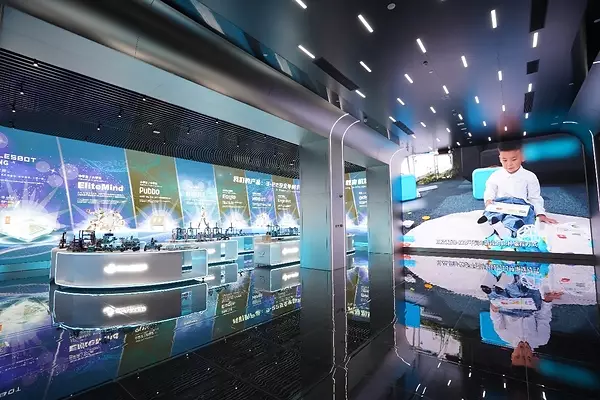
Leading Chinese Robotics Company Sets Sights on Off-Screen AI Education