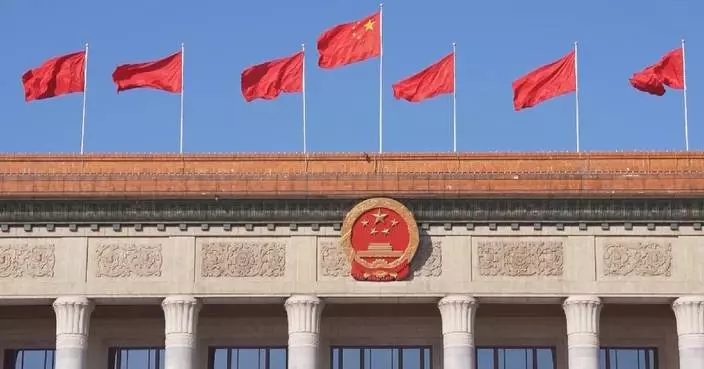
The fourth China-CEEC Spokespersons Dialogue was held in Beijing on Monday, aiming to enhance experience sharing in the crafting of effective press releases and explore the responsible application of AI in that field.
Over 20 spokespersons from China and Central and Eastern European countries (CEEC) engaged in in-depth discussions under the theme "Press Releases and Modernization."
Participants noted that the friendly relations between China and CEEC have remained strong over time, with broad and high-quality cooperation.
They stressed that spokespersons should act as bridges between civilizations, showcasing the achievements of China-CEEC cooperation through effective means.
"Spokespersons and professionals must be more than messengers. We must be coordinators, interpreters and guardians of institutional credibility. We must understand media logic, public expectations, digital platforms and international sensitivities. This is especially true in the before-mentioned crisis communication. When the situation is difficult, people do not expect great rhetorics. They expect clarity, honesty, empathy and competence," said Ivan Maric, spokesperson of the Ministry of Foreign and European Affairs of Croatia.
In the context of a complex and volatile international landscape, rapid AI evolution, and fast-changing media ecosystems, the importance of releasing authoritative information through press briefings has become more prominent.
Participants expressed support for exploring the responsible use of AI in information release and communication, while emphasizing the need to uphold the authority and credibility of press briefings.
They also proposed institutionalizing and regularizing the meeting to enhance mutual learning.
"I see AI as a great tool, but we have to be careful about using it. We need to promote learning of AI tools to people so that we can use it for good. Because we could see the representation of AI can also be used for bad intentions, as some fake news as we call it," said Matija Miklavcic, head of media affairs for the secretary general of the National Assembly of Slovenia.
"It is our professional obligation to explain to our people how relations among countries, among various cultures are built and the perspective of human to human connections and the need to see how different realities, how different societies and cultures can collaborate and can learn from one another, to address solutions for common challenges in today's world and for a better perspective," said Alteo Hysi, advisor, chief spokesperson for the Minister of European and Foreign Affairs of Albania.
The dialogue was hosted by China's State Council Information Office. The spokespersons from Central and Eastern European countries will also visit Beijing, Zhejiang and Shanghai during their stay.
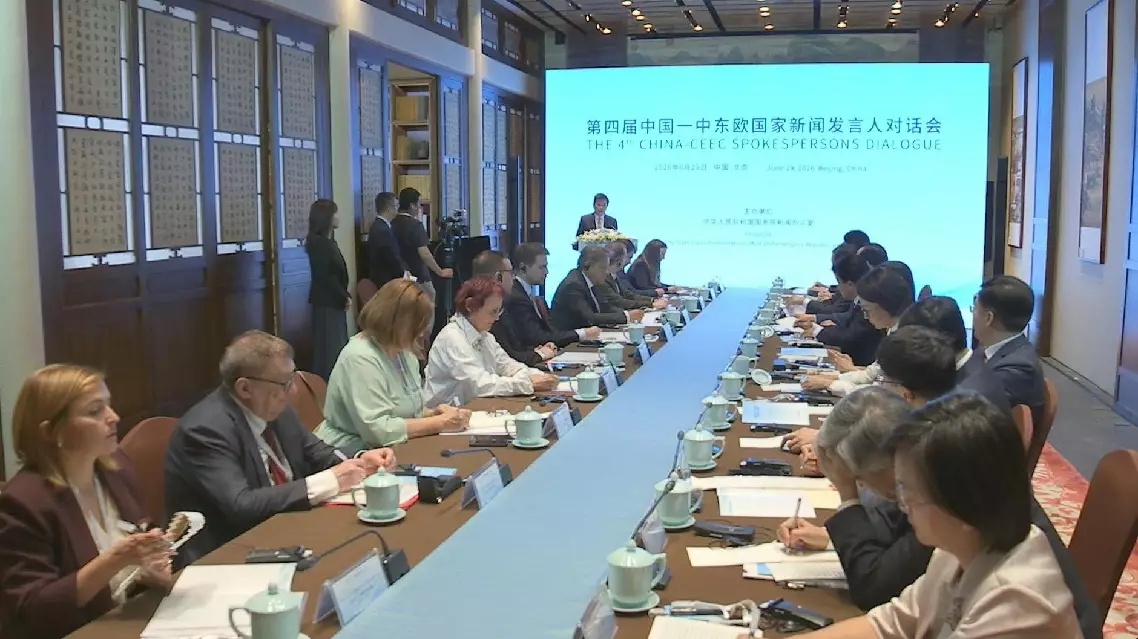
4th China-CEEC Spokespersons Dialogue opens in Beijing