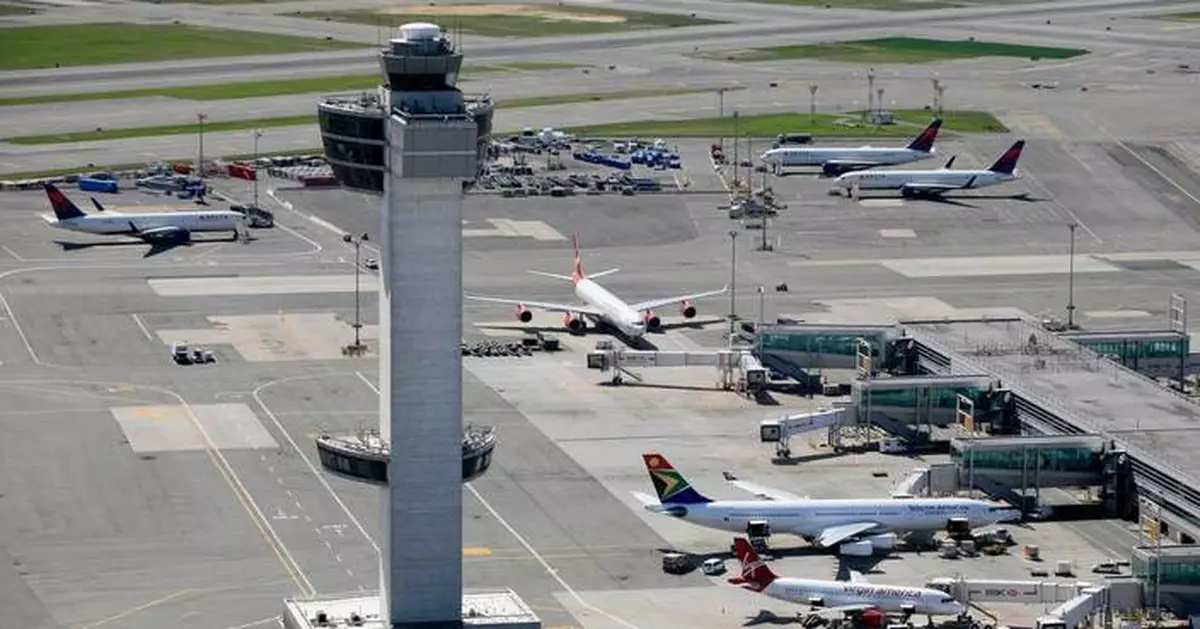
A JetBlue pilot reported hitting a drone as he approached JFK International Airport to land in New York Monday morning.
The Federal Aviation Administration is investigating the incident that happened as the plane passed through 3,000 feet (914 meters) around 7:15 a.m. as it was crossing the coastline. The plane landed safely without any additional help, and no damage was found when the plane was inspected afterwards.
“We collided with a drone back there in the turn,” the pilot told an air traffic controller, according to ATC.com. “It hit us right above the cockpit.”
The airline said all the passengers deplaned normally, and then the plane was removed from service so it could be inspected. JetBlue said the airline “found no damage or evidence of a collision.” The Airbus A321 plane was flying overnight into New York from Las Vegas.
“Safety is JetBlue’s first priority, and we will assist with any relevant investigations,” the airline said in a statement.
Drones are generally allowed to fly below 400 feet (122 meters), but the FAA does restrict airspace around airports and public events like the World Cup because of safety concerns. Law enforcement officials say that even when a drone pilot is just trying to shoot an overhead video, their presence distracts officers from dealing with other potential threats.
But even though drones are supposed to stay under 400 feet (122 meters) unless their pilots get approval, many drones are capable of flying more than 3,000 feet (914 meters) in the air. Scott Shtofman, who is with the Association for Uncrewed Vehicle Systems International, said even a drone as small as five pounds or so can fly that high.
“Now the rules restrict that, but that doesn’t mean that somebody couldn’t do it,” said Shtofman, who is vice president and counsel for regulatory affairs for the trade group.
Incident reports collected by the FAA show that drones are a growing threat around airports. The risk of a collision is most acute near airports because that is where the flight paths of drones and airplanes most overlap.
More than 100 drone sightings near airports are reported to the FAA every month, and the agency said it works with law enforcement to investigate them. Drone operators that violate restricted airspace can face substantial fines and even lose their license or have their drones confiscated. But Shtofman said collisions between drones and other aircraft have been rare thus far.
Planes are designed to survive a direct hit from a bird strike, but hitting an object in the sky can cause significant damage, particularly if an engine or key control surface is struck. Just last fall, a United Airlines plane had to make an emergency landing after hitting a weather balloon and damaging its windshild. And during the devastating California wildfires in early 2025 an errant drone collided with a firefighting plane and knocked it out of commission for several days while a hole in its left wing was repaired.
The death and destruction drones have caused on the battlefields of the Ukraine and Iran wars has officials increasingly concerned about the threat drones pose.
Sometimes an initial report from an airline pilot about a close encounter with a drone doesn't always turn out to be an actual collision after officials investigate. In April, the FAA was able to determine that a drone passed roughly 1,000 feet (305 meters) below a United Airlines plane as it came into San Diego and did not strike the plane.
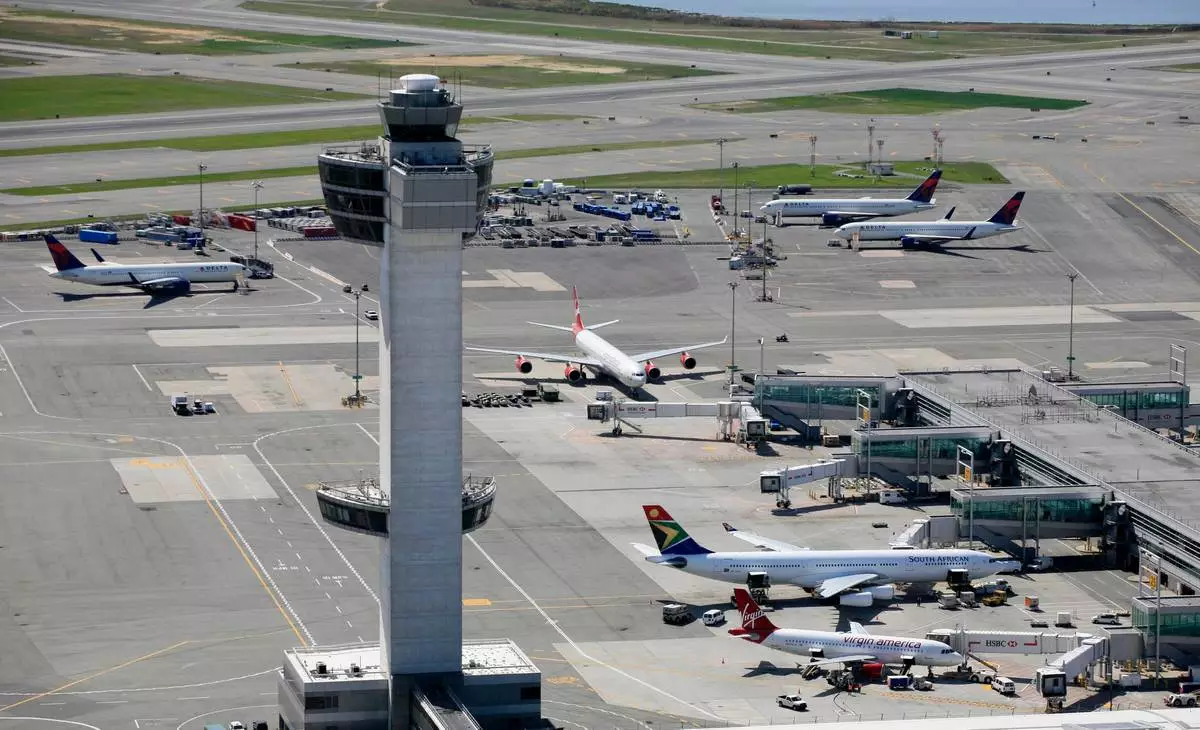
FILE - The air traffic control tower rises above terminals at John F. Kennedy International Airport in New York, April 20, 2010. (AP Photo/Mark Lennihan, File)
DES MOINES, Iowa (AP) — Summer camps and other outdoor activities were canceled Monday as tens of millions of people across the Midwest endured a heat wave that is expected to spread eastward this week. Communities opened cooling centers and urged people to take it easy and stay hydrated.
Forty-seven million people across big chunks of the Midwest and parts of the Ohio Valley are under an extreme heat warning through at least Tuesday. Temperatures are forecast to reach the 90s, with heat index values, or “feels-like” temperatures, expected to top 100 degrees (37.8 degrees Celsius) in the region, according to the National Weather Service.
Visiting Des Moines with family, Rachel Washburn searched for things to do with kids during a heat wave. They landed at a water sprayground before lunch Monday, where her children played tag in the cool water.
“My kids were quite shocked at the heat and humidity,” said Washburn of her seven children ages 18 months to 17 who had been used to more temperate weather farther north in Bemidji, Minnesota. “We were hoping for some good weather, but we'll make do.”
About 56 million Americans are under an extreme heat watch as hot and humid weather is expected to move farther east later in the week, with some of the worst conditions expected by Thursday and Friday in the Ohio Valley, the Mid-Atlantic and into the Northeast. Some areas could experience record-high temperatures, said Scott Kleebauer, a meteorologist with the Weather Prediction Center in College Park, Maryland.
On Monday, cities and event planners were already announcing adjustments for or calling off events later in the week, including a farmer's market scheduled for Tuesday in DeWitt, Michigan; a movie screening Wednesday in Fairfield, Ohio; and Thursday’s food truck festival in Warwick, New York.
The heat wave will also likely coincide with the Fourth of July holiday weekend, providing additional risk as more people have cookouts or watch fireworks outside for the 250th anniversary of American independence.
Kleebauer said the center recommends people stay hydrated and ensure access to shady areas and air conditioning.
Emergency workers were out in Nashville on Monday to offer water and check on people during the hottest time of the day.
Mike Russell, a captain at the Nashville Office of Emergency Management, said he saw many empty areas where people typically sleep outside, which he said was a good sign that they found someplace cool to escape the heat for a while.
Logan King, 29, brought a cart to fill up on cold water and snacks when the emergency workers came out to a patch of woods behind a Walmart where he and others sleep outside. The trees where people have pitched tents offer some cover from the direct sun, but not much relief.
“It’s just miserable honestly, but this helps so much,” King said. “Even with the shade and a tent ... it gets hot."
Extreme heat has also taken its toll in Europe, where temperature records were set and many heat-related deaths were reported in France.
People can be caught off guard by the first heat wave of the year, said Dr. Roy Elrod, chief of staff at DMC Detroit Receiving Hospital.
“You’re happy winter’s gone, you’re ready to enjoy the summer, you’ve just been aching for it,” Elrod said. “And so, I think we slip into kind of a position where we think it’s got to be OK.”
Heat-related injuries can happen in a matter of minutes, he said, especially to those who don’t prepare for the weather by hydrating, wearing light clothing, avoiding the hottest times of the day and minimizing exposure to the sun.
The University of Wisconsin-Madison said it was closing 23 buildings to the public starting Tuesday, allowing only limited access to 11 others. It was relocating some summer classes after a broken water line at its cooling plant earlier this month severely reduced the ability to provide air conditioning across campus.
Temperatures approaching 90 degrees and high humidity didn’t stop Toni Kreutzer, 28, from taking a walk Monday along the shores of Lake Mendota in Madison, Wisconsin, with her 13-year-old dog Chester.
“I like it hot,” Kreutzer said. "I just don’t like the humidity."
McCormack reported from Concord, New Hampshire. Associated Press reporters Scott Bauer in Madison, Wisconsin, Kristin M. Hall in Nashville and Haya Panjwani in Washington, D.C., contributed.

Toni Kreutzer gives her 13-year-old dog Chester a drink of water during a break in a walk as temperatures approach 90 degrees on Monday, June 29, 2026, in Madison, Wis. (AP Photo/Scott Bauer)

Children play at a water sprayground in Des Moines, Iowa, Monday, June 29, 2026. (AP Photo/Hannah Fingerhut)

Children play at a water sprayground in Des Moines, Iowa, Monday, June 29, 2026. (AP Photo/Hannah Fingerhut)

Children play at a water sprayground in Des Moines, Iowa, Monday, June 29, 2026. (AP Photo/Hannah Fingerhut)

FILE - A Japan soccer fan wipes his brow while standing in the heat in downtown Dallas, June 24, 2026. (AP Photo/LM Otero, File)