LONDON (AP) — This Wimbledon couldn't have started much worse for the home team.
After Emma Raducanu withdrew on the eve of the Grand Slam tournament with a stress fracture, Jack Draper followed suit on Monday by pulling out because of long-term arm injury.
That left the grass-court tournament without the two biggest names in British tennis.
And the lesser names soon tumbled out, one by one.
All 10 British players who completed their first-round matches on Monday lost. An 11th, Jack Pinnington Jones, was two sets down and trailing 4-3 in the third against American Brandon Nakashima when play was suspended because of bad light.
None of those 11 players were tipped to make a deep run, though, unlike Raducanu and Draper.
Raducanu won the 2021 U.S. Open while Draper was seeded No. 4 at Wimbledon last year and reached the U.S. Open semifinals in 2024.
“There have been a lot of painful moments in the last 12 months, but this one is definitely the absolute worst,” Draper, who had been set to play Taylor Fritz on Centre Court in the first round on Tuesday, said in a statement.
Draper's withdrawal also scuppers a return to Wimbledon for two-time champion Andy Murray, who ended a 77-year wait for a British men's champion when he won the tournament in 2013. Murray was set to be in Draper's box during matches this fortnight after agreeing to coach him through the grass-court season.
But Raducanu's withdrawal was perhaps the biggest blow to organizers, especially as she had played some of her best tennis since that U.S. Open triumph in reaching the final at the Queen's Club grass-court tournament this month.
“It’s so devastating for a player to have to withdraw the night before a Grand Slam and particularly for your home Grand Slam,” said Sally Bolton, the All England Club chief executive. “I’m terribly sorry for Emma. ... It is devastating. For us, I suppose the good thing to look forward to is we’ve got lots of Brits competing."
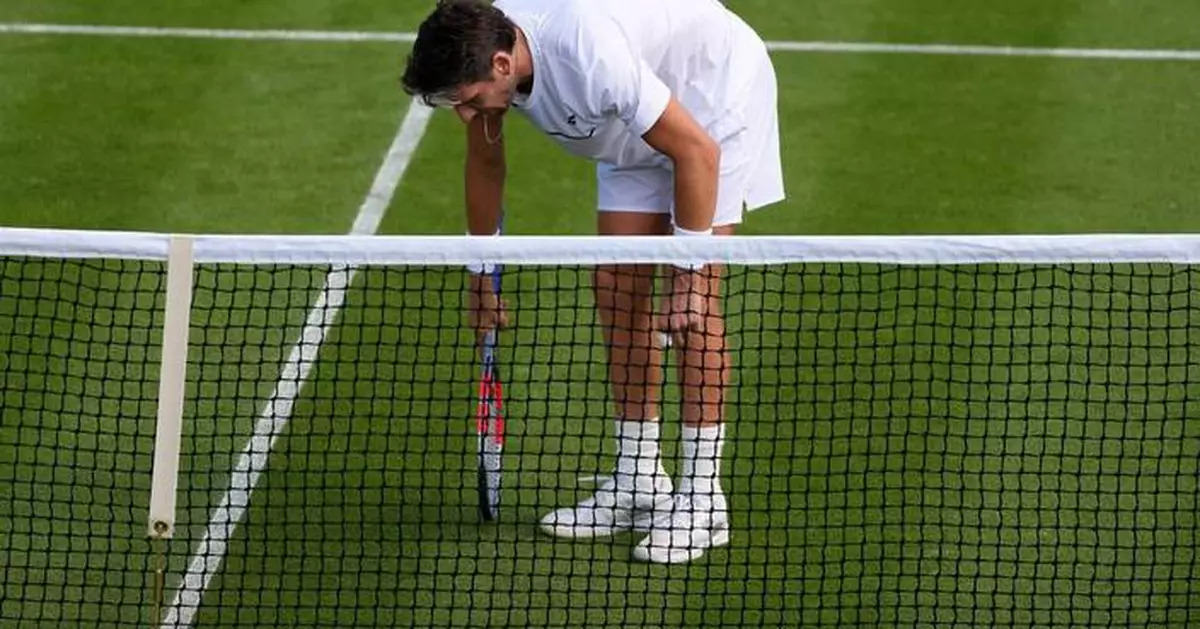
Those comments were made before the early mass exodus of home talent, which included a five-set loss by No. 26 Cam Norrie, a 2022 Wimbledon semifinalist who was the only seeded British man or woman in the tournament.
AP tennis: https://apnews.com/hub/tennis

Britain's Emma Raducanu serves on the practice court ahead of the Wimbledon Tennis Championships, at the All England Lawn Tennis and Croquet Club, in London, Monday June 22, 2026. (John Walton/PA via AP)

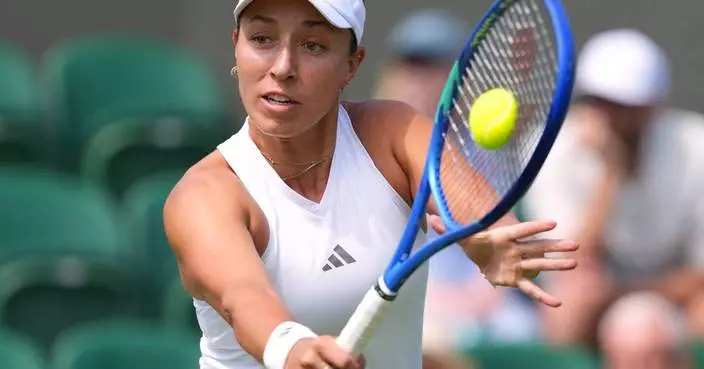
Harriet Dart of Britain plays a forehand against Jelena Ostapenko of Latvia in their first round women's singles match at the Wimbledon Tennis Championships in London, Monday, June 29, 2026. (AP Photo/Brian Inganga)
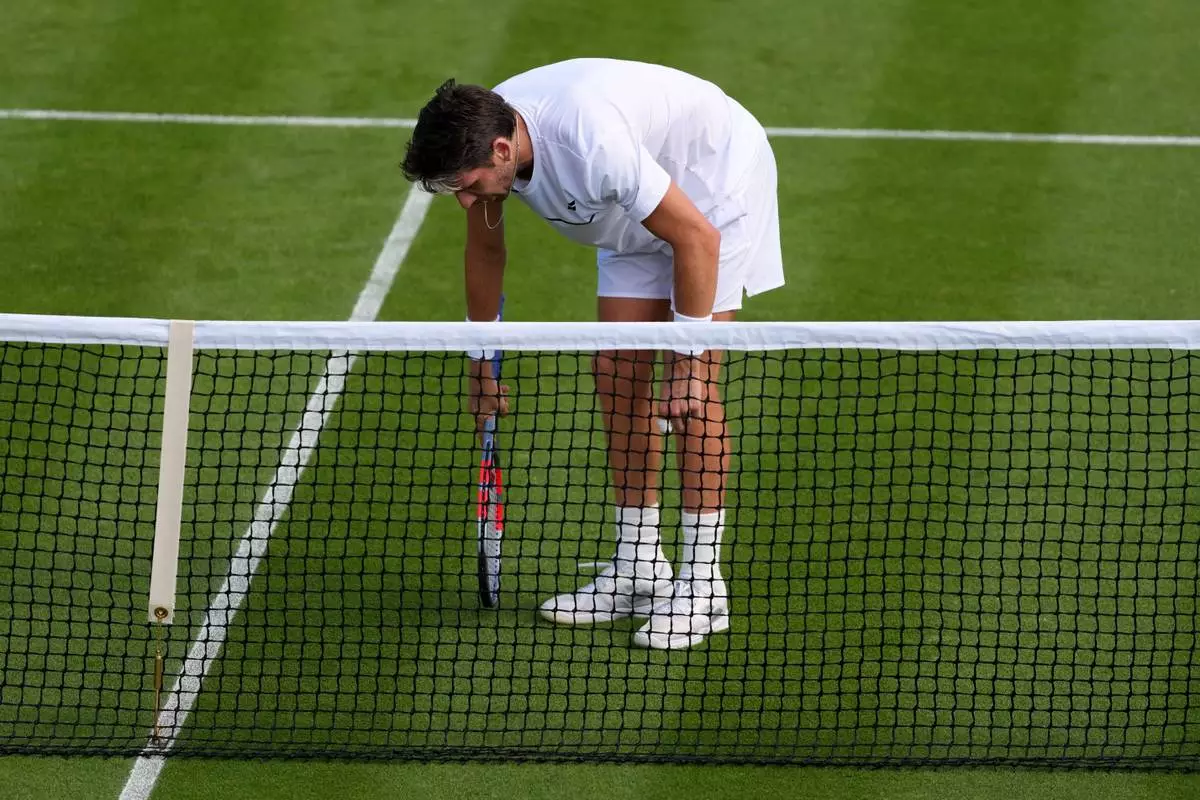
Cameron Norrie of Britain reacts during the men's singles match against Michael Zheng of the United States at the Wimbledon Tennis Championships in London, Monday, June 29, 2026.(AP Photo/Kirsty Wigglesworth)
LA GUAIRA, Venezuela (AP) — With the window for finding survivors shrinking fast, Venezuelans combed Monday through more ruins of buildings toppled by last week’s powerful back-to-back earthquakes, and attention turned to the country's humanitarian crisis that could persist for years.
Relief organizations say the first 72 hours after a natural disaster is the most crucial time period for rescues, though survival can be extended if people have access to food and water. Five days after the twin quakes, questions loomed about whether the cash-strapped government will be able to coordinate the effort needed to care for thousands of people who have been left homeless.
In other developments, a 4.6 magnitude aftershock rumbled through the disaster zone in the northern state of La Guaira.
The death toll stood at more than 1,700 people, according to the government, which has long retained tight control over coverage of major events by Venezuelan news outlets.
Facing criticism that authorities have done too little, too slowly, government officials aggressively promoted their recovery and rescue efforts.
In a speech Monday, Jorge Rodríguez, the leader of the Venezuelan National Assembly and brother of acting President Delcy Rodríguez, said electricity had been restored to 90% of the hard-hit state of La Guaira. He said authorities were racing to evaluate damaged buildings that still posed a danger and had set up 15 temporary encampments for displaced people.
Many Venezuelan news reports have avoided politically delicate questions related to the earthquake, such as the widespread collapse of buildings, sticking instead to safer stories about heroic rescues. Delcy Rodríguez, who came to power in January after U.S. President Donald Trump’s administration seized former President Nicolás Maduro, shared footage Monday of emergency workers lifting a man out of the ruins to applause after a 43-hour search effort.
“Each life saved is a victory for hope,” she wrote on X.
But such bright spots are rare at the quake's epicenter, where families keep vigil at search sites.
“We have to stay strong, even without food, without sleep,” said Ana Rada, watching as civil defense workers looked for her brother. “Until I see the body, I still have hope.”
Following a weekend of smaller aftershocks and what the government said were more than 600 seismic events since Wednesday's quakes, the moderate temblor on Monday struck 27 kilometers (17 miles) north of Caraballeda on Venezuela’s Caribbean coast and measured 4.6 magnitude, according to the United States Geological Survey. Colombia’s geological survey put the magnitude at 5.1.
Jorge Rodríguez said there were no reports of additional damage, but the latest aftershock sent residents in the capital of Caracas screaming into the streets.
“Here we are again, back in the street. I don’t know when we’ll have a moment of true peace,” said Concepción Hernández, 51, who evacuated her apartment building in the Chacao municipality of Caracas.
Dozens of countries have offered assistance. But the disaster has raised expectations for the Trump administration after its takeover of Venezuela’s oil industry earlier this year.
In a briefing with reporters, a senior State Department official said 300 first responders sent from the U.S. are working on the ground and two dozen C-17 military transport planes arrive every day with supplies. Financial support from the U.S. now exceeds $300 million.
The American military is also assisting with some repairs, including damage to the port in La Guaira to enable the arrival of more relief supplies by sea. Another team is helping to manage air traffic after the quakes destroyed part of the control tower at Simón Bolívar International Airport in Caracas, said the official, who spoke on condition of anonymity because he was not authorized to speak publicly.
It seemed unlikely, however, that the Trump administration would grant temporary humanitarian protections to Venezuelans as previous administrations have done for people from disaster-stricken countries already in the U.S. Such action was taken after earthquakes in 2010 in Haiti and 2001 in El Salvador. Venezuelans have been a major focus of the Trump administration’s immigration crackdown.
Among the rescuers digging through the rubble Monday in La Guaira was 31-year-old miner Jean Sosa, who said he was deported from the U.S. in January over a missed immigration court hearing and returned to Caracas last month, dazed by an odyssey that began in shackles at an Arizona immigration detention center.
He had built a new life in New York City over the past four years, he said, working at a taco stand near Penn Station, before Department of Homeland Security officials detained him. They ultimately shuttled him between immigration detention centers across the U.S. before leaving him and a busload of other deportees in southern Mexico without his passport, phone or wallet.
Since arriving Wednesday in La Guaira, Sosa has scrambled to pull people from the rubble with his old mining pickaxe and shovel in the absence of national rescue teams. For the first few days before more help arrived, survivors were driven to hospitals by private car or motorcycle, he said.
“I’m not involved in politics, but I believe many people could have been saved if there had been equipment and support from top authorities from the very beginning,” he told The Associated Press, wearing a helmet and a black T-shirt splotched with dust in the port city where he said he had already rescued 20 people alive.
Those rescues heartened him, he said, despite the lack of supplies. “We’re working without gloves, without equipment, borrowing supplies, improvising bandages and whatever else we can.”
Experts and aid organizations are struggling to assess the scope of damage, but they generally agree that the government's figures are a vast undercount.
Jorge Rodríguez said that as of Monday, a total of 15,866 people had been affected, while the number of damaged or collapsed buildings had reached 855.
Such updates are given in brief televised announcements where journalists have no opportunity to ask questions or request details. In a further obstacle to coverage, the Venezuelan press union said Monday that the Ministry of Communication was blocking access to La Guaira for at least some foreign reporters for 48 hours.
It said the ministry cited the need “to reduce noise during rescue operations." The union urged the government to drop the restriction: “Preventing on-the-ground reporting does not resolve the emergency. As hours pass, the health situation may worsen, and the country needs verified and timely information, especially the families of the victims.”
A preliminary assessment by NASA estimated that the earthquake damaged or destroyed 58,870 buildings. The assessment relied on radar imagery from the European Space Agency’s Sentinel-1 satellites, which can detect changes to infrastructure.
The United Nations has said that up to 6.8 million of Venezuela’s nearly 30 million residents may be affected, which could mean being displaced or losing access to essential services such as electricity and water.
The Venezuelan Red Cross said it expected its relief efforts for at least 300,000 people to continue for two years.
Because of the chaos and poor cellphone service, many Venezuelans have turned to non-governmental digital databases to report their loved ones as missing. More than 50,000 people were reported missing on one such database, though it is unclear how many have been found.
Firefighter Kleider Carrillo said nothing prepared him for the destruction in La Guaira.
“When you study for this profession, you’re trained for situations like this," he said. “But what's in textbooks is one thing. Reality is another.”
DeBre reported from Buenos Aires, Argentina. Associated Press writers Jorge Rueda and Regina Garcia Cano in Caracas, Venezuela, Dánica Coto in San Juan, Puerto Rico, and Gabriela Aoun Angueira in Tijuana, Mexico, contributed to this report.
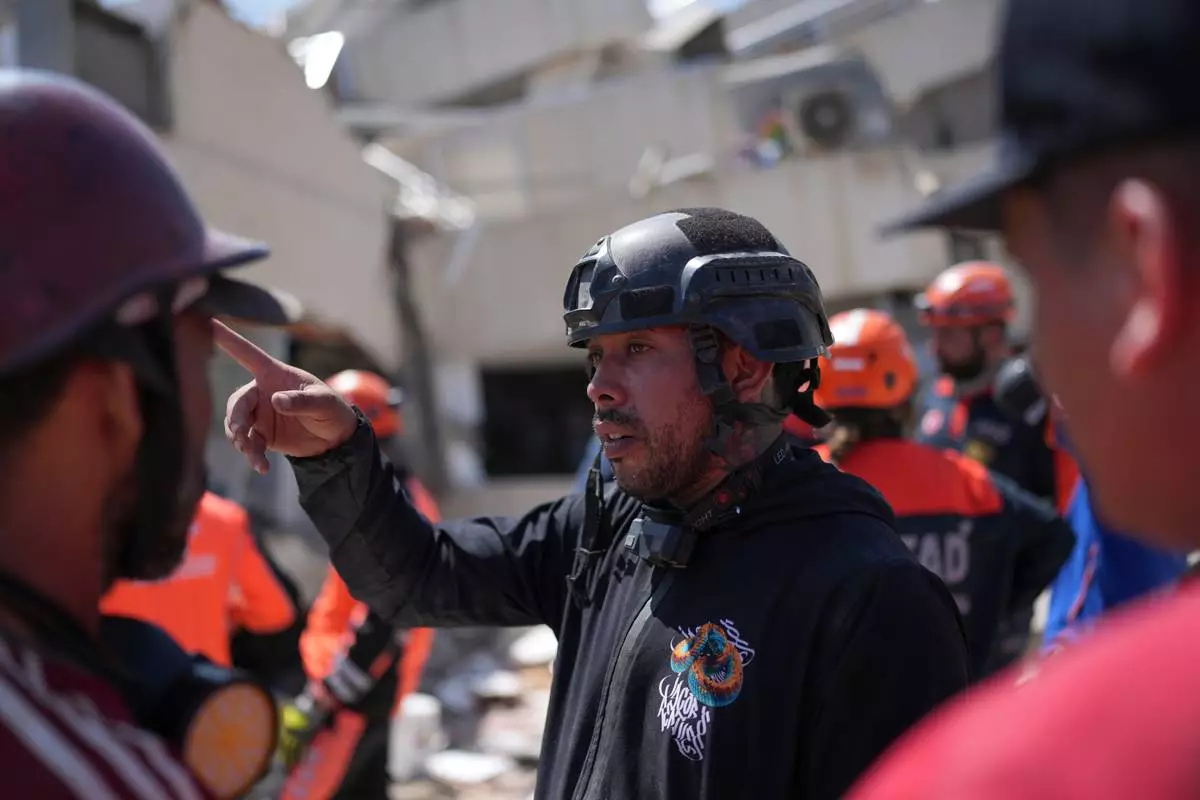
Volunteer Jean Sosa, who joined rescue teams searching for earthquake survivors, explains what he saw after going under the rubble of a building where rescuers are trying to reach trapped people in La Guaira, Venezuela, Monday, June 29, 2026. (AP Photo/Matias Delacroix)
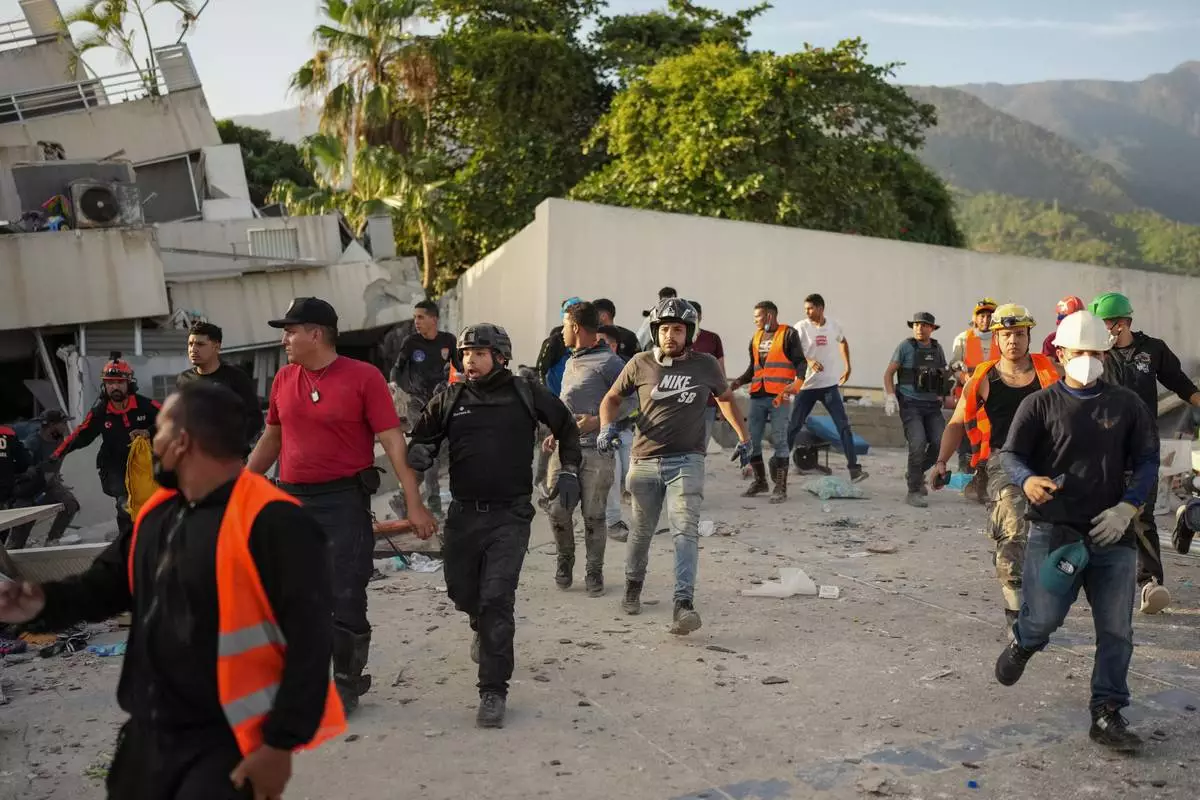
Residents and rescuers searching for survivors run as an aftershock shakes the area five days after back-to-back earthquakes struck La Guaira, Venezuela, Monday, June 29, 2026. (AP Photo/Matias Delacroix)
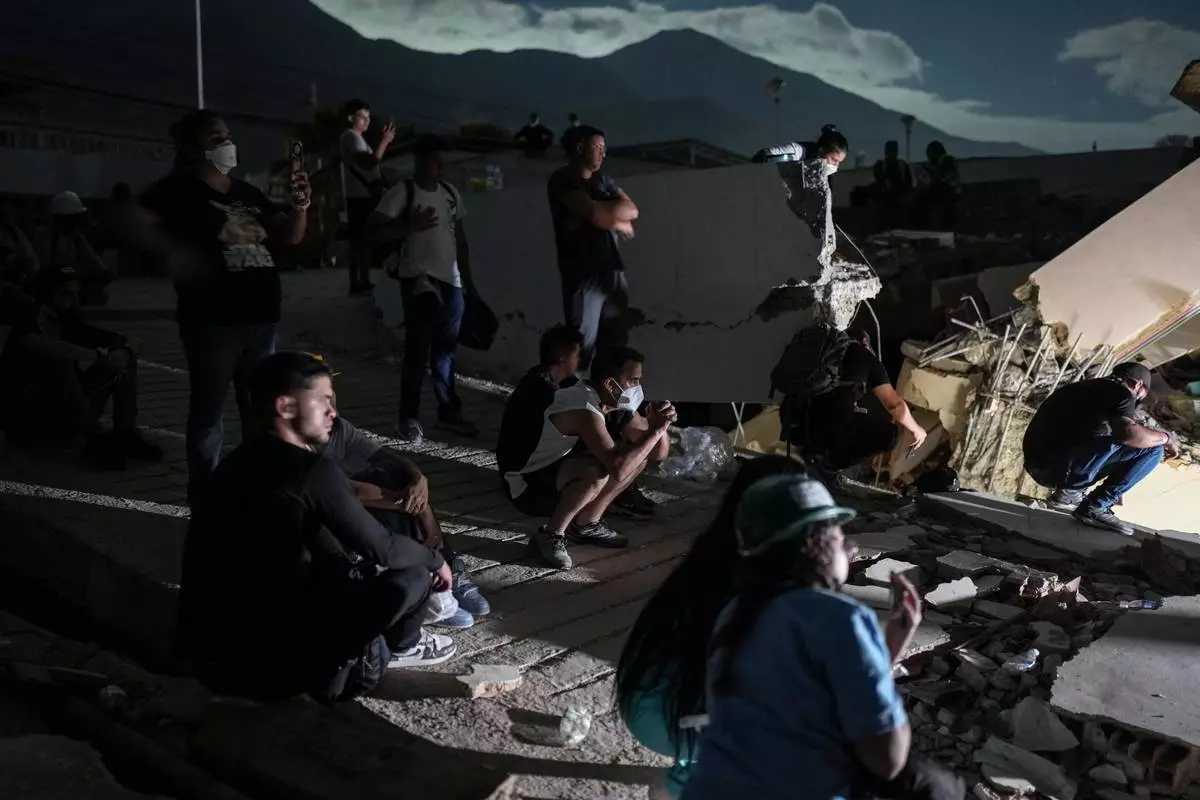
Residents watch rescuers' efforts to reach survivors beneath the rubble of a building that collapsed in the earthquakes in La Guaira, Venezuela, early Monday, June 29, 2026. (AP Photo/Matias Delacroix)
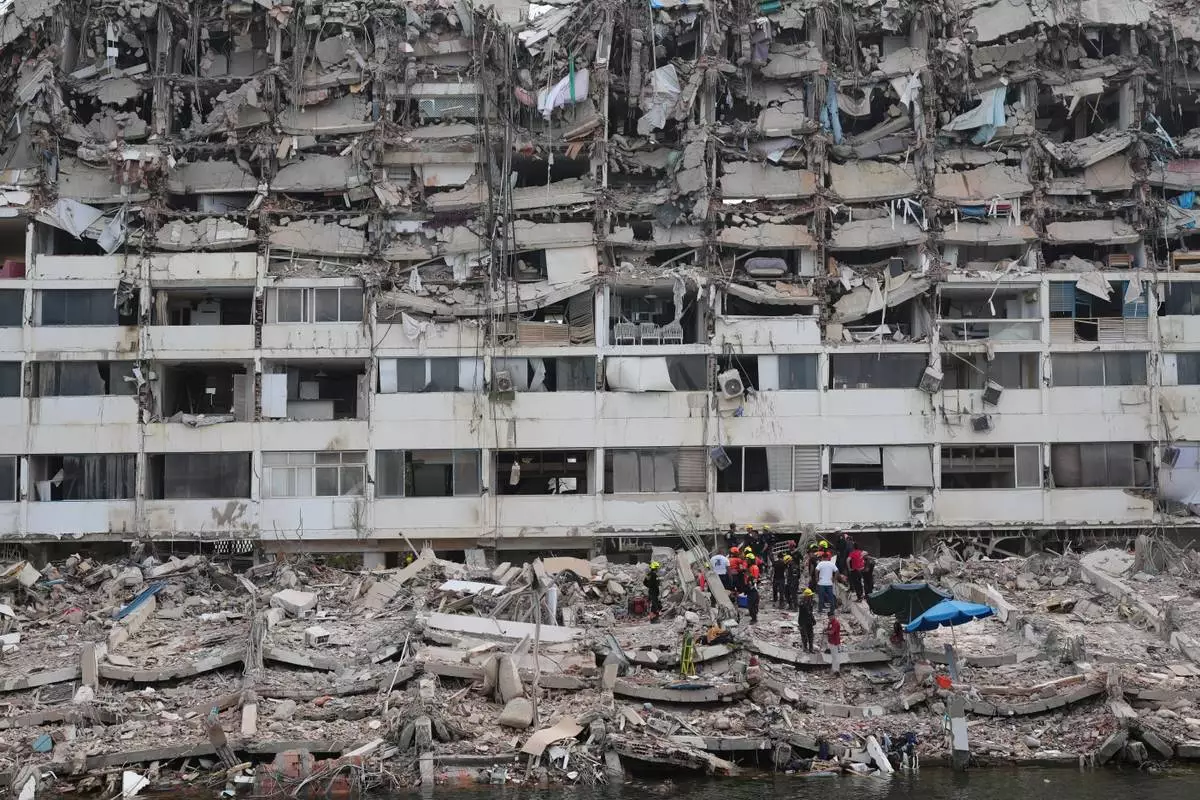
Rescue workers search through the rubble of a building that collapsed when earthquakes struck La Guaira, Venezuela, Sunday, June 28, 2026. (AP Photo/Matias Delacroix)
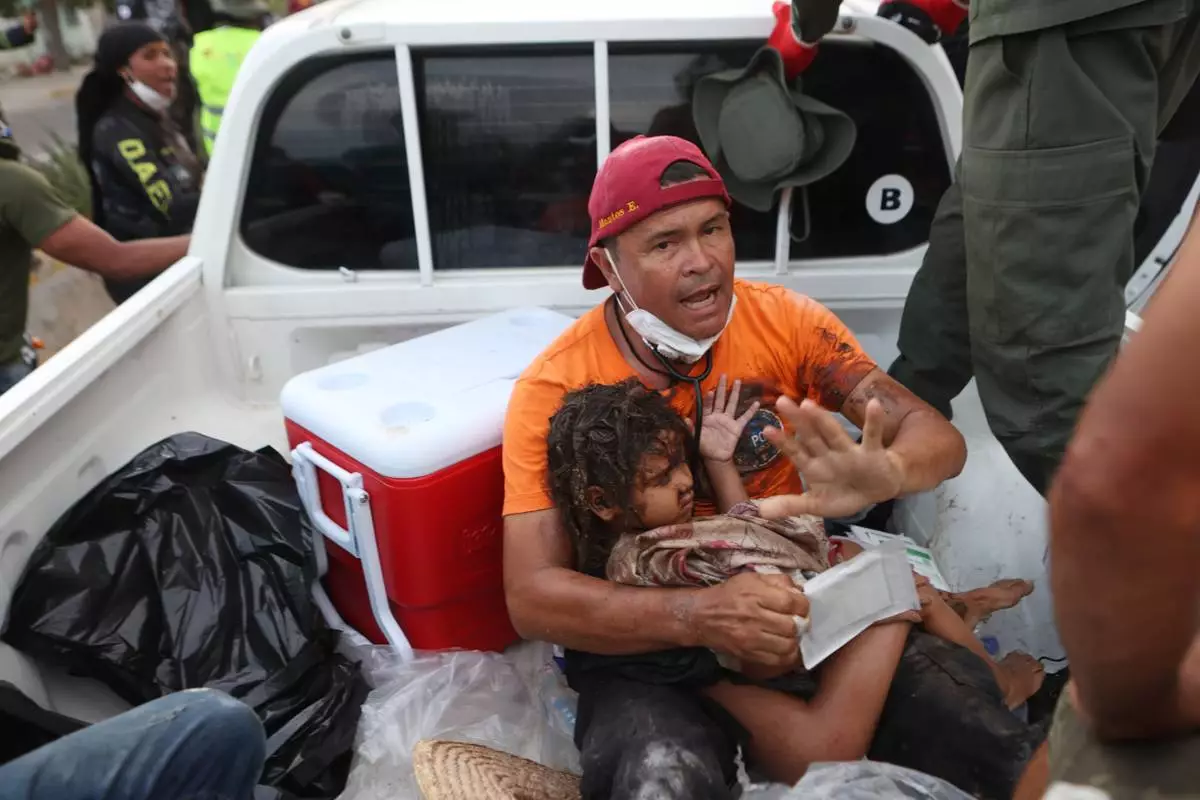
A rescuer carries a girl pulled from the rubble four days after twin earthquakes struck La Guaira, Venezuela, Sunday, June 28, 2026. (AP Photo/Pedro Mattey)
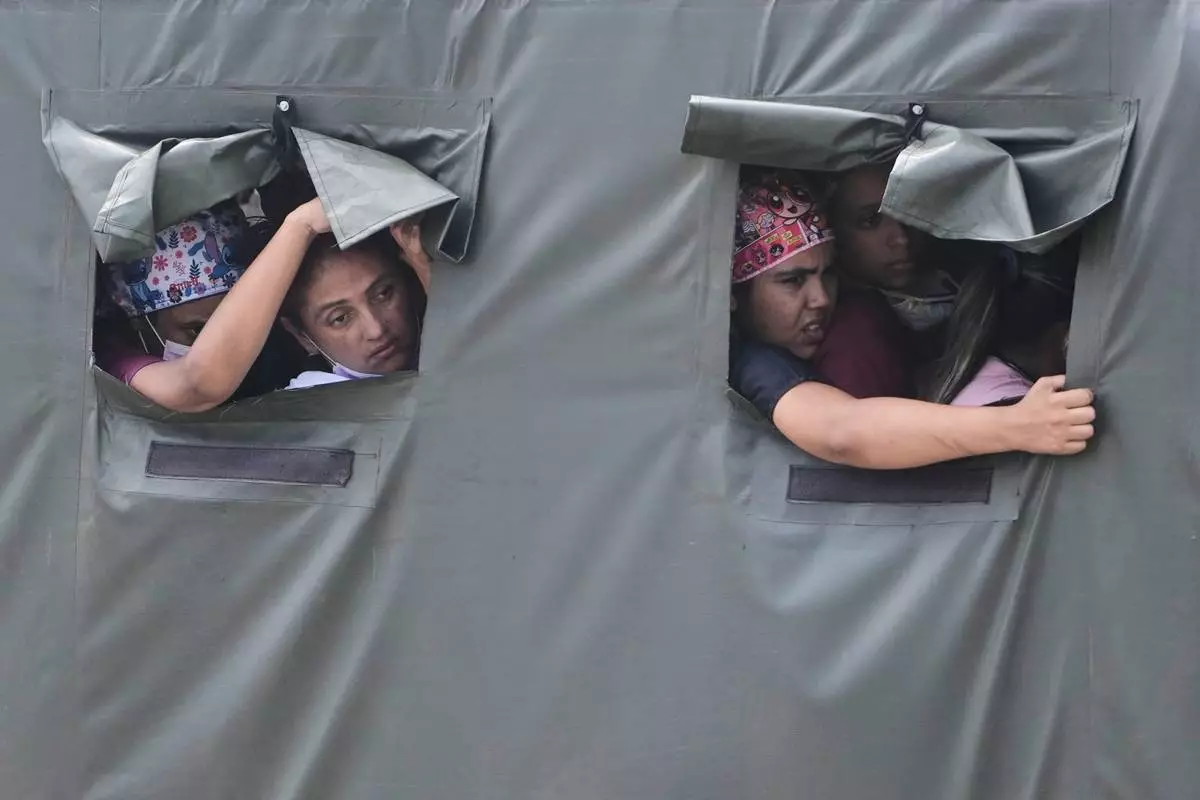
Health workers ride in a truck on their way to join earthquake relief efforts in La Guaira, Venezuela, Sunday, June 28, 2026. (AP Photo/Fernando Vergara)
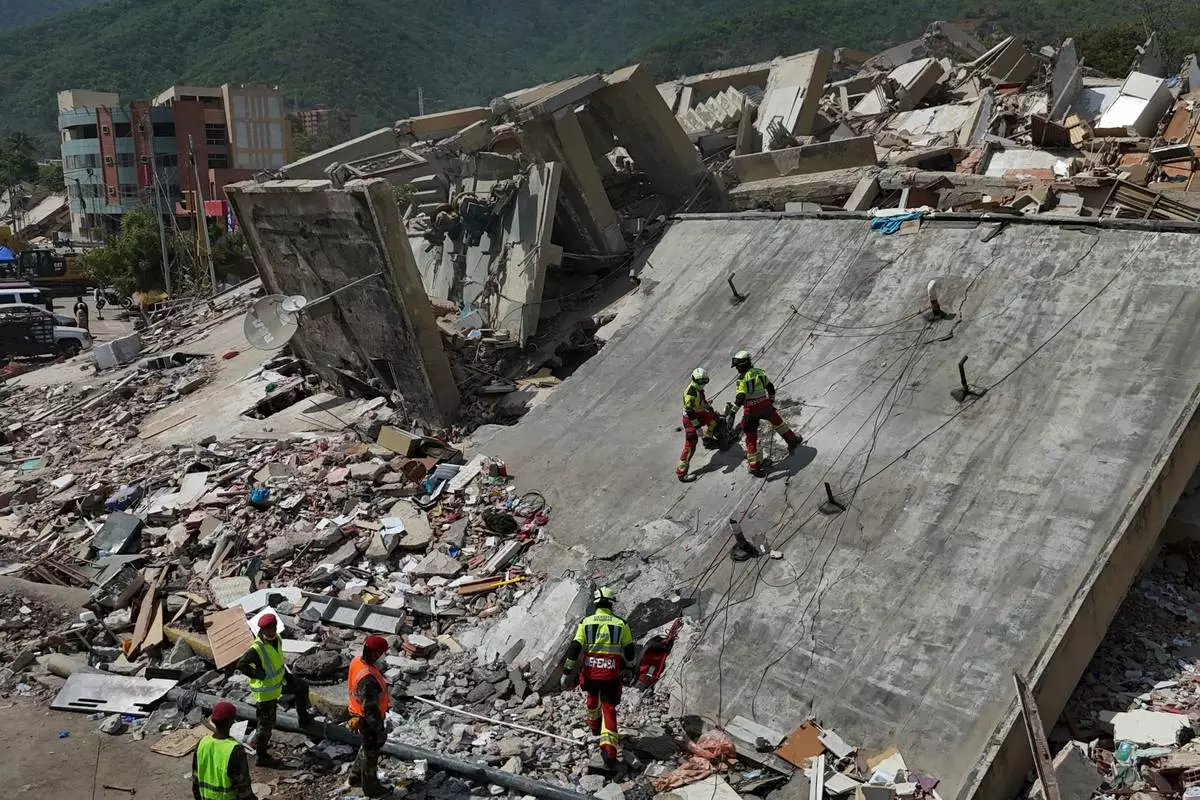
Mexican Army rescue workers search for people trapped in collapsed buildings after earthquakes struck La Guaira, Venezuela, Sunday, June 28, 2026. (AP Photo/Matias Delacroix)
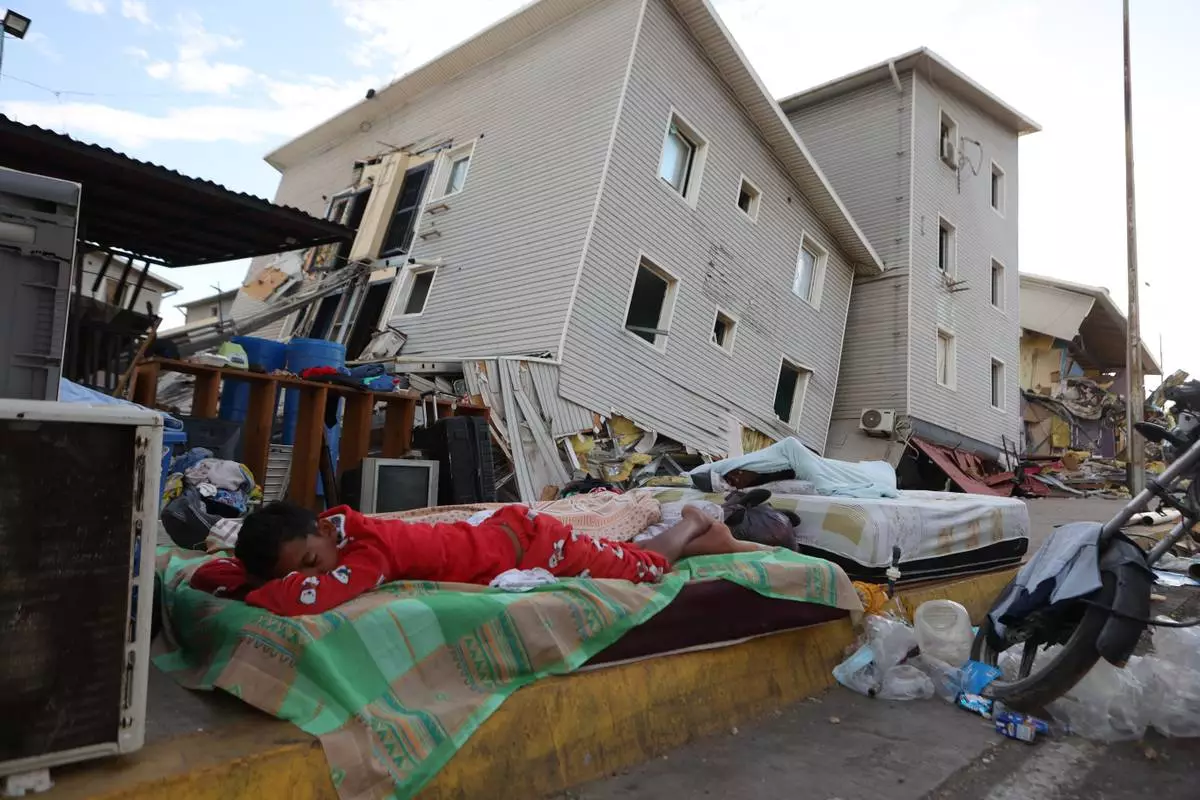
A boy sleeps outside earthquake-damaged homes in Catia La Mar, Venezuela, Sunday, June 28, 2026. (AP Photo/Pedro Mattey)