MUNICH--(BUSINESS WIRE)--Jun 30, 2026--
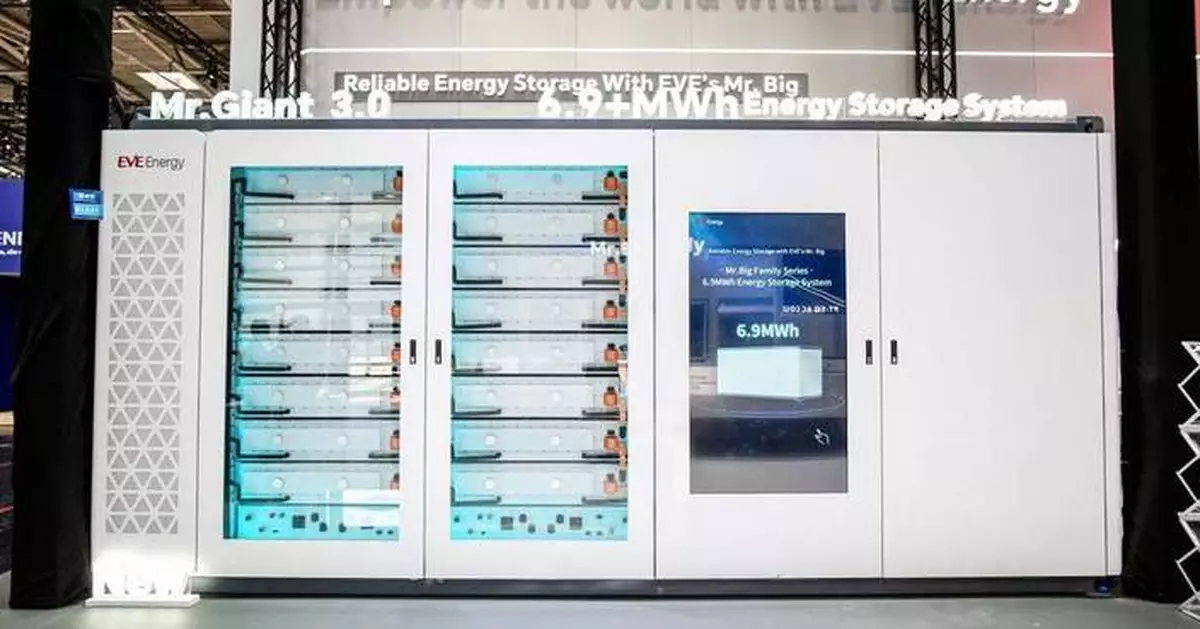
EVE Energy unveiled its Mr. Big Family series, a 6.9+ MWh energy storage system, and all-scenario energy storage solutions at Intersolar Europe in Munich. Drawing on traceable large-cell technology, proven large-scale energy storage project delivery experience, and global delivery capabilities, the company is addressing Europe's diverse energy storage requirements across utility-scale, commercial & industrial (C&I ), and data center segments.
This press release features multimedia. View the full release here: https://www.businesswire.com/news/home/20260630889717/en/
Advancing Large-Cell Technology with Global Project Validation
As one of the first companies to focus on large-capacity energy storage cells, EVE Energy has iteratively upgraded its cell platform from 560 Ah and 628 Ah to 702 Ah, adhering to a stacking process route throughout. At the exhibition, the Mr. Giant 3.0 6.9+ MWh system made its European debut, equipped with 702 Ah cells upgraded directly from the 628 Ah cells, and achieving a volumetric energy density exceeding 430 Wh/L. For a 200 MWh power station, the system reduces site footprint by 6% and lowers upfront capital costs, while its 10,000-cycle lifespan extends operational life and improves full-lifecycle returns.
The technology has been validated at scale. The world's first 400 MWh independent energy storage station, using 628 Ah cells—the Lingshou Project in Hebei province, China—was grid-connected in January 2026. Overseas, EVE Energy's storage products have been deployed across Europe, Australia, and the Americas, including a 140 MWh project in Argentina, demonstrating adaptability to diverse climatic conditions and grid specifications.
At the exhibition, EVE Energy signed long-term partnerships with SolarEdge Technologies, INFOWARE Zrt, IWEll B.V., and Idea, with cumulative contracted storage capacity exceeding 13.5 GWh.
Deploying Dual Lithium-Sodium Technologies for Full-Scenario Coverage
Building on its standardized technology for its 628 Ah platform, EVE Energy is advancing both lithium iron phosphate (LFP) and sodium-ion technology lines to cover a wider range of applications. The portfolio includes cells rated at 355 Ah and above, a 180 kWh sodium-ion outdoor integrated cabinet, and 2.5 MWh/3.5 MWh sodium-ion storage systems for long-duration energy storage (LDES). EVE Energy has successfully grid-connected this 180 kWh cabinet at a demonstration project site, with measured DC-side efficiency exceeding 96.7%.
In the C&I segment, the 609 kWh outdoor integrated cabinet delivers 20% higher energy density with a smaller footprint, and incorporates independent cluster management to isolate faults without disrupting system operation. For data center applications requiring 5–10 minutes of emergency backup power, EVE Energy introduced the Fortron Series—specifically high-rate cabinets offered in 6C and 10C discharge specifications. These units improve high-temperature tolerance by over 50%, double current-carrying capacity, reduce heat generation by 20%, and support a 512V–768V voltage range compatible with next-generation 800V architectures, with a system service life of up to 15 years.
EVE Energy will continue to develop its lithium-ion, sodium-ion, and high-rate backup power product lines, delivering safe, reliable, and cost-effective all-scenario energy storage solutions for global markets.
About EVE Energy
Founded in 2001 and listed on the Shenzhen Stock Exchange in 2009, EVE Energy is a global lithium battery company serving the consumer, mobility, and energy storage markets. The company provides battery technologies and solutions for electric vehicles, energy storage systems, and consumer applications, with manufacturing and service operations supporting customers worldwide.
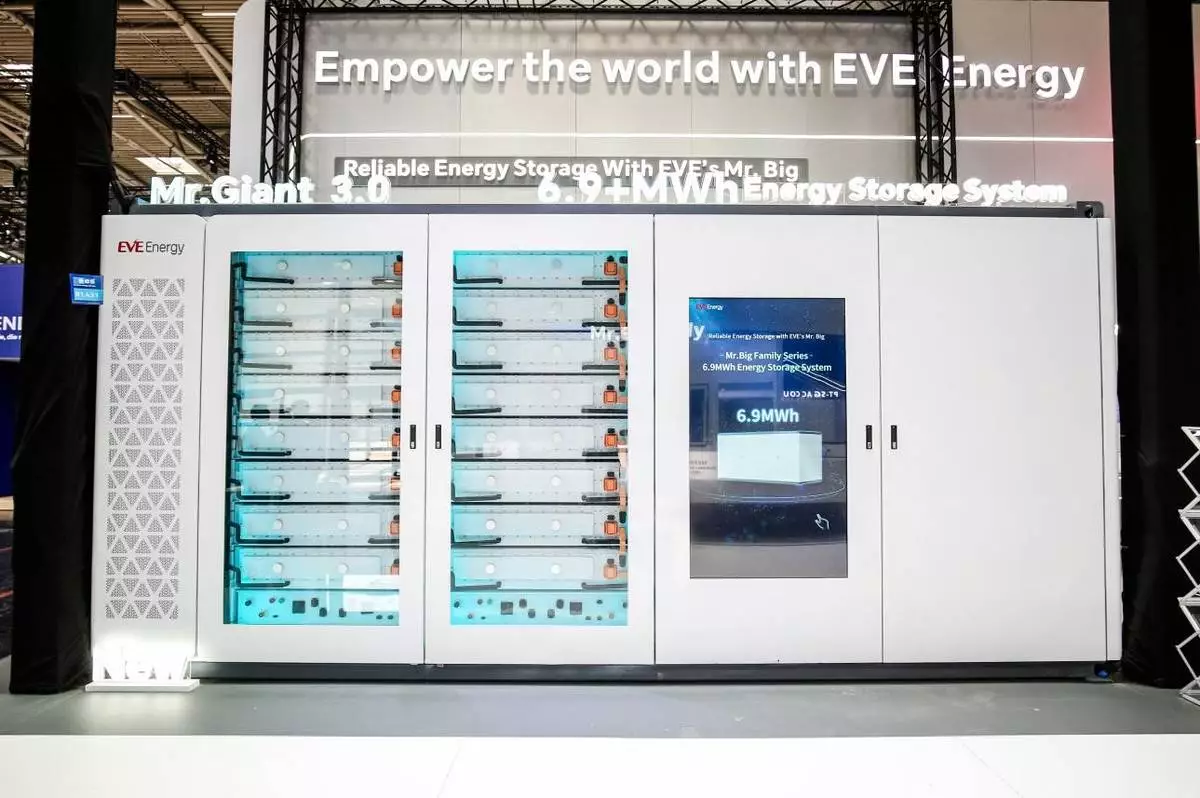
EVE Energy showcases its Mr. Giant 3.0 6.9+ MWh energy storage system at The Smarter E Europe 2026 in Munich, Germany
Colorado’s Democratic primaries on Tuesday will help answer a question the party has increasingly faced nationally: Are voters gravitating toward a younger, more progressive generation of leaders or sticking with established veterans?
That choice is starkly reflected in the fight to represent the state's 1st Congressional District, where incumbent Rep. Diana DeGette has been in office for as long as her challenger, a 29-year-old democratic socialist named Melat Kiros, has been alive. In a similar faceoff, Sen. John Hickenlooper successfully fended off a primary challenge from self-fashioned “insurgent progressive" state Sen. Julie Gonzales.
And a similar, if smaller, divide separated the two Democrats competing for the U.S. House in the state's lone swing district that's one of the key's in party control of Congress. The candidate considered more progressive, state Rep. Manny Rutinel beat Shannon Bird, another state representative with a more moderate record in the statehouse.
In the Democratic primary for governor, however, the opposite was the case: Colorado Attorney General Phil Weiser and U.S. Sen. Michael Bennet struggled to meaningfully distinguish their agendas. Instead, the two Democrats have accused each other of pulling punches against Trump.
Polls closed at 7 p.m.
DeGette comfortably controlled her House seat in Denver for nearly 30 years, then came Kiros.
In a March Democratic assembly, a process to decide which candidates get on the primary ballot, DeGette barely qualified as Kiros, a first-time candidate, blew past her with more than double the votes.
While the assembly process is far from determinative of who will win Tuesday, it was a jolt for the Democratic establishment and DeGette, who's been a progressive lawmaker herself.
Then, in New York last week, two democratic socialists and a progressive beat out establishment-backed candidates — two of whom were incumbents — in Democratic primaries for U.S. House, energizing a movement that's just finding some political purchase.
Similar to the New York races, Kiros had the endorsement of Sen. Bernie Sanders, while DeGette was backed by Colorado’s established Democratic House delegation.
A victory by Kiros in Colorado, while far from guaranteed, would work toward cementing the nascent but clear uprising of democratic socialist candidates, which has filled some Democratic leaders with anxiety.
DeGette argued that experience in Congress is needed right now to combat Trump, while Kiros, a former attorney, accused DeGette of ineffectiveness. Also running was University of Colorado Regent Wanda James, who may split the anti-DeGette vote.
Gonzales, the state senator, tried and failed Tuesday to kick Hickenlooper, the more centrist former governor of Colorado, out of his U.S. Senate seat.
She leaned into the same arguments that others used in challenging establishment incumbents, including that Hickenlooper was an “incrementalist."
Gonzales had said she previously joined the Democratic Socialists of America in 2018, but that her membership has lapsed.
Colorado's 8th Congressional District is relatively new and stretches from the northern suburbs of Denver up through farming country, but it's drawn national focus as a highly competitive swing district as Democrats seek to retake control of the House.
Initially, party leaders though the more moderate Bird was best equipped to challenge Republican Rep. Gabe Evans. But Rutinel, who had the more progressive record, beat Bird Tuesday night.
The district is also heavily Hispanic and poorer than much of the rest of the state, and that's where Rutinel, who is Latino, planted a flag, arguing his personal story and more aggressive economic agenda would be more potent against Evans.
Weiser and Bennet slugged that question out in the governor's race after struggling to show major differences in their political agendas.
Weiser attacked Bennet for voting for Trump nominees and Bennet lambasted Weiser for not joining state lawsuits against the first Trump administration.
“The attorney general says he’s really tough but was completely missing in action in Donald Trump’s first term," Bennet said in a recent debate.
Weiser accused Bennet of a weak response to the president. But he also said Bennet should remain in the Senate instead of running for governor.
“You’ve made some mistakes; you didn’t stand up the way you should. I know you can shape up, use your seniority," Weiser told Bennet during a debate. “With all that experience, to throw it away, would be such a waste for Colorado.”
With Colorado a blue state, Tuesday's Democratic winner will be seen as the favorite to defeat the winner of the GOP primary and take over from term-limited Gov. Jared Polis.
The three main candidates seeking the Republican nomination included state Rep. Scott Bottoms, a further right state lawmaker. State Sen. Barbara Kirkmeyer was considered the more conventional Republican, while Victor Marx was something of a wild card candidate with an eclectic past.
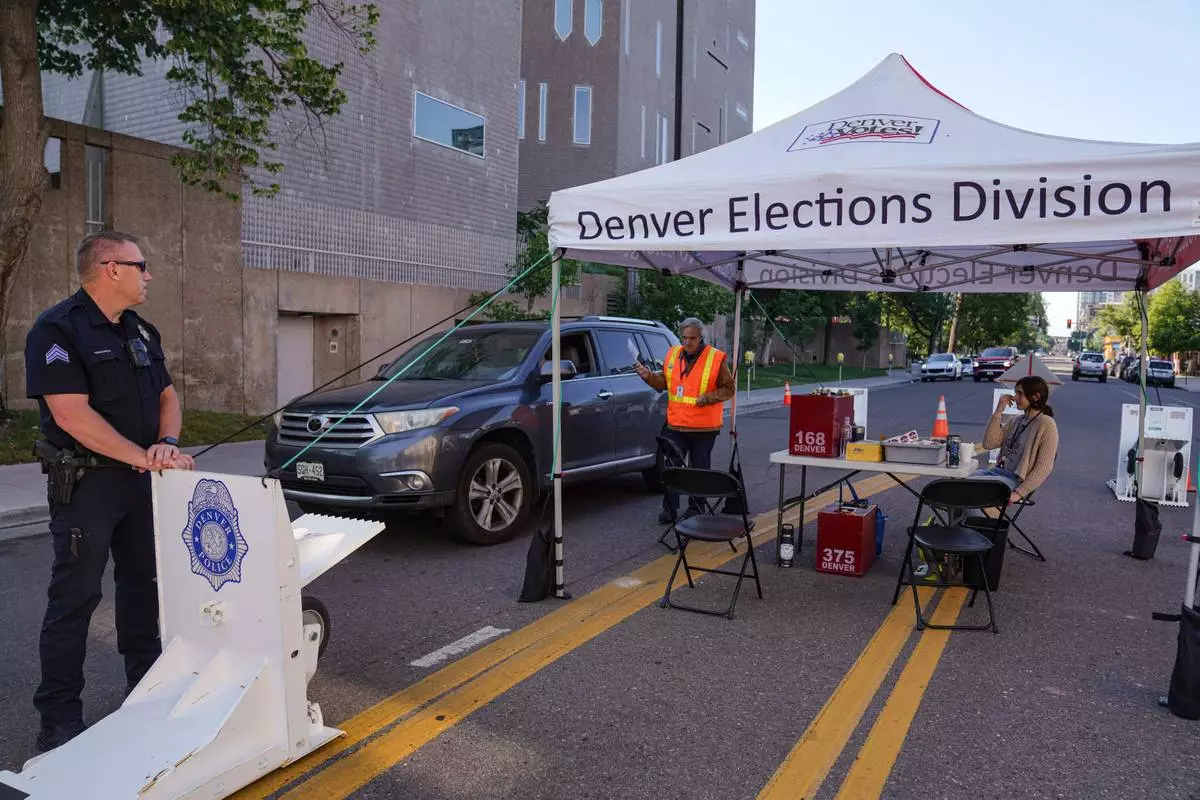
Adam Ballinger walks a voters ballot to the box in the Democratic primaries at a drop off location near the Denver Museum of Art, Tuesday, June 30, 2026, in Denver. (AP Photo/Rebecca Slezak)

People vote in the Democratic primaries at Blair-Caldwell Library, Tuesday, June 30, 2026, in Denver. (AP Photo/Rebecca Slezak)