BOSTON (AP) — Washington Nationals pitcher Cade Cavalli apologized Wednesday for shouting “sit down, boy!” at Boston Red Sox first baseman Willson Contreras while instigating a benches’ clearing scrum a night earlier.
“I’m extremely torn up about the way that things were perceived,” Cavalli said before the Nationals beat the Red Sox 10-2. “Obviously, there was no ill intention behind that.”
Cavalli shouted at Contreras after striking him out looking with a full-count pitch in the fourth inning of the Nationals’ 8-1 victory over the Red Sox.
The term “boy” has a racist history in the United States. Contreras, who is Venezuelan, demurred when asked after the game if he felt there was a racial component to Cavalli’s word choice.
“My teammates know me, my family knows me, this organization knows me,” Cavalli said. “I couldn’t sleep because of it. It hurt my heart, knowing that, if there’s a 13-year-old Black kid in D.C. that sees that — that looked up to me and thinks that he perceived it in a way that wasn’t intended the way that it came out, and then he’s not looking up to me anymore — that hurts my heart.”
When asked, he said he understands the meaning behind the word used.
“There’s a history behind that word, and that’s just something that as a competitor, like in football or basketball, playing wiffle ball with my brother, you don’t understand it,” Cavalli said. “And then it gets perceived in a way that was not my intention, and then you learn from that. It’ll never happen again.”
The 27-year-old right-hander said he didn’t realize the public outcry on social media until he got back to his hotel room.
“I looked at my phone, and I saw what people were saying about me. Saw how torn up my wife was. It hurt my heart,” he said. “I couldn’t believe it. I really couldn’t. Because I know that people know me, and they know my character, and that’s not me. So, it was hard. I truly didn’t sleep last night.”
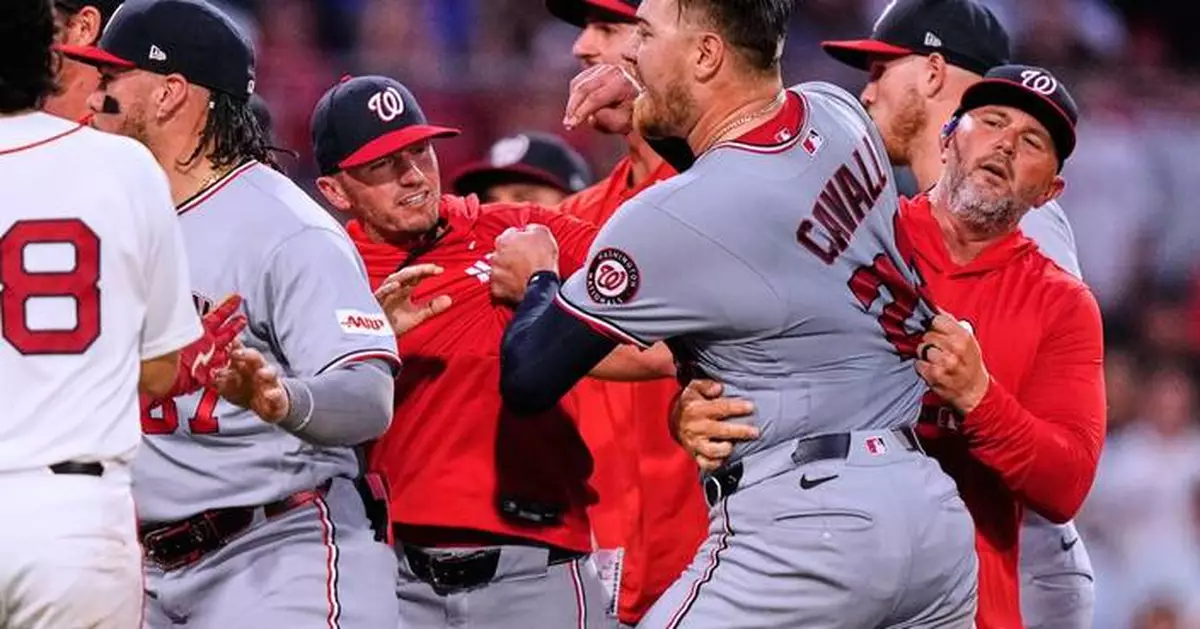
Contreras was walking back to the dugout after striking out and yelled back at Cavalli: “Are you talking to me?” A few words were exchanged, and he charged the mound. He was stopped before he got to the pitcher. He tried to throw his helmet over a group of players at the righty.
Things settled down quickly after that, though the brief dustup ended with Contreras, Boston interim manager Chad Tracy, Red Sox outfielder Nate Eaton and Washington pitcher Miles Mikolas being ejected.
Cavalli said he hadn’t apologized to Contreras yet, but he hopes he hears his explanation.
“I have not reached out to him. I know that we’re both competitors, I hope that he hears this and he understands that was not what was intended at all,” Cavalli said. “I think he knows that. But if I see him, I want to make sure that he knows that.”
AP MLB: https://apnews.com/hub/mlb

Boston Red Sox's Willson Contreras (40) is held back as tempers flare during the fourth inning of a baseball game against the Washington Nationals, Tuesday, June 30, 2026, in Boston. (AP Photo/Charles Krupa)

Washington Nationals starting pitcher Cade Cavalli delivers during the first inning of a baseball game against the Boston Red Sox, Tuesday, June 30, 2026, in Boston. (AP Photo/Charles Krupa)

Washington Nationals' Cade Cavalli, front right, is held back as tempers flare during the fourth inning of a baseball game against the Boston Red Sox, Tuesday, June 30, 2026, in Boston. (AP Photo/Charles Krupa)
SAN JUAN, Puerto Rico (AP) — A federal audit released Wednesday found that only 25% of some $14 billion in federal funds obligated for Puerto Rico’s power grid after Hurricane Maria razed it almost a decade ago has reached the U.S. territory.
Of the $11 billion obligated by the U.S. Federal Emergency Management Agency alone, some $2.7 billion has been disbursed, mostly for things like equipment, materials and architecture and engineering design costs, according to the U.S. Government Accountability Office.
Obligated funds means the government is legally bound to disburse that money for a specific purpose.
The 86-page report is based on an audit from August 2024 to June 2026. It was released by U.S. Democratic lawmakers.
“The people of Puerto Rico have waited nine years for their government to keep its word,” Rep. Jared Hoffman, a California Democrat, said in a statement. “They watched billions get appropriated and almost none of it arrive.”
Hurricane Maria struck Puerto Rico in September 2017 as a powerful Category 4 storm, knocking out power in some neighborhoods for almost a year – the longest outage in U.S. history. An estimated 2,975 people died in the storm’s sweltering aftermath.
Two weeks before Maria hit, Hurricane Irma swiped past the island’s northeast corner as a Category 5 storm, also knocking out power.
The grid was further destabilized by a series of strong earthquakes that struck southern Puerto Rico in late 2019 and early 2020.
Chronic blackouts prompted Puerto Rico's governor to declare a state of emergency in April 2025, but outages persist, with about half of those incidents blamed on vegetation overrunning transmission and distribution lines.
As of February, only 400 miles (640 kilometers) had been cleared using federal funds out of 16,000 planned miles (26,000 kilometers), according to the report. Overall, nearly 2,800 miles (4,500 kilometers) of lines were cleared in fiscal year 2025, according to Luma Energy, a private company overseeing the transmission and distribution of power in Puerto Rico. It currently is facing a lawsuit by the island’s government seeking to terminate its contract; the company has since counter sued.
The report noted that staff turnover; project review processes it described as “onerous;” and the financial state of Puerto Rico’s Electric Power Authority – which is still struggling to restructure more than $10 billion in debt – are preventing progress.
One move that further delayed the release of funds was when former Homeland Security Secretary Kristi Noem implemented a policy in June 2025 that DHS expenditures over $100,000 be personally approved by that office. The rule was rescinded in April by new Homeland Security Secretary Markwayne Mullin.
As of December 2025, nine large FEMA-funded projects were completed, most of them related to generation; 133 projects remain at different stages.
The agency also has obligated about $1.3 billion to 24 critical generation projects, seven of which have been completed.
The report noted that repair work often means planned outages and finding replacement parts can take up to two years.
Of the $2.9 billion allotted by the U.S. Department of Housing and Urban Development to modernize and repair the grid, only about $589 million had been disbursed as of February.
Meanwhile, of the $1 billion obligated by the U.S. Department of Energy, about $255 million has been disbursed, the report found.
Some $365 million originally allotted for solar energy projects have since been redirected to the power grid, for “practical fixes and emergency repairs” according to department officials interviewed by auditors.
The Department of Energy also canceled up to $350 million in grants under a solar access program, the report noted.
It did disburse all $1.2 million slated for hubs aimed at providing vulnerable communities in Puerto Rico with electricity during disasters.
The Government Accountability Office called on FEMA to update guidance to reflect flexibilities and on the Department of Energy to clarify roles and responsibilities, and create a collaboration plan.
“Given the complexity of funding, the numerous players involved, and the various plans for grid recovery, extensive coordination across Puerto Rico and federal entities is vital,” the report states.
The Department of Energy and the U.S. Department of Homeland Security concurred with the recommendations, although the latter noted that “the government of Puerto Rico is ultimately responsible for developing a comprehensive solution and rebuilding the electrical grid.”
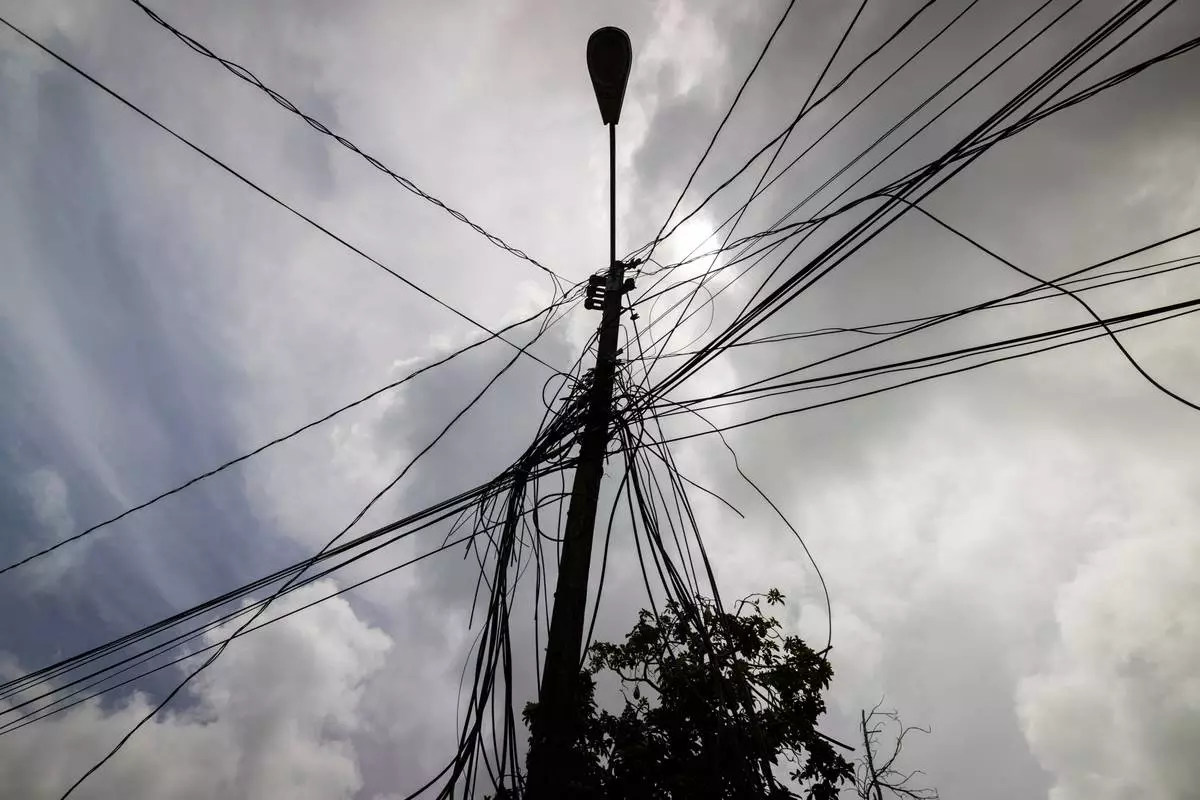
FILE - A utility pole with loose cables towers over the home of Jetsabel Osorio in Loiza, Puerto Rico, Thursday, Sept. 15, 2022. (AP Photo/Alejandro Granadillo,File)
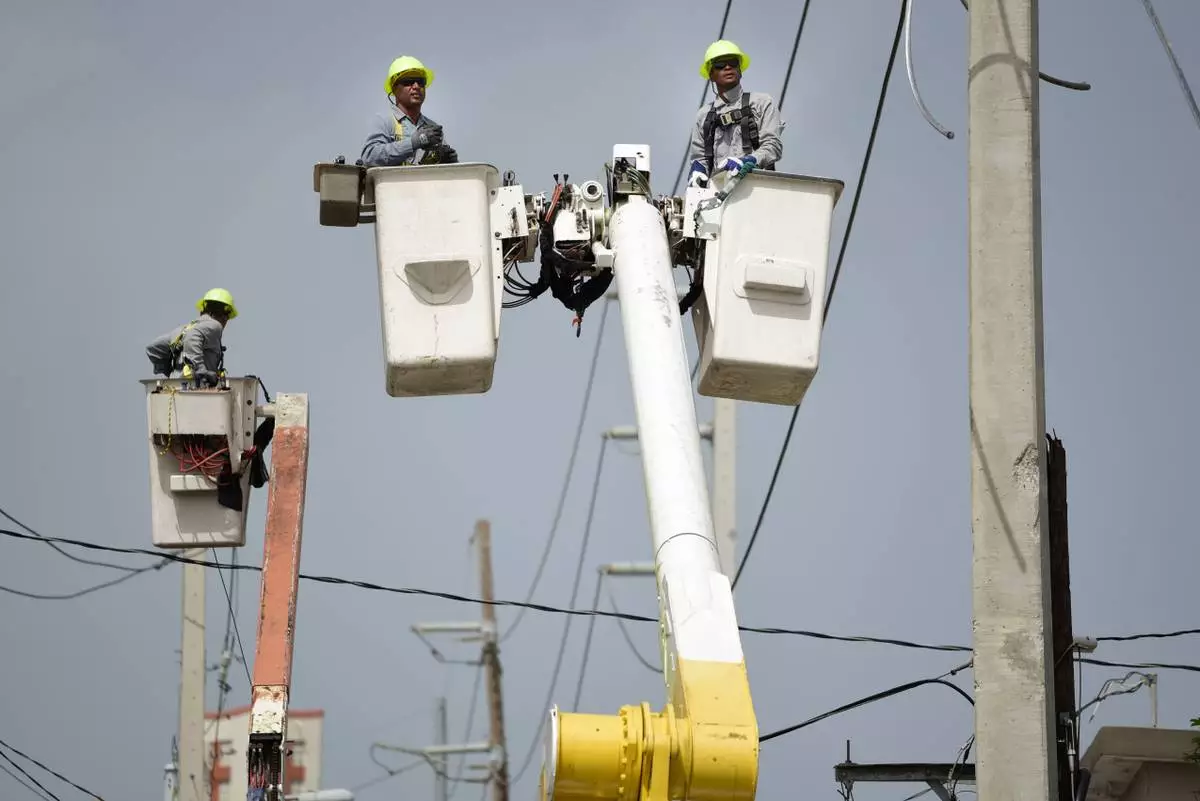
FILE - Puerto Rico Electric Power Authority workers repair distribution lines damaged by Hurricane Maria in the Cantera community of San Juan, Puerto Rico, Oct. 19, 2017. (AP Photo/Carlos Giusti, File)