Real-world challenges ranging from retail operations to urban management are accelerating the deployment of embodied intelligence beyond laboratories in China, as researchers and industry partners collaborate to develop general-purpose AI models capable of learning, adapting and operating safely in real environments.
In Beijing, a humanoid robot developed by Galbot is now running a 24-hour convenience store. The robot can take payment and hand over items smoothly.
"About 30 percent of demand in supermarkets comes from orders of non-standard items like breakfast foods. An indoor store like this one might be relatively easier for our robots, but there could be others located in the Dunhuang desert or by the seaside -- each facing different lighting conditions and external environments every day. These variations can largely interfere with a robot's perception and interaction with its surroundings. How can we develop a general foundation model capable of generalized deployment across diverse scenarios? This places extremely high demands on the capabilities of embodied intelligent large models," explained Zeng Hui, senior vice president of Galbot.
A general foundation model acts as a central brain, giving robots the ability to learn by analogy. It does not just make decisions; it learns to apply knowledge to new situations. But to make it work in real homes, the amount of training data needs to be enormous millions of hours, said Zhao Hang, CTO at Galaxea AI.
"The ultimate goal of embodied intelligence is 'one brain, multiple bodies' -- having a foundational model or a single 'brain' capable of controlling various types of physical forms. To achieve this, it needs to be trained on diverse data. When data volume reaches the scale of millions of hours, it becomes feasible to train larger-scale native embodied intelligence models," Zhao stated.
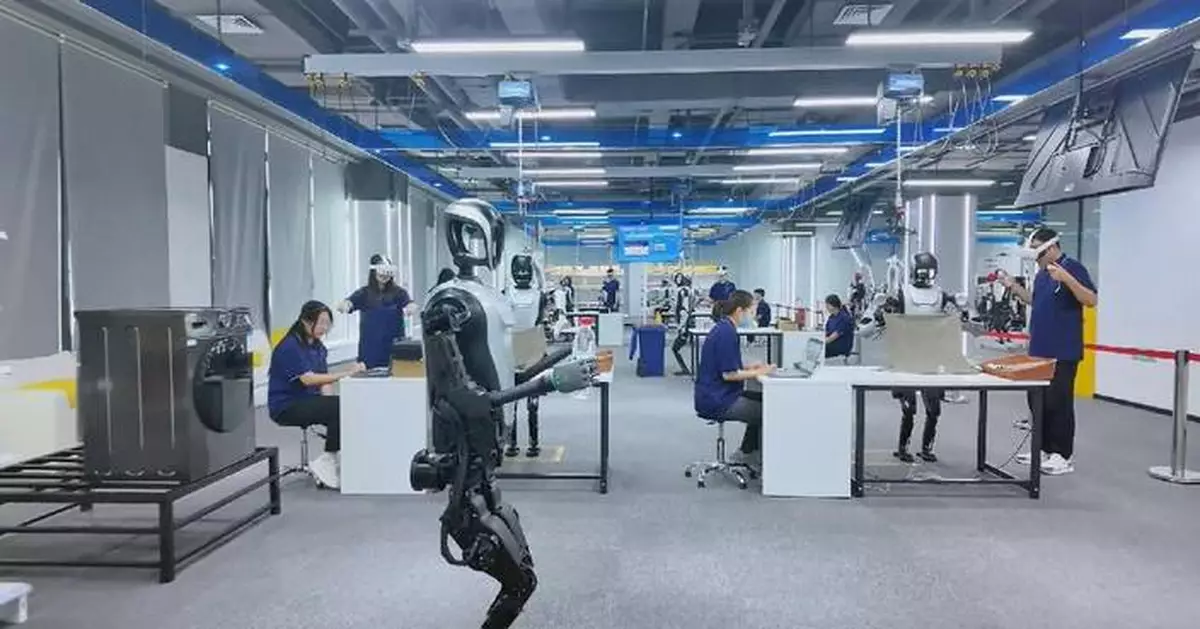
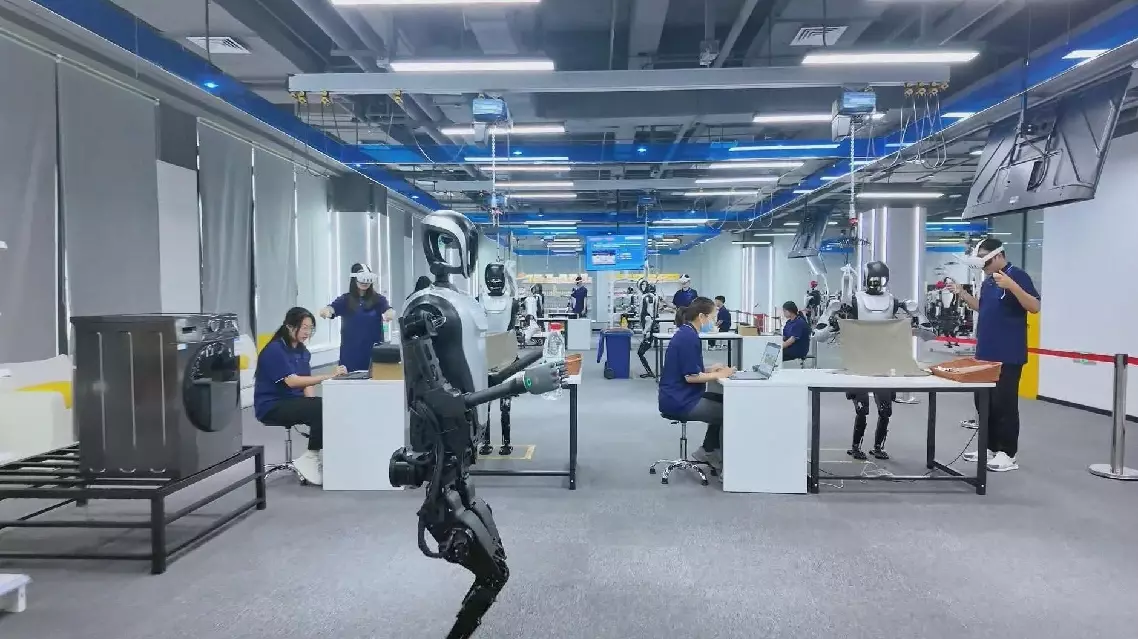
To collect more data, staff at the Humanoid Robot Data Training Center in Beijing are guiding robots through housework hand by hand, including washing dishes and wiping countertops.
The subtle motion of each joint and the force applied by a fingertip are captured in real time by high-precision sensors. Such data is an indispensable resource for training embodied AI.
"It records three-channel video data, full-body joint data, and sensor data from the body. All those data are collected and provided to the model for training. Generally speaking, hundreds or even thousands of hours of data may be required for a specific application scenario. The daily data output is approximately seven to eight terabytes," said Guo Rui, deputy general manager of the Beijing Humanoid Robot Data Training Center.
But collecting such data is only one part of the puzzle. A bigger problem is safety. When robots assist the elderly, children, or the visually impaired, they cannot afford to make mistakes.
A guide-dog robot developed by Chinese mapping service provider Amap has recently demonstrated smooth navigation on a real street, but developers knew that trial and error in reality is too dangerous.
To address this potential risk, the team has built a virtual world that is completely identical to the real one.
"Abot-Earth is a city-scale 3D world model. By using a single satellite image or a small number of street view photos, it can directly generate a high-precision digital city model. It now features high-fidelity 3D models of most countries and regions around the world. This is a three-dimensional digital asset of cities that accurately captures real-world geometry and scale. In fact, although this robotic dog hasn't physically traveled anywhere, it has already seen every scene in the world," said Xu Mu, head of embodied intelligence at Amap.
From virtual worlds to real-world scenarios, embodied intelligence is steadily bridging the gap between controlled labs and unpredictable reality, taking another step closer to becoming not just a tool, but a trusted partner in people's daily lives.
Embodied intelligence transitions to real-world application in China
Embodied intelligence transitions to real-world application in China