Skip to Content Facebook Feature Image

US support for Israel slips as Democrats grow more critical, AP-NORC poll finds

News

US support for Israel slips as Democrats grow more critical, AP-NORC poll finds
News

News

US support for Israel slips as Democrats grow more critical, AP-NORC poll finds

2026-07-07 17:03 Last Updated At:17:10

NEW YORK (AP) — After decades of reliable bipartisan backing for Israel, a new AP-NORC poll reveals a dramatic erosion of support for the longtime U.S. ally, with rising opposition from Democrats and signs of division among Republicans.

The survey by The Associated Press-NORC Center for Public Affairs Research arrives at a moment when a once-consensus foreign policy issue is increasingly polarizing Americans along partisan and generational lines, driven by criticism for Israel's conduct nearly three years after the outbreak of its latest war with Hamas in Gaza.

About one-third of U.S. adults — including roughly half of Democrats — believe that Israel has committed genocide against Palestinians during the war in Gaza, an accusation that’s been leveled by some human rights organizations and vehemently denied by Israel and the U.S. government. About 2 in 10 Americans say Israel has not and the rest, about half, don’t know enough to say.

A similar share, 30%, of Jewish adults say Israel has committed genocide, although about half, 49%, say it has not.

Harold Kalmus, a 69-year-old Democrat from Arden, Delaware who describes himself as Jewish by birth, said he remembers being proud of Israel when he was younger. Not anymore.

“I realize that there is a threat from Hamas. And I realize they’re in a very difficult situation, but what they have done is just an unspeakable horror,” he said of Israel’s military action against the Palestinians. “They’re trying to wipe out a civilization as far as I’m concerned.”

The findings show sharply eroded views of Israel in the U.S., nearly three years after Hamas' attack on Oct. 7, 2023, which left 1,200 people dead in Israel, mainly civilians, while 251 hostages were taken back to Gaza. More than 73,000 Palestinians have died in Gaza according to the Hamas-run Gaza Health Ministry, which doesn’t distinguish between civilian and militant deaths, including more than 1,000 killed since the beginning of the latest ceasefire. American sympathies had been shifting toward the Palestinians and away from the Israelis since around 2020, according to other polling, but has nose-dived since the latest war in Gaza began.

Many Americans, about 4 in 10, don't know enough to say whether Israel’s immediate military response to Hamas’ attack or its ongoing military operations were justified. Among those who did have an opinion in each case, most say the initial retaliation was justified — but a majority think its current actions are not.

About three-quarters of Jewish adults said Israel's initial response was justified, but only about 4 in 10 believe that about its ongoing operations.

Only about one-third of U.S. adults view Israel as an “extremely” or “very" important issue to them personally. But it's been a searing topic in American politics as the relationship between the two countries remains tense, just four months before high-stakes midterm elections determine the balance of power in Congress for President Donald Trump’s final two years in office. Vice President JD Vance recently criticized Israeli leaders who have expressed frustration with Trump, while vocal critics of Israel recently defeated establishment-backed Democrats in New York and Colorado primaries.

The AP-NORC poll reveals a decisive shift within the Democratic Party.

About 58% of Democrats now say the U.S. is “too supportive” of the Israelis, up from 45% in an AP-NORC poll from January 2024 when former President Joe Biden was in office. That includes 51% of Jewish Democrats in the new poll.

Roughly 6 in 10 Democrats, 62%, say the U.S. is “not supportive enough” of the Palestinians, up from 49% in 2024. Younger Democrats — those 45 and younger — are still more likely than older ones to say that the United States is “not supportive enough” of the Palestinians, but older Democrats are catching up to their younger counterparts. About 57% of older Democrats now say the U.S. should do more for the Palestinians, up from 39% two years ago.

Joy Jennik, a 73-year-old Democrat from Brookfield, Wisconsin, said she didn’t have strong opinions about the U.S. relationship with Israel until after Hamas’ Oct. 7 attack.

Now, she believes Israel is guilty of genocide.

“The Gaza Strip, there’s not a lot left of it. Those poor people are barely living,” said Jennik, a retired home economics teacher.

Just a sliver of Republicans, 13%, describe Israel’s actions as genocide, although there is an apparent age gap. About 2 in 10 Republicans under 45 say Israel has committed genocide, while about 1 in 10 Republicans ages 45 and older say the same.

Overall, 60% of Republicans describe the U.S. support for Israel as “about right." Only about 2 in 10 Republicans say that the United States is “too supportive” of the Israelis, although Republicans under 45 are more likely to say this.

The share of Republicans overall who say the U.S. is “too supportive” of Israel has not changed meaningfully since 2024, but the share who say the U.S. is “not supportive enough” has shrunk from 39% to 15%.

Mike Cardona, a 70-year-old Republican from suburban Phoenix, said he's pleased with the level of support that the U.S. is giving Israel and rejects the notion that Israel has committed genocide.

“I wish they’d gone in harder and better,” Cardona, a retired industrial supply salesperson said of Israel's military action in Gaza. “Unfortunately, some innocents will be hurt, but Hamas and Hezbollah never took that into consideration when they were killing children and women in Israel.”

In interviews, several respondents emphasized that their criticism of Israel was focused on its leaders, especially Prime Minister Benjamin Netanyahu, who is perceived as closely aligned with Trump after repeated clashes with Democratic presidents.

Overall, only 20% of U.S. adults have a favorable view of the Israeli prime minister, while about twice as many, 38%, have an unfavorable view. About 41% don't know enough to have an opinion.

Netanyahu is particularly unpopular among Jewish adults: about 6 in 10 view him unfavorably, while about one-third see him positively.

Younger adults, regardless of party, are more likely than older adults to say they don't have an opinion about Netanyahu. But while older Republicans see Netanyahu more positively than negatively, younger Republicans' views tilt unfavorably.

New York City Mayor Zohran Mamdani has gained prominence as an outspoken critic of Israel, and 27% of U.S. adults have a favorable opinion of the 34-year-old democratic socialist. Another 28% of U.S. adults have an unfavorable opinion, while 44% don’t know enough to say.

Jewish adults, who overwhelmingly identify as Democrats, have a more positive view of Mamdani than of Netanyahu, with 44% viewing the New York City mayor positively, 39% viewing him negatively, and 17% saying they don't know enough to say.

About half of Democrats overall have a favorable impression of Mamdani and only about 1 in 10 have an unfavorable view of him, while the rest, about 39%, don't have an opinion.

Meanwhile, the U.S.-Israel relationship is not top of mind for many Americans as they think about the upcoming midterm elections.

For people like Michael Ripka, a 34-year-old stage hand from Casper, Wyoming who typically votes Republican, the economy is by far the most important thing on his mind.

“Everything is mad expensive,” he said. The conflicts in the Middle East, he added, is “100% a very big distraction.”

Sanders reported from Washington.

The AP-NORC poll of 3,040 adults was conducted June 11-17 using a sample drawn from NORC’s probability-based AmeriSpeak Panel, which is designed to be representative of the U.S. population. The poll included interviews with 1,022 Jewish adults. The margin of sampling error for adults overall is plus or minus 2.8 percentage points and the margin of sampling error for Jewish adults is plus or minus 5.0 percentage points.

Mayor Zohran Mamdani delivers an address from George Washington's desk, surrounded by recently naturalized citizens, to commemorate America's 250th anniversary on Friday, July 3, 2026, in New York. (Anna Connors /The New York Times via AP, Pool)


Mayor Zohran Mamdani delivers an address from George Washington's desk, surrounded by recently naturalized citizens, to commemorate America's 250th anniversary on Friday, July 3, 2026, in New York. (Anna Connors /The New York Times via AP, Pool)
ANKARA, Turkey (AP) — NATO on Tuesday showcased a series of military projects worth billions of dollars in an attempt to convince President Donald Trump that U.S. allies are converting fresh defense spending into real firepower.

“It’s money well spent,” an energized NATO Secretary-General Mark Rutte told government ministers and defense industry officials on the sidelines of a summit in Turkey. He was speaking at a defense industry forum billed as NATO’s “big reveal,” to the thrum of techno music and a slick video display.

Trump, who is slated to arrive in Ankara later Tuesday, has branded NATO a “paper tiger” that would cease to function without American arms and leadership.

NATO as an organization does not own any weapons — these are the property of the 32 member countries — but it does have a fleet of 14 AWACS early warning radar surveillance planes that are about 50 years old, along with some newer surveillance drones.

A deal to replace the aging planes was announced Tuesday. Swedish manufacturer Saab will be supplying up to 10 new GlobalEye surveillance aircraft for a 10-nation consortium, Sweden's Prime Minister Ulf Kristersson announced.

“It’s a moment of great pride,” he said, noting that the twin-engine aircraft would be “made within the alliance for all the alliance.”

Some of the projects will be paid for with funds from a system of cheap loans for defense purposes set up by the European Union, comprising up to $170 billion raised on capital markets.

“We need to ensure that we are translating our economic might into military capabilities, putting the cash to work from defense plans to drones, from money to missiles and interceptors,” Rutte said.

Representatives from 15 nations shook hands and patted shoulders on a vast podium under the NATO logo as they announced a multinational effort to buy air-to-air refueling and transport planes from Airbus.

Then Rutte announced a four-country effort to purchase as many as five new Triton surveillance drones to add to NATO’s small fleet.

“It is genuinely made in NATO, and creating jobs on both sides of the Atlantic,” he said.

Rutte told reporters on the eve of the military alliance’s two-day summit in Turkey that “we will announce tens of billions in new contracts that will provide the crucial kit we need to deter and defend.”

However, at Tuesday's event, no dollar figures were given and the display included some projects long since agreed.

The defense industry splash comes a few weeks after Rutte tried to ease U.S. concerns about military spending at NATO with a new pitch using a chart labeled the “The Trump Trillion” — showing $1.2 trillion in spending by European allies and Canada since 2017.

Far from being impressed, Trump appeared unmoved, saying he was still disappointed at some NATO allies’ refusal to join the Iran war, which he had launched alongside Israel without consulting them.

“We don’t need their money — we don’t need anything,” Trump said. “I just want loyalty.”

The summit is being held in President Recep Tayyip Erdogan’s sprawling palace compound in Ankara and Trump has suggested he would come bearing gifts for the Turkish leader.

Speaking Monday on the morning show “Fox & Friends,” Israeli Prime Minister Benjamin Netanyahu urged the U.S. not to sell F-35 fighter jets to Turkey, saying that Erdogan “calls openly for the annihilation of Israel.”

Turkey and Israel have acrimonious relations. Erdogan frequently accuses Israel of committing genocide in its war in Gaza, triggered by the deadly Oct. 7, 2023 Hamas-led attack on southern Israel.

Turkey was barred from the F-35 program in 2019, after it purchased Russian-made S-400 missile defense systems. However, Trump, who has warm relations with Erdogan, has hinted ahead of his planned visit to Ankara that the sales could soon resume.

Netanyahu said selling Turkey F-35s would “upset the power balance in the Middle East, which is ultimately guaranteed by Israeli air superiority and also, I think, by America’s posture in the Middle East.”

Israel’s Air Force depends on hundreds of U.S. fighter jets, including F-35s, F-16s and F-15s.

The focus of the summit is a stronger Europe for a stronger NATO. The Trump administration has warned the allies that they must handle Europe’s security alone as the United States focuses on China and the Indo-Pacific region.

The Pentagon wants a reboot and is promoting what it calls “NATO 3.0,” a vision of the alliance in which Europe assumes greater responsibility for its own defense, freeing the U.S. to concentrate on other priorities.

But hiking defense spending means increasing taxes or diverting resources from other priorities. U.K. Defense Secretary John Healey unexpectedly quit last month, saying the British government was not willing to spend at a time of rising threats.

Concern is mounting among some northern and central eastern countries that Russia might be preparing a hybrid attack — a combination of conventional warfare with tactics like cyberattacks — on the continent as Russian President Vladimir Putin struggles to secure victory in Ukraine.

Keir Starmer’s office said the British leader will be “focused on building a stronger and more European NATO” on what is likely to be his last foreign trip as prime minister.

Starmer, who announced his resignation June 22, has faced criticism from military leaders, opposition politicians and some in his center-left party for the slow rate of increase in U.K. military spending.

His government has committed to reach the NATO budget target of spending 3.5% of gross domestic product on defense by 2035 but does not have a concrete plan to get there. Its current spending plan will see that spending hit 2.7% of GDP by 2029.

Associated Press writer Jill Lawless in London contributed to this report.

NATO banners in front of the Bestepe National Mosque ahead of the NATO Summit in Ankara, Turkey, Monday, July 6, 2026. (AP Photo/Emrah Gurel)

NATO banners in front of the Bestepe National Mosque ahead of the NATO Summit in Ankara, Turkey, Monday, July 6, 2026. (AP Photo/Emrah Gurel)

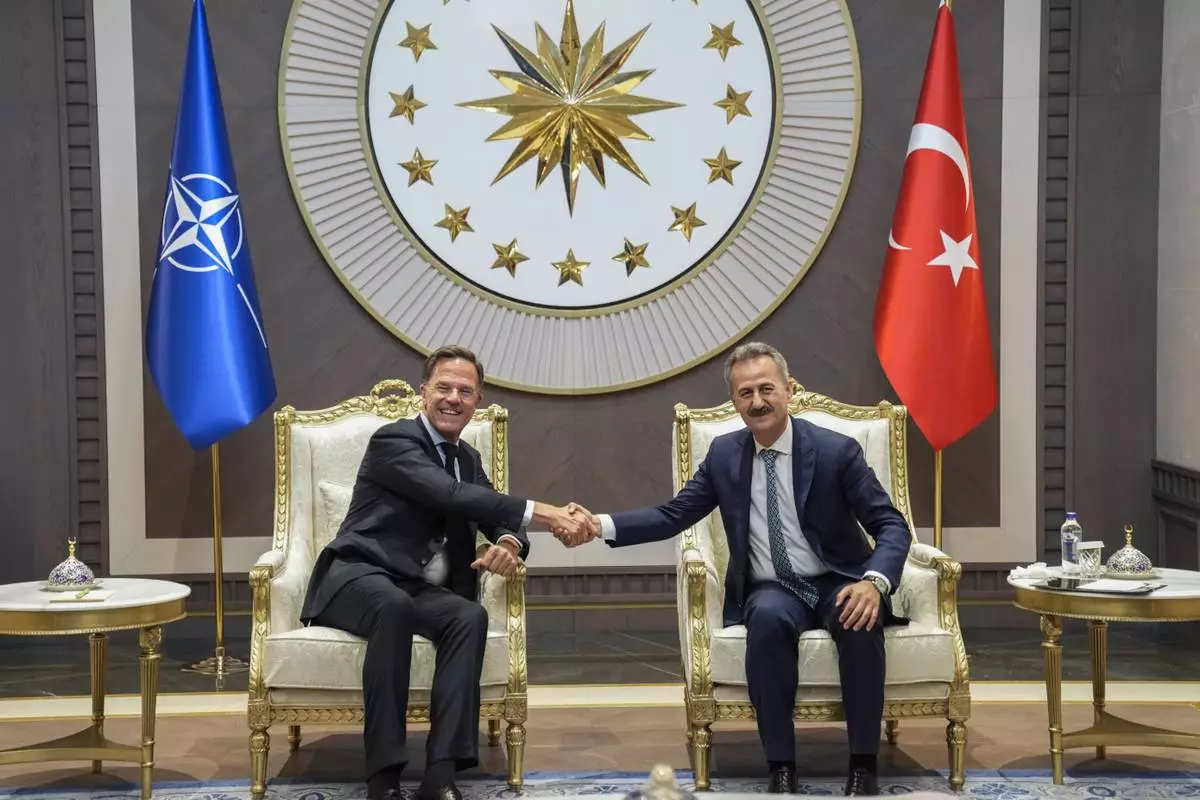
NATO Secretary General Mark Rutte, left, meets with Turkish Presidential Defense Industries Directorate Haluk Gorgun as he arrives ahead of the NATO Summit in Ankara, Turkey, Monday, July 6, 2026. (Osmancan Gürdoğan, Pool Photo via AP)

NATO Secretary General Mark Rutte, left, meets with Turkish Presidential Defense Industries Directorate Haluk Gorgun as he arrives ahead of the NATO Summit in Ankara, Turkey, Monday, July 6, 2026. (Osmancan Gürdoğan, Pool Photo via AP)

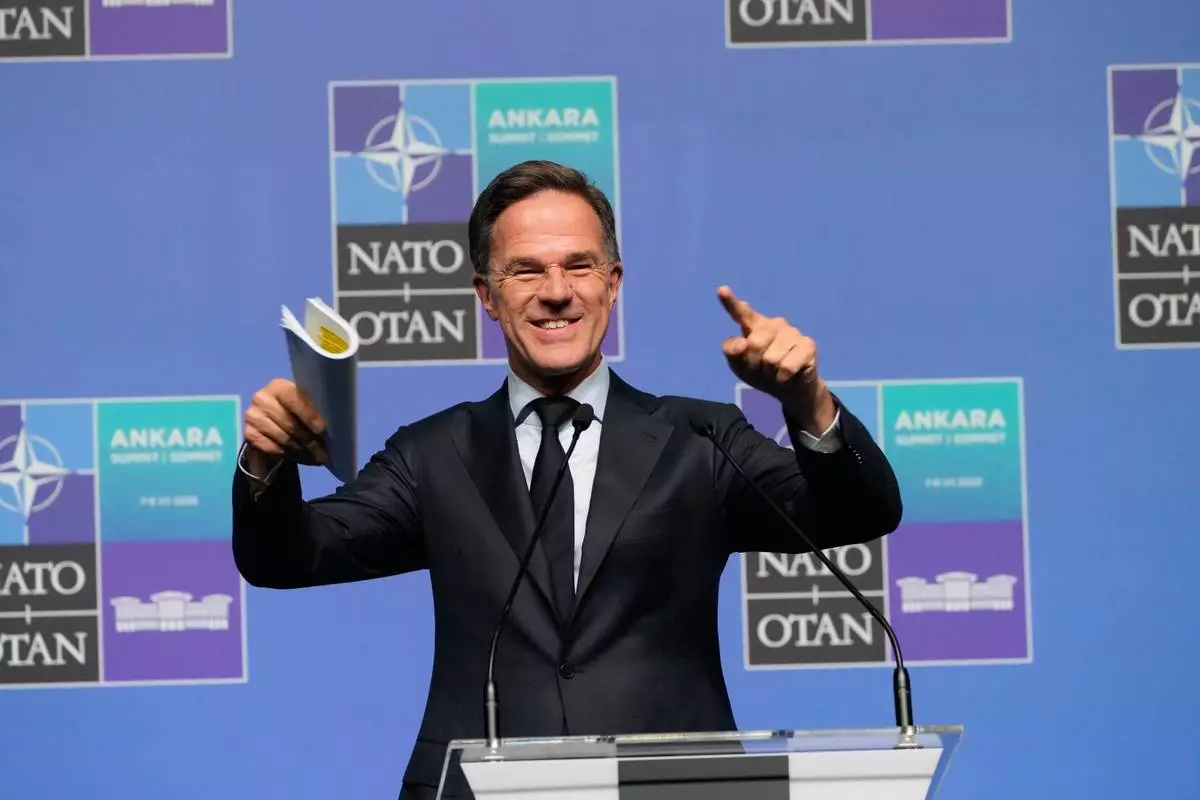
NATO Secretary General Mark Rutte speaks during a media conference at the International Media Center ahead of the NATO Summit in Ankara, Turkey, Monday, July 6, 2026. (AP Photo/Hussein Malla)

NATO Secretary General Mark Rutte speaks during a media conference at the International Media Center ahead of the NATO Summit in Ankara, Turkey, Monday, July 6, 2026. (AP Photo/Hussein Malla)

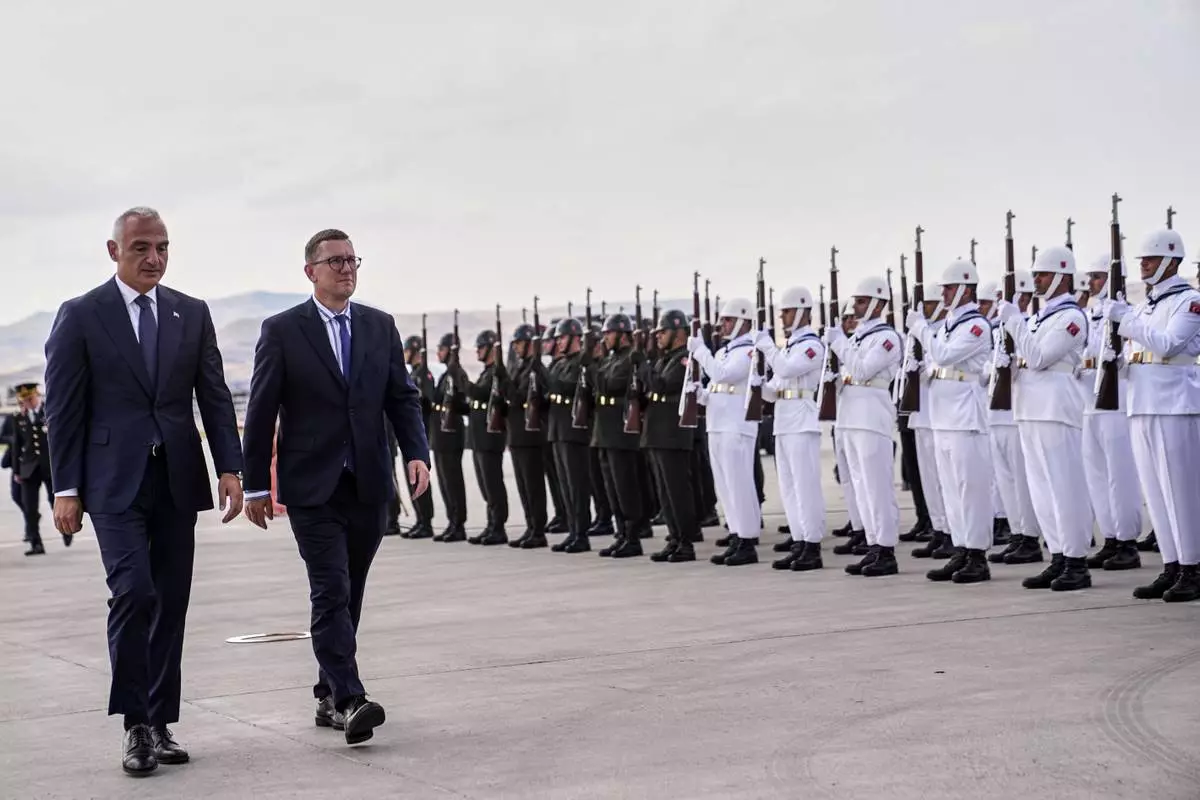
Estonia's Prime Minister Kristen Michal, center left, walks with Turkish Culture and Tourism Minister Mehmet Nuri Ersoy, left, during airport arrivals ahead of the NATO Summit in Ankara, Turkey, Monday, July 6, 2026. (Metin Aktas, Pool Photo via AP)

Estonia's Prime Minister Kristen Michal, center left, walks with Turkish Culture and Tourism Minister Mehmet Nuri Ersoy, left, during airport arrivals ahead of the NATO Summit in Ankara, Turkey, Monday, July 6, 2026. (Metin Aktas, Pool Photo via AP)

A Turkish flag and NATO banners cover buildings ahead of the NATO Summit in Ankara, Turkey, Monday, July 6, 2026. (AP Photo/Hussein Malla)

A Turkish flag and NATO banners cover buildings ahead of the NATO Summit in Ankara, Turkey, Monday, July 6, 2026. (AP Photo/Hussein Malla)

Recommended Articles