Dawa Yangdron, an early participant in a large-scale afforestation project in southwest China's Xizang Autonomous Region, has led her team in using native seedlings, which boast higher survival rates and lower maintenance costs, to restore barren highland slopes, showing a locally adapted approach to ecological restoration.
The afforestation project in the mountains to the north and south of Lhasa, the first large-scale tree planting and afforestation initiative in the history of Xizang, aims to complete 2.0672 million mu (about 137,813 hectares) of land greening over a period of 10 years since its launch in 2021.
Yangdron, general manager of Xizang Zangjian Wusheng Greening Co., is one of the earliest builders who joined the decade-long project in 2022. She has led her team at Xizang's largest native seedling breeding base, where they are dedicated to growing indigenous trees.
"This is the largest native seedling breeding base in Xizang. It covers 80 hectares and stores the seeds of more than 70 species of local plants. After collecting the seeds from across the region, we cultivate them here. On the one hand, the base supports early-stage scientific research. On the other, it supplies seedlings for the afforestation project in the mountains to the north and south of Lhasa," Yangdron said.
"When we talk about native seedlings, we mean seedlings that originated here. We've recruited more than 100 college graduates and are training local students from Xizang to research and cultivate indigenous species. To date, we've supplied 10 million native seedlings for the afforestation project. Using local seedlings for afforestation has clear advantages. The survival rate's higher, and subsequent maintenance costs are much lower. Later this year, we'll provide three million seedlings of the Piptanthus concolor variety. It's an evergreen species native to Xizang that doesn't shed its leaves in winter," she said.
Ecological protection on the plateau is no easy feat, Yangdron noted.
"The environment in Xizang is quite fragile and the climate is unique. From collecting the seeds to cultivating the seedlings, the process is highly complex and demanding, and takes a long time. While everyone talks about protecting the plateau environment, I believe Xizang Autonomous Region has stressed adapting measures to the local conditions and respecting nature. What we need to do is work even harder to put these principles into practice and safeguard the environment on the Qinghai-Xizang Plateau," Yangdron said.
Since the afforestation project took root, Yangdron said, the local climate has grown noticeably more humid, and the air feels richer in oxygen. The barren hills of the past are now draped in green, and in winter, the landscape is dotted with reds and yellows. What started as a mission to green the mountains, she added, has become a quest to make them beautiful.
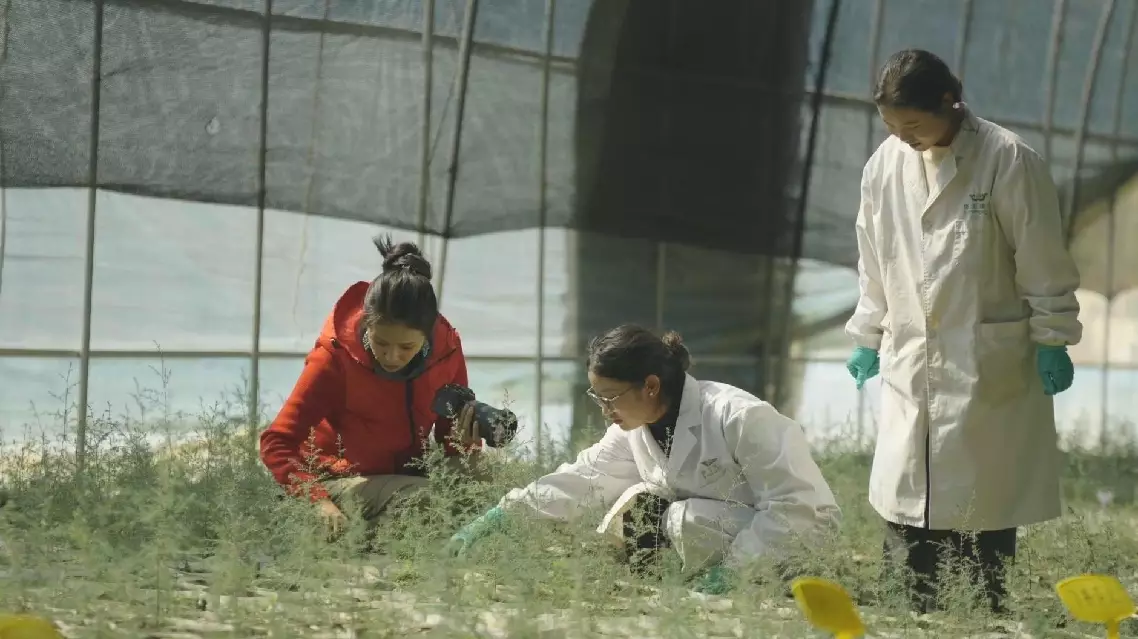
Locals foster indigenous species for ecological restoration in Xizang