Giant panda Mang Cancan celebrated his 3rd birthday on Monday with a special feast featuring various fruit and vegetable at Chongqing Zoo in southwest China.
Zookeepers prepared an elaborate birthday meal for the giant panda, including a pumpkin-carved cart and fruit hamper made of cantaloupe. The festivities were further enhanced with snow-and-ice decorations and a water-mist spray.
Despite the intense summer heat, numerous local residents and tourists made a special trip to the zoo to share birthday wishes to this beloved giant panda.
"I came to see Mang Xiaowu celebrating his birthday. He was eating watermelon and ice and looks very happy. Here I wish Mang Xiaowu a happy birthday," said a visitor.
Mang Cancan was born on July 6, 2023 at Chongqing Zoo, weighing 191 grams at birth.
As the fifth cub of his mother Mangzai, he is affectionately called Mang Xiaowu, meaning "Mang Little Five".
His official name, "Mang Cancan", was selected by over 13,000 citizens and netizens through a public vote when he was 100 days old, symbolizing beauty and brilliance in Chinese.

Giant panda Mang Cancan celebrates 3rd birthday in Chongqing
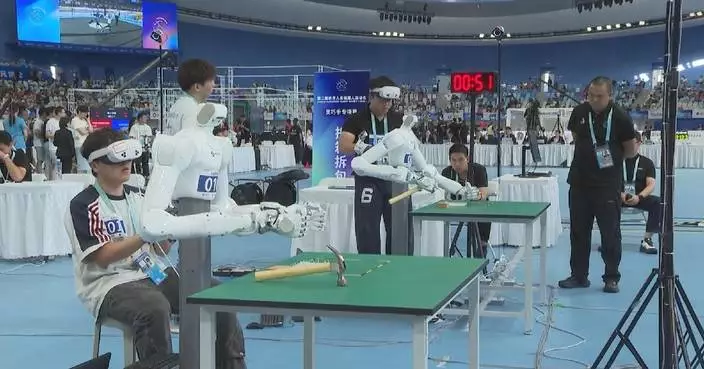
A robot unpacking competition at the 2026 World Humanoid Robot Games in Beijing concluded on Monday, putting contestants' delicate manipulation skills to the test.
As a sub-discipline of the dedicated competition for dexterous-hand, the unpacking challenge required robots to use a utility knife to slice through the sealing tape on express delivery boxes and remove the contents, all without damaging the items or significantly tearing the boxes. Scores were based on how many boxes each robot could successfully open within five minutes.
"My robot completed just one box in the preliminary round, but managed six today. We train hard every day because the precision requirements are extremely high. After cutting the tape, the robot has to open all four sides of the box so the item falls out naturally," said Wang Ruichao, a member of a competition team
Though simple for human, the task is deceptively demanding for robots to handle on their own. With a narrow blade and small handle, the utility knife requires stable multi-finger gripping and the ability to align a blade just 0.5 millimeters thick against the tape. That pushes robots to demonstrate not only object recognition and precise control, but also bimanual coordination and multi-step planning, experts said.
"The hardest part is pushing out the blade of the knife. That motion alone is very difficult. During cutting, grip strength and sensitivity vary, and incidents can happen. For example, the knife can slip. In face of such circumstances, the robot has to reposition it properly, which tests its force-control sensing," said chief referee Wang Shilong.
From picking up the knife and extending the blade to completing the cut, the routine demands comprehensive control of force, angle, and precision, as well as deep coordination between robotic arms and intelligent algorithms. Industry insiders noted that skills tested in such tasks are expected to find wider use in logistics sorting, precision instrument assembly, and other real-world scenarios where humanoid robots can add practical value.
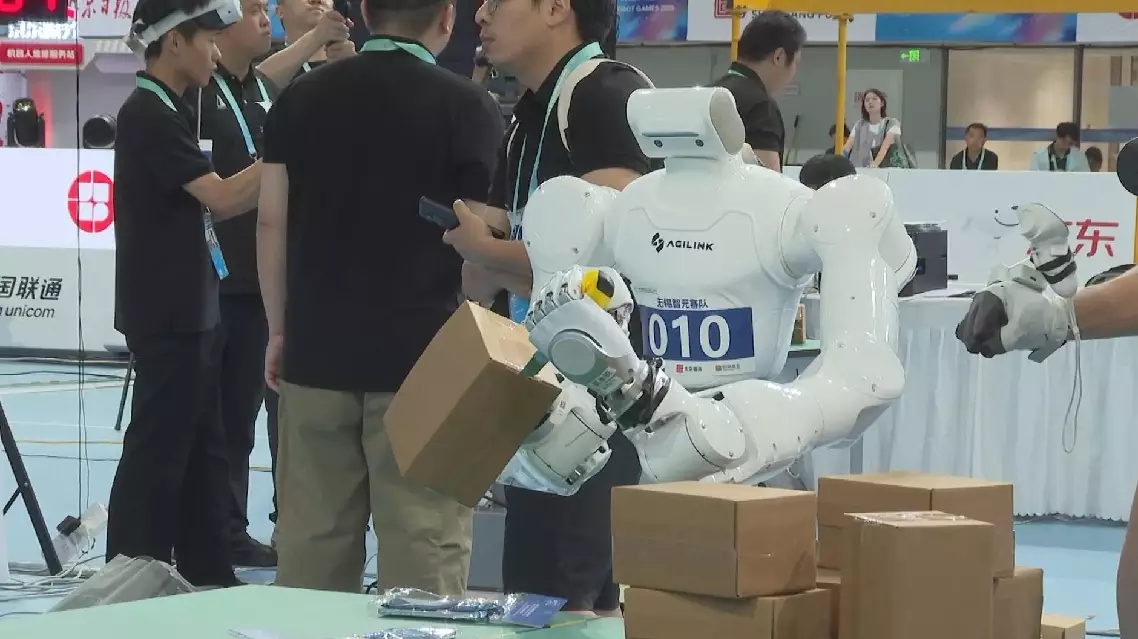
Robots race to unpack boxes at Humanoid Robot Games, showcasing delicate manipulation