Global foreign direct investment (FDI) rebounded 6 percent year on year to 1.6 trillion U.S. dollars in 2025 after two consecutive years of decline, though the recovery remained narrow, fragile and uneven, the United Nations Trade and Development (UNCTAD) said on Tuesday.
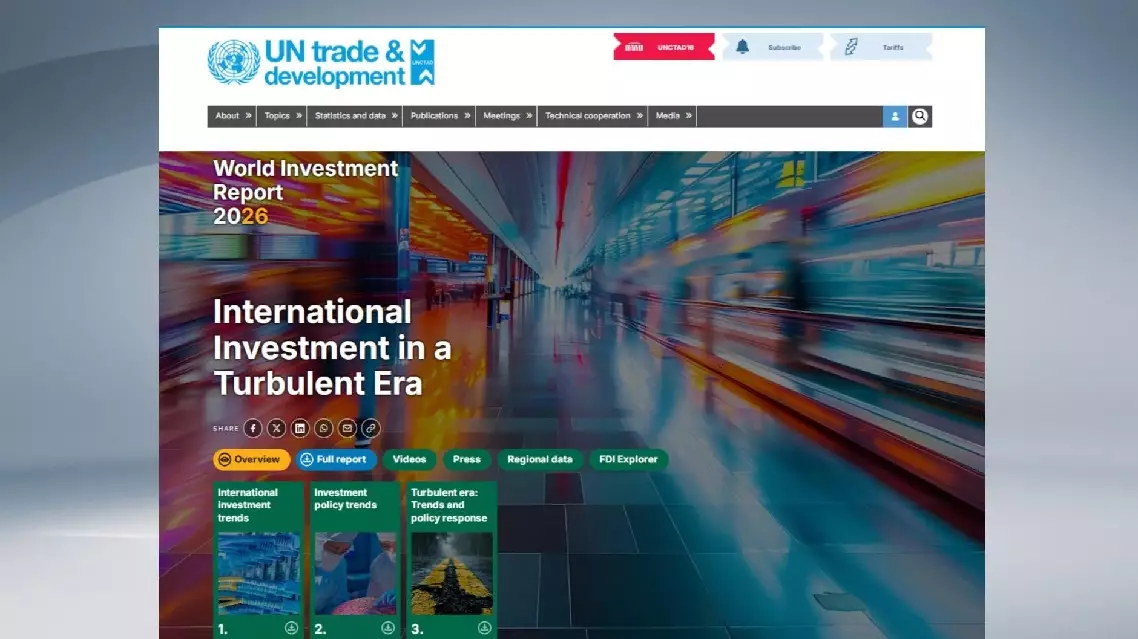
"The World Investment Report 2026: International Investment in a Turbulent Era" released by UNCTAD showed that FDI inflows to developed economies grew by 11 percent in 2025, while developing economies recorded only 2 percent growth.
The world's top 20 host economies attracted more than 80 percent of global FDI, underscoring a trend of increasing concentration, it said.
This trend was particularly evident in industries linked to technology, energy and industrial policy. Strategic sectors, including artificial intelligence (AI) infrastructure, semiconductors, critical minerals, and energy-transition technologies and services, accounted for 44 percent of global greenfield project values in 2025, up from just 16 percent in 2020, the report noted.
While global FDI returned to growth, UNCTAD said the headline figures tell only part of the story, stressing that the quality and development impact of investment matter more than the overall volume.
"The central question, then, is not how much investment crosses borders. The question is where it goes, what it builds and who it benefits. A higher FDI number is welcome, but it doesn't automatically mean stronger development impacts," said Pedro Manuel Moreno, acting secretary-general of the UNCTAD, at a press briefing in Geneva, Switzerland.
Developing economies received more than half of global FDI in 2025, but growth was "modest and uneven" across regions, the report said. According to UNCTAD, China maintained its position as a major player in two-way investment.
The UN trade body also noted that China's inward FDI is shifting from scale-driven expansion towards structural upgrading and quality improvement. The composition of FDI inflows in the country continues to move towards advanced manufacturing, scientific and technological innovation, and modern services.
The report warned that the global investment recovery has not translated evenly into development opportunities. It called for scrutiny of whether investment is expanding productive capacity, creating jobs, upgrading skills and facilitating technology transfer.
Looking ahead, UNCTAD projected that the global investment outlook for 2026 remains "difficult." It said trade policy uncertainty, geopolitical tensions, conflicts, high financing costs and economic fragmentation continue to weigh on investment decisions.
UNCTAD also noted that developing economies need more than investment promotion to compete. Measures such as integrating into global value chains, improving trade facilitation and strengthening international cooperation are also essential.
Moreno said to meeting those challenges will require countries to focus not only on attracting more investment but also on ensuring it contributes to sustainable development.
"This is not simply about attracting more investment. It is about attracting investment that supports development, resilience, and domestic value creation. For developing countries, international cooperation, investment partnerships, and risk sharing mechanisms can help create conditions that individual countries cannot build alone. That role is to help countries understand these changes and turn investment trends into development choices," Moreno said.
Global investment recovers in 2025, but remains fragile, uneven: UN Report