Skip to Content Facebook Feature Image

Amazon Supports Weekly Humanitarian Relief Flights to Venezuela in First-of-its-Kind Collaboration

Business

Amazon Supports Weekly Humanitarian Relief Flights to Venezuela in First-of-its-Kind Collaboration
Business

Business

Amazon Supports Weekly Humanitarian Relief Flights to Venezuela in First-of-its-Kind Collaboration

2026-07-08 20:32 Last Updated At:20:40

MIAMI--(BUSINESS WIRE)--Jul 8, 2026--

Amazon (NASDAQ: AMZN) today announced it will support a seven-flight humanitarian air delivery operation into Caracas, Venezuela, in response to the devastating twin earthquakes that struck northern Venezuela on June 24, leaving more than 650,000 people in need of aid.

This press release features multimedia. View the full release here: https://www.businesswire.com/news/home/20260708623040/en/

The weekly flights are possible through a collaboration between Amazon, Airlink, the U.S. State Department, and United Nations World Food Programme. The State Department will coordinate access with local authorities, Amazon will donate the aircraft and fuel at no cost to humanitarian organizations, Airlink will determine what goes on each flight based on nonprofit needs, and the World Food Programme will manage logistics in Venezuela.

"When more than 6 million people are affected and entire neighborhoods have been reduced to rubble, getting supplies quickly isn't just helpful—it's critical," said Bettina Stix, Director of Amazon's Community Impact. "This air bridge will route supplies to trusted nonprofits on the ground in Venezuela that can put them to use immediately to serve the people most affected by this catastrophe."

The humanitarian air bridge is designed to prevent an aid bottleneck—as well as a so-called "second disaster" when unrequested in-kind donations overwhelm communities and divert resources from the most urgent needs. Throughout history, collaborative humanitarian air bridges have been established to meet critical civilian needs, including after World War II, during the COVID-19 pandemic, and after Haiti earthquakes in 2010 and 2021.

Nearly a decade ago, Amazon launched its disaster relief program to use the same logistics network and aviation capabilities that deliver packages every day to customers to get emergency supplies to people who need them most. The company started with a first relief flight for Hurricane Maria and has since donated and delivered more than 26 million emergency supplies and technology in response to 200+ disasters around the world. This first-of-its-kind collaboration with Airlink is another important step in supporting people affected by natural disasters. The weekly flights are possible through Amazon Air Cargo, an air freight network built for reliability and scale. Amazon partners said:

"In a disaster of this magnitude, coordination and speed of response is everything. Amazon's donated airlift capacity allows us to move quickly and efficiently to heavily-impacted communities in Venezuela—eliminating bottlenecks and ensuring that every flight delivers what they need most. This partnership embodies Airlink's model in action: bringing the humanitarian, aviation, public, and private sectors together to get help to people in their moment of greatest need." — Paloma Adams-Allen, Airlink President and CEO

"The need on the ground in Venezuela is immense. This air bridge will support the transfer of supplies to communities efficiently through trusted humanitarian channels. Once cargo arrives in Caracas, our teams coordinate staging and distribution, so aid reaches those who need it without delay." — World Food Programme Country Director in Venezuela Stephanie Hochstetter

"This collaboration with Amazon, Airlink, and World Food Programme demonstrates what's possible when government and the private sector come together to overcome logistical barriers in a humanitarian crisis. By facilitating access and coordinating with local authorities, we're helping ensure that lifesaving aid reaches Venezuela as quickly as possible." — State Department Spokesperson Tommy Pigott

The air bridge is one part of a broad Amazon relief effort for Venezuela earthquake relief, which includes ongoing support to more than a dozen nonprofits supporting communities on the ground, volunteering events led by Amazon team members in multiple cities, and the donation and delivery of over half a million emergency supplies within days of the earthquakes. Supplies already in the hands of those who need them include tarps, water filters, sleeping bags, hygiene kits, diapers, and more. In addition, Amazon put its technology expertise to work to help the people of Venezuela—supplying rapid response technology systems (self-contained units that provide critical technology like Wi-Fi in the aftermath of disasters). In La Guaira, Venezuela, near the epicenter of the twin quakes, the systems are connecting staff at hospitals and shelters and enabling them to communicate across locations. Amazon will continue working closely with organizations on the ground as their needs evolve and stands with the people of Venezuela who have been impacted by this catastrophe.

About Amazon

When major disasters strike, Amazon applies the same strengths that get packages to doorsteps every day to get critical aid where it’s needed, fast. We work with local organizations who understand their communities best, applying our core business capabilities in logistics, technology, and innovation to help. Since 2017, we've donated and delivered more than 26 million emergency supplies and technology in response to more than 200 disasters around the world. For more information, visit aboutamazon.com/impact/community.
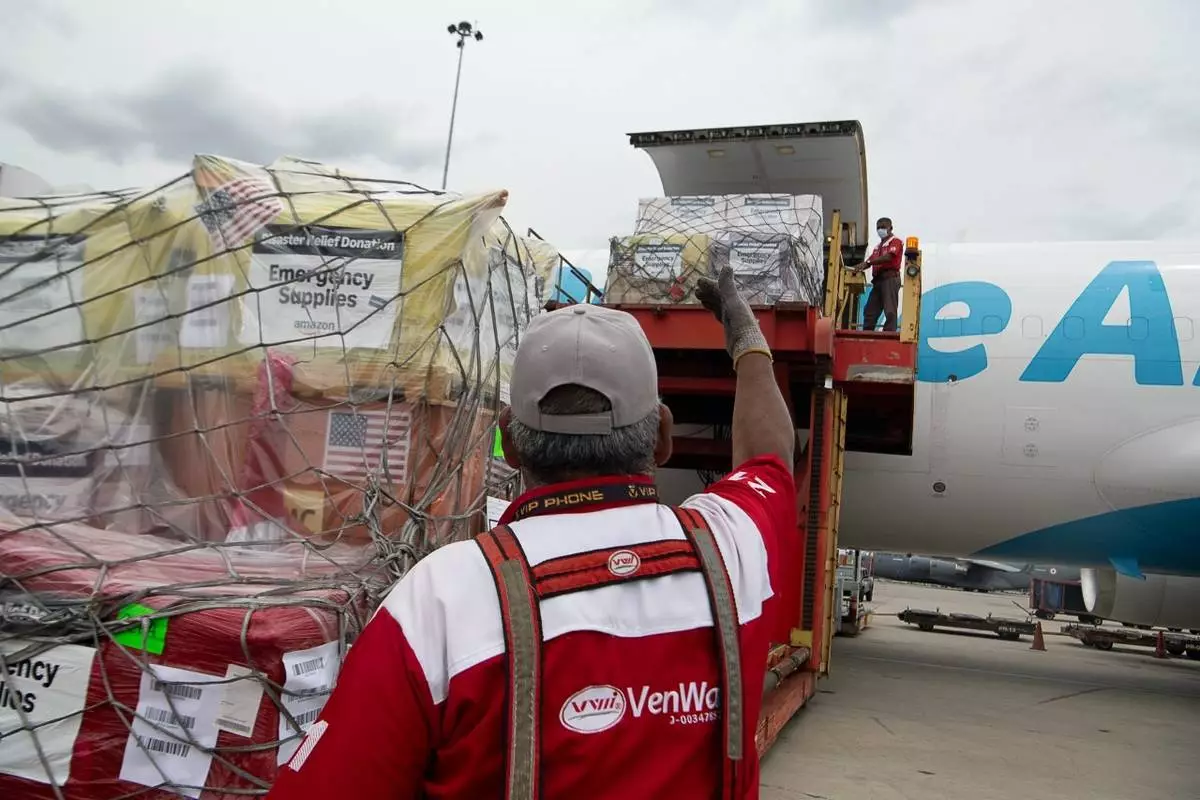
Seven weekly flights will deliver critical earthquake relief supplies to nonprofits


Seven weekly flights will deliver critical earthquake relief supplies to nonprofits

ISLAMABAD (AP) — Civilian and navy searchers off Pakistan's coast Wednesday located and recovered wreckage of a cargo plane that disappeared while approaching the southern port of Karachi while the search continues for five missing crew members, officials said.

The aircraft operated by the private carrier K2 Airways had departed from Sharjah in the United Arab Emirates and reported a navigational system problem before losing contact with air traffic control late Tuesday.

The Pakistani navy and civilian teams in planes and ships found the plane debris after about 12 hours of searching in the Arabian Sea, Pakistan’s Airports Authority said in a post on X.

Retired Rear Adm. Faisal Shah said searchers were dealing with rough seas and that they were still looking for the main wreckage of the plane, which could prove much more difficult to find because the area is believed to be about 3,000 meters (9,800 feet) deep, requiring specialized equipment.

He said recovering debris does not necessarily reveal the aircraft’s exact crash site because ocean currents, waves and wind can carry the floating wreckage far from where the aircraft went down.

In a statement, K2 Airways identified the missing crew as Capt. Muhammad Rizwan Idris, First Officer Faisal Jatoi, flight engineers Muhammad Hamid and Muhammad Arif Siddiqui, and aircraft loader Muhammad Taufiq Khan.

“We continue to pray earnestly for the safety of our colleagues,” it said.

Ghulam Nabi Bahrani, the father-in-law of co-pilot Faisal Jatoi, said the family was in regular contact with him while he was in Sharjah, and that he had called his wife shortly before departure Tuesday. Bahrani said government officials have been in contact with the family since the aircraft disappeared.

“All we can do is wait and pray for a miracle,” he said.

Pakistani Prime Minister Shehbaz Sharif released a statement expressing sympathy with the families of the five crew members, and directed the government to deploy all available resources for the search effort.

Pakistan’s Airports Authority said earlier on X that radar data showed the aircraft making a sharp change in heading and rapidly descending before radar and radio contact were lost at about 9:21 p.m., approximately 155 nautical miles (287 kilometers, 178 miles) west of Karachi.

Aviation expert Imran Aslam told local broadcaster ARY News late Tuesday that it remained unclear what caused the aircraft to disappear from radar. He said that even if an aircraft suffered an engine failure, it would normally continue gliding rather than plunge suddenly. He said the exact cause would become clear only after investigators gathered more evidence.

In May 2020, a Pakistan International Airlines flight carrying 98 people crashed into a densely populated neighborhood near Karachi airport while attempting to land. All but one of the 99 people on board were killed. A government investigation later concluded that human error by the pilots and air traffic controllers caused the crash.

Associated Press writer Muhammad Farooq contributed to this story from Karachi, Pakistan.

Ghulam Nabi Bahrani, left, father-in-law of missing cargo plane crew First Officer Faisal Jatoi, with others pray for Jatoi at his home in Karachi, Pakistan, Wednesday, July 8, 2026. (AP Photo/Ali Raza)

Ghulam Nabi Bahrani, left, father-in-law of missing cargo plane crew First Officer Faisal Jatoi, with others pray for Jatoi at his home in Karachi, Pakistan, Wednesday, July 8, 2026. (AP Photo/Ali Raza)

Ghulam Nabi Bahrani, father-in-law of missing cargo plane crew First Officer Faisal Jatoi, showed his picture on a mobile phone in Karachi, Pakistan, Wednesday, July 8, 2026. (AP Photo/Ali Raza)

Ghulam Nabi Bahrani, father-in-law of missing cargo plane crew First Officer Faisal Jatoi, showed his picture on a mobile phone in Karachi, Pakistan, Wednesday, July 8, 2026. (AP Photo/Ali Raza)

In this photo released by Pakistan Navy, Pakistan Navy personnel examine the wreckage of a cargo plane of the private carrier K2 Airways on a naval ship after recovering them from deep sea near Omara, a town some 360 kms. (220 miles) west of Karachi, Pakistan, Wednesday, July 8, 2026. (Pakistan Navy via AP)

In this photo released by Pakistan Navy, Pakistan Navy personnel examine the wreckage of a cargo plane of the private carrier K2 Airways on a naval ship after recovering them from deep sea near Omara, a town some 360 kms. (220 miles) west of Karachi, Pakistan, Wednesday, July 8, 2026. (Pakistan Navy via AP)

In this photo released by Pakistan Navy, Pakistan Navy personnel shift the wreckage of a cargo plane of the private carrier K2 Airways into a naval ship after recovering them from deep sea near Omara, a town some 360 kms. (220 miles) west of Karachi, Pakistan, Wednesday, July 8, 2026. (Pakistan Navy via AP)

In this photo released by Pakistan Navy, Pakistan Navy personnel shift the wreckage of a cargo plane of the private carrier K2 Airways into a naval ship after recovering them from deep sea near Omara, a town some 360 kms. (220 miles) west of Karachi, Pakistan, Wednesday, July 8, 2026. (Pakistan Navy via AP)

In this photo released by Pakistan Navy, Pakistan Navy personnel shift the wreckage of a cargo plane of the private carrier K2 Airways into a naval ship after recovering them from deep sea near Omara, a town some 360 kms. (220 miles) west of Karachi, Pakistan, Wednesday, July 8, 2026. (Pakistan Navy via AP)

In this photo released by Pakistan Navy, Pakistan Navy personnel shift the wreckage of a cargo plane of the private carrier K2 Airways into a naval ship after recovering them from deep sea near Omara, a town some 360 kms. (220 miles) west of Karachi, Pakistan, Wednesday, July 8, 2026. (Pakistan Navy via AP)

Recommended Articles