A veteran scientist's five decades of unwavering dedication to research has laid the foundation for China to secure a spot among leading global players in lithium battery technology.
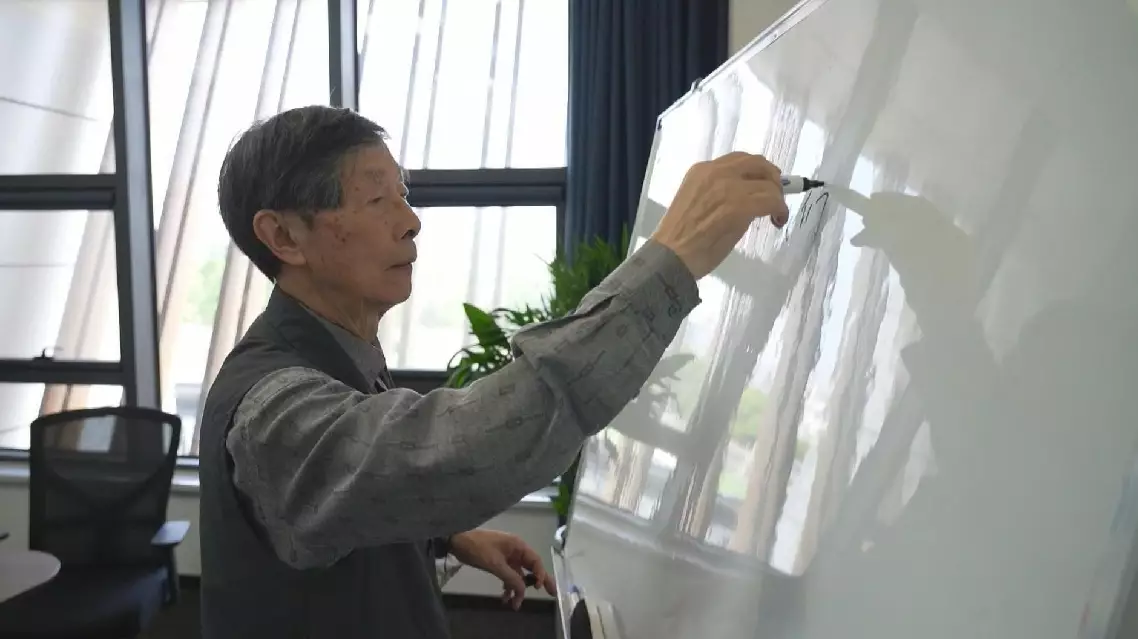
Chen Liquan, born in 1940, is a researcher at the Institute of Physics (IOP) under the Chinese Academy of Sciences (CAS), and an academician of the Chinese Academy of Engineering (CAE). He is widely recognized as the founder, pioneer and leader of China's lithium battery sector.
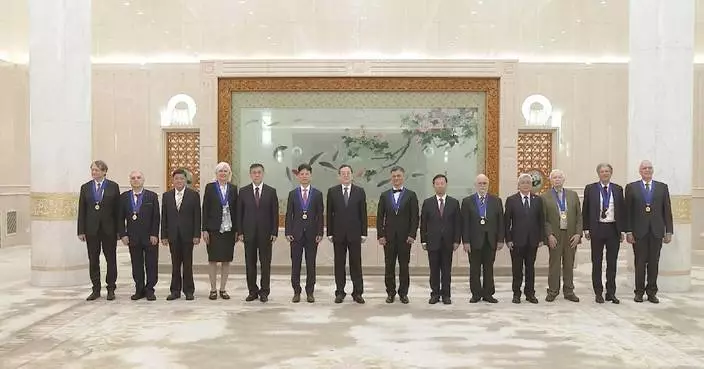
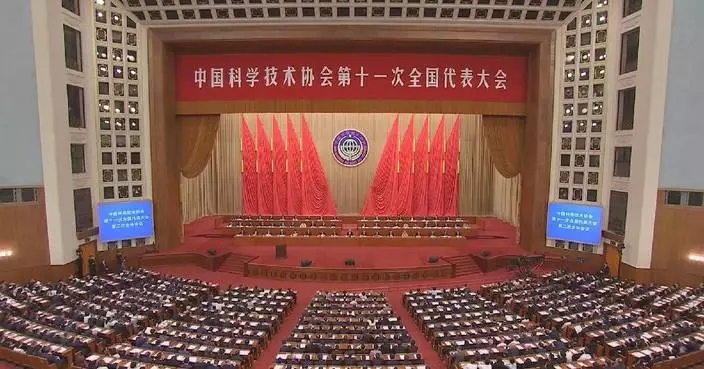
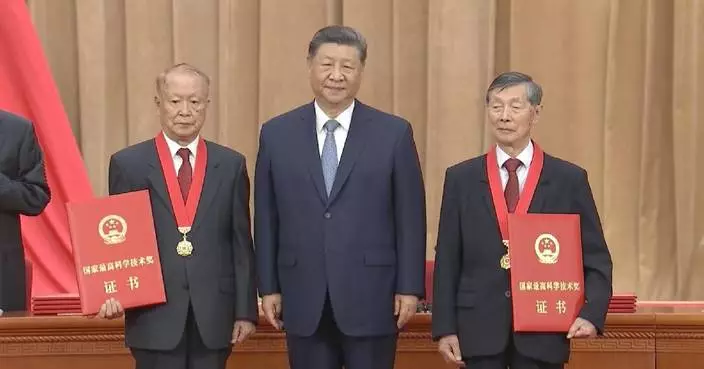
He led his team to develop China's first solid-state lithium battery and first liquid lithium-ion battery, while actively pushing for their industrialization. For his indispensable contributions to China's lithium battery journey -- from scratch to global prominence, from follower to front-runner -- he was presented with China's top sci-tech award for the year 2025 in Beijing on Wednesday.
Electric vehicles now weave through every corner of China's streets, but few know that the tide of this green revolution began with a single turning point in Chen Liquan's life 50 years ago. In 1976, the 36-year-old researcher was sent to Germany by the CAS, where a material called lithium nitride rerouted his entire career.
"This was a piece of lithium nitride we had back then. A German researcher told me that this material was something extraordinary -- it could one day power batteries and even cars. Those words changed my path. I knew I had to find a way to switch and devote myself to this line of work," said Chen.
"I do whatever the country needs. Why am I so driven by national priorities? Much of it comes from the environment I grew up in -- we were raised with the ideal of building communism. I joined the Communist Party of China (CPC) in 1961, and communism has been my goal ever since," he said.
For Chen, the nation's needs define the direction of his efforts. Before his trip to Germany, he had followed the arrangements of the Institute of Physics and taken on a variety of research tasks over a decade.
But the shift to lithium nitride research was different -- it was Chen's own initiative to change course. He submitted a formal request to the institute to pivot from crystal growth to solid-state ionics. The request was quickly approved, setting him on a path that would keep him rooted in lithium battery research for the next 50 years.
At the time, domestic research on lithium batteries was virtually nonexistent. Chen and his team pressed forward against overwhelming odds -- sharing lab space when they had none, building their own equipment when they couldn't buy it. Through repeated failures and relentless exploration, they finally succeeded in 1988, ten years after Chen returned from Germany, with the birth of China's first solid-state lithium battery at the IOP.
But just as the solid-state battery took shape, the global technological landscape turned dramatically. In 1990, a Japanese company announced the commercialization of liquid lithium-ion batteries. Realizing China could not afford to fall behind, Chen pivoted immediately to liquid lithium-ion research and traveled to Japan to learn from the pioneers.
In 1998, using home-built equipment, domestically sourced raw materials and homegrown technology, Chen's team completed China's first pilot production line, capable of producing 200,000 cylindrical liquid lithium-ion cells annually, solving the key technical and engineering challenges of scalable production.
"Back then, there were no lithium battery manufacturing equipment in China. We had to source materials everywhere -- and if they weren't available, we had to make them ourselves. We used the most basic furnaces, even a microwave oven from the kitchen, to prepare cathode materials. We did make sample cells, but they were far from meeting application requirements. Every step posed new challenges. Our team was shrinking too -- some retired, others went abroad -- and funding was extremely tight. But none of that shook Chen's resolve to keep the lithium battery program going." said Huang Xuejie, a researcher at the IOP and a student of Chen.
At the lowest point, the research team was down to just a few members. Chen responded by doubling down on basic research to improve battery performance, while simultaneously pushing for industrial adoption of the technology.
He has long emphasized the critical importance of basic research. He said, "Basic research -- once you're convinced it matters, you have to stick with it. Without that persistence, you wouldn't have six or seven PhD students all working in the same direction. A good paper doesn't equal good technology; good technology doesn't equal a good product; and a good product doesn't equal a good market. You can't just publish a paper and call it done. In 2010, I gave a presentation on how China's lithium battery industry could break through. Afterward, the chairman of Contemporary Amperex Technology Co. Limited (CATL) made a pact with me -- we committed to making that breakthrough happen."
"We had always been followers -- following Japanese scientists and engineers. Whether we could one day surpass Japan, South Korea and other countries -- that was a dream he always carried with him," said Li Hong, another student of Chen.
Driven by that dream, Chen and his team achieved one breakthrough after another in core technologies and key materials. They developed nano-silicon-carbon anode materials -- the world's first such innovation to be produced at scale -- with overall performance reaching globally competitive levels.
With strong state backing and concerted efforts from research institutions and enterprises, China's share of the global lithium-ion battery market overtook Japan and South Korea in 2014, climbing to number one.
But for Chen, the mission was far from complete. "Once we made breakthrough, everyone was overjoyed. But I immediately started thinking -- how do we keep our top position? You need fresh ideas, constantly. A nation moving forward can't just copy others. We need our own approach. Without new thinking, you can't lead -- and you can't stay ahead," he said.
With lithium-ion batteries approaching their energy density limits, persistent safety concerns and finite lithium resources, Chen turned his focus back to where it all began -- solid-state batteries.
In 2016, his team pioneered an "in-situ solidification" approach to solid-state batteries, solving the long-standing global challenge of solid-solid interfaces and delivering a comprehensive solution for solid-state battery systems. In 2020, at the age of 80, Chen gave a public lecture reiterating his vision for an "Electric China" and calling for urgent action to make it happen.
Through five decades of perseverance, Chen and his team built an end-to-end innovation chain for lithium battery technology -- from basic research and key materials to device prototyping, pilot-scale production and industrial deployment. The dreams he once pursued have long become reality. Yet even in his 80s, Chen continues to look ahead with fresh ambitions.
"There is still so much to do. This is by no means the end. The goals ahead are even greater. I pledged to devote my entire life to the cause of communism -- and that is exactly what I have been doing, every step of the way," said Chen.
Scientist's half-century persistence powers China's lithium battery global dominance