Driven by advantages in new energy and intelligent vehicle technologies, China's automotive exports are evolving into a new development pattern characterized by "ecosystem-based global expansion."
An official from the China Council for the Promotion of International Trade(CCPIT) said that since 2023, China's new energy vehicle exports have maintained an average annual compound growth rate of approximately 50 percent. Meanwhile, export destinations have continued to expand, reaching over 100 countries and regions across the world, forming a new feature of diversified overseas market development.
"Through two decades of export accumulation, Chinese automakers have gradually established overseas presence, driving a wave of supply chain enterprises to expand abroad. Additionally, we are continuously upgrading our overseas parts warehouses and after-sales service networks," said Zhao Yang, vice chairman of the Automotive Committee of the China Council for the Promotion of International Trade (CCPIT).
A representative from the China Association of Automobile Manufacturers (CAAM) noted that in the first half of this year, China's automotive industry operated in a generally stable manner. Looking ahead to the second half of the year, the industry should focus on globalization.
"Chinese automakers are actively advancing global strategic layouts, with overseas market presence continuing to diversify and local services constantly improving, effectively enhancing trade resilience. Industry enterprises need to proceed steadily and focus on three key areas: international market compliance, risk prevention and control, and service guarantees," said Chen Shihua, deputy secretary-general of CAAM.
In the second half of 2026, Chinese automakers should shift from "price wars" to "value wars," winning markets through optimized configurations, upgraded services, and a focus on core self-developed technologies, Chen noted.
On the technical front, automakers should continue investing in cutting-edge fields such as artificial intelligence large models and solid-state batteries, he added.
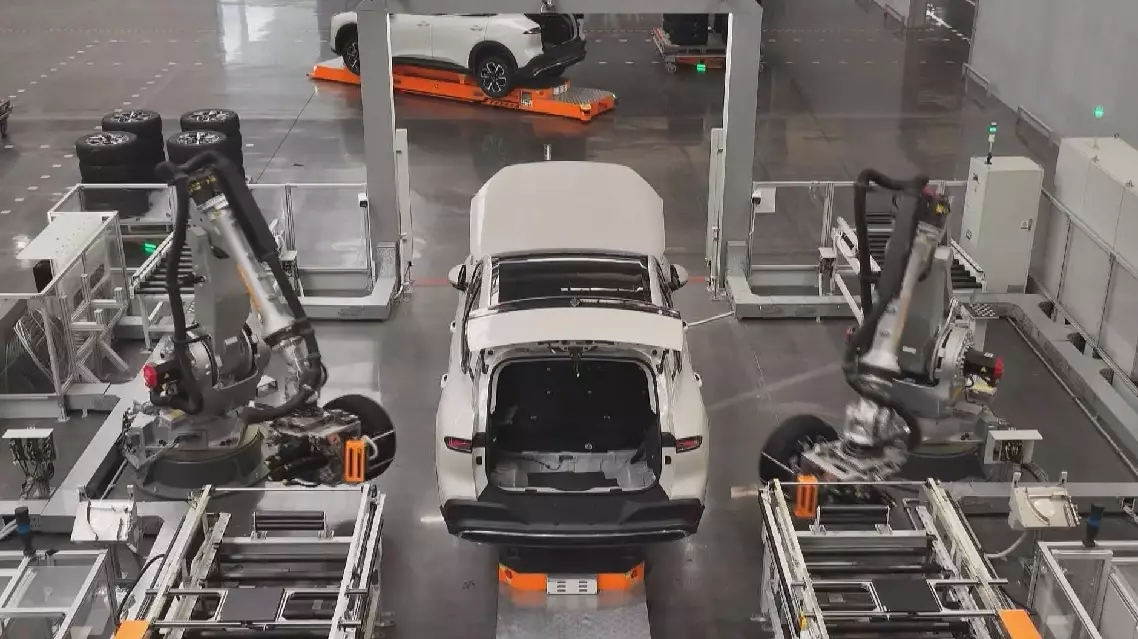
China's auto industry embraces "ecosystem-based" global expansion
China's Producer Price Index (PPI) rose 1.5 percent year‑on‑year in the first half of the year, influenced by improved supply‑demand dynamics in domestic industries and fluctuations in international commodity prices, the National Bureau of Statistics (NBS) said Friday.
The growth rate widened compared with the same period last year, pointing to a gradual recovery in industrial production prices, the NBS said.
Data showed that in June alone, the PPI increased by 4.1 percent, with the growth rate widening by 0.2 percentage points compared to the previous month.
"In terms of production, the industrial sector has become increasingly intelligent, green, and integrated, while the new economy and new growth drivers played an ever-greater role in supporting and leading the sector, resulting in rising prices in related industries," said Dong Lijuan, chief statistician of the NBS' Department of Urban Surveys.
Due to international factors, prices in the petroleum-related industries have shifted from a downward trend to an upward one. In the first half of the year, prices in petroleum and natural gas extraction, as well as petroleum, coal, and other fuel processing industries, all turned from decline in the first quarter to growth, according to the NBS.
Additionally, certain downstream manufacturing sectors saw sustained price improvement thanks to optimized market competition order. The year-on-year growth rates of ex-factory prices in the electrical machinery and equipment manufacturing sector, as well as the computer communication, and other electronic equipment manufacturing sector, both expanded compared to last year.
In the non-ferrous metals industry, driven by demand from new energy and artificial intelligence development, prices continued their strong upward trend. Specifically, in the first half of the year, ex-factory prices in non-ferrous metal mining and dressing, as well as non-ferrous metal smelting and rolling processing, rose by 31.7 and 21.9 percent year-on-year, respectively.
In the petrochemical industry, influenced by the U.S.-Israel-Iran conflict, prices rose to varying degrees. In the first half of the year, ex-factory prices in petroleum and natural gas extraction, petroleum, coal, and other fuel processing, and chemical raw materials and chemical products manufacturing increased by 8.6 percent, 3.1 percent, and 3.9 percent year-on-year respectively.
In the ferrous metals industry, supported by front-loaded infrastructure investment and strengthened capacity and output regulation, prices stabilized. The year-on-year price change in ferrous metal smelting and rolling processing turned from negative to positive starting in May, with the decline in the first half of the year narrowing compared to the same period last year.
"Certain downstream manufacturing sectors have seen sustained price improvement under the influence of optimized market competition order, computing infrastructure construction, and industrial technology upgrades. In the first half of the year, the year-on-year growth rates of ex-factory prices in the electrical machinery and equipment manufacturing sector, as well as the computer, communication, and other electronic equipment manufacturing sector, both expanded compared to the same period last year," said Liu Nancun, an economist with the National Development and Reform Commission.
China's PPI rises 1.5 pct in first half of 2026