LONDON (AP) — British police on Friday arrested a 26-year-old man on suspicion of murder in the killing of Ann Widdecombe, a former British member of Parliament and reality TV contestant.
Widdecombe, 78, was found dead on Thursday in her Haytor Vale home on the edge of Dartmoor National Park in southwest England after sustaining what police said were “serious injuries.”
The killing was not believed to be an act of terror and there was no information to suggest it was politically motivated, Devon and Cornwall Police Assistant Chief Constable Matt Longman said.
Longman did not discuss a possible motive but said the suspect was in custody as the investigation continues.
“This is really shocking news, and my thoughts, I think all of our thoughts, will be with the family and friends of Ann Widdecombe at this awful time,” Prime Minister Keir Starmer said. “Ann was a distinguished politician over many, many years with many achievements, and it’s a huge, huge loss.”
Widdecombe found fame after leaving Parliament as a contestant on the Strictly Come Dancing and Celebrity Big Brother reality television shows. She later joined the Brexit Party and became a spokeswoman for the anti-immigration Reform UK party.
She served in the House of Commons as an MP from 1987 to 2010 and was known for socially conservative views opposing abortion rights and expansion of LGBTQ rights.
Starmer said the security of lawmakers was “of the utmost importance” as he urged people to rise above political differences.
Security has been tightened for politicians after the murders of two serving members of Parliament in the past decade. Labour lawmaker Jo Cox was shot and stabbed in 2016 by a far-right extremist, and Conservative David Amess was stabbed in 2021 by an attacker inspired by the Islamic State group.
Nigel Farage, leader of Reform, said he was deeply upset over Widdecombe's death and noted that “things have become even more dangerous” for people in public life.
Former Prime Minister Boris Johnson called Widdecombe a “heroic Brexiteer and a great speaker who could move Tory audiences to such ecstasy that she was a very hard act to follow."
The management company that represented her after she left politics said her life and career were driven by strong Christian values and a commitment to public service.
“She loved the cut and thrust of political debate and, 16 years after leaving Parliament, was still actively campaigning for Reform UK and offering forthright views on the hot topics of the day,” Cloud9 Management said.
“As Ann once said...‘we get one go this side of eternity, one go. Life is not a dress rehearsal, you take opportunities that you like and you go for it, that’s my philosophy’.”
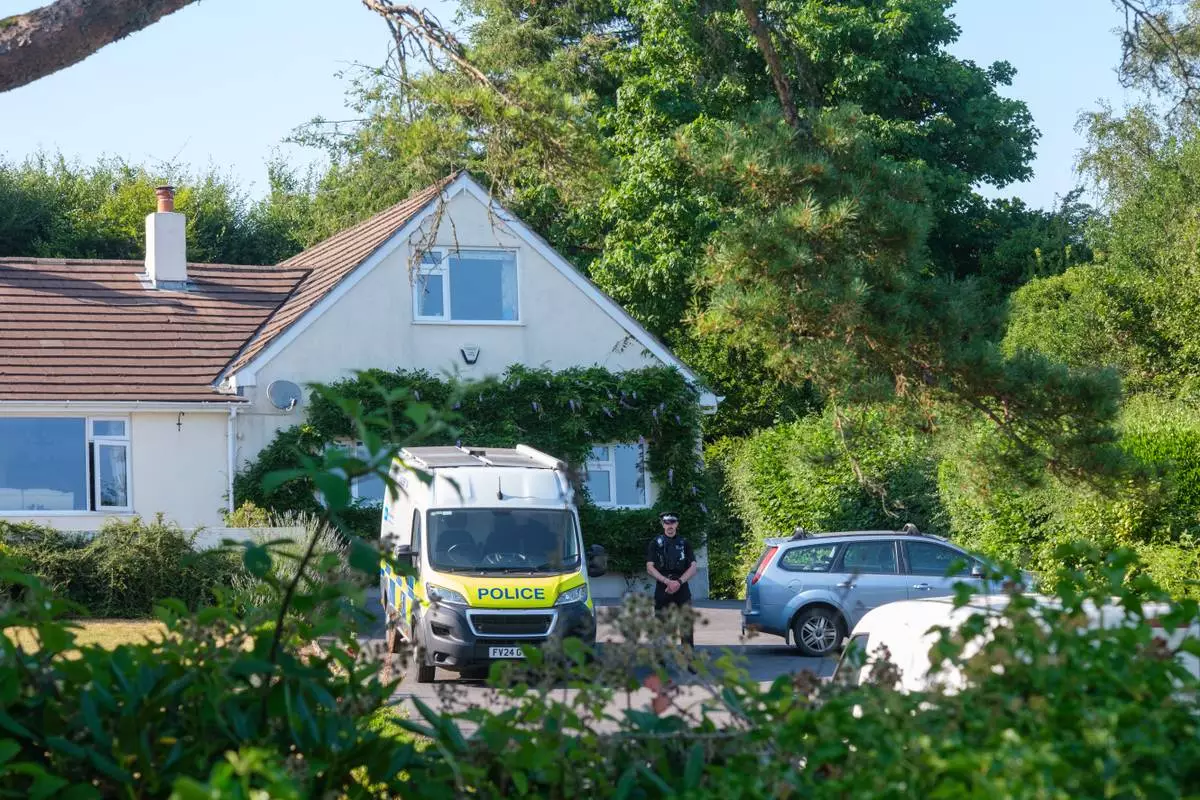
Police outside the house of former lawmaker Ann Widdecombe, in Haytor, England, Friday July 10, 2026, after she was found dead in her home on Thursday with serious injuries. (Matt Keeble/PA via AP)
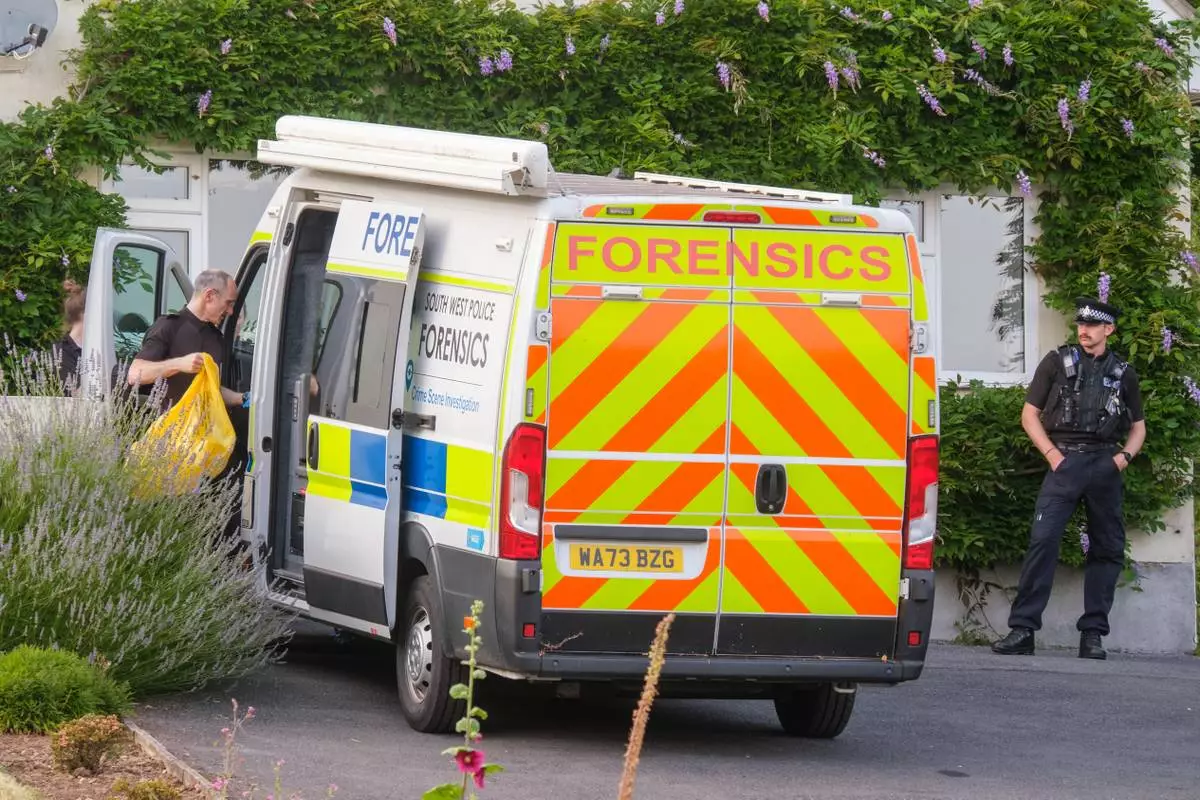
Police outside the house of former lawmaker Ann Widdecombe, in Haytor, England, Friday July 10, 2026, after she was found dead in her home on Thursday with serious injuries. (Matt Keeble/PA via AP)

FILE - Britain's European parliament member Ann Widdecombe, right, of the Brexit party, speaks during a debate at the European parliament, Jan. 14, 2020, in Strasbourg, eastern France. (AP Photo/Jean-Francois Badias, File)
MILAN (AP) — Italy deployed soldiers to Milan as the nation's fashion and finance capital expected fresh protests on Saturday, one week after looting and clashes with police.
Premier Giorgia Meloni announced a raft of measures, including sending an additional 500 soldiers to Milan, and tougher penalties for minors, who police said made up a large part of the violent protesters.
While protests in France have claimed most international attention, Milan is among the many other European cities where protests are also scheduled Saturday, from Portugal to Albania.
The 500 soldiers deployed to Milan come in addition to hundreds already stationed there, and will support about 5,000 police and other law enforcement personnel. Authorities are conducting drone surveillance, checks at railway stations, rapid-response units and online monitoring for potential calls to violence. Milan Mayor Giuseppe Sala has said he is concerned about a repeat of violence this weekend and expressed support for the deployment of more soldiers.
Rioters last weekend smashed their way into stores, targeting sneakers, athletic wear and sporting goods on streets that run off the city’s central Duomo square.
Officials said security measures on Saturday would extend beyond the city center amid concerns protesters could move into other neighborhoods to evade heavily policed areas.
Valter Mazzetti, secretary general of the Fsp police union, told The Associated Press that soldiers could provide immediate reinforcements, but not resolve police staffing shortages, noting that managing demonstrations requires specialized police training.
Defense Minister Guido Crosetto said in a social media post that the troops lacked key tools available for public-order operations, and that soldiers were only recently allowed to use plastic restraint ties and only in areas around train stations, not throughout the city. They are not authorized to carry pepper spray or tasers, he said.
Milan police say last week's violence and looting involved about 2,000 very young protesters, a large number of whom were “naturalized, second-generation Italians,” alongside foreign nationals. Over two days, police arrested 45 people, 34 of them minors.
Milan’s welfare councilor Lamberto Bertolé told the AP that more investigation is needed to understand the backgrounds and motives of the young people who joined the looting.
“Many young people increasingly lack a sense of belonging and prospects for the future. Part of our society feels excluded, amid social and economic inequalities,” said Bertolé, a member of the center-left Democratic Party.
Security was also heightened in Rome, where authorities locked down luxury shopping streets and stepped up controls around the Circus Maximus and Piazza del Popolo ahead of planned demonstrations, including one by right-wing students.
An anti-war march is scheduled to start in the early afternoon at the central Piazza della Repubblica, and there are concerns over possible infiltration by violent groups.
Organizers sought to distance themselves from potential unrest, urging participants to keep their faces uncovered and hands visible.
Aside from Rome and Milan, demonstrations have been called in at least seven other cities. The newly formed “October 17 Movement” has been the main driver alongside student federations, grassroots trade unions, and anti-war coalitions.
Protests are expected to continue in Albania’s capital. For over a week, protesters have hurled rocks, flares, firebombs and fireworks at police who have used batons, water cannons and tear gas in clashes in the city center.
High school and university students are demanding lower tuition fees, greater state investment in education and protesting corruption in the education system. They have joined a broader anti-government movement calling for the resignation of Socialist Prime Minister Edi Rama.
Thousands of retirees and others marched in Spain's capital Saturday to demand public pensions aren’t meddled with.
Crowds marched peacefully down a treelined avenue in central Madrid, waving colorful flags and banners reading “protect pensions” and “decent pensions for today and the future."
The protests came ahead of next month’s snap election as Prime Minister Pedro Sánchez’s Socialist Party criticized the conservative opposition Popular Party for making overtures about privatizing public pensions.
Spain has been roiled by protests this fall around the issue of housing, as rental and home costs have risen in recent years beyond what many Spaniards can afford.
In Spanish cities, a housing supply shortage has worsened thanks to population growth driven by tourism, immigration and a proliferation of short-term rentals. The September eviction of an 87-year-old woman from her rented apartment in Madrid triggered huge street protests in the capital and elsewhere.
The movement is centered at a tent camp protest that has remained in the capital’s Puerta del Sol square for almost a month.
Taking their cue from Spaniards, protesters in Lisbon who have been gathering to demand affordable housing are expected to march across the city on Saturday.
They have also targeted recent measures announced by the government of Prime Minister Luis Montenegro that include easing the cap on yearly rent increases and facilitating the eviction of tenants who fail to pay rent.
Montenegro defends the measures saying that it aims at reinforcing trust between tenants and landlords and boosting the rentals market. Protesters claim that the measures are not balanced and put tenants in a more vulnerable position.
Associated Press writers Suman Naishadham in Madrid, Giada Zampano in Rome, and videojournalist Helena Alves in Lisbon contributed to this report.
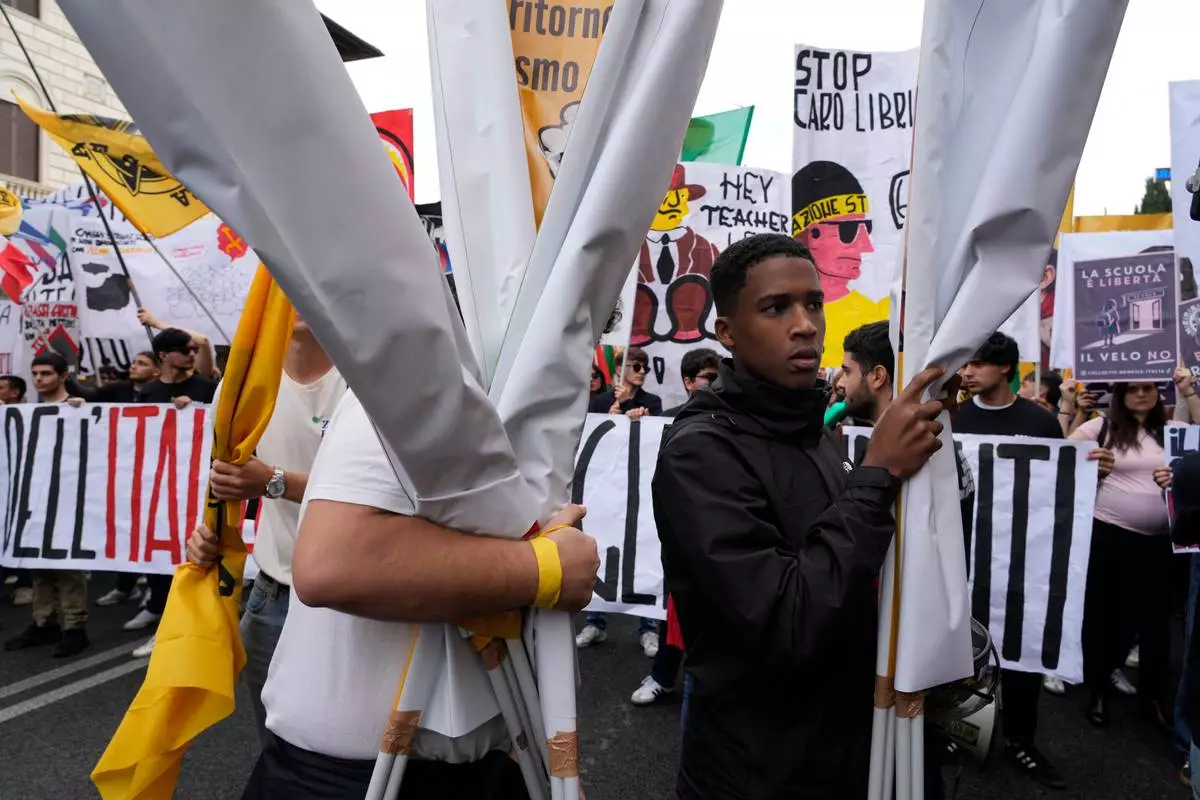
Members of right-wing student groups march through the streets of Rome, Saturday, Oct. 24, 2026, during a demonstration called "Unlock Everything," organized in opposition to recent left-wing student protests and one of several demonstrations held by groups across the political spectrum. (AP Photo/Gregorio Borgia)
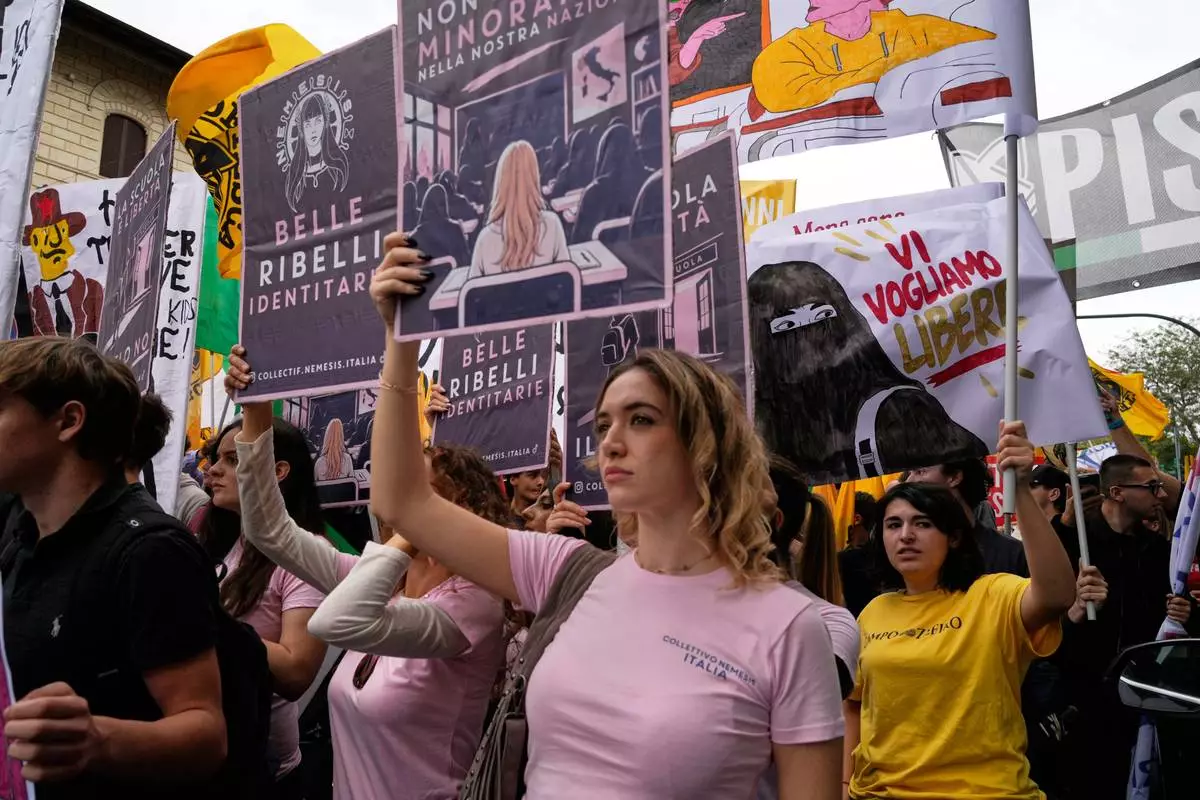
Members of right-wing student groups march through the streets of Rome during a demonstration called "Unlock Everything," organized in opposition to recent left-wing student protests and one of several demonstrations held by groups across the political spectrum, Saturday, Oct. 24, 2026. (AP Photo/Gregorio Borgia)
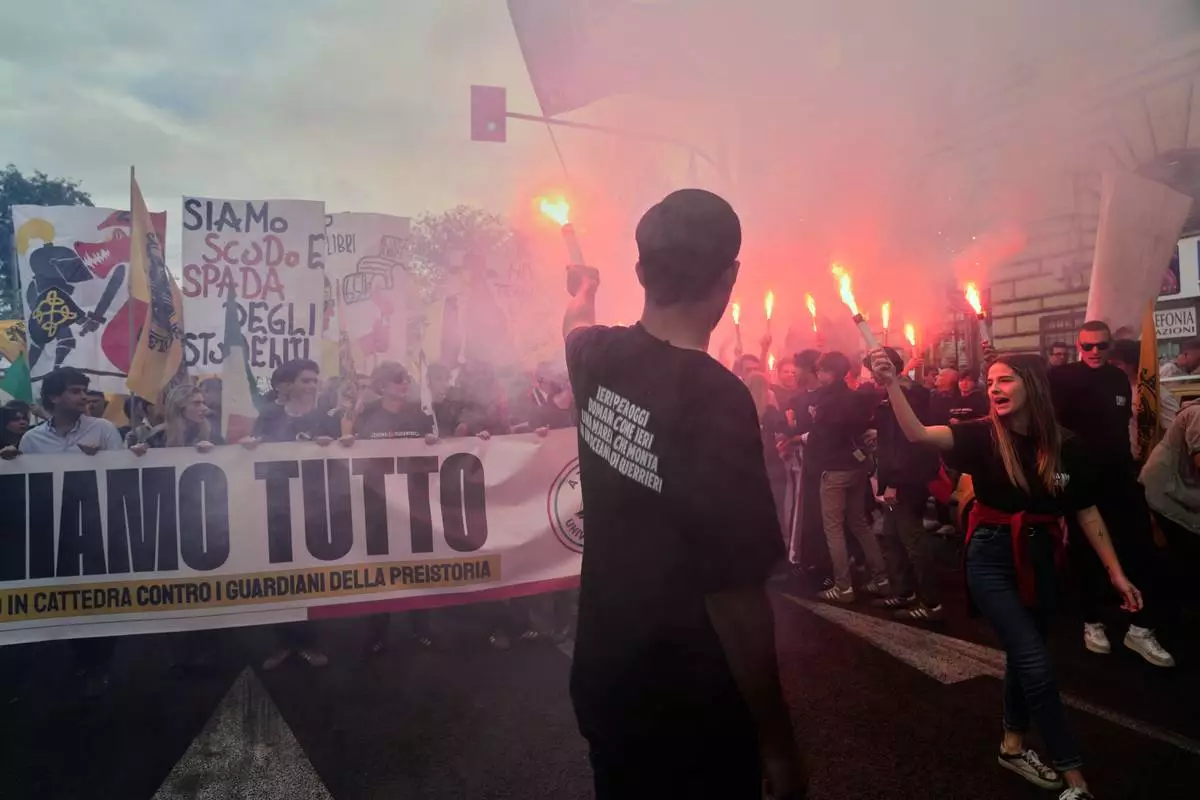
Members of right-wing student groups march through the streets of Rome during a demonstration called "Unlock Everything," organized in opposition to recent left-wing student protests and one of several demonstrations held by groups across the political spectrum, Saturday, Oct. 24, 2026. (AP Photo/Gregorio Borgia)
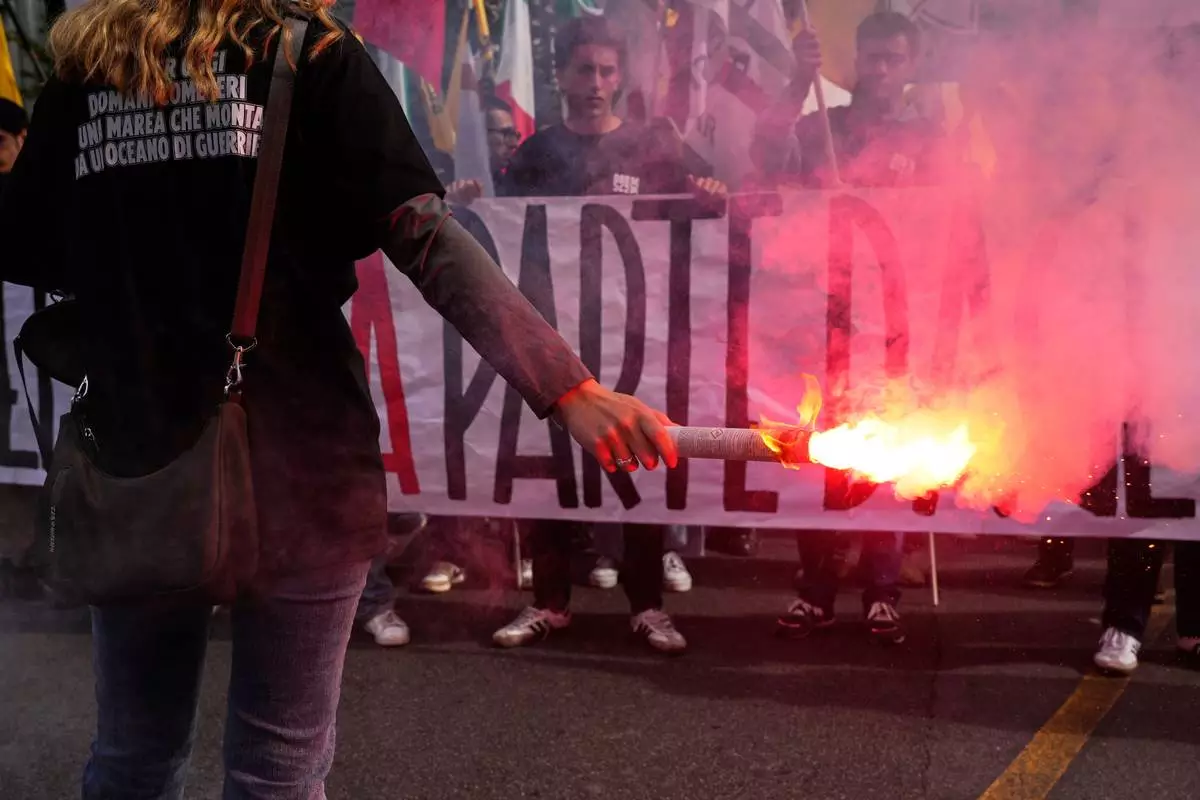
Members of right-wing student groups march through the streets of Rome, Saturday, Oct. 24, 2026, during a demonstration called "Unlock Everything," organized in opposition to recent left-wing student protests and one of several demonstrations held by groups across the political spectrum. (AP Photo/Gregorio Borgia)
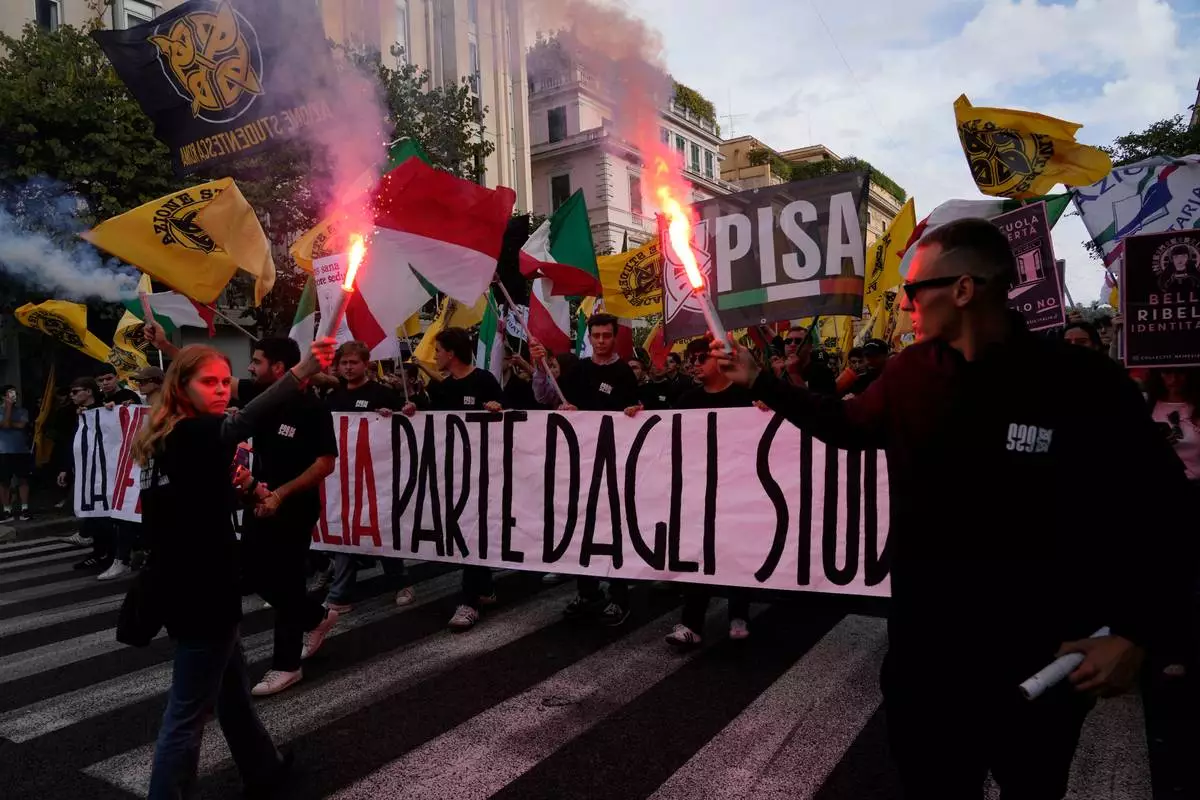
Members of right-wing student groups march through the streets of Rome, Saturday, Oct. 24, 2026, during a demonstration called "Unlock Everything," organized in opposition to recent left-wing student protests and one of several demonstrations held by groups across the political spectrum. (AP Photo/Gregorio Borgia)