Skip to Content Facebook Feature Image

Apple files lawsuit accusing ChatGPT maker OpenAI of stealing trade secrets

News

Apple files lawsuit accusing ChatGPT maker OpenAI of stealing trade secrets
News

News

Apple files lawsuit accusing ChatGPT maker OpenAI of stealing trade secrets

2026-07-11 08:22 Last Updated At:08:30

Apple on Friday accused OpenAI of stealing trade secrets as it seeks to build its own hardware for ChatGPT, a major rupture in a partnership between the iPhone maker and the artificial intelligence company.

Apple said in the lawsuit filed in a California federal court that OpenAI encouraged Apple employees it was recruiting to share confidential information, even guiding how to avoid scrutiny when taking jobs at the other company.

“This case is about Apple’s former employees stealing Apple’s trade secrets for the benefit of OpenAI,” the filing says. “Apple brings this suit to put a stop to it.”

Two former Apple employees who now work for OpenAI are also named as defendants. One is Tang Tan, who helped design the iPhone, Apple Watch and iPod and is now OpenAI’s chief hardware officer. The other is Chang Liu, a former electrical engineer Apple says it entrusted with some of its most sensitive product development efforts before Liu left Apple to join OpenAI earlier this year.

OpenAI said it is still reviewing the filing, but spokesperson Drew Pusateri said in a statement Friday that OpenAI has “no interest in other companies’ trade secrets. We remain focused on building innovative technology that empowers people everywhere.”

OpenAI has never said exactly what type of device it is building, but has described it as an effort to find a new way to interact with AI that goes beyond “traditional products and interfaces.” It’s part of a broader push to create a physical embodiment of the latest AI advances, a decade after Amazon and Google introduced screen-free talking speakers into homes.

The lawsuit claims the effort was built partly on knowledge stolen from Apple.

“OpenAI’s nascent hardware business now rests on the shakiest of foundations, rotten to its core by its illegal reliance on misappropriated trade secrets,” the lawsuit says.

Apple said it began investigating whether some of its confidential information was compromised and “uncovered a pattern of theft” of Apple’s trade secrets by former employees who moved on to positions at OpenAI.

The lawsuit alleges both Liu and Tan accessed Apple’s confidential company information and files while working at OpenAI. Among the allegations, Apple claims Liu accessed and downloaded several confidential hardware-related files on an Apple-issued device he kept after departing. It also alleges Tan directed job candidates who were still working for Apple to bring “Actual parts” from Apple to their interviews at OpenAI.

Apple said in the lawsuit that it reached out to OpenAI in February to raise its concerns early in its investigation, but said that OpenAI did not respond.

An Apple spokesperson said in a statement Friday that the company will “always defend our teams’ hard work and innovations, and we are taking all appropriate steps to do so.”

Apple sought help from OpenAI several years ago as it was behind in the AI race sparked by ChatGPT’s arrival. The two companies partnered in 2024 to use ChatGPT as an AI-powered “answer engine” on the iPhone when the built-in Siri technology couldn’t satisfy user needs. More recently, the partnership has veered toward rivalry.

As part of its expansion efforts, OpenAI recruited former Apple designer Jony Ive to oversee a project to build an AI-powered device that many analysts believe could eventually challenge Apple’s products.

Last year, OpenAI announced it was working on a secret hardware collaboration with Ive to pioneer a new way of communicating with artificial intelligence. As part of the collaboration, OpenAI acquired io Products, a product and engineering company co-founded by Ive, Tan and two others, in a deal valued at nearly $6.5 billion.

That led a little-known tech startup iyO Inc. to sue Ive and OpenAI CEO Sam Altman for trademark infringement due to the similar-sounding name and the firms’ past interactions. The startup also sued one of its own former employees for allegedly leaking a confidential drawing of iyO’s unreleased product, and it later added trade secret theft claims against Tan to the lawsuit.

Apple’s lawsuit also names io Products as a defendant. Lawyers who previously represented the firm and Tan referred The Associated Press to OpenAI for comment.

Apple’s lawsuit comes as OpenAI has been exploring whether to go public on Wall Street and faces heightened competition from rivals including Anthropic and Google.

OpenAI winnowed down some of its business ventures earlier this year to focus on its core product, ChatGPT, but has continued to pursue a device, the company’s chief financial officer told The Associated Press this spring.

“We have consumer hardware that will come towards the end of this year,” CFO Sarah Friar told the AP in April.
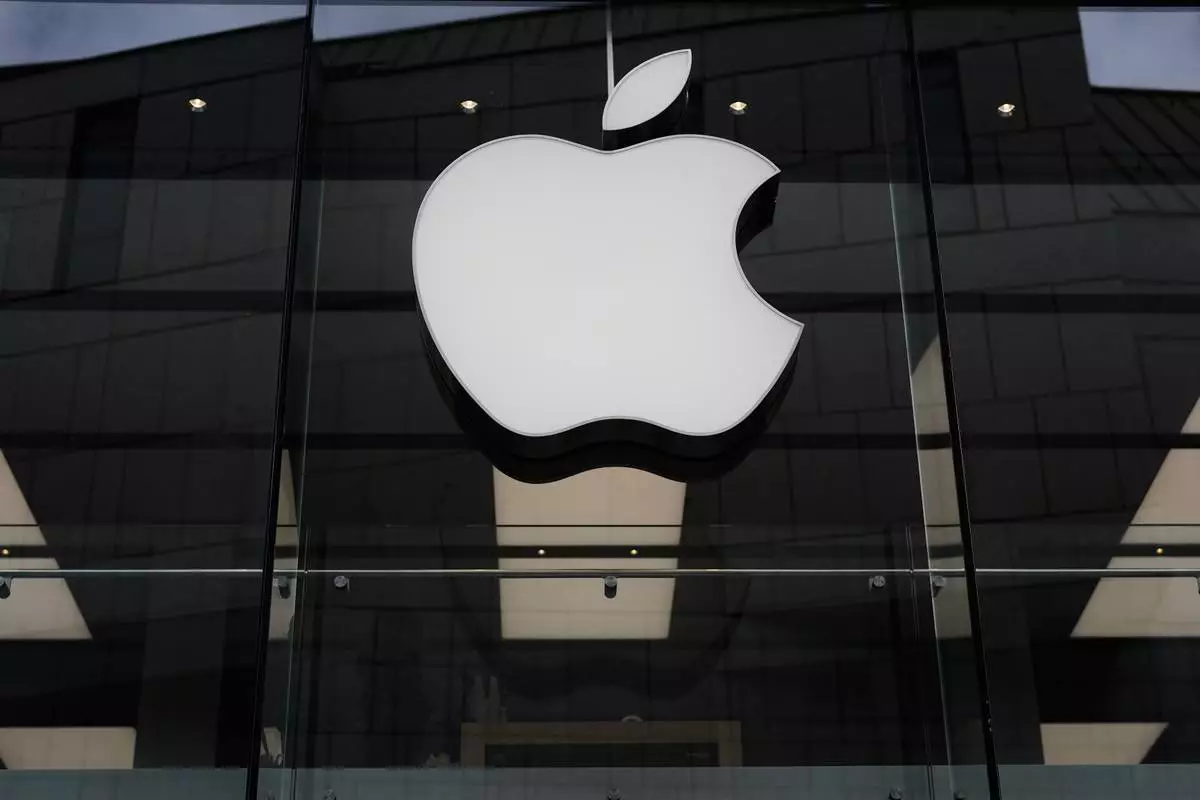
FILE - The Apple logo is illuminated at a store in Munich, April 2, 2026. (AP Photo/Matthias Schrader, File)

FILE - The Apple logo is illuminated at a store in Munich, April 2, 2026. (AP Photo/Matthias Schrader, File)

THESSALONIKI, Greece (AP) — Fellow passengers pulled back a man who was partially sucked out of a dislodged airplane window on Friday, a few minutes after takeoff on a flight from northern Greece to Germany. The plane subsequently returned to the airport in Greece.

The incident happened on a morning flight from the northern Greek city of Thessaloniki to Memmingen, near Munich, operated by Malta Air, a subsidiary of Ryanair, Europe’s largest budget carrier.

Ryanair said in a statement the flight “returned to Thessaloniki shortly after takeoff when a passenger window dislodged in-flight.”

The 61-year-old passenger, who was not identified by name, suffered neck and shoulder injuries and friction burns, according to a Greek hospital official who spoke on condition of anonymity because they were not authorized to speak publicly to the media.

It was not immediately clear if the injured passenger remained in hospital later Friday.

Passengers told Greek media that they heard a loud bang, oxygen masks dropped and the plane began to lose altitude.

One passenger, identified only as Christina, told Radio Thessaloniki that some passengers panicked and screamed and that one passenger was partially sucked out of the window.

“His whole head, neck, shoulders” were pulled out of the window, she said, adding that those seated near him pulled him back in.

“Most people had fallen asleep, we had closed our eyes. We heard a sound, I’d describe it like a tire bursting … but very loud,” she said. “We knew straight away we lost pressure because we lost altitude."

She said there were "screams, shrieks, shouting.”

The airline has not said what caused the window to dislodge, but the U.S. National Transportation Safety Board said it was notified that the flight turned back because of “a right engine issue and cabin decompression.”

Ryanair did not immediately respond to an email request seeking comment on the engine issue.

The NTSB, the U.S. federal agency that investigates aviation and other major transportation incidents, said it was standing by to assist the investigation. It said the probe will be led by the Aircraft Accident and Incident Investigation Committee of the Republic of North Macedonia, which under international aviation rules takes the lead because the incident occurred in that country's airspace.

The agency in North Macedonia, which borders Greece to the north, did not immediately respond to an emailed request for comment.

A series of short videos recorded from inside the plane and shared by Radio Thessaloniki showed passengers wearing oxygen masks after the cabin lost pressure. Another appeared to show the blown-out window, with a man seated nearby wearing an oxygen mask. A third video, apparently filmed after the aircraft landed, showed first responders working in the aisle.

Shye Gilad, a former airline pilot who teaches at Georgetown University’s business school in the United States, said the incident underscored the importance of keeping seatbelts fastened while seated. A rapid decompression can create a brief but powerful suction effect near a breach in the cabin before the cabin's pressure stabilizes, he said.

“The seatbelt can help in those first few seconds. It’s a difference maker and people should keep their seatbelts fastened at all times,” Gilad said, adding that events such as Friday's incident are “a very rare” because “it takes a lot to breach a cabin.”

The aircraft was a Boeing 737-800, which can seat up to 189 passengers. The narrow-body plane was delivered new to Ryanair in 2008, according to flight-tracking site Flightradar24.

Flight records show that the aircraft climbed past 15,000 feet (4,570 meters) about six minutes after departure and then immediately descended to about 6,000 feet (1,830 meters) “to burn fuel for 30 minutes” before returning to Thessaloniki about an hour after taking off, Flightradar24 said.

The plane landed normally and passengers returned to the terminal, and one passenger requested and received medical assistance on the ground in Thessaloniki, the airline said in a statement. A replacement aircraft was later provided to fly the passengers to Germany.

Yamat, AP's airlines and travel writer, reported from Las Vegas.

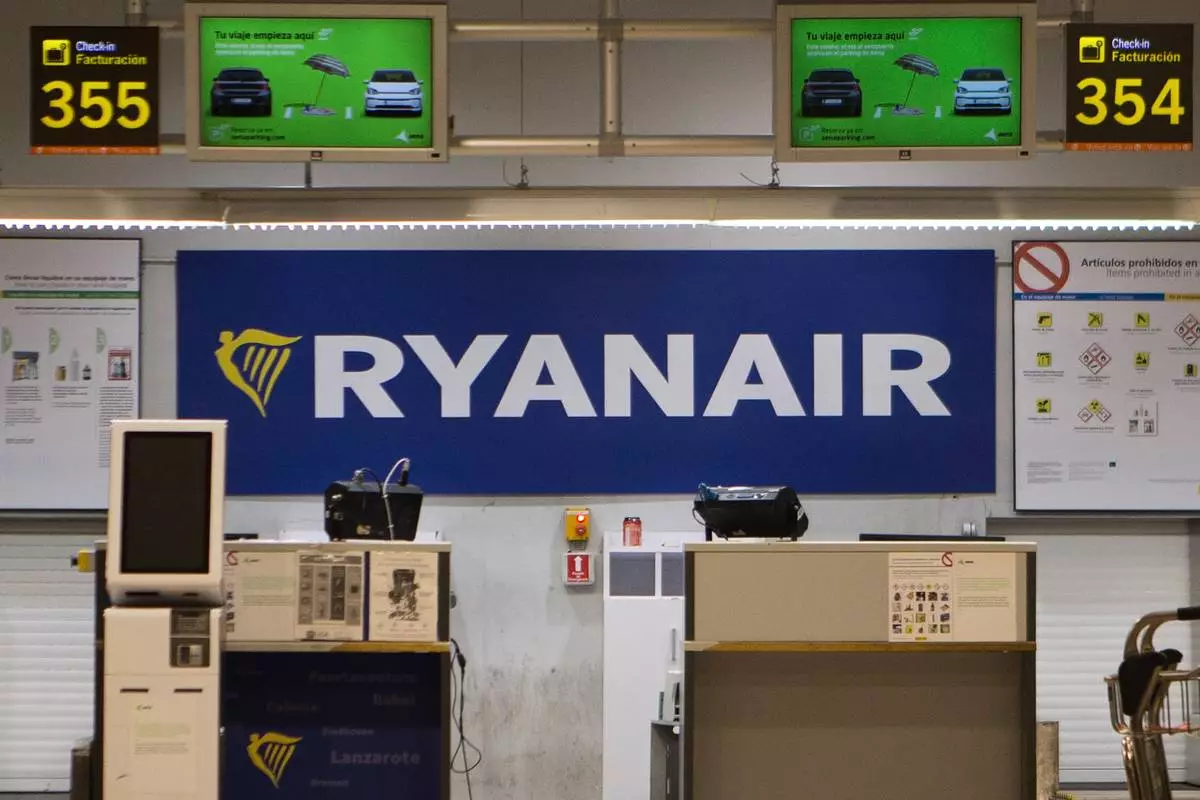
FILE - The Ryanair desk is seen, Aug. 10, 2018, at the Barajas airport in Madrid, Spain. (AP Photo/Paul White, File)

FILE - The Ryanair desk is seen, Aug. 10, 2018, at the Barajas airport in Madrid, Spain. (AP Photo/Paul White, File)

Recommended Articles