Skip to Content Facebook Feature Image

Typhoon Bavi bears down on China's east coast; Zhejiang, Fujian on high alert

China

China

China

Typhoon Bavi bears down on China's east coast; Zhejiang, Fujian on high alert

2026-07-11 21:10 Last Updated At:07-12 14:17

China's eastern coastal provinces of Zhejiang and Fujian are on high alert as Typhoon Bavi, the ninth typhoon of the year, is forecast to make landfall on the coast of Zhejiang from Saturday night to early Sunday morning.

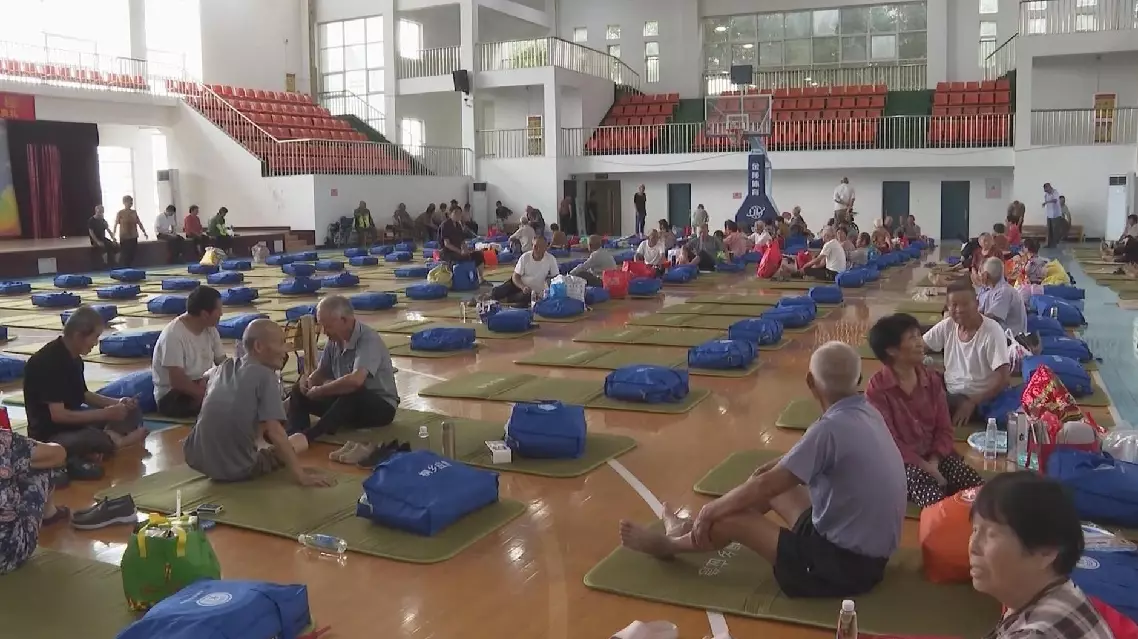
Zhejiang Province raised its typhoon emergency response to the highest Level I on Saturday. In Yuhuan City, coastal patrol teams have been deployed to monitor high-risk areas. In Xiangshan County of Ningbo City, wind speeds increased to 9 to 12 on the Beaufort scale, with authorities stepping up patrols to keep residents and tourists away from dangerous zones. In Leqing City, over 400 shelters have been set up to accommodate evacuees, with essential supplies stocked and basic medical services in place.

As of 14:00 Saturday, Zhejiang had evacuated over 2.21 million people and put into use 19,000 shelters. A total of 163 passenger ferry routes, 912 trains and 855 flights were suspended. Schools, kindergartens and training institutions were closed, and 444 A-class tourist attractions, 78 public cultural venues and 222 high-risk amusement facilities were shut down.

In the neighboring Fujian Province, 70 passenger ferry routes have been suspended, all offshore construction projects and wind farms have been halted, and over 60,000 vessels have returned to port. More than 180,000 people in high-risk areas have been relocated.

In Fujian's Ningde City, local authorities reinforced sea dikes and helped aquaculture farmers secure their facilities. In Fuding City, which is located at the Fujian-Zhejiang border, officials conducted intensive inspections of the 726-meter Xiamen Seawall, the primary defense line for 12,000 residents, with sluice gates scheduled to open after midnight to release floodwaters.

The Ministry of Finance and the Ministry of Emergency Management has allocated 40 million yuan (about 5.9 million U.S. dollars) in emergency relief funds to support disaster responses in Fujian and Zhejiang.

Typhoon Bavi also brought heavy rain to the Beijing-Tianjin-Hebei region in the north.

Beijing has issued a red alert, the highest level in the alert system, for mountain flood risks on Saturday, increasing pre-discharge flows at several local reservoirs. Authorities warned of high flood risks in suburban Pinggu, Huairou and Fangshan districts, urging the public to stay away from mountain streams and avoid outdoor activities in mountainous or water-adjacent areas. 
Typhoon Bavi bears down on China's east coast; Zhejiang, Fujian on high alert

Typhoon Bavi bears down on China's east coast; Zhejiang, Fujian on high alert
Rally participants gathered in the Japanese capital on Aug 9, which also marked the 81st anniversary of the Nagasaki atomic bombing, to voice strong opposition to the government's push to boost defense spending and revise the war-renouncing Article 9 of the national Constitution.

Holding anti-war placards, chanting anti-war slogans, protesters warned that remilitarizing the nation would betray its pacifist ideals and endanger future generations.

"Defense spending keeps increasing. Based on Article 9 of the Constitution, Japan pledged never to wage war again, yet it keeps strengthening its military. I find this extremely dangerous. They are also trying to revise Article 9. So I believe that for the sake of future young people and children, Article 9 must never be revised. Japan decided never to repeat the mistakes of waging a war after its defeat in WWII. I think we should continue to safeguard that commitment," said a rally participant.

For many in the crowd, the shadow of Hiroshima and Nagasaki remains a powerful moral compass as they believe that militarization offers no path forward for a nation that knows the devastation of war firsthand.

"Japan is the only country in the world to have suffered atomic bombings. Yet now Japan is going to deploy missiles. I believe Japan must never possess nuclear weapons," said another rally participant.

"I believe Japan has no future if it goes down the path of militarization. Nuclear weapons are absolutely bad for Japan," said a third woman, also a rally participant.

Beyond moral objections, some demonstrators said that Japan's economic vulnerabilities articulate that saber-rattling is a luxury the country cannot afford.

"I can't help but wonder what on earth a country with only a 36 percent food self-sufficiency rate would be fighting with. I have always been opposed to war, and I'm deeply dissatisfied with what the Takaichi administration is doing now," said another rally participant.

Other rally participants said that seeing revision of the Constitution could unleash unchecked military expansion, stripping away the very safeguards that have kept Japan at peace for eight decades.

"Article 9 of the Constitution is the key. If the nature of the Self-Defense Forces is elevated to a level beyond collective self-defense, which is explicitly written into the Constitution, it will allow the authority of the Self-Defense Forces to expand without limit. So no matter what, I want to prevent this from happening," said one more rally participant.

Japanese citizens rally against Takaichi's military expansion, constitutional revision

Japanese citizens rally against Takaichi's military expansion, constitutional revision

Recommended Articles