The vast array of events at the second World Humanoid Robot Games in Beijing has highlighted the expanding abilities of advanced robots and stoked curiosity about how these humanoids could soon become commonplace across multiple industries.
The five-day Games conclude at the National Speed Skating Oval in the Chinese capital on Wednesday, after over 2,000 robots developed by more than 600 teams from 16 countries and regions battled it out in 51 competitive events.
As well as a series of sporting challenges from soccer to athletics, the Games also features 21 scenario-based contests covering various real-world settings from factories, to logistics and the service sector.
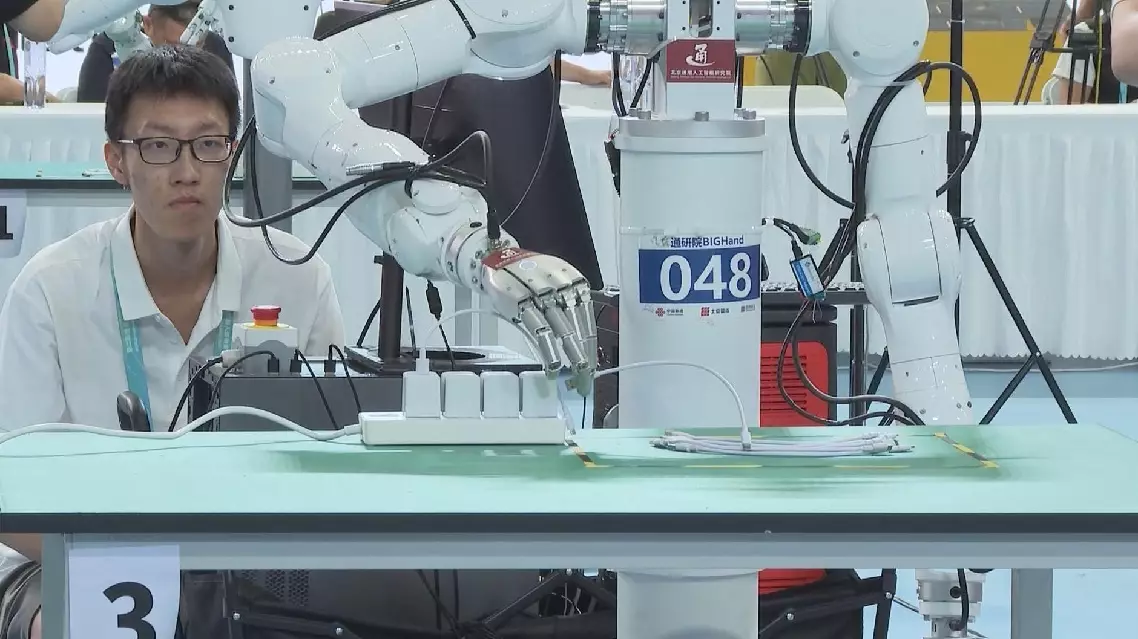
Among these, one of the most technically demanding events has grabbed the spotlight for its simplicity and its day-to-day relevance. Humanoid robots have been using dexterous hands to plug in data cables, a deceptively simple task that showcases exceptional fine motor control and joint flexibility.
"This dexterous hand is equipped with 22 degrees of freedom, representing 22 active joints. It is a fully direct-drive device, with each joint powered by a motor, enabling highly precise control. It also has relatively high durability thanks to the good cooling system. Otherwise, insufficient heat dissipation may lead to overheating and affect its performance," said Wu Yingying, a researcher at the Beijing Institute for General Artificial Intelligence.
Fine motor skills are just one benchmark for these machines, as others show off their sporting prowess.
On the soccer field, humanoid robots move across the turf, tracking fast moving balls and coordinating with teammates with zero human intervention – and can even pick themselves up and dust themselves down after any on-field fall.
These five on five matches offer a vivid demonstration of the sophisticated visual perception and autonomous decision-making capabilities of the current generation of robots.
A combined team from Germany comprised of the HTWK Robots from the Leipzig University of Applied Sciences and the Nao Devils from TU Dortmund University were among those vying for glory.
"The robots have two cameras in their eyes -- yeah, you can see them up here. With those cameras, it has stereo vision, just like a human. So it will detect visually where the ball is, how fast it's moving. There are two ways [to distinguish the teams]. One is obviously the jerseys' colors. we are playing in blue. The other team was playing in red. And the other way is that since the team members are telling each other where they are and what they are doing, they also know this must be my teammate because he just said he's over there," said one of the team members.
Beyond quick decision team sports, the Games also tests robots’ full body coordination.
In other competition arenas, humanoids are performing fluid martial arts moves and snappy, coordinated cheerleading routines. These eye catching displays require bursts of high torque power and sustained, complex movements, which requires impressive stability and balance control.
"The Games serves as a platform for training through competition. It tests robots’ high-torque output capability and balance stability. Such technologies will provide stronger advantages for robots to be applied in more extreme scenarios in the future," said Xu Zhiyuan, head of motion control at the Beijing Innovation Center of Humanoid Robotics.
Robot Games shines spotlight on advancing abilities, potential practical applications of humanoids