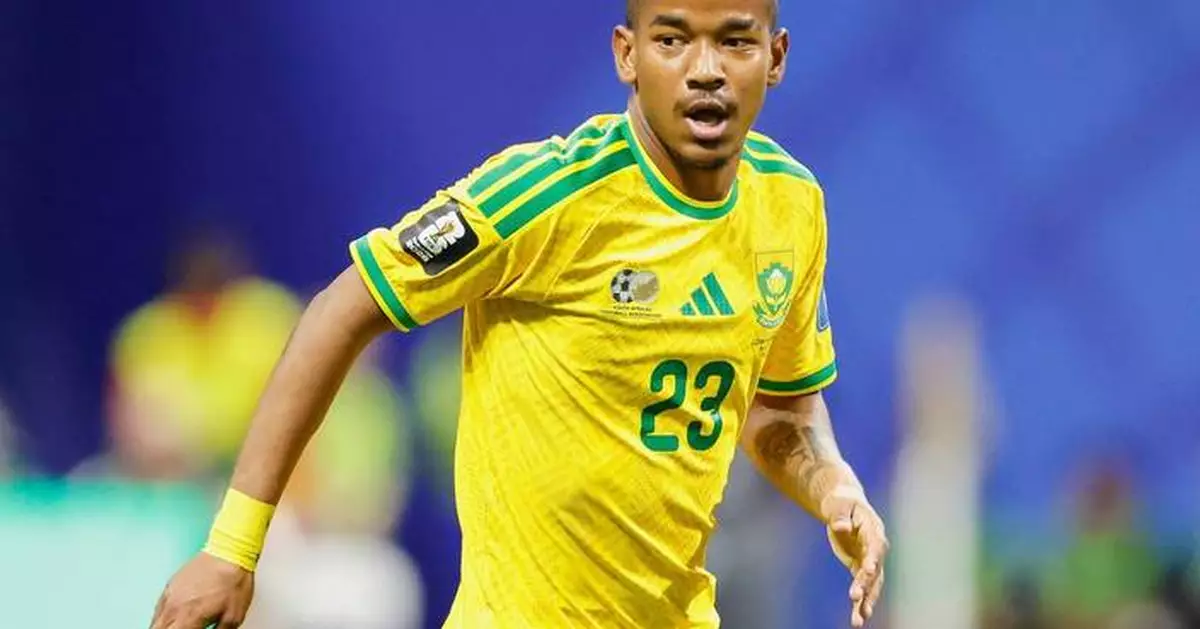
JOHANNESBURG (AP) — South Africa midfielder Jayden Adams, who played at the World Cup, has died. He was 25.
His death was confirmed by Gayton McKenzie, South Africa’s minister of sport, arts and culture, in a statement on Saturday.
“It is with profound shock and a heavy heart that I have learnt of the passing of Jayden Adams, midfielder for Mamelodi Sundowns and Bafana Bafana, at the age of 25," McKenzie posted on X.
"South African football has lost one of its brightest young talents, and our nation mourns alongside his family, his team-mates and the millions of supporters.”
Adams helped South Africa reach the World Cup knockout stage for the first time.
Further details of his death were not given.
“The cause of Jayden’s passing has not yet been confirmed," McKenzie said. “I wish to appeal to members of the media and the public to exercise restraint and compassion, and to refrain from speculation.”
A moment of silence in honor of Adams was held ahead of the World Cup quarterfinal between Norway and England in Miami Gardens, Florida, on Saturday.
Adams started in South Africa's first Group A games against Mexico and Czech Republic. McKenzie said Adams played the second game only hours after learning that his grandmother had died. He came on as a second-half substitute in the third game against South Korea.
Adams played several seasons for Stellenbosch before joining Mamelodi Sundowns last year. He helped the club win the CAF (African) Champions League this year.
“Death has cruelly stolen one of our own. It has robbed our nation of a remarkable footballer,” the South African Football Players Union posted on X. “We will forever remember his humility, his extraordinary talent and the pride with which he represented South Africa. Rest in eternal peace, Jayden. You will never be forgotten.”
South African President Cyril Ramaphosa and the South African Federation of Trade Unions also expressed their condolences.
See more of AP’s World Cup coverage here
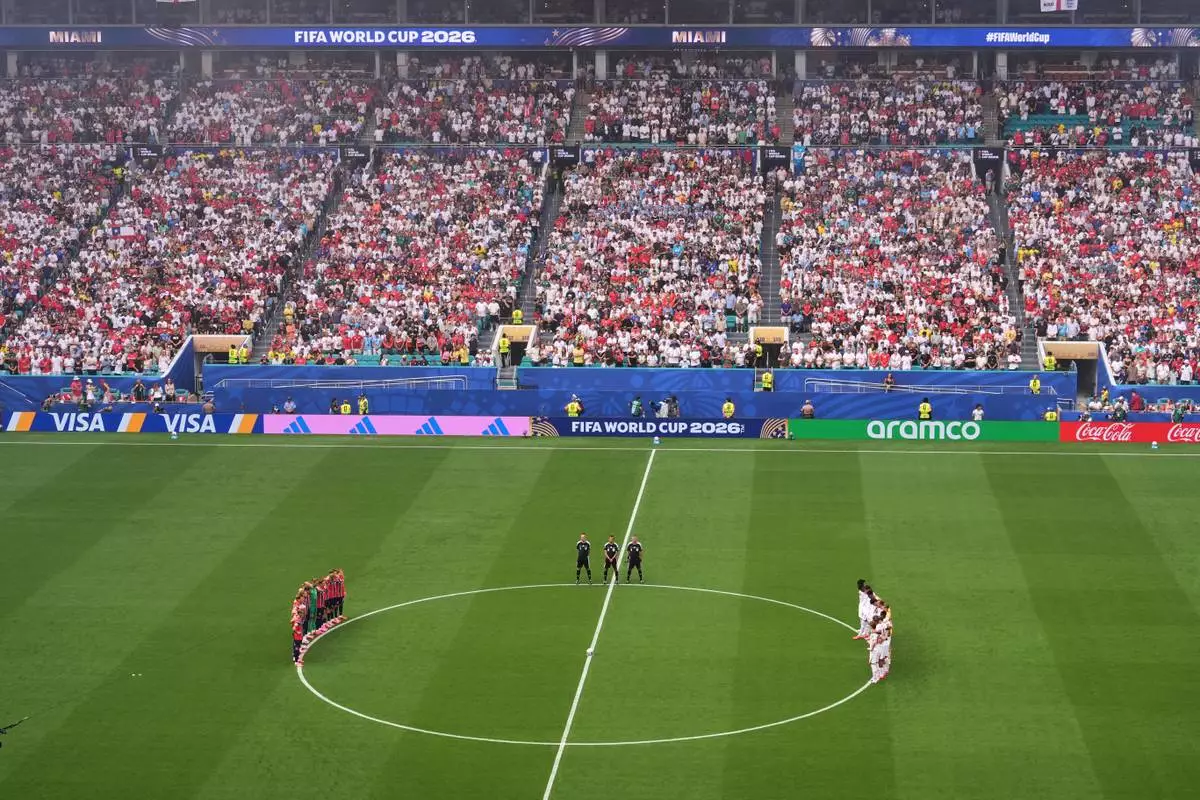
Players, officials and fans stand for a moment of silence for South Africa's Jayden Adams during the World Cup quarterfinal soccer match between Norway and England in Miami Gardens, Fla., Saturday, July 11, 2026. (AP Photo/Marta Lavandier)

FILE - Mamelodi Sundowns' Jayden Adams (8) controls the ball during a Club World Cup group F soccer match against Ulsan HD, June 18, 2025 in Orlando, Fla. (AP Photo/Phelan M. Ebenhack, File)
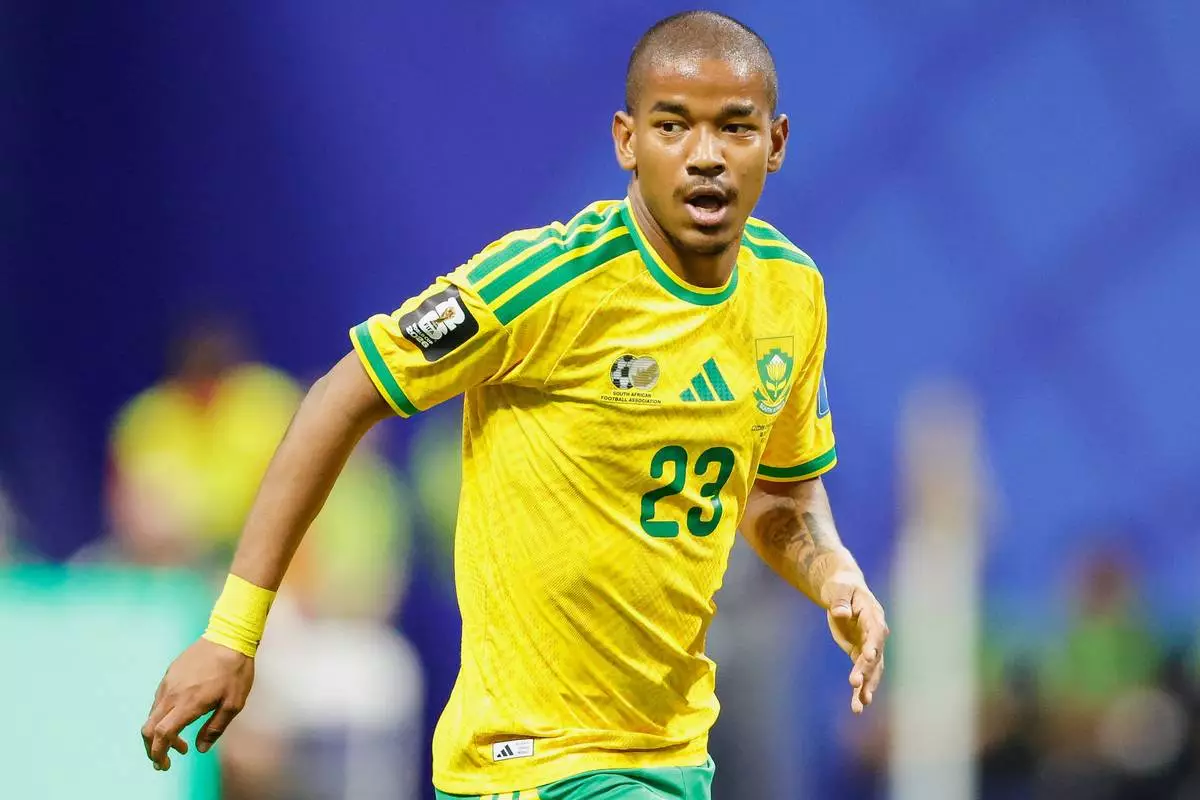
FILE - South Africa's Jayden Adams during the World Cup Group A soccer match between Czechia and South Africa in Atlanta, Thursday, June 18, 2026. (AP Photo/Stew Milne, File)

DUBAI, United Arab Emirates (AP) — Iran and Oman’s foreign ministers met on Saturday to discuss the Strait of Hormuz that lies between them, after days of Iranian attacks on ships and U.S. retaliation that dealt a blow to the interim deal to end the war.
Iran’s new supreme leader, still unseen since the war began, vowed in his first statement since the funeral of his father, Ayatollah Ali Khamenei that Iranians would avenge his killing in the war’s opening strikes on Feb. 28.
Such revenge “is the will of our nation and must certainly be carried out,” Supreme Leader Mojtaba Khamenei said in a statement carried on state television, hours after U.S. President Donald Trump threatened more missile attacks.
Oman said it and Iran agreed to keep talking about the crucial waterway “at the technical and political levels,” a day after the United States called on Iran to publicly say the crucial waterway is open and ships won’t be attacked.
Iranian Foreign Minister Abbas Araghchi said he met with his counterpart in Oman to discuss “appropriate mechanisms for ensuring the safe passage of ships.”
The world for decades has considered the strait an international waterway. Iran has insisted that the strait now remain under its control and that it be allowed to charge ships moving through it, a stance it took after the war began. The U.S. urges mariners to transit on a southern route through Oman’s territorial waters.
About a fifth of all traded oil and natural gas passed through the strait before the war began. Iran’s grip on it during the war led to a global energy crisis, though oil prices have sharply dropped since wartime highs of $120 a barrel.
Iran's top diplomat also accused the U.S. of violating the interim deal by ending waivers allowing Iran to sell crude oil on the open market in U.S. dollars. Washington ended them in response to the attacks on ships in the strait.
“Reality check: There can only be mutual compliance,” Araghchi wrote on X.
A thousand “missiles are Locked and Loaded and aimed at the Islamic Republic of Iran, with thousands more to immediately follow, should the Iranian Government act on its threat,” Trump wrote on social media overnight
He said he was responding to threats “to assassinate, or attempt to assassinate” him. During Khamenei's funeral, mourners held posters or banners calling for Trump to be killed along with Israeli Prime Minister Benjamin Netanyahu.
Trump has declared the ceasefire over but said the U.S. would continue negotiations.
U.S. officials, speaking Friday on condition of anonymity about the current situation with Iran, said the resumption of strikes in recent days came after what they described as a rogue faction of Iranian hard-liners tried to sabotage the ceasefire.
Iran has insisted its theocracy is unified under the new supreme leader.
After the U.S. wrapped up its latest strikes on Thursday, more attacks reportedly hit Iran, raising questions about who else may be targeting the Islamic Republic.
Israel didn't claim them, meaning the Gulf Arab states may have launched them, likely as a means to deter Iran from attacking them again. Iran on Thursday retaliated for U.S. strikes by targeting Bahrain, Jordan, Kuwait and Qatar.
The strikes in Iran over two days killed at least 17 people and wounded 115 others, Iranian Health Ministry spokesperson Hossein Kermanpour said.
Price and Weissert reported from Washington. Associated Press writer Sam Metz in Ramallah, West Bank, contributed to this report.
A pro-government demonstrator wears an Iranian flag as she waves a religious flag in a gathering commemorating the late Iranian Supreme Leader Ayatollah Ali Khamenei at a square in Tehran, Saturday, July 11, 2026. (AP Photo/Vahid Salemi)
A pro-government demonstrator holds an anti-Trump placard in a gathering commemorating the late Iranian Supreme Leader Ayatollah Ali Khamenei at a square in Tehran, Saturday, July 11, 2026. (AP Photo/Vahid Salemi)
A girl waves an Iranian flag in a pro-government gathering commemorating the late Iranian Supreme Leader Ayatollah Ali Khamenei at a square in Tehran, Saturday, July 11, 2026. (AP Photo/Vahid Salemi)
A man holds a poster of the late Iranian Supreme Leader Ayatollah Ali Khamenei in a gathering commemorating him at a square in Tehran, Saturday, July 11, 2026. (AP Photo/Vahid Salemi)
A cleric waves an Iranian flag while holding a child as a woman waves a religious flag in a pro-government gathering commemorating the late Iranian Supreme Leader Ayatollah Ali Khamenei at a square in Tehran, Saturday, July 11, 2026. (AP Photo/Vahid Salemi)
Mostafa Khamenei, center, brother of Iran's new Supreme Leader Mojtaba Khamenei, leads a prayer over the coffin of his late father, Iranian Supreme Leader Ayatollah Ali Khamenei before his burial at the Imam Reza Shrine in Mashhad, northeastern Iran, Thursday, July 9, 2026. (Office of the Iranian Supreme Leader via AP)
In this photo released by Iran's Supreme Leader's office, mourners chant and raise their fists during the final funeral ceremony for the late Iranian Supreme Leader Ayatollah Ali Khamenei at the Imam Reza Shrine before his burial in Mashhad, northeastern Iran, Thursday, July 9, 2026. (Office of the Iranian Supreme Leader via AP)
In this photo released by Iran's Supreme Leader's office, mourners carry the coffin of the late Iranian Supreme Leader Ayatollah Ali Khamenei above the crowd for the final prayer before his burial at the Imam Reza Shrine in Mashhad, northeastern Iran, Thursday, July 9, 2026. (Office of the Iranian Supreme Leader via AP)