Argentine Antonio Rattín, a former Boca Juniors player whose act of defiance while representing Argentina at the 1966 World Cup helped lead to the introduction of yellow and red cards, has died, the country’s football federation said Saturday. He was 89.
Rattín died in Buenos Aires, according to the Argentine Football Association, or AFA, which expressed its “deepest sorrow at the passing of a historic symbol of Boca Juniors and the national team,” with whom he played in two World Cups.
A defensive midfielder known for his physical, hard-tackling style, Rattín won six Argentine league titles with Boca Juniors and was a Copa Libertadores runner-up in 1963.
“Rattín was one of us and loved these colours so much that they were the only ones he chose to defend throughout his 14-year career. A leader, an Argentine and forever a Bostero,” the club said.
With Argentina, Rattín played at the 1962 World Cup in Chile and the 1966 tournament in England, and also finished runner-up in the Copa América twice.
In the quarterfinals of the 1966 World Cup, Argentina faced England at Wembley Stadium. In the 36th minute, Rattín protested a foul and was sent off for “verbal dissent.” At the time, referees did not use cards but instead verbally informed players that they had been dismissed.
As he left the pitch, Rattín crumpled one of the corner flags, which featured the design of the English flag. He then sat down on the red carpet reserved for the late Queen Elizabeth II.
The two acts of protest sparked a barrage of objects thrown at him by fans from the stands.
In the wake of the confusing incident, and amid growing concern over the increasingly violent nature of the game, FIFA’s refereeing authorities concluded that a practical, universally understood system was needed to communicate cautions and dismissals.
Kenneth George Aston, who headed FIFA’s refereeing committee, took inspiration from traffic lights and, in 1967, introduced the yellow and red cards that are still used today.
Rattín’s defiant gesture at Wembley also marked the beginning of the football rivalry between Argentina and England. It reached its most iconic chapter in the quarterfinals of the 1986 World Cup in Mexico, when Argentina won thanks to Diego Maradona’s unforgettable goals — one scored with his hand, unnoticed by the referee, and the other after a brilliant solo run.
Argentina plays Switzerland in another World Cup quarter-final on Saturday. Many supporters are hoping for a semifinal meeting with England, who will face Norway in another quarter-final also on Saturday.
Follow AP’s coverage of Latin America and the Caribbean at https://apnews.com/hub/latin-america

Argentina fans wave flags as they gather to celebrate and cheer on their team at a beachfront park in Miami Beach, Fla., Thursday, July 2, 2026, one day ahead of their World Cup round of 32 soccer match against Cape Verde. (AP Photo/Rebecca Blackwell)
BUÑOL, Spain (AP) — Thousands of revelers descended on Buñol on Wednesday for the annual La Tomatina food fight, where they painted the small Spanish town red with up to 165 tons of overripe tomatoes.
Loaded trucks plodded through the crowd with people in their cargo beds throwing tomatoes at the revelers — who, in turn, hurled them at one another. Their white shirts soon turned pink and red while pop songs blasted from speakers. At one point, police appeared to use pepper spray to disperse an area of the crowd, but a festive vibe quickly resumed.
The messy melee takes place for over an hour in the town, where buildings are covered with tarps ahead of the festivities. Held on the last Wednesday of August, the festival traces its origins to a food fight in 1945.
La Tomatina became an annual tradition before Spanish dictator Gen. Francisco Franco banned it in the 1950s. Televised media attention in the 1980s helped turn the festival into a national event, and eventually, an international attraction.
More than 20,000 people had been expected to take part this year, with the Spanish news agency EFE reporting this week that roughly 40% of participants over the past three years have been tourists from outside Spain.
There has been a notable jump in visitors from India in recent years, following the 2011 Bollywood movie “Zindagi Na Milegi Dobara” (“You Only Live Once”), in which three friends take a road-trip through Spain during an extended bachelor party. The film recreated La Tomatina, introducing the festival to many Indians.
The movie is what first drew Romail Khokhar, a 27-year-old from Mumbai, to Buñol. He was there on Wednesday morning, eager to participate in the food fight for his third time.
“I feel really great, actually. It's the best festival that I ever had, and I enjoy a lot here,” said Khokhar, who owns a clothing business.
Similar tomato-flinging events have taken place in Florida, London, Amsterdam, the Colombian town of Sutamarchán and Hyderabad, India.
Non-local attendees pay 15 euros ($17.50) for a ticket. The first and only rule: Squash your tomatoes before hurling them to avoid injuries. Still, many participants don swimming goggles and earplugs for protection.
Once the hour is up, the sound of a cannon blast marks the end of festivities and crowds wash off at communal showers nearby. The town's streets are later hosed down.
Though stains on clothes can be permanent, the tomatoes' citric acid acts as a cleaning agent, often leaving Buñol’s streets cleaner than before.
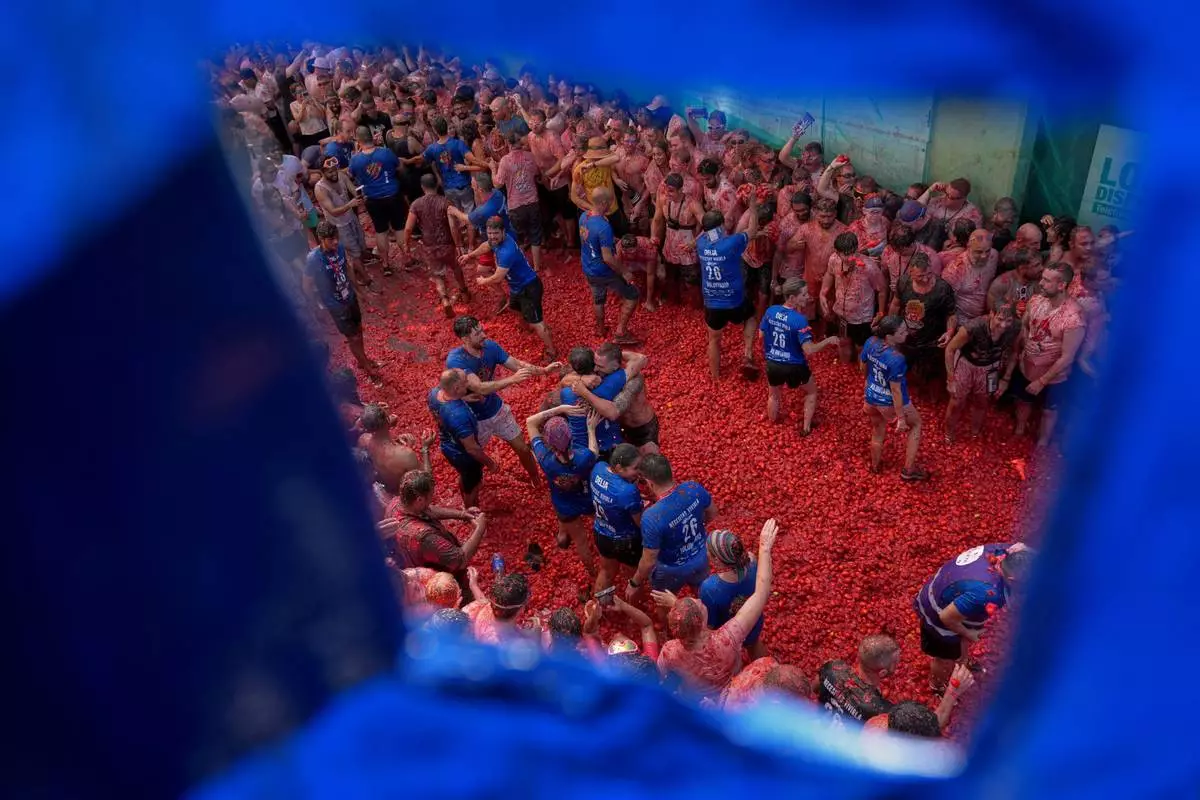
Revelers throw tomatoes at each other during the annual "Tomatina" tomato fight fiesta, in the village of Bunol near Valencia, Spain, Wednesday, Aug. 26, 2026. (AP Photo/Alberto Saiz)
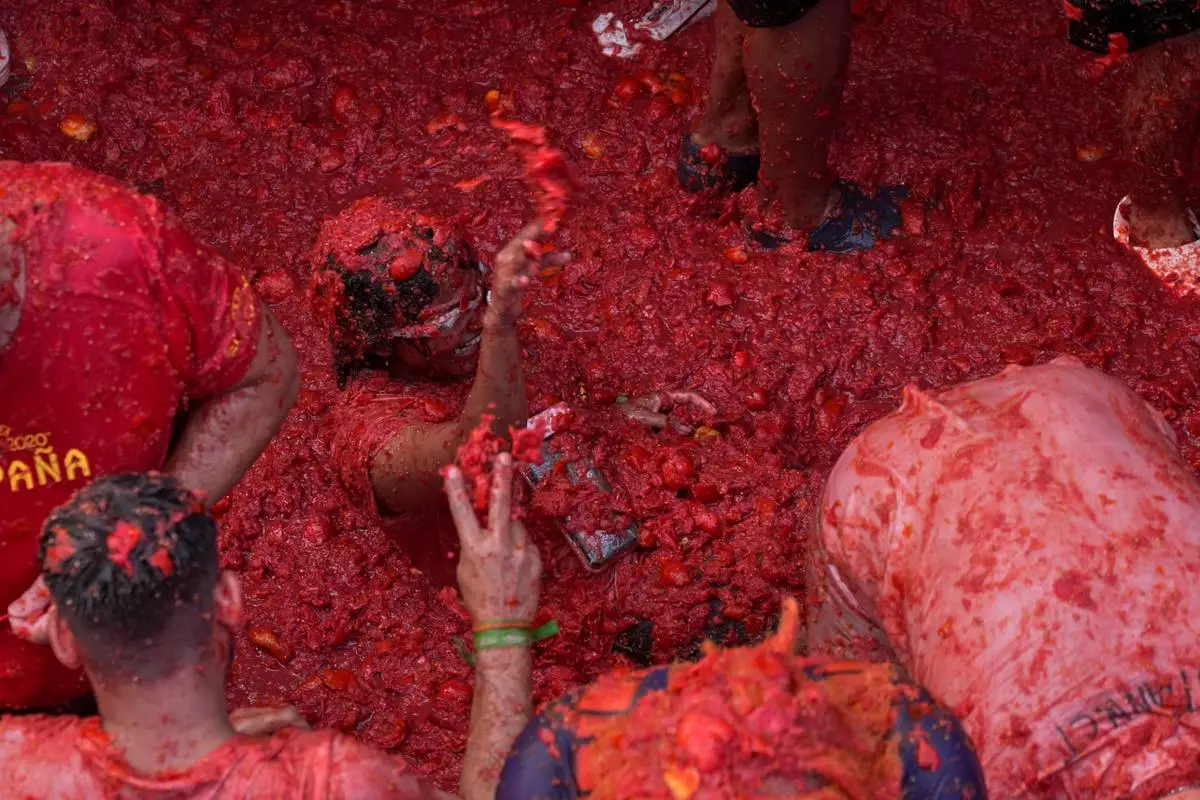
Revelers throw tomatoes at each other during the annual "Tomatina" tomato fight fiesta, in the village of Bunol near Valencia, Spain, Wednesday, Aug. 26, 2026. (AP Photo/Alberto Saiz)
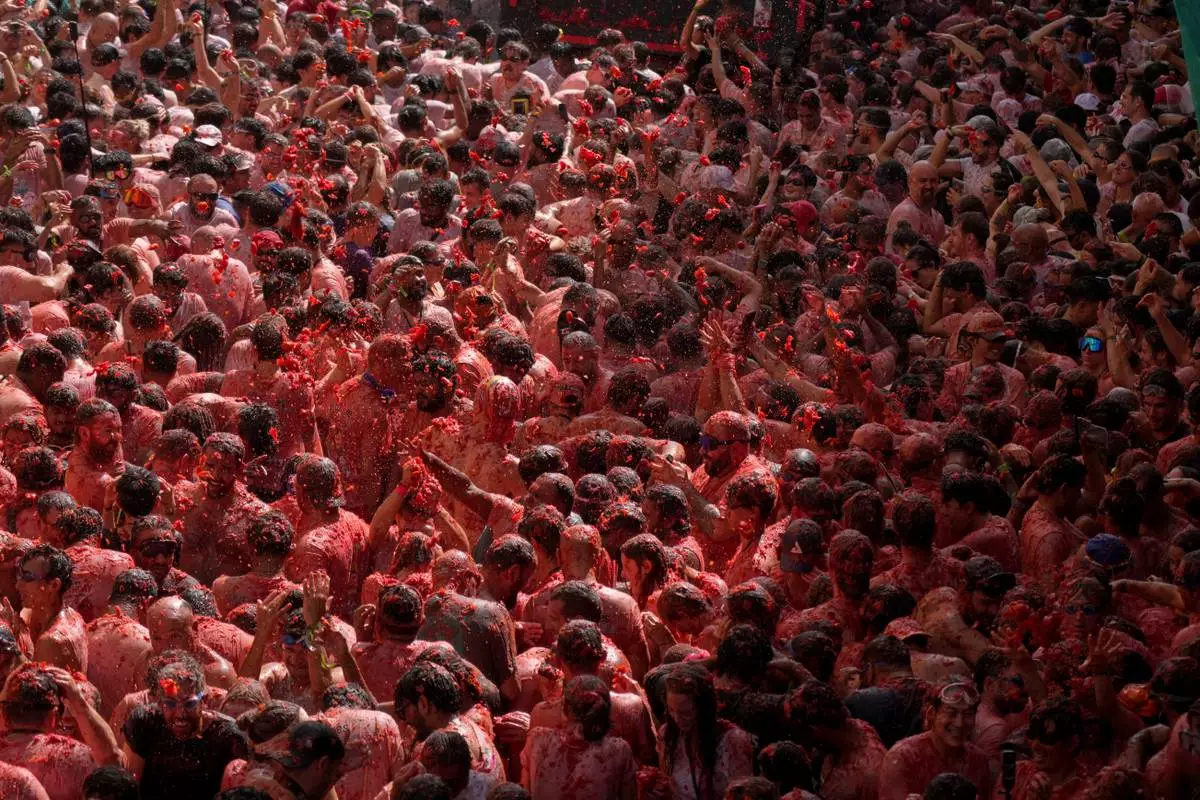
Revelers throw tomatoes at each other during the annual "Tomatina" tomato fight fiesta, in the village of Bunol near Valencia, Spain, Wednesday, Aug. 26, 2026. (AP Photo/Alberto Saiz)
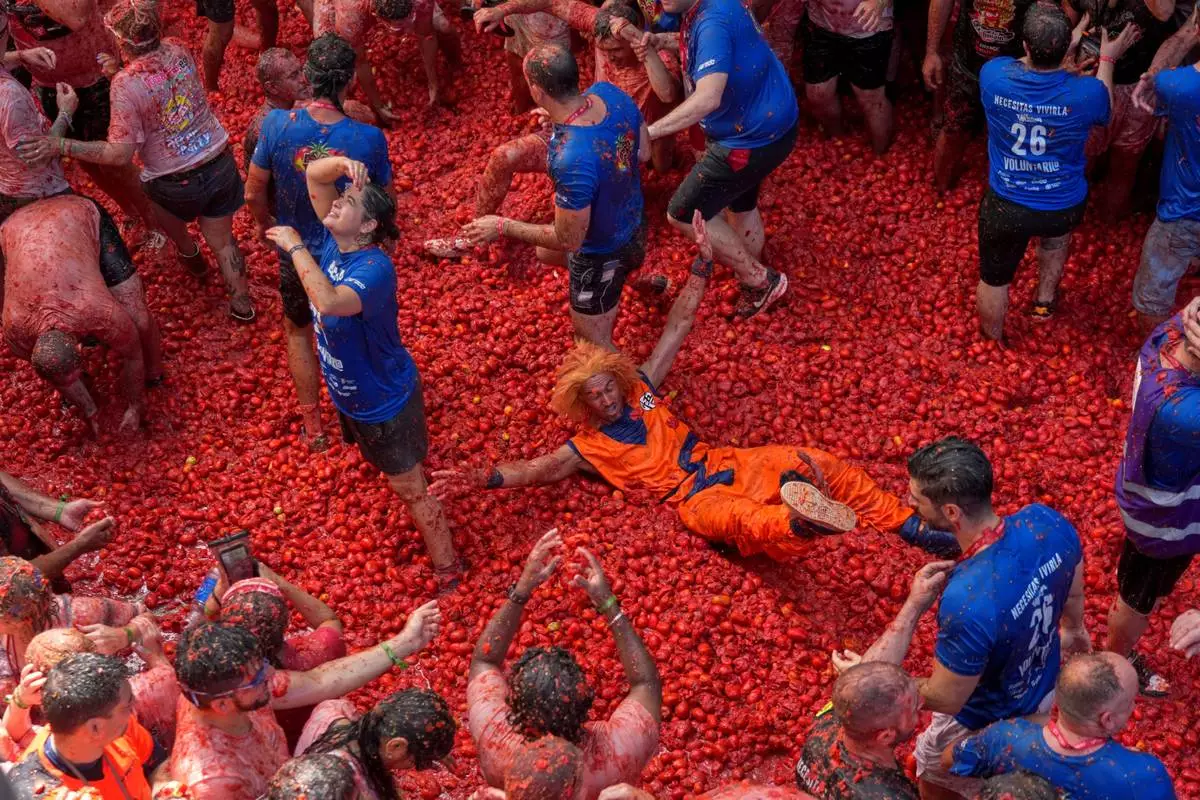
Revelers throw tomatoes at each other during the annual "Tomatina" tomato fight fiesta, in the village of Bunol near Valencia, Spain, Wednesday, Aug. 26, 2026. (AP Photo/Alberto Saiz)
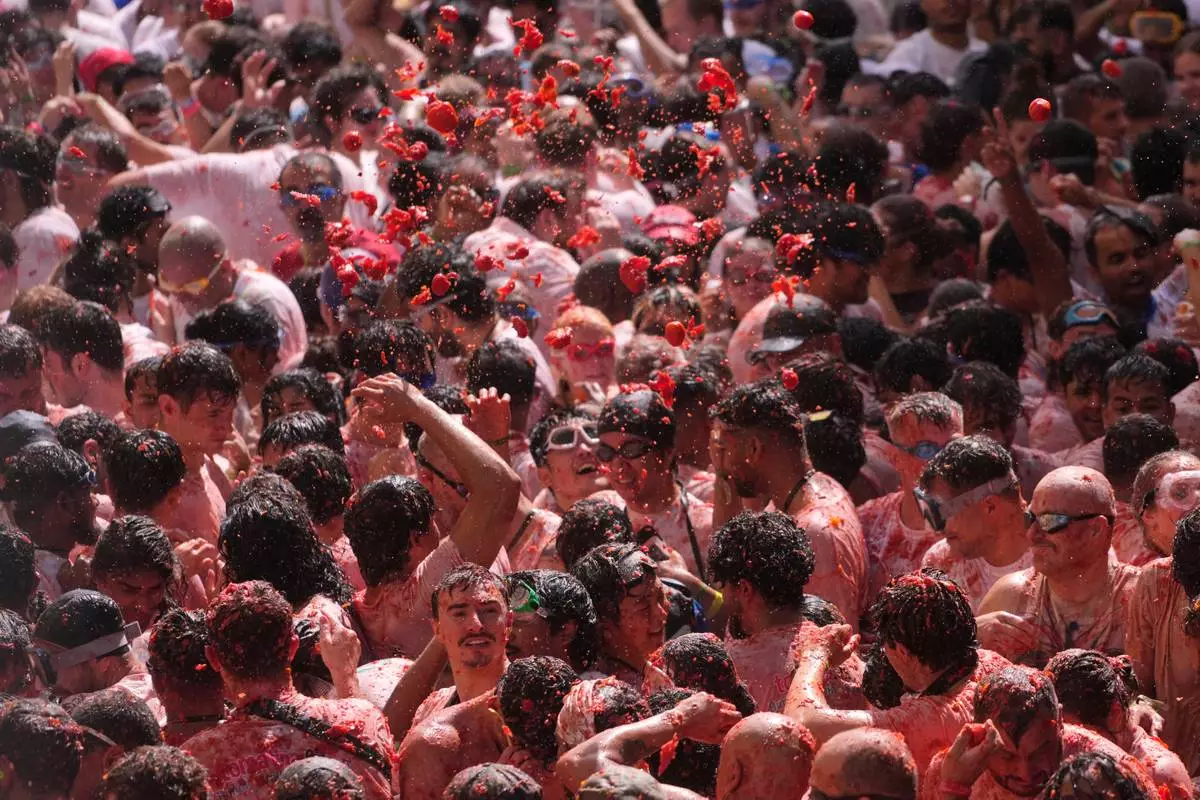
Revelers throw tomatoes at each other during the annual "Tomatina" tomato fight fiesta, in the village of Bunol near Valencia, Spain, Wednesday, Aug. 26, 2026. (AP Photo/Alberto Saiz)
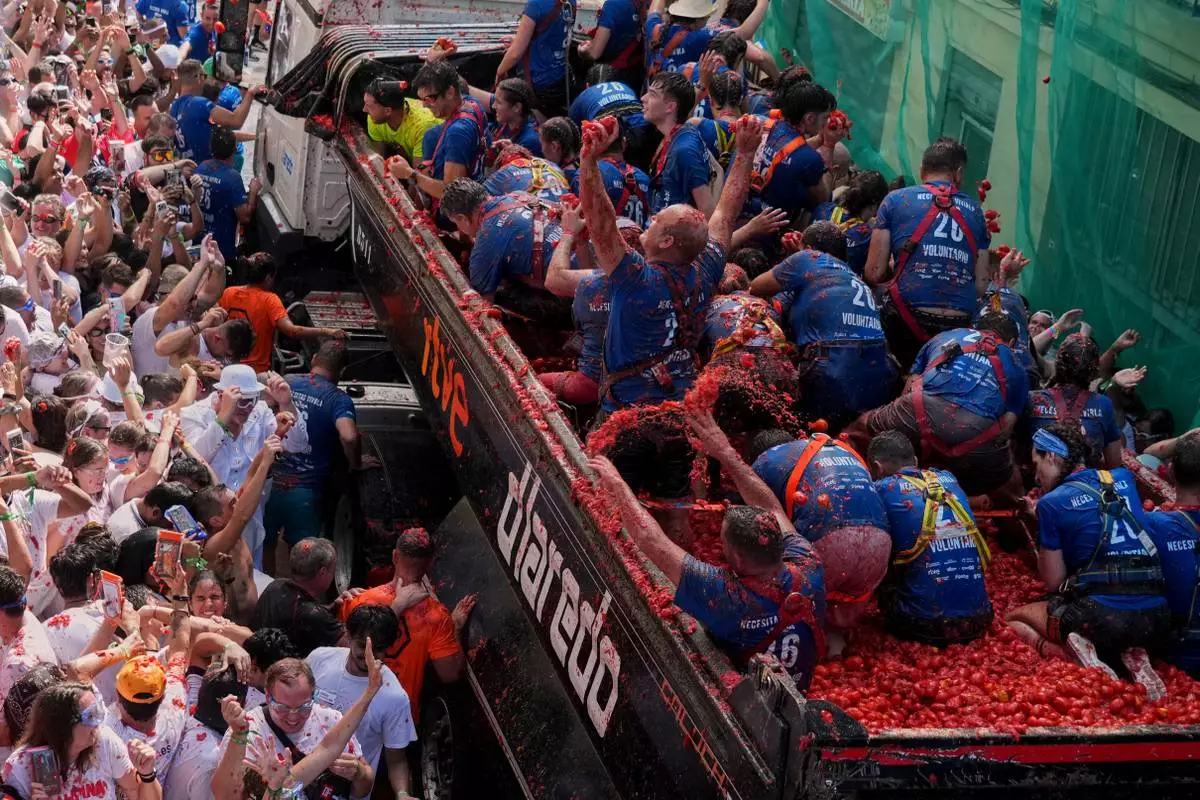
Revelers throw tomatoes at each other during the annual "Tomatina" tomato fight fiesta, in the village of Bunol near Valencia, Spain, Wednesday, Aug. 26, 2026. (AP Photo/Alberto Saiz)
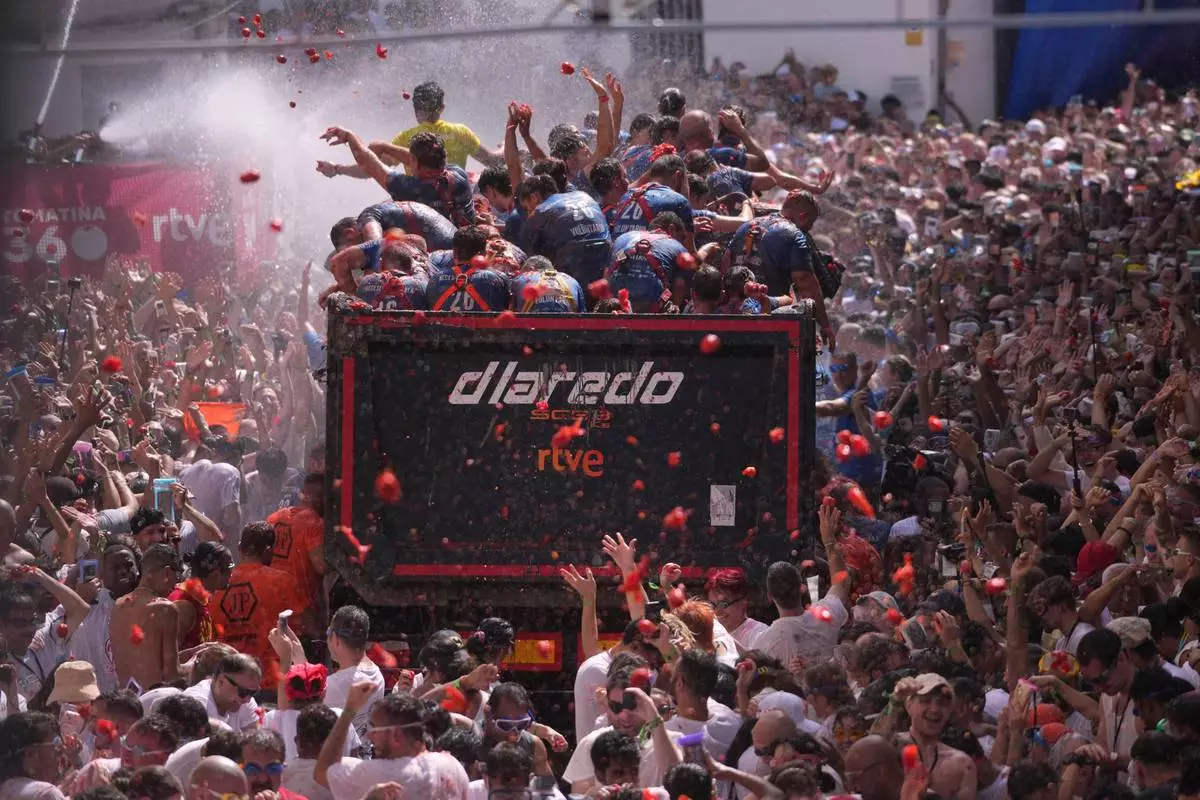
Revelers throw tomatoes at each other during the annual "Tomatina" tomato fight fiesta, in the village of Bunol near Valencia, Spain, Wednesday, Aug. 26, 2026. (AP Photo/Alberto Saiz)
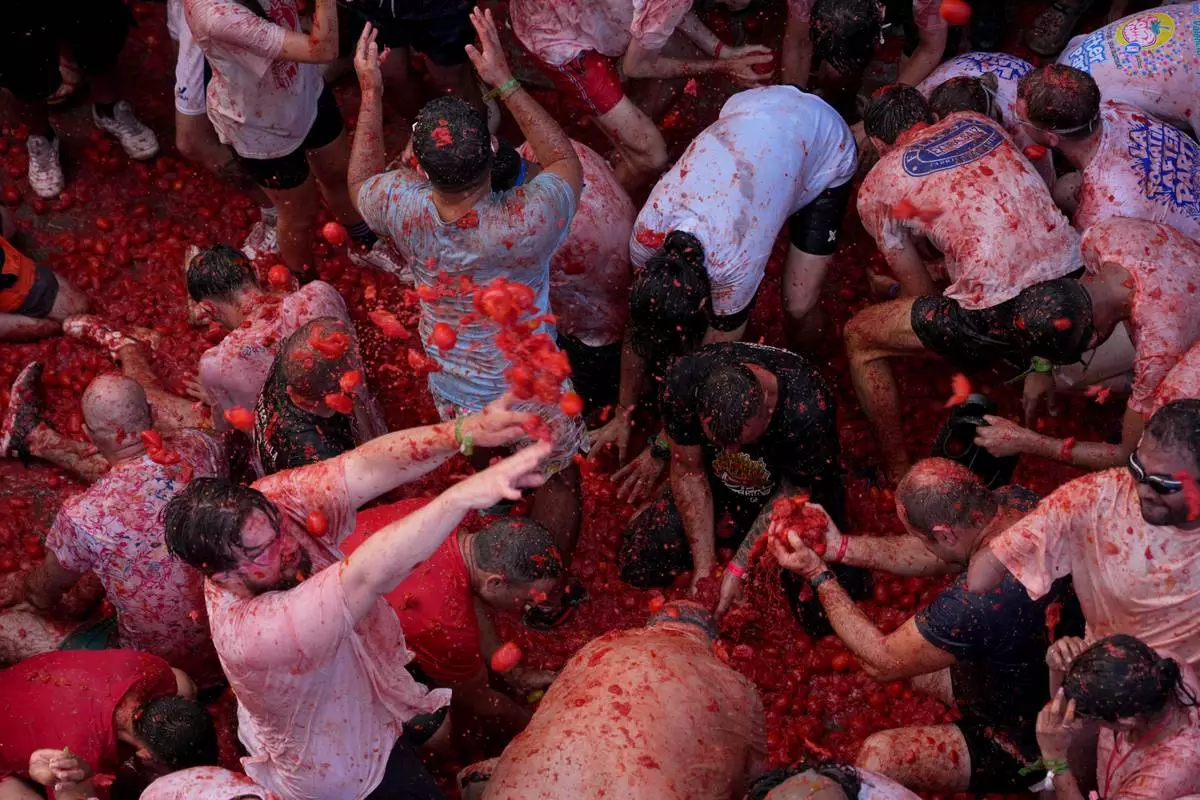
Revelers throw tomatoes at each other during the annual "Tomatina" tomato fight fiesta, in the village of Bunol near Valencia, Spain, Wednesday, Aug. 26, 2026. (AP Photo/Alberto Saiz)

Revelers cheer ahead of the annual "Tomatina" tomato fight fiesta, in the village of Bunol near Valencia, Spain, Wednesday, Aug. 26, 2026. (AP Photo/Alberto Saiz)

Revelers from India pose for a picture ahead of the annual "Tomatina" tomato fight fiesta, in the village of Bunol near Valencia, Spain, Wednesday, Aug. 26, 2026. (AP Photo/Alberto Saiz)

A reveler dressed in a tomato costume poses for a picture before the annual "Tomatina" tomato fight fiesta, in the village of Bunol near Valencia, Spain, Wednesday, Aug. 26, 2026. (AP Photo/Alberto Saiz)

Revelers Vigu, left, and Megha from India pose for a picture ahead of the annual "Tomatina" tomato fight fiesta, in the village of Bunol near Valencia, Spain, Wednesday, Aug. 26, 2026. (AP Photo/Alberto Saiz)

Revelers ahead of the annual "Tomatina" tomato fight fiesta, in the village of Bunol near Valencia, Spain, Wednesday, Aug. 26, 2026. (AP Photo/Alberto Saiz)