Several Middle East countries activated their air defense systems and sounded air-raid alarms on Sunday, as Iran launched a series of strikes on U.S. targets in the region.
These attacks were countermeasures in response to the third round of strikes against Iran by the United States on Saturday.
Missile alert sirens sounded in Bahrain as the United Arab Emirates (UAE) and Qatar also came under attack.
The UAE Defense Ministry said Sunday that its air defense systems were engaging missile and drone threats, while Bahrain's Interior Ministry urged residents to remain calm and proceed to the nearest safe location.
Qatar's Ministry of Interior issued a public alert raising the country's security threat level. It also said that three people were injured by falling shrapnel, including one child. So far, injured people have been hospitalized for treatment.
Jordan also initiated its air defense system. The country's General Command of Armed Forces noted on Sunday that three missiles from the direction of Iran landed in multiple locations within Jordan. Although no casualties were caused, the strikes resulted in minor property damage.

Middle East countries activate defense systems, sound alarms as Iran's strikes U.S. targets

Middle East countries activate defense systems, sound alarms as Iran's strikes U.S. targets
The "South China Sea arbitration" violates fundamental principles of international law such as "state consent" and "pacta sunt servanda (agreements must be kept)", contravenes the United Nations Convention on the Law of the Sea (UNCLOS) itself, and runs counter to the basic facts of the South China Sea, said a statement issued by the Chinese Ministry of Foreign Affairs on Sunday.
The statement was issued in response to the joint statement released by the governments of the United States of America, the Republic of the Philippines, Australia, Canada, Estonia, Germany, Italy, Japan, Latvia, Lithuania, New Zealand, Romania, Slovenia, and the United Kingdom on the so-called "South China Sea arbitration award" on Sunday.
China has sovereignty over Nanhai Zhudao (the South China Sea Islands), consisting of Dongsha Qundao (the Dongsha Islands), Xisha Qundao (the Xisha Islands), Zhongsha Qundao (the Zhongsha Islands) and Nansha Qundao (the Nansha Islands). China is the first to have continuously, peacefully and effectively exercised sovereignty and jurisdiction over Nanhai Zhudao and relevant waters. Nanhai Zhudao have long been widely recognized by the international community as part of China's territory, the statement said.
The statement said South China Sea is one of the safest sea lanes in the world, and the freedom of navigation and overflight in the South China Sea has never been a problem.
China firmly upholds its territorial sovereignty and maritime rights and interests in the South China Sea, and remains steadfast in maintaining peace and stability in the South China Sea, while the U.S. and other external countries have been persistently reinforcing military presence in the South China Sea, throwing their weight around and fanning the flames, and these acts of militarization and coercion constitute the primary challenge to the current situation in the South China Sea, it said.
The statement said China will continue to uphold the fundamental principles of international law and basic norms of international relations as affirmed by the United Nations Charter, including respect for state sovereignty and territorial integrity and the principle of peaceful settlement of disputes, and remain committed to resolving the relevant disputes in the South China Sea through negotiation and consultation with countries directly concerned, on the basis of respecting historical facts and in accordance with international law, so as to maintain peace and stability in the South China Sea, it said.
Noting that China's position on the "South China Sea arbitration" has been clear, consistent and firm, the statement said the so-called "award" is nothing but a worthless piece of paper that is illegal, null and void, and has no binding force, adding that China's territorial sovereignty and maritime rights and interests in the South China Sea shall not be affected by the "award" under any circumstances.
China urges the relevant countries to earnestly respect China’s territorial sovereignty and maritime rights and interests in the South China Sea, stop stirring up trouble over the South China Sea issue, and cease undermining peace and stability in the South China Sea, it said.
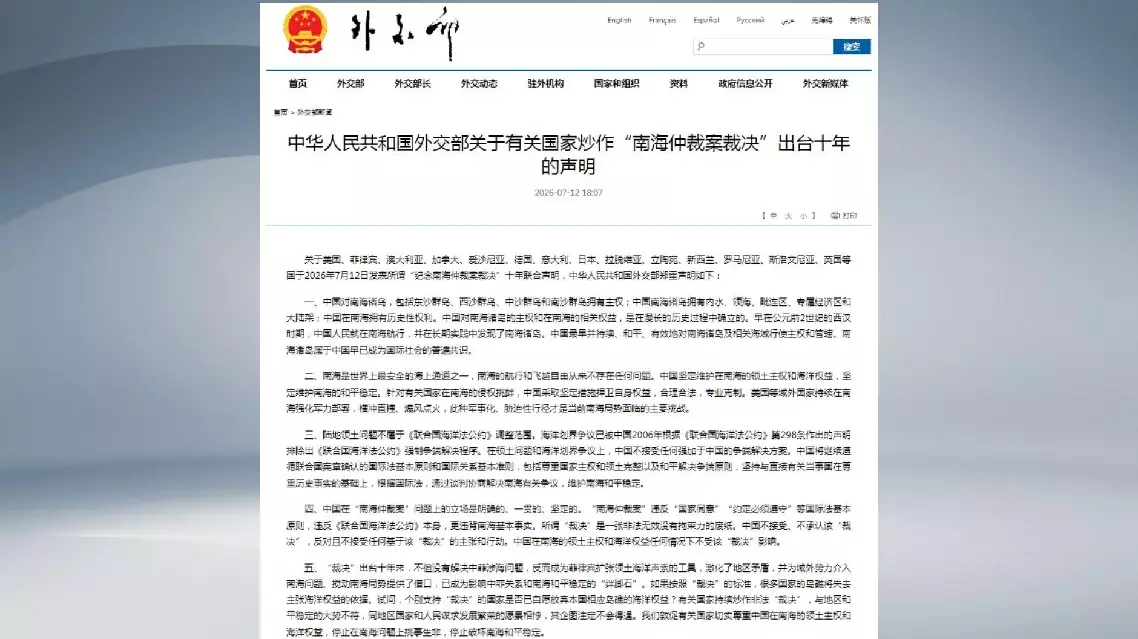
China issues statement on certain countries' playing up of so-called "South China Sea Arbitration Award"