Militiamen and emergency crews launched a massive cleanup and repair operation across China's eastern Zhejiang Province on Sunday, tackling widespread mud, uprooted trees, and power outages left in the aftermath of Typhoon Bavi.
Typhoon Bavi, the ninth typhoon of the year, made two landfalls in Zhejiang Province -- late Saturday on the coast of Yuhuan in Taizhou, then shortly after midnight on the coast of Yueqing in Wenzhou.
It caused waterlogging and road blocks in cities such as Taizhou, Wenzhou, and Jiaxing.
In Yuhuan, where heavy rainfall left urban streets coated in thick mud, local militiamen were deployed to clear main thoroughfares to restore regular traffic and normal life.
In Wenzhou's Yongjia County, surging water levels near a section of the Hangzhou-Shenzhen railway threatened a local museum, prompting militiamen to erect sandbag barricades to protect the public facility.
Fallen trees and debris cut off roads in other parts of Wenzhou, including Yueqing, Longgang, and Dongtou, requiring militiamen equipped with power saws to clear traffic lanes.
In Jiaxing, the typhoon caused severe disruption to public transit networks , leaving more than 2,600 rail passengers stranded at the Jiaxing South railway station. Militiamen and local railway police were deployed to evacuate stranded passengers.
Typhoon Bavi also caused heavy damage to the power grid in Taizhou, prompting local electricity departments to start emergency repair after multiple power lines failed.
By 14:00 local time on Sunday, state grid workers had inspected 266 substations, reinforced over 3,200 outdoor terminal boxes, and cleared nearly 10,000 trees obstructing transmission lines.
Authorities have also deployed 36 mobile power generator vehicles to vulnerable areas.
While 80 percent of the primary power grid has been successfully repaired, intensive emergency work continues to restore local distribution lines, according to the local authorities.
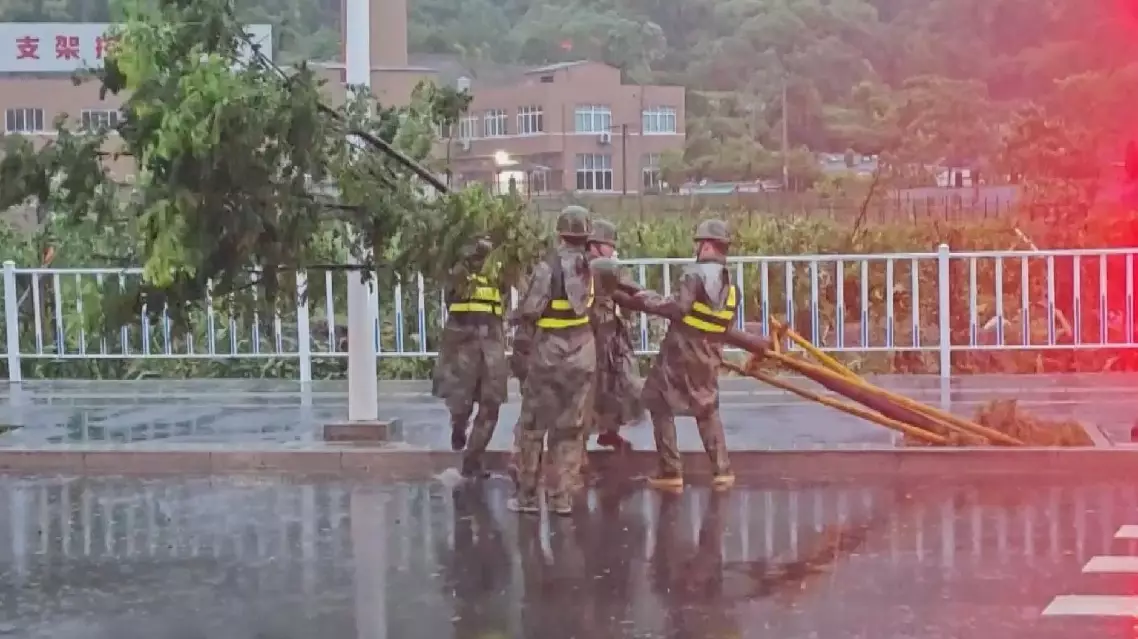
China's Zhejiang starts cleanup, power repairs after Typhoon Bavi hits coast