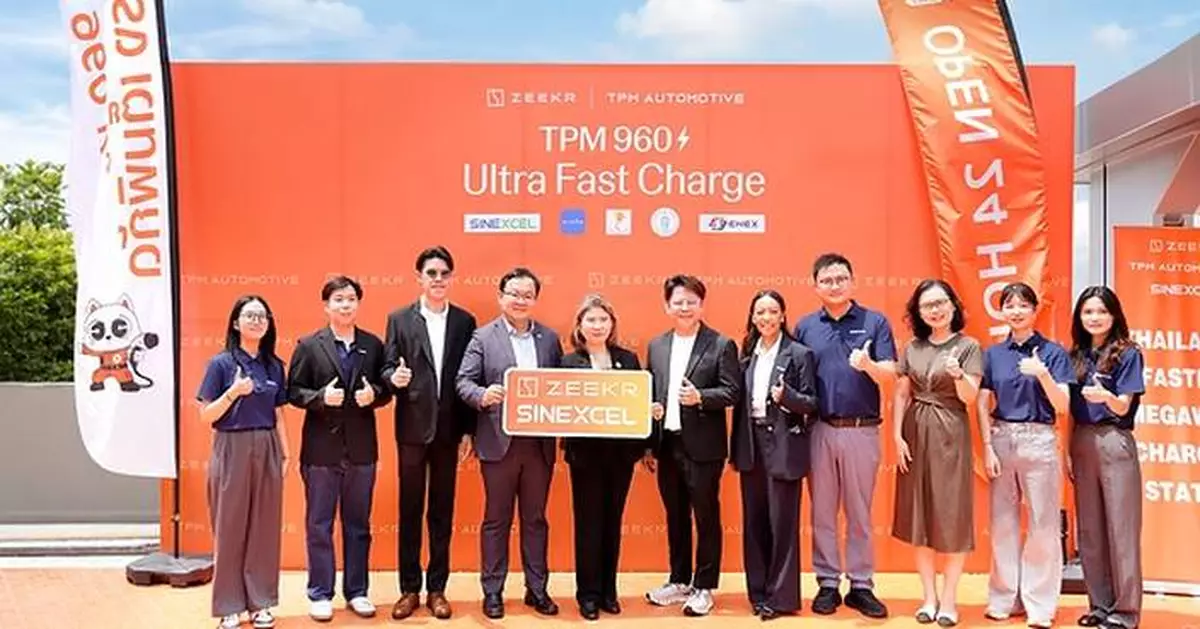
BANGKOK, July 13, 2026 /PRNewswire/ -- ZEEKR, TPM Automotive, and SINEXCEL announced the grand opening of Thailand's first megawatt-level supercharging station in Bangkok, marking Thailand's entry into the megawatt charging era. Representatives from the Bangkok Metropolitan Administration, operators, charging platform providers, and the media gathered to witness this milestone for Southeast Asia's electric mobility landscape.
The Challenge: High-Voltage EVs vs. Legacy Charging Infrastructure
Thailand's EV transition is accelerating, with 800V models making up 15% of the market. However, lagging public infrastructure creates a mismatch that presents three critical challenges:
- Slow Charging: Low-power chargers can take over an hour, limiting the performance of 800V EVs.
- Inefficient Power Utilization: Traditional standalone chargers lack dynamic power-sharing capabilities, unable to support simultaneous multi-vehicle charging.
- Grid Instability: Megawatt-level charging demands introduce intense, instantaneous spikes that threaten local grid stability.
The Solution: 960kW Ultra-Fast Charging Stack
To solve these bottlenecks, the three partners deployed SINEXCEL's 960kW ultra-fast charging stack —built to pair the fastest EVs with the fastest charging. The system features one 700A liquid-cooled supercharging dispenser paired with three 500A air-cooled fast-charging dispensers, delivering two advantages:
Powering Ultra-Fast EVs at Once, 10-Min to Full Power
- The intelligent 960kW power pool dynamically allocates power based on vehicle demand.
- In live testing, two ZEEKR 7X vehicles charged simultaneously at peak speeds, surging from 20% to 80% in just 10 minutes.
- Power utilization reaches 97%—16% higher than conventional charging solutions.
Seamless Upgrades, Sustained Speed Leadership
- Scalable Power: The system can seamlessly scale from 960kW to 1,280kW simply by adding power modules.
- Interchangeable Terminals: Supports future upgrades to liquid-cooled or MCS dispensers.
- Eco-System Integration: Supports solar and energy storage integration to reduce grid impact and expand charging capacity.
Co-Building the Future of Southeast Asian Mobility
As industry pioneers, ZEEKR spearheads premium electrification via its 800V platform, while SINEXCEL delivers 16 years of expertise as the world's No.1 in megawatt-level charger sales. Alongside TPM Automotive's premier local network, this tripartite alliance marks a milestone in vehicle-charger synergy.
By successfully validating the "EV + Charger + Local Partner" ecosystem, the coalition establishes a powerful, sustainable blueprint for Thailand's supercharging network.
Moving forward, SINEXCEL remains committed to deepening its collaboration with ZEEKR, TPM, and industry leaders to accelerate ultra-fast charging infrastructure and power Southeast Asia's green transition.
Media contact: zhimin_huang@sinexcel.com
** This press release is distributed by PR Newswire through automated distribution system, for which the client assumes full responsibility. **
ZEEKR, TPM Automotive, and SINEXCEL Jointly Build Thailand's Fastest Megawatt-Level Charging Station
As AI agents move into production, organizations are treating AI as a governed and measured business resource
SINGAPORE, Nov. 27, 2026 /PRNewswire/ -- A year after developers across Southeast Asia and India were largely writing their own rules for AI, organizations are now stepping in to govern it, according to new findings from Agoda's AI Developer Report 2026. As AI agents move from experimentation into production, companies are treating AI less as an open tool and more as a managed business resource, with usage limits, guidelines, and cost controls.
The shift shows most in how access to AI is managed. Four in five developers now work under some form of usage limit, including token quotas, usage caps, or budget restrictions. These controls scale with organizational size, from 41% of developers at small organizations (1 to 50 employees) to more than 91% at organizations with over 1,000 employees. The report finds these limits are as much a governance tool as a cost mechanism, shaping how and where AI is used across the organization.
Formal guidance is also associated with stronger adoption. Developers at organizations with established AI guidelines report production or broad agent use at 56%, compared with 43% at organizations without them, and codebase readiness at 40%, compared with 30%.
Managing risk has become a leadership priority. Nearly a third of respondents (31%) identify managing AI risk as engineering leadership's biggest challenge over the next 12 months, ahead of integrating AI into workflows (21%) and upskilling existing talent (18%). Engineering leaders surveyed for the report note that policy alone is not enough. Some argue the larger gap is literacy rather than policy: decision-makers need to understand what they are deploying well enough to know what governance it requires. In regulated environments, the challenge is more structural, as legal or regulatory requirements may restrict how sensitive data can be used with external AI services.
Idan Zalzberg, Chief Technology Officer at Agoda, said: "Last year, developers across the region were building their own guardrails for AI. This year, organizations are catching up. As AI agents take on more of the work, AI becomes something companies have to manage like any other business resource, with visibility into who uses it, what it costs, and whether the output can be trusted. The goal of governance is not to slow developers down. It is to let them use AI at scale, safely."
At Agoda, this approach is built into the company's engineering infrastructure. Its GenAI Proxy serves as a unified layer that authenticates usage, enforces limits, monitors costs, and supports compliance across multiple model providers. Because switching between models is straightforward, teams can evaluate them offline and on live traffic, matching each task to the most suitable model, from frontier models for complex work to smaller, lower-cost models for routine tasks.
The Agoda AI Developer Report 2026 was commissioned by Agoda and conducted in partnership with Macramé Consulting. It surveyed over 800 software developers and engineering leaders across India, Indonesia, Malaysia, the Philippines, Singapore, Thailand, and Vietnam, and includes insights from regional companies such as Omise, SCB 10X, and dataxet. It examines how developers are navigating the shift from AI assistants to autonomous AI agents.
For more information and to download the free report, visit Agoda AI Developer Report 2026.
** This press release is distributed by PR Newswire through automated distribution system, for which the client assumes full responsibility. **
Four in five developers in Southeast Asia and India now work under AI usage limits, Agoda report finds