KYIV, Ukraine (AP) — With the death of Republican Sen. Lindsey Graham, Ukraine lost a close ally in President Donald Trump’s orbit, leaving its leaders grappling with the implications for their war-torn country.
Graham had been in Ukraine two days prior, standing in Kyiv’s St. Michael’s Square, flanked by the golden domes of the monastery and the burned-out remains of Russian military equipment.
There, he offered Ukrainians reason to be optimistic, telling reporters that sweeping new hard-hitting economic sanctions against Russia, legislation he had spent years pushing with Democratic Sen. Richard Blumenthal, were finally within reach. He would be heading back to Washington to meet with bipartisan leaders to advance the proposal.
Two days later, on Sunday, the world learned of his sudden death.
Ukrainian officials and lawmakers were devastated by the news. For years, Graham had been one of Kyiv’s closest allies in Washington and a trusted intermediary with Trump, who had a strained relationship with President Volodymyr Zelenskyy.
Now, officials fear that without Graham, Ukraine’s ability to influence the White House could be diminished across a broad range of issues, not just the fate of the Russia sanctions bill.
“Huge and absolutely unexpected loss,” said Oleksandr Merezhko, a lawmaker with Zelenskyy’s party. “He was truly indispensable. I even don’t know who might be as important for us now in Trump’s entourage.”
“He was the closest link between Ukraine, our president and Trump,” he added. “Our position in Trump’s entourage might be weaker.”
Condolences poured in from senior Ukrainian officials including Zelenskyy, who remembered Graham as one of Ukraine’s staunchest champions in Washington and someone who was in constant contact with Kyiv.
Zelenskyy said he was “deeply saddened” by the senator’s sudden death, noting that Graham had visited Ukraine 10 times since Russia’s full-scale invasion and had been with Ukrainians “when it was most needed.”
“We were in constant dialogue and will miss that greatly,” Zelenskyy wrote on Telegram, recalling that the two had met twice last week, at the NATO summit and again during Graham’s visit to Kyiv.
Parliamentary Speaker Ruslan Stefanchuk described Graham as a “steadfast friend of Ukraine” whose support was “principled and resolute.” He said he would always remember their “meaningful, sincere, and warmly personal meetings,” adding that he believed Graham’s efforts to impose tougher sanctions on Russia would be carried forward despite his death.
With Trump’s return to the White House after the Biden administration, Ukrainian officials moved swiftly to cultivate relationships with Republicans close to him amid growing uncertainty over future U.S. backing. Graham became a central figure in those efforts, lawmakers said at the time.
Oleksandr Kraiev, a political analyst at the think tank Ukrainian Prism, said Graham was an unusually prominent figure in Ukraine.
“Graham is even more well-known and more popular among Ukrainians than many Ukrainian politicians,” Kraiev said.
Without Graham, Ukraine could lose an influential advocate with direct access to Trump, Kraiev said.
“I don’t see anyone else who will take the lead in helping Ukraine maintain those necessary connections,” he said.
Graham was a political phenomenon now rare in a Republican Party where Trump has absolute control.
The senator steadfastly held onto more traditional conservative foreign policy values that included staunchly opposing Russia, being especially hawkish on Iran and pushing the White House to even more fully embrace Israeli Prime Minister Benjamin Netanyahu.
Graham also was a vocal supporter of traditional U.S. allies in Europe at a time when Trump threatened to pull American troops off the continent and denigrated NATO with increasing zeal.
The senator maintained those views despite them often putting him at odds with many vocal supporters of the isolationism and “America First” approach of the president’s “Make America Great Again” movement.
Although Trump frequently ridicules Republican members of Congress he perceives as not sufficiently loyal, he remained close to Graham and listened to him, especially on foreign policy matters.
A powerful voice in the Senate, even Democrats noticed Graham’s independent streak with much of the rest of his party.
“He marched to his own drummer,” Blumenthal, a Democrat from Connecticut, said in a statement. “He could be strong-minded, fiercely driven, and sometimes unpredictable, but also deeply compassionate and sympathetic when he saw suffering and injustice.”
Graham’s support of Ukraine bumped up against Trump's complaints that the U.S. was spending too much money to help the besieged country.
Still, Graham thought he was close to advancing legislation bolstering economic sanctions against Russia. Blumenthal said he’d spoken to Graham over the weekend and that the South Carolinian was “exulted” about the prospect of moving such a package forward.
Blumenthal added that the bill should now be passed as a “fitting tribute” to Graham.
Weissert reported from Washington.

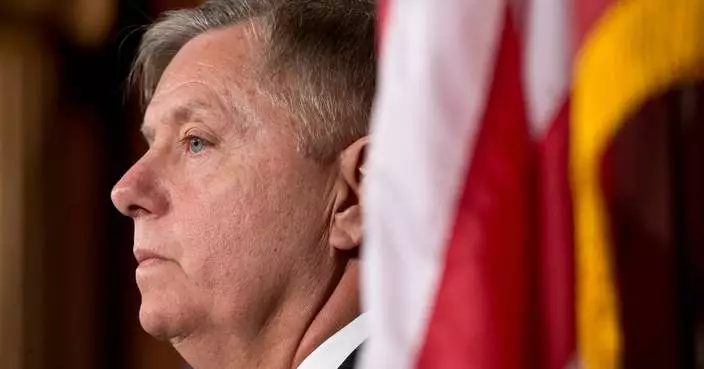
U.S. Sen. Lindsey Graham, R-S.C. answer media questions near damaged Russian tanks exhibition in central Kyiv, Friday, July 10, 2026. (AP Photo/Efrem Lukatsky)
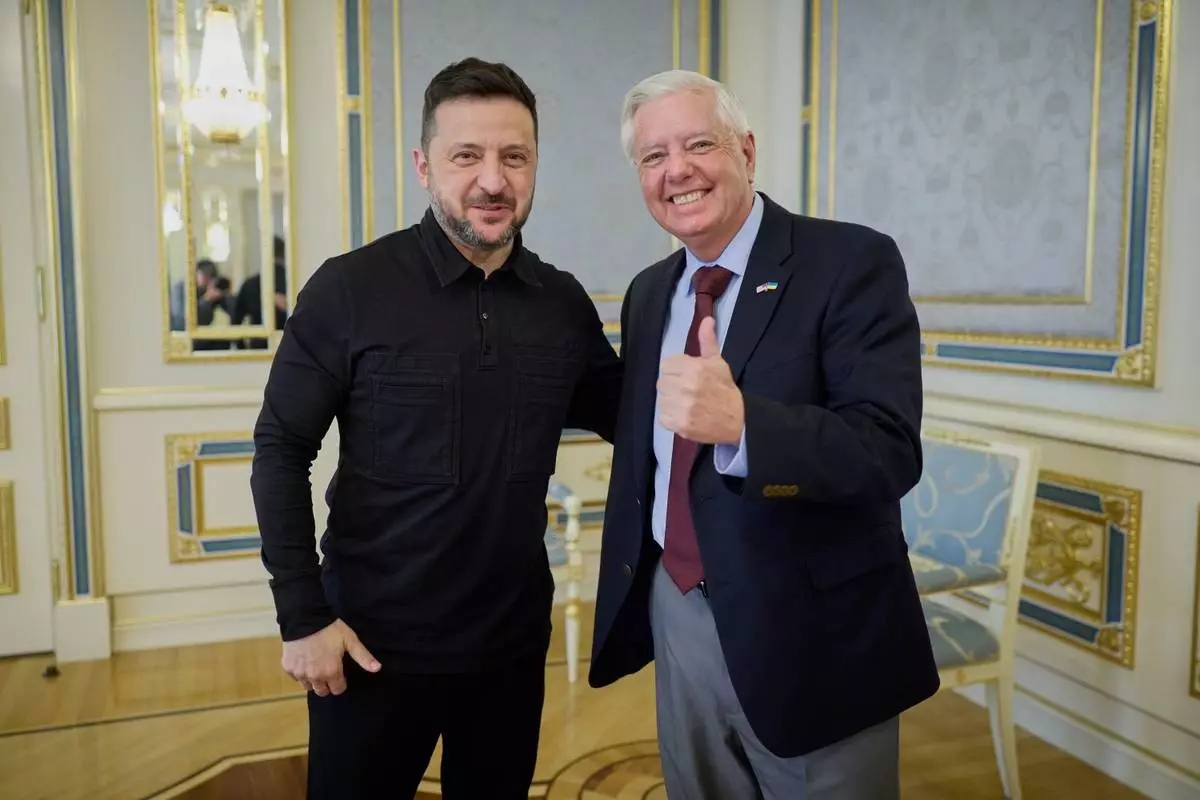
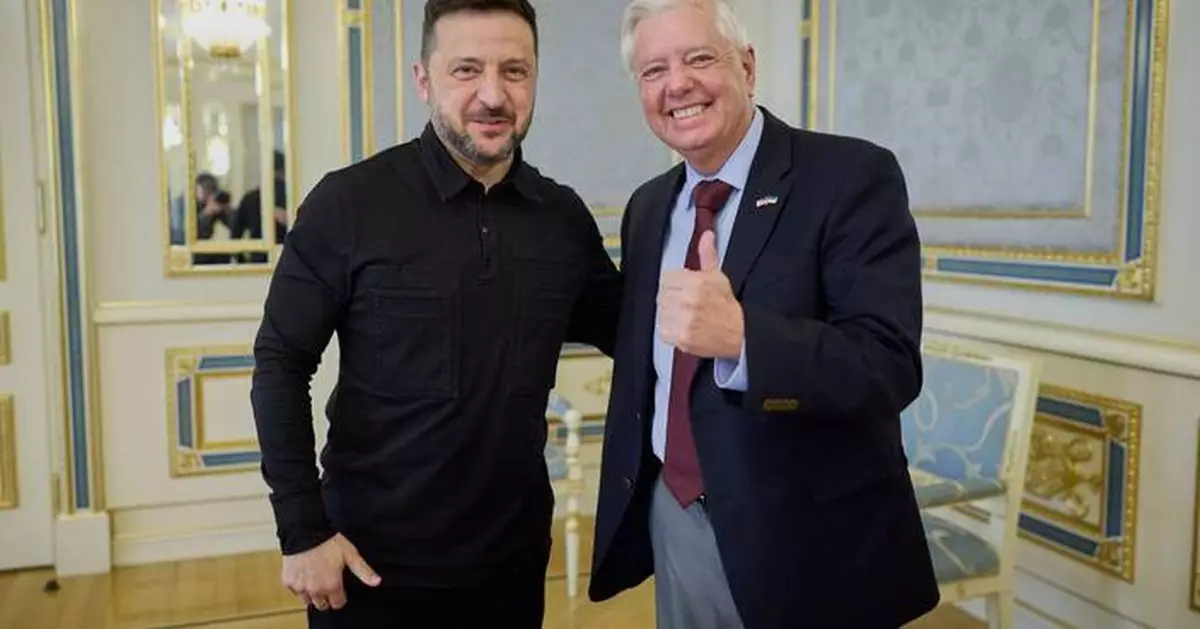
In this photo provided by the Ukrainian Presidential Press Office, Ukrainian President Volodymyr Zelenskyy, left, and U.S. Sen. Lindsey Graham, R-S.C. in Kyiv, Ukraine, Friday, July 10, 2026. (Ukrainian Presidential Press Office via AP)
CHARLESTON, S.C. (AP) — The death of Sen. Lindsey Graham, who was running for a fifth term when he passed away over the weekend, began a tumultuous new chapter in South Carolina politics during a year that has already been full of upheaval.
As the conservative state's senior senator and an influential ally of President Donald Trump, Graham was presumed to be on a glide path toward reelection.
Now, Gov. Henry McMaster must choose a temporary replacement who can serve until January while the state also prepares a special primary so voters can choose a new Republican nominee for the general election.
The rare open Senate seat has ignited a scramble among South Carolina's most ambitious conservatives, who have been eager to climb the political ladder.
Republicans just finished a sprawling and bruising contest to figure out their nominee for succeeding McMaster, who is wrapping up his second term. State Attorney General Alan Wilson won the nomination, overcoming a field that included Lt. Gov. Pamela Evette, Rep. Nancy Mace and Ralph Norman — all of whom are now eyeing Graham's seat.
According to South Carolina law, a one-week filing period for a special primary election begins on the second Tuesday after the candidate’s death, or July 21.
The special primary election would be held on the second Tuesday after that filing period closes, or Aug. 11. Any necessary runoff would follow two weeks after that, or Aug. 25.
From that point, the new nominee would have just over two months to campaign for the general election on Nov. 3.
All of this is problematic according to federal law, which requires military and overseas ballots to go out 45 days before any federal election. For the general election primary, that would have been June 27. Federal Election Commission officials didn’t immediately return a message seeking clarity about the process.
Graham died on Saturday night, and a preliminary medical examiner report said he suffered a tear in his aorta, known as an aortic dissection.
In the hours after Graham's death was announced, South Carolina’s Republican circles were already swirling with rumors about possible replacements. Given the proximity of November's election, it's likely that whomever McMaster appoints could be a top contender in the special primary, although it's possible that McMaster's choice will only serve as a temporary caretaker.
Evette, who has served nearly eight years alongside McMaster and received his endorsement in the governor's race, is one possibility. She lost the June 23 runoff to Wilson.
A person with knowledge of Evette's thinking but not authorized to discuss it publicly said that she was getting encouragement from across the state and feels she would have good chances in the special primary.
It's unlikely that any House member would be appointed to finish Graham's current term, since Republicans have such a slim majority in the chamber.
U.S. Rep. Joe Wilson, a rumored replacement, said he assured Trump on Sunday that “my goal is to remain in the House to keep his two-vote majority for the American people!!!”
However, that doesn't mean that House members won't run for the next full term. A person with knowledge of Mace's thinking but not authorized to speak about it publicly said she was considering the race. Mace is not running for reelection to the House.
But another Republican from the state, Rep. Russell Fry, could be a possibility. The two-term lawmaker represents the growing area around Myrtle Beach, and he's been a top Trump ally.
A spokesman for businessman Mark Lynch, whom Graham defeated in the primary, didn't return a message Sunday.
Treasury Secretary Scott Bessent, who lived in South Carolina prior to joining the Trump administration, has fielded calls about potentially replacing Graham but doesn’t have interest in the role and enjoys working for the president, according to a person who requested anonymity to describe private conversations.
No Democrat has won a Senate seat in South Carolina in decades, and Republicans in recent history typically take statewide seats by double digits. When he last ran in 2020, Graham defeated his Democratic opponent, Jaime Harrison, by a 10 percentage point margin.
So while history suggests that Graham was en route to a fifth term, Republicans are carefully surveying the landscape.
Charleston pediatrician Annie Andrews won the Democratic nomination last month and has raised more than $8 million in the race, and had just under $3 million cash on hand at the end of May, according to federal filings. Graham had taken in $6 million, with just over $4 million on hand.
In a statement Sunday, Andrews called on South Carolinians to join her “in setting partisanship aside and offering gratitude" to Graham for his service.
Noting that he and Graham “had our share of political disagreements,” Harrison wrote on social media that he “always appreciated that even in our fiercest political battles, we could still share a conversation, a laugh, and a mutual respect for South Carolina and the institutions we were both privileged to serve.”
Graham leaves a major void in the Senate, where seniority can determine influence. He served more than two decades in the chamber, positioning himself to lead committees and set the agenda.
Sen. Tim Scott, South Carolina's junior senator, has only been in office since 2012 — short by the state's standards. Fritz Hollings served for 38 years and Strom Thurmond was there for 47.
Scott, who co-chaired Graham's reelection effort, described his former colleague as “irreplaceable.”
“America lost a statesman, but I lost a friend,” he told ABC's “This Week."
Associated Press writer Fatima Hussein in Washington contributed to this report.
Kinnard can be reached at http://x.com/MegKinnardAP
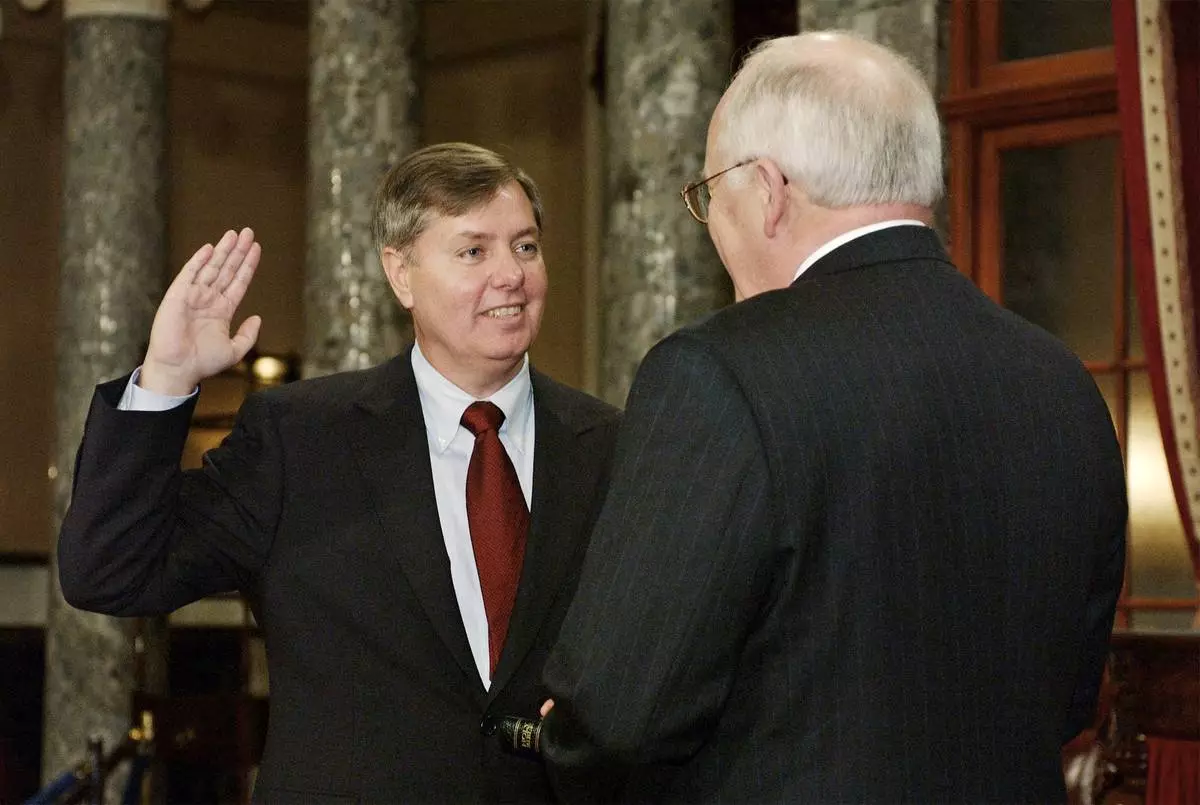
FILE - Sen. Lindsey Graham, R-S.C., takes the oath of office with Vice President Dick Cheney, right, during a re-enactment swearing-in ceremony in the Old Senate Chamber on Capitol Hill in Washington, Jan. 7, 2003, following his election to the Senate. (AP Photos/Evan Vucci, File)
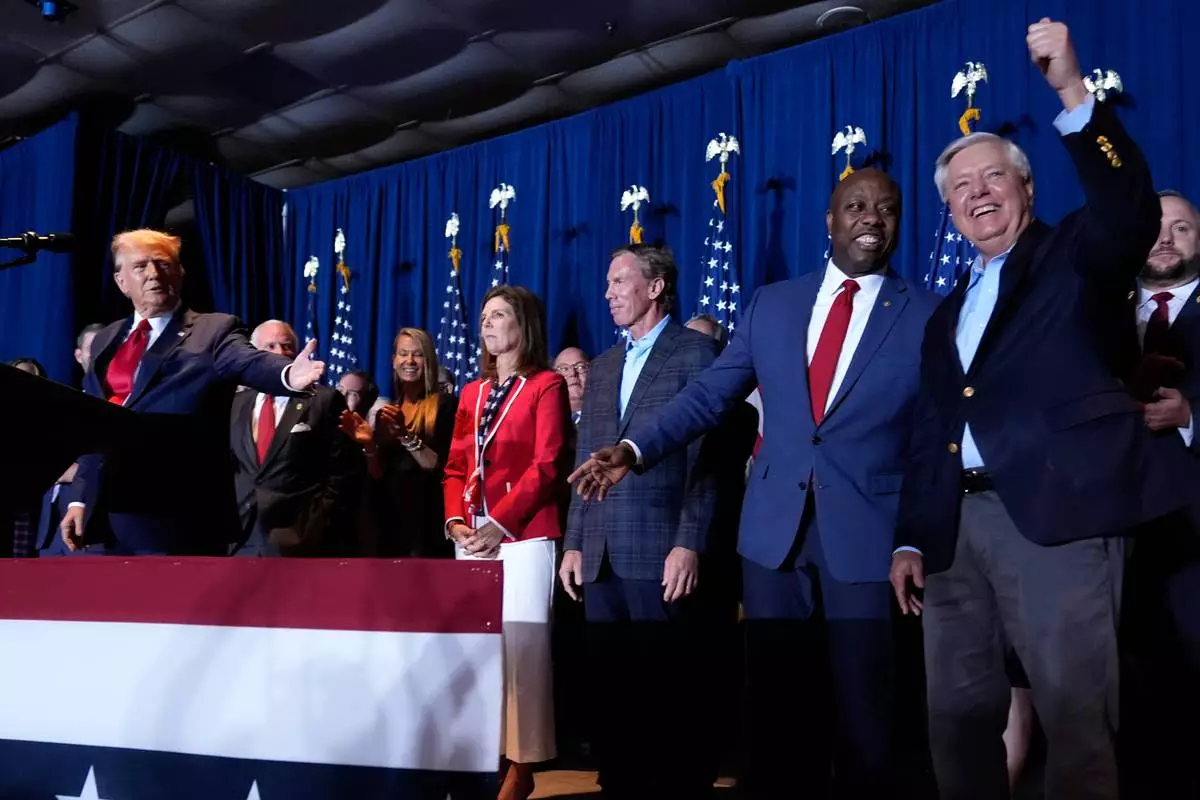
FILE - Republican presidential candidate former President Donald Trump speaks as Sen. Tim Scott, R-S.C., and Sen. Lindsey Graham, R-S.C., listen, at a primary election night party at the South Carolina State Fairgrounds in Columbia, S.C., Feb. 24, 2024. (AP Photo/Andrew Harnik, File)