The Ebola outbreak in eastern Congo is now the fastest-growing one in history, and new challenges keep emerging even as work begins on a study of two badly needed treatments for a type of Ebola that currently has none.
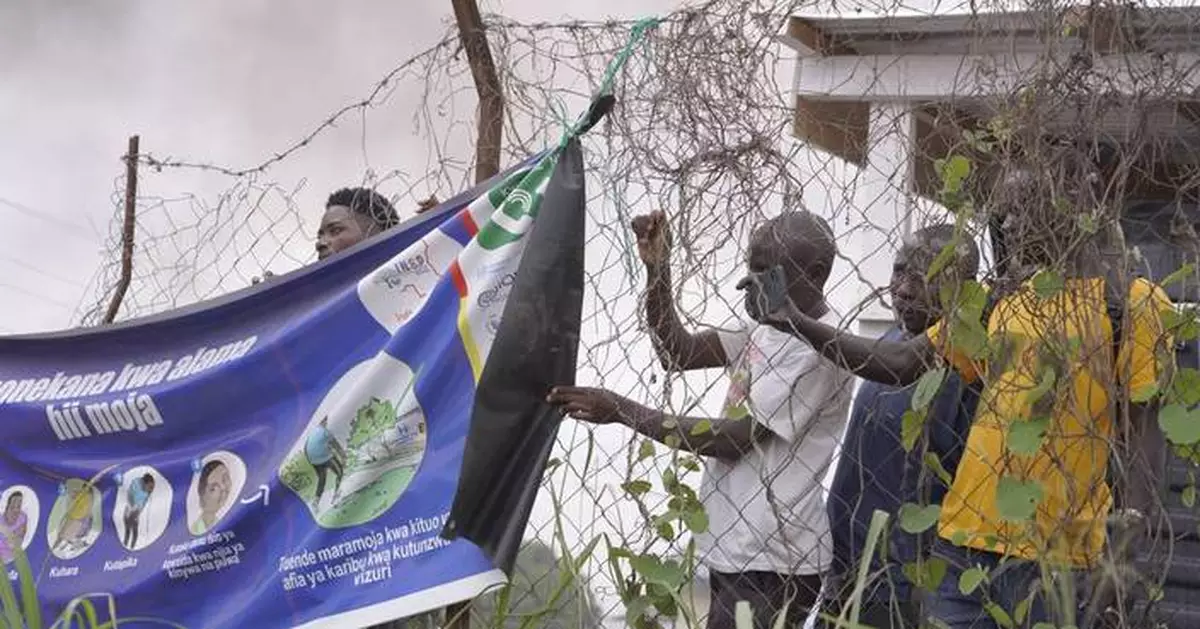
A strike this week by unpaid workers at an Ebola treatment center at the heart of the outbreak could light the flame for others in a remote region already suffering from bare-bones infrastructure, rebel threats and misinformation asserting that the deadly virus isn’t real.
Nearly 2,000 cases, including 702 deaths, have been confirmed. Now cases are suspected in two more provinces, including one of Congo’s largest cities, Kisangani, as responders struggle to understand how far Ebola has spread. Experts have said the outbreak was missed for weeks because tests were conducted for a more common type of Ebola, and its origin is still not known.
Here’s a look at the outbreak and the growing effort to contain it.
The outbreak is caused by the Bundibugyo virus, a type of Ebola that has no approved vaccines.
Ebola is highly contagious and can be transmitted to people from wild animals. It spreads in the human population through contact with bodily fluids such as vomit, blood or semen, and with contaminated surfaces and materials such as bedding and clothing.
Traditional funerals in which loved ones wash and prepare bodies have been restricted, to some anger by residents.
The disease is rare but severe and often fatal. Symptoms include fever, vomiting, diarrhea, muscle pain and at times internal and external bleeding. Outbreaks often occur in remote villages in Central Africa, near rainforests.
Associated Press journalists have witnessed the aftermath of attacks on health centers by a wary, highly mobile population that has long been traumatized by armed groups.
Outsiders can be looked upon with suspicion, and community outreach teams have worked to spread the word about Ebola prevention measures in the face of abuse and accusations that the outbreak is a scam.
Part of the outbreak is unfolding in a major city and humanitarian hub, Goma, that rebels backed by neighboring Rwanda seized over a year ago, further complicating the response.
Now there is unrest among local Ebola responders themselves after weeks of risky crisis work and little or no pay from the Congolese government. On Monday, staff at a treatment center in Ituri province, the outbreak’s epicenter, closed the facility and blocked access, burning a tire. Striking staffers included epidemiologists, case investigators, drivers and gravediggers.
Congolese officials have said they are in talks with the health workers to find a solution. A labor strike that spreads to other overstretched and underequipped facilities would be another serious blow to Ebola containment efforts.
The strikes come at a vulnerable time. Earlier this month, researchers began a study of two possible Ebola treatments and began enrolling participants.
One is Gilead Sciences’ remdesivir, a broad-acting antiviral approved to treat COVID-19 that has shown some hints in lab tests that it may help fight the Bundibugyo virus. The other is Mapp Biopharmaceutical’s experimental MBP134, antibodies engineered to target Ebola viruses including Bundibugyo.
The World Health Organization has said patients will be randomly assigned to receive today’s best standard of care as well as remdesivir, MBP134, both or neither.
The United Nations body has warned it could take months and possibly as many as 1,000 study participants to tell if either drug works.
Currently the study is offered in just one Ebola treatment center in Ituri province — not the one where the strike has begun. Officials plan to expand the study to other locations once it is safe to do so.
——-
For more on Africa and development: https://apnews.com/hub/africa-pulse
The Associated Press receives financial support for global health and development coverage in Africa from the Gates Foundation. The AP is solely responsible for all content. Find AP’s standards for working with philanthropies, a list of supporters and funded coverage areas at AP.org.
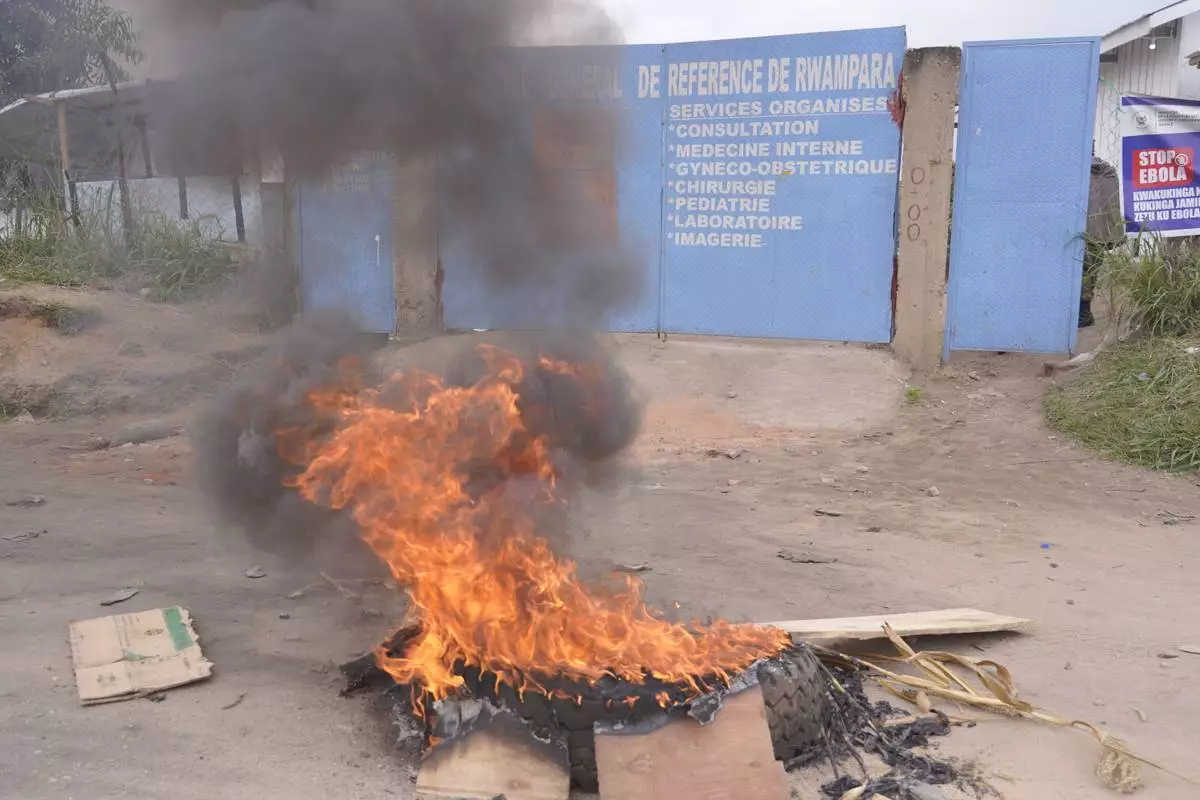
Workers at an Ebola treatment center go on strike over unpaid salaries and bonuses at Rwampara General Hospital, in Ituri, northeastern Congo, Monday, July 13, 2026, (AP Photo/Dirole Lotsima Dieudonne)
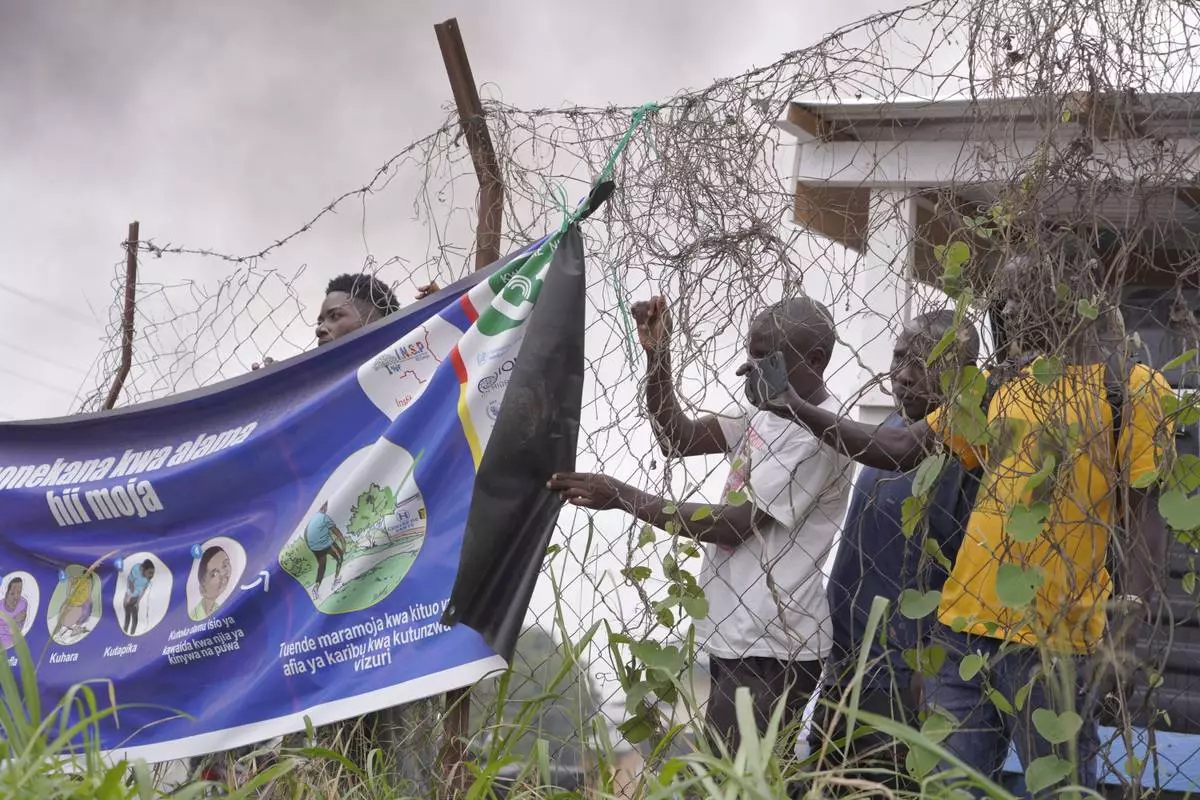
Workers at an Ebola treatment center go on strike over unpaid salaries and bonuses at Rwampara General Hospital, in Ituri, northeastern Congo, Monday, July 13, 2026, (AP Photo/Dirole Lotsima Dieudonne)
PARIS (AP) — This year’s Bastille Day celebrations aren’t just about France. Troops and warplanes from around Europe joined Tuesday’s pomp-filled parade through Paris, in a showcase of support for Ukraine and a symbolic flexing of European military muscle.
On President Emmanuel Macron’s last Bastille Day as president, he is hosting around 30 other leaders for an event that appears aimed at showing both Russian President Vladimir Putin and U.S. President Donald Trump that Europe is united and stepping up to defend itself.
Macron's wife, Brigitte, welcomed leaders including Ukrainian President Volodymyr Zelenskyy as they arrived for the celebrations. Zelenskyy got an ovation from the assembled dignitaries.
Meanwhile, raging forest fires and a red-alert heat wave are shaking up France’s biggest national holiday, forcing the cancellation of traditional fireworks and firefighters’ balls.
Here’s what to know about Bastille Day this year.
It’s celebrated on July 14 because that’s the day Parisians stormed the Bastille fortress and prison in 1789, helping spark the French Revolution that overthrew the monarchy and sent King Louis XVI and his queen Marie-Antoinette to the guillotine.
Today, the day is central to the French calendar. Presidents use it to vaunt France’s accomplishments and national pride, mayors host village festivals and families gather for holiday meals.
The centerpiece is the Paris parade beneath the Napoleon-era Arc de Triomphe and along the Champs-Elysees avenue, which inspired Trump to stage his own parade last year.
A huge French tricolor flag hanging below the monumental arch rippled in the wind as a military band on horseback rode down the tree-lined avenue followed by Macron standing in an open military vehicle to kick off the parade.
Spectators wore hats and brandished small fans to fend off the heat as a formation of air force planes roared overhead trailing red, white and blue smoke.
Zelenskyy joined Macron along with some 30 other heads of state or government in the special viewing area for the parade.
Ukrainian troops marched along the cobblestoned avenue, and Ukrainian co-pilots trained in France will fly two Mirage 2000B fighter jets alongside French air force pilots.
On the ground, the parade opened with around 500 troops from the ″coalition of the willing″ grouping of countries that have pledged to help with Ukraine’s postwar security.
Macron said Monday night that it’s a ″great honor″ to welcome to the parade ″all the partners in the coalition of the willing and our Ukrainian friends who will march with us and illustrate its strategic reawakening and our unity.″
The foreign fighters in combat fatigues and dress uniforms marched with their national flags, in a break with tradition — usually only one foreign country is invited to take part in the parade. It was the first time in some 20 years that British troops took part. Ukrainian forces got the loudest cheers from the crowd.
In the skies, aircraft from Germany, the United Kingdom, Croatia, Poland, Denmark, Greece, Sweden, Norway, Spain and Italy were taking part.
The parade set a record in terms of number of troops: The Paris military governor said 7,600 troops were marching this year, compared with 5,810 in 2025. Thousands of soldiers started taking up positions early Tuesday, many taking selfies as helicopters flew overhead.
Forest fires are raging in the Fontainebleau forest south of Paris and in areas of southern France, as the country suffers through its third heat wave this year.
As a result, authorities in some regions — including the French capital — banned fireworks and firefighters' balls customarily held around Bastille Day.
The Eiffel Tower's fireworks and drone show was maintained, however, and held Monday night, including a drone formation shaped like the Statue of Liberty — a gift from France to the United States that arrived in New York in 1885 to mark the U.S. centennial, the end of the American Civil War, and friendship between the two countries.
Associated Press writers Sylvie Corbet and Angela Charlton in Paris contributed.
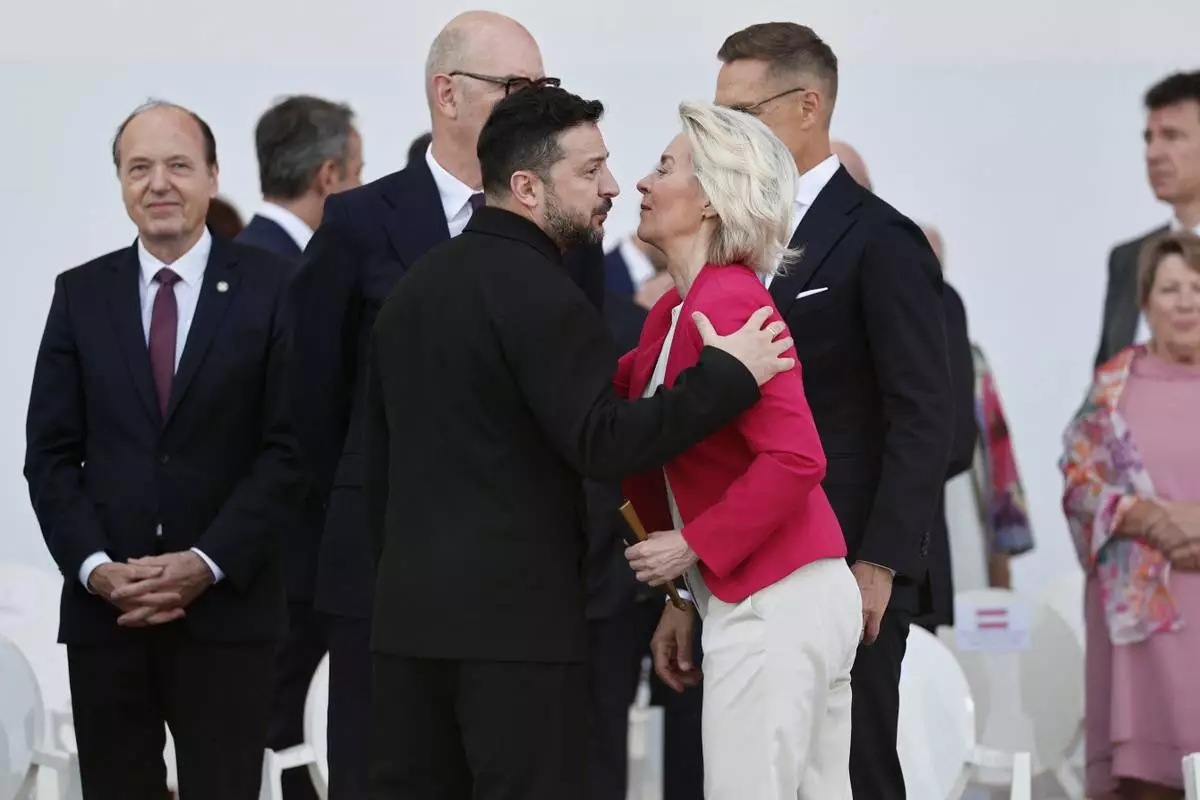
European Commission President Ursula von der Leyen, centre right, greets Ukraine's President Volodymyr Zelenskiyy before the start of the annual Bastille Day military parade in Paris, France, Tuesday, July 14, 2026. (Benoit Tessier/Pool Photo via AP)
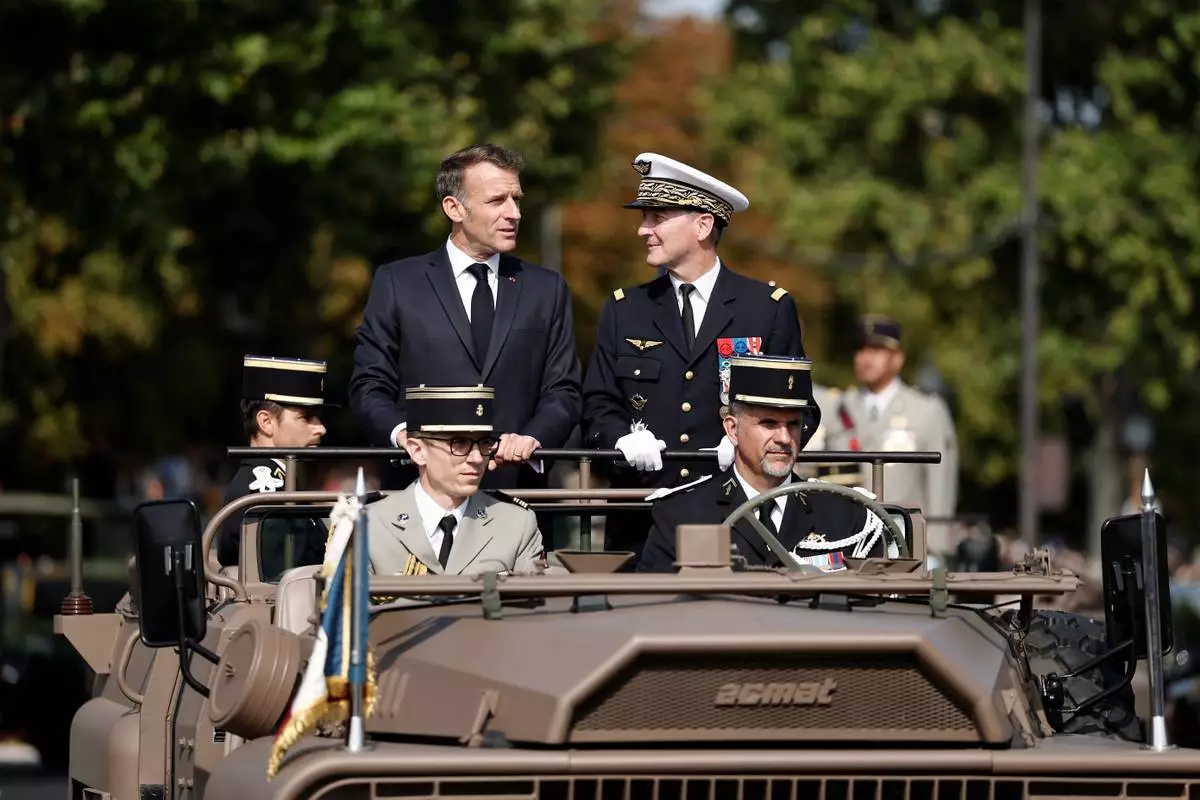
French President Emmanuel Macron, left, stands in the command car with General Chief of Staff of the French Armed Forces Fabien Mandon during the annual Bastille Day military parade on the Champs-Elysees avenue in Paris, France, Tuesday, July 14, 2026. (Benoit Tessier/Pool Photo via AP)
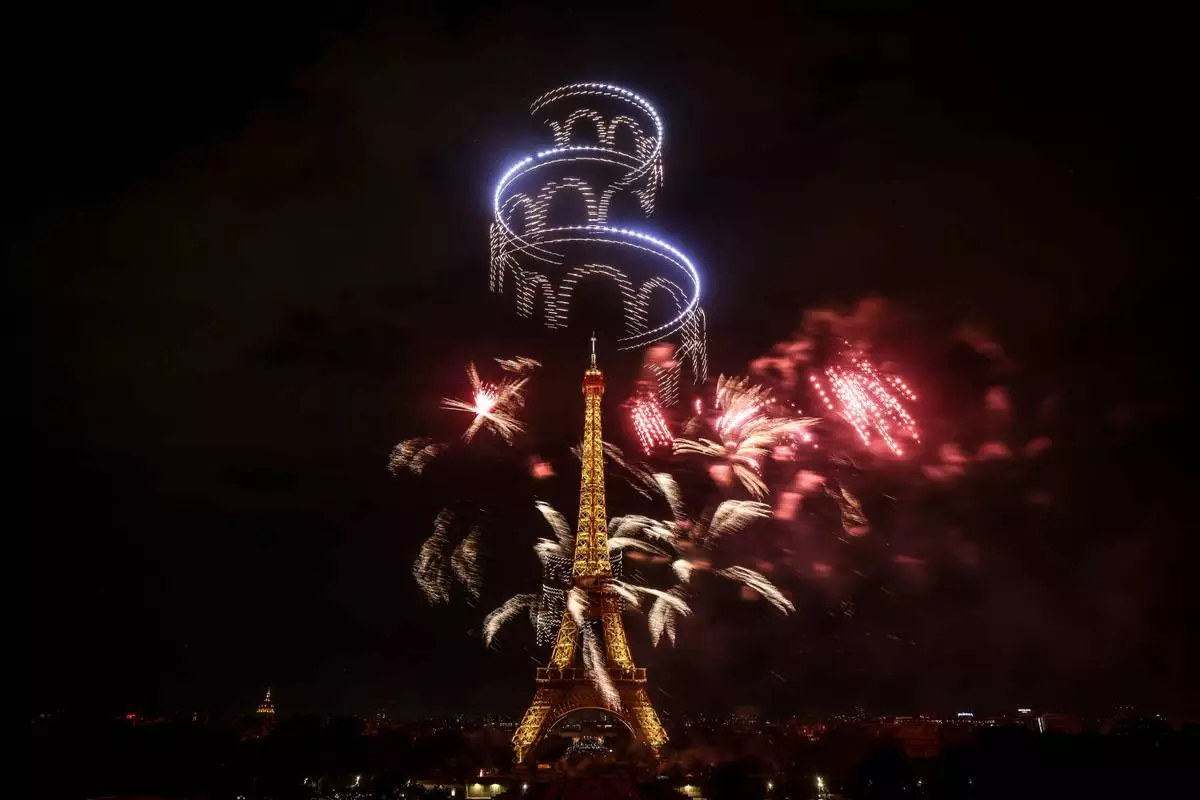
Fireworks and drones illuminate the Eiffel Tower in Paris, during the eve of Bastille Day celebrations late Monday, July 13, 2026. (AP Photo/Thomas Padilla)
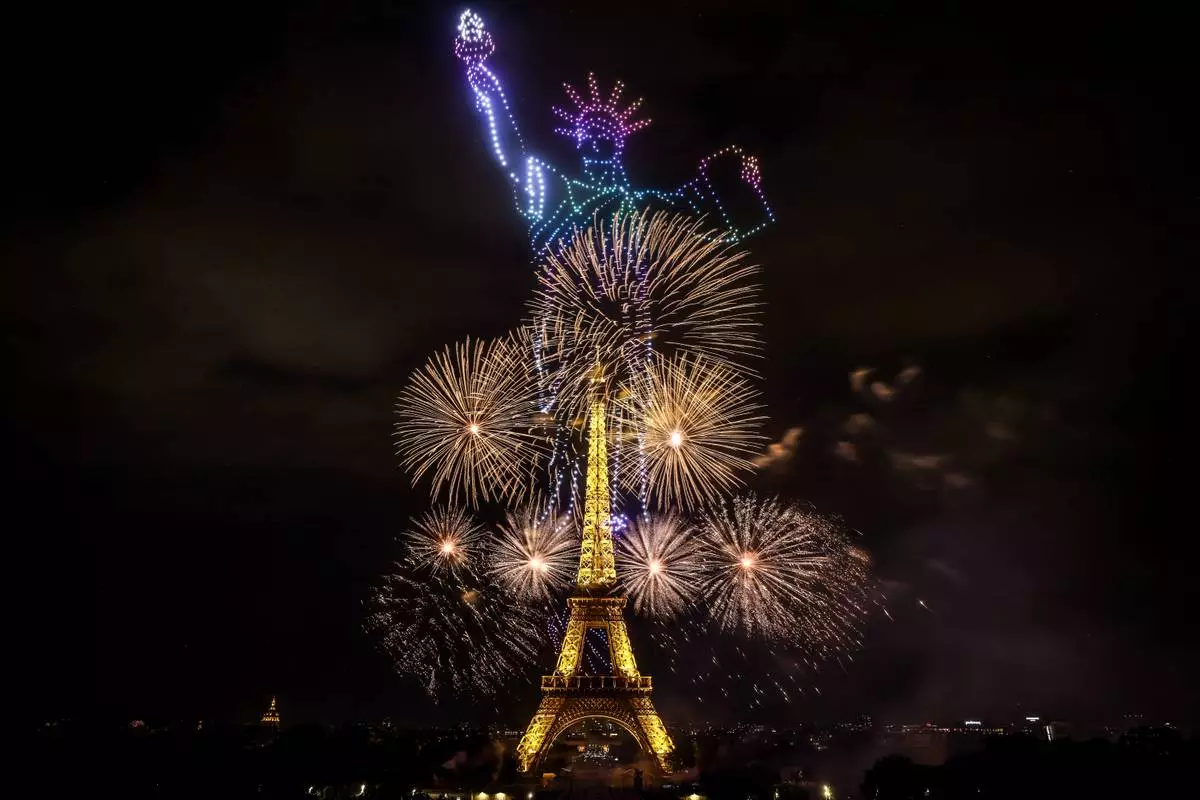
Fireworks and drones illuminate the Eiffel Tower in Paris, during the eve of Bastille Day celebrations late Monday, July 13, 2026. (AP Photo/Thomas Padilla)
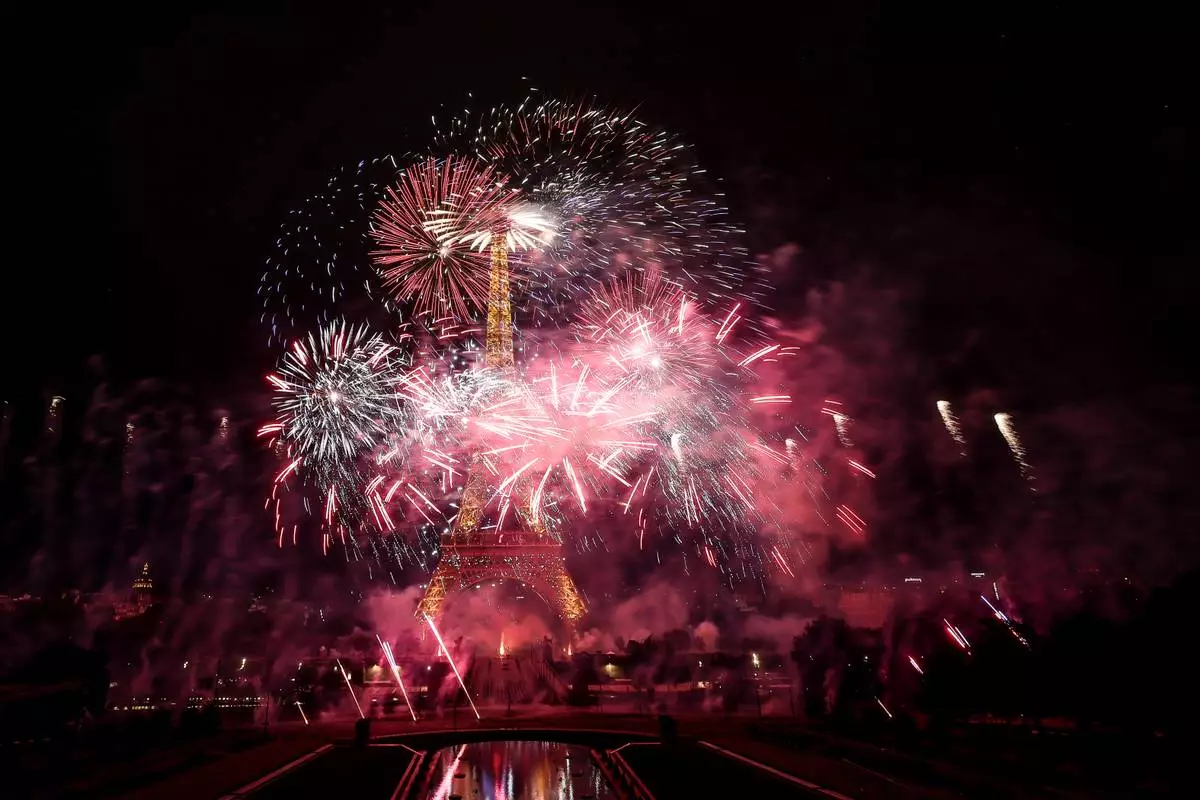
Fireworks and drones illuminate the Eiffel Tower in Paris, during the eve of Bastille Day celebrations, Monday, July 13, 2026. (AP Photo/Thomas Padilla)
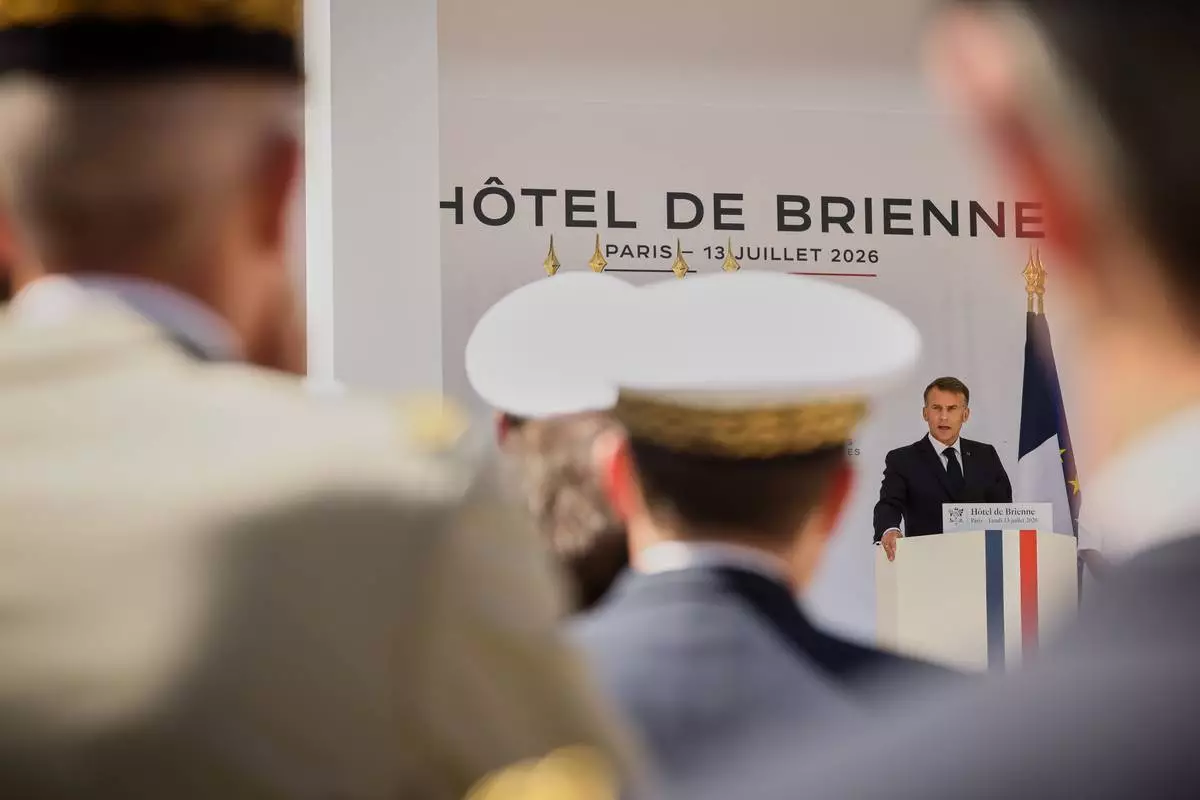
French President Emmanuel Macron delivers his traditional address to the armed forces on the eve of the Bastille Day parade at the Ministry of Defense in Paris, Monday, July 13, 2026. (AP Photo/Thomas Padilla, Pool)
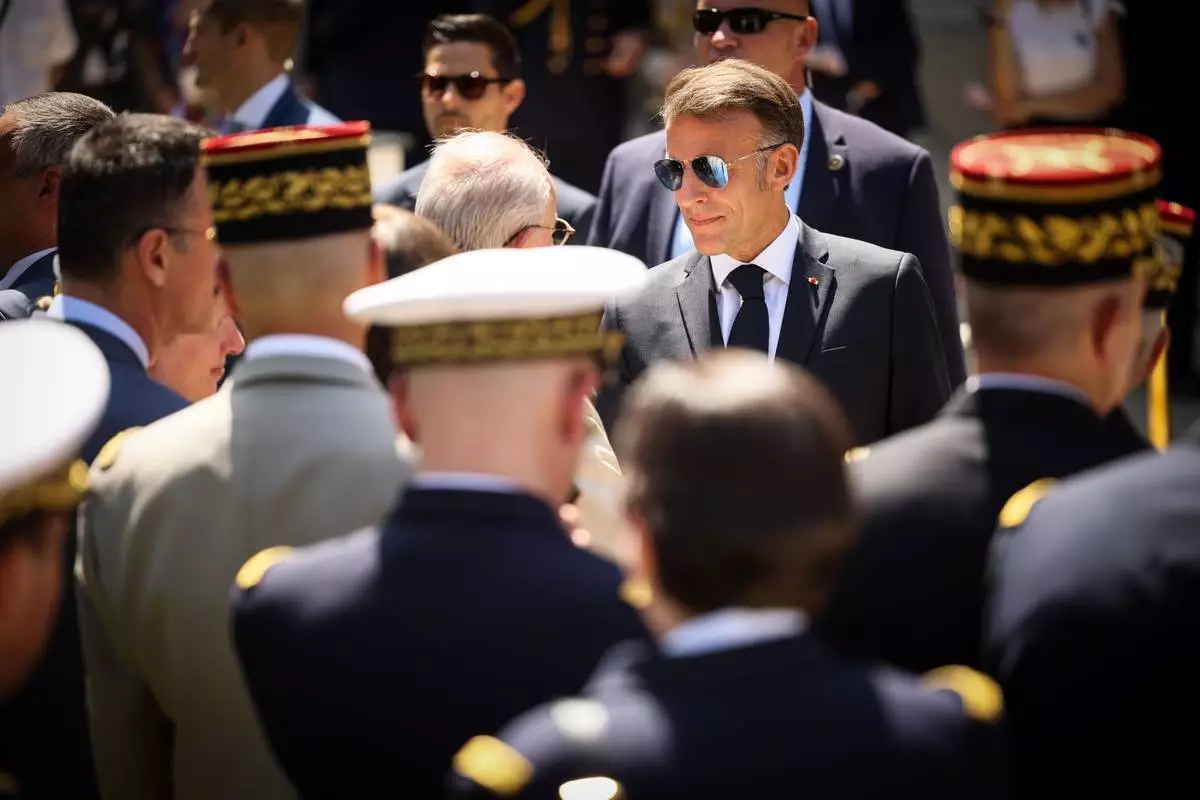
French President Emmanuel Macron greets senior military officers after his traditional address to the armed forces on the eve of the Bastille Day parade at the Ministry of Defense in Paris, Monday, July 13, 2026. (AP Photo/Thomas Padilla, Pool)