An episode of "Genglubu: Charting the South China Sea", a China Global Television Network (CGTN) documentary series, highlights the work of weather sentinels in the South China Sea.
Titled "The Weather Sentinels", the episode features stories of people dedicated to recording and capturing rapidly shifting weather conditions in the South China Sea, to help strengthen early warnings and support weather services.
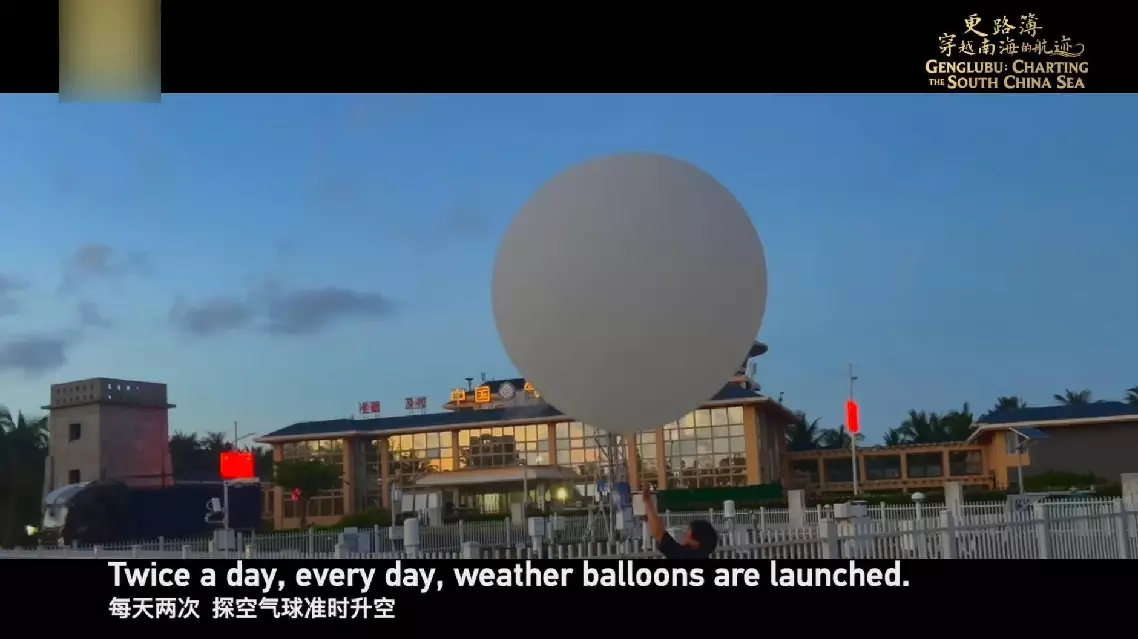
Regardless of the weather on Yongxing Island, meteorologist Tang Hairong launches weather balloons that feed real-time data into China's national and the global meteorological systems, helping ships navigate safely through one of Asia's busiest seas.
"Whatever the weather, we launch the balloon without fail. It never stops," said Tang.
As weather often changes rapidly across the South China Sea, forecasting begins with observation. For more than two decades, Tang has helped provide these observations from Yongxing Island.
"A small shift can have far-reaching consequences. As observers, we can't choose the weather. But we can record it and capture it with the greatest precision possible," said Tang.
Twice a day, every day, weather balloons are launched.
"The balloons rise from the ground to an altitude of 30,000 meters, sending back real-time data every second on temperature, humidity, air pressure, wind direction and wind speed," said Tang.
The data does not stay on the island. It is fed into national and global forecasting systems, helping improve warnings for ships, coastal communities and weather services far beyond the South China Sea.
"The South China Sea is prone to severe weather. It sees around seven tropical cyclones each year. About 45 percent form locally, while the remaining 55 percent move in from the northwestern Pacific. Typhoons mainly affect the region from June to November. The South China Sea is a key node in the global exchange of meteorological data," said Xing Jun, another sentinel at Sansha Meteorological Bureau.
The South China Sea is one of the world's busiest maritime passages, with tens of thousands of vessels passing through each year.
"'Sentinels' should never let their guard down. Missing a crucial piece of data could leave a gap in the early warning system," said Tang.
CGTN documentary highlights work of dedicated weather sentinels in South China Sea