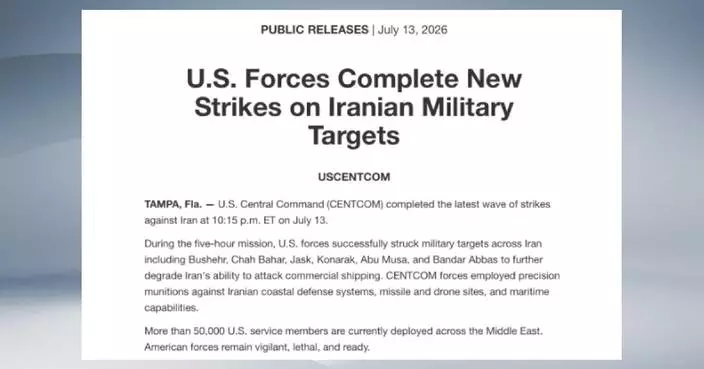
The United States on Monday launched its third consecutive night of new strikes on Iran, while Iran retaliated by attacking U.S. military assets in Gulf countries amid the recent escalation of tensions in the Strait of Hormuz.
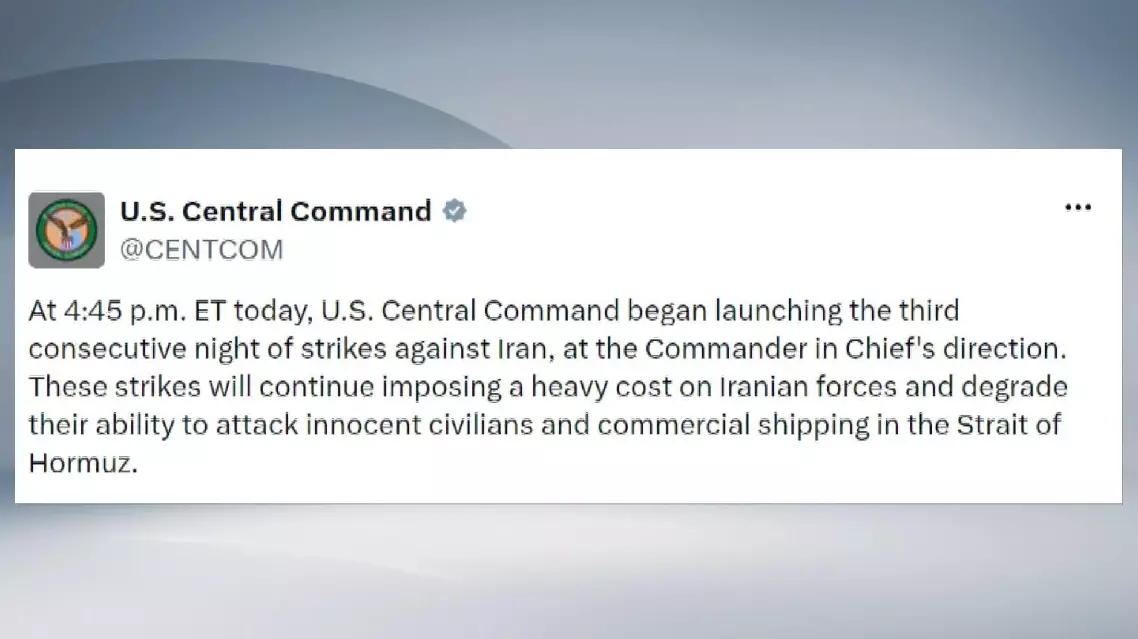
In a post on X, the U.S. Central Command (CENTCOM) confirmed the latest strikes on Iranian targets, saying: "These strikes will continue imposing a heavy cost on Iranian forces and degrade their ability to attack innocent civilians and commercial shipping in the Strait of Hormuz."
The U.S. was targeting Iranian military assets including coastal surveillance systems, drone and missile capabilities, the CNN quoted a U.S. official as saying.
Earlier on Monday, U.S. President Donald Trump vowed that "We're going to hit them very hard tonight, and we're going to hit them hard tomorrow", when speaking to a U.S. media outlet.
He also stated that the memorandum of understanding (MoU) signed in June was meant to test Iran, that it was not particularly binding in itself, and that Iran "failed the test."
CENTCOM also announced Monday that U.S. forces had struck a submarine and ship maintenance facility in Iran the day earlier, using one-way attack surface drones for the first time in an active combat mission.
Video footage released by CENTCOM showed three unmanned "Corsair" surface drones striking the port at the naval base in south Iran's Bandar Abbas, a major hub for the country's naval operations and commercial shipping control.
Iranian media reported explosions Monday noon near the port city of Bandar Abbas and Qeshm Island in southern Iran.
Later during the day, four explosions were heard east of Bandar Abbas, according to the official news agency IRNA. The semi-official Tasnim news agency reported six explosions in the southeastern counties of Chabahar and Konarak in Sistan and Baluchestan province, adding the air defense system has been activated in Bandar Abbas.
Meanwhile, Al Jazeera reported on Monday that Iranian forces fired missiles at U.S. vessels in the same day. Iran's Islamic Revolutionary Guard Corps (IRGC) announced on Monday evening that it had shot down two U.S. drones near Bandar Abbas and the southern Iranian city of Lar.
Additionally, the IRGC issued a statement on Monday saying that it had launched multiple attacks that day against U.S. military bases and other targets in Kuwait, destroying HIMARS rocket launcher positions, fuel depots, and Patriot air defense systems, among others. The IRGC also struck a U.S. facility and infrastructure in Bahrain on the same day, and destroyed U.S. long-range air surveillance and maritime detection radar systems in Oman.
Iran and the U.S. are in theory nearly halfway through the 60-day period of the 14-point MoU that was supposed to lift the U.S. maritime blockade, normalize commercial navigation in the Strait of Hormuz, and launch talks for a permanent end to the war which began on Feb 28 with joint U.S.-Israeli airstrikes against the Islamic republic.
The United States has launched a series of strikes on Iran over the past week, citing Tehran's attacks on ships seeking to transit the Strait of Hormuz using a U.S.-backed Omani route. Iran responded by targeting U.S. military bases in neighboring countries.
Trump said on Monday the United States is reinstating the blockade on Iran, preventing Iranian ships from entering or leaving.
U.S. launches new strikes on Iran for 3rd consecutive night, Iran attacks U.S. military assets in Gulf countries
A book promotion event for the fifth volume of Chinese President Xi Jinping's book on the governance of China was held in Kyrgyzstan's capital, Bishkek, on Monday, ahead of a Shanghai Cooperation Organization (SCO) summit.
Participants said that as the event coincided with the 25th anniversary of the the establishment of the SCO as an intergovernmental organization, it was of great significance for representatives from all walks of life in both countries and from the SCO family to exchange views on the book.
The important work systematically expounds the theory and practice of Chinese modernization, vividly presents China's vision and program for building a community with a shared future for humanity, and serves as an authoritative work for understanding Chinese modernization and contemporary China.
It also provides important guidance for China and Kyrgyzstan to deepen exchanges of governance experience and strengthen the alignment of their development strategies.
"As an authoritative work for understanding Chinese modernization and gaining insight into contemporary China, it also serves as an important guide for China and Kyrgyzstan to deepen exchanges on governance and strengthen the alignment of their development strategies," said Mo Gaoyi, deputy director the Publicity Department of the Communist Party of China (CPC) Central Committee, in addressing the event.
Former Kyrgyz President Roza Otunbayeva pointed out that the vision of building a community with a shared future for humanity, proposed by Chinese President Xi Jinping, is an idea and proposition with global influence.
High-quality Belt and Road cooperation has brought new development opportunities and helped Kyrgyzstan gradually transform into an important hub on the Eurasian continent, she said, adding that an in-depth study on the internal logic, governance mechanism and long-term planning of China's development is of great practical value.
"Today, we are building new highways, railway corridors, and economic corridors. These are, of course, essential. But no less important is building roads of trust through books, education, culture, academic exchanges, and people-to-people ties," she said.
Also addressing the event, Kyrgyz State Secretary Arslan Koichiev said China has been successful in adapting Marxism to its national conditions and has accumulated rich experience in integrating Marxism with China's realities. To understand Marxism in the 21st century, one should carefully study the works of President Xi, he said.
Reading the book can help people think more deeply about Kyrgyzstan's relations with China and the rest of the world, and encourage practical cooperation to promote mutual learning among civilizations as well as development and prosperity, Koichiev said.
"China's policies are viewed and interpreted differently across Europe, the United States, and other regions. On these issues, President Xi Jinping's works provide a Chinese perspective and interpretation, calling on the world to pursue dialogue, peace, and security," he said.
SCO Deputy Secretary-General Piao Yangfan said China and Kyrgyzstan, as founding members of the SCO, have made unique contributions to the establishment and development of the "Shanghai Five" mechanism.
The book includes President Xi's important speeches on building a China-Central Asia community with a shared future and an SCO community with a shared future, providing guidance for strengthening solidarity and coordination among regional countries, consolidating a secure and stable environment, enhancing the alignment of development strategies, and promoting closer people-to-people bonds, Piao said.
During the event, the Chinese side presented Kyrgyz guests with copies of the Kyrgyz edition of the third volume and the Russian edition of the fifth volume of "Xi Jinping: The Governance of China." Representatives of Kyrgyz medical workers and journalists shared stories of cooperation between the two countries in practicing the philosophy of putting the people first.
Participating experts exchanged views on topics including Chinese modernization, building a community with a shared future for humanity, the Global Governance Initiative, Belt and Road cooperation, and mutual learning among civilizations.
The event was jointly organized by China's State Council Information Office, China International Communications Group and the Chinese Embassy in Kyrgyzstan. About 300 representatives from political parties, media organizations, think tanks and other sectors of the two countries attended the event.
Kyrgyzstan, one of the founding members of the Shanghai Cooperation Organization, holds the rotating SCO presidency this year.

Book promotion event for "Xi Jinping: The Governance of China" held in Kyrgyzstan