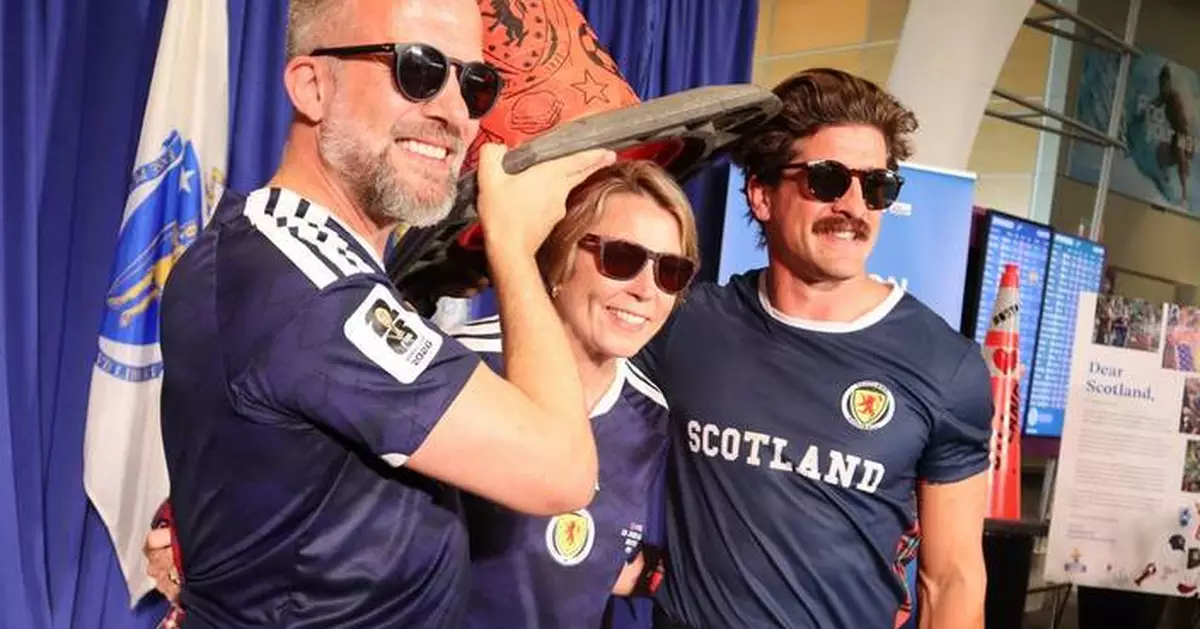
BOSTON (AP) — Fresh off its first-class flight from Glasgow, it received a reception befitting a visiting dignitary: a bagpiper in full regalia playing inside Boston Logan International Airport. Waiting to greet it were diplomats, the governor and Boston’s mayor.
The guest of honor? An orange traffic cone.
Tuesday’s arrival of the “Boston Cone” marked the latest chapter in the city's unlikely love affair with Scotland’s Tartan Army, whose habit of placing traffic cones atop statues during the team's World Cup run last month turned the humble orange cone into one of the tournament’s defining symbols.
“I have to admit, this is probably — yes, it is — my first official welcoming ceremony for a traffic cone,” Massachusetts Gov. Maura Healey said in the airport's Terminal E, before signing her name to the cone. “But it’s a pretty special one, isn’t it? Because this cone tells the story of what happened this summer. What happened in Boston, what happened in Massachusetts.”
“And special thanks to the Scots for drinking all the beer,” she added to laughter. “I do promise you, when you return … we will never again run out of beer in Massachusetts.”
During Scottish fans’ World Cup visit, Boston bars struggled to keep up with the Tartan Army’s thirst, with some running out of beer and scrambling for emergency deliveries. The fans transformed parts of Boston into an unofficial outpost of Scotland, filling downtown with bagpipes, songs and chants while bright orange traffic cones sprouted atop some of the city’s most recognizable landmarks — from Samuel Adams outside Faneuil Hall to Red Auerbach outside TD Garden, former Mayor Kevin White near Quincy Market and even the beloved Make Way for Ducklings statues in the Public Garden.
“There are still some traffic cones atop our most important statues,” Boston Mayor Michelle Wu joked Tuesday, recalling how Boston had “unofficially become New Scotland.”
The official commemorative cone, decorated with illustrations celebrating Boston and Scotland and the slogan “No Boston, No Party,” will spend the next week visiting landmarks across Massachusetts to raise money for mental health charities before returning home to Scotland.
The tradition dates to Glasgow, where placing bright orange traffic cones atop public statues began as a late-night prank in the 1980s before evolving into an unofficial symbol of the country’s irreverent humor. The best-known example is the Duke of Wellington statue in the city center, where the cone has become so iconic that repeated efforts to remove it have been met with public opposition.
“It’s an in-joke that’s gone too far, actually,” one of the cone's Scottish escorts, Danny Campbell, said, laughing as he stood beside the cone in a kilt. “But no, it isn’t a joke. This is a metaphor for life.”
Campbell said people can become consumed by “going to our jobs and cooking sausages and all the sort of serious stuff that adults have to do” and lose sight of what matters.
“That’s what our countrymen represented when they came here,” he said, speaking of Scottish fans' stay in Boston. “They left stomachs and cheeks sore from laughing, they cleaned up after themselves, they spread joy and these people came together with humor and they built relationships with each other.”
“This is not just a silly cone,” Campbell said. “It means love. It means love, and that is the whole point.”
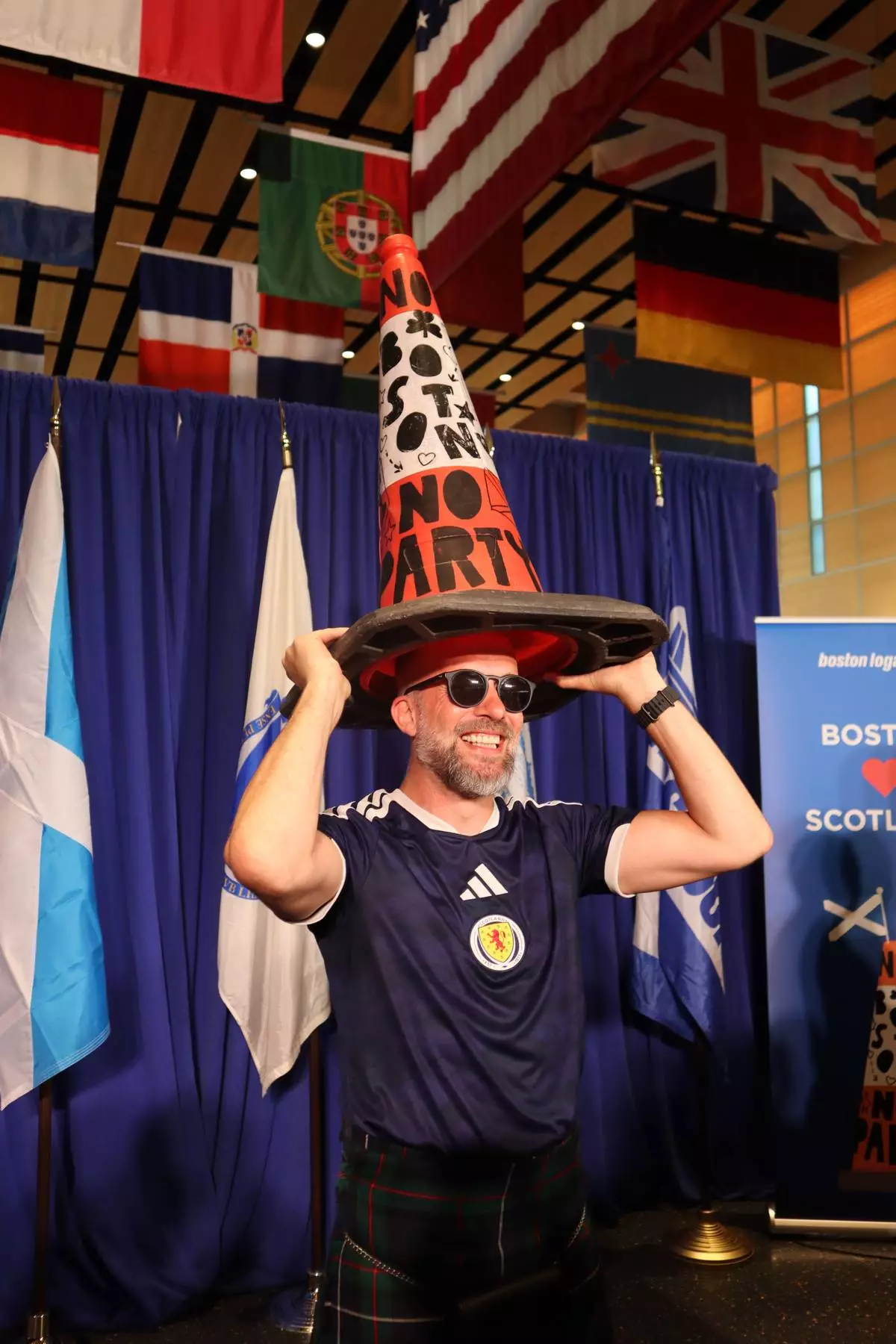
Scottish soccer fan Andrew Dobbie wears the commemorative Boston Cone during a welcoming ceremony at Boston Logan International Airport, Tuesday, July 14, 2026, in Boston. (AP Photo/Leah Willingham)
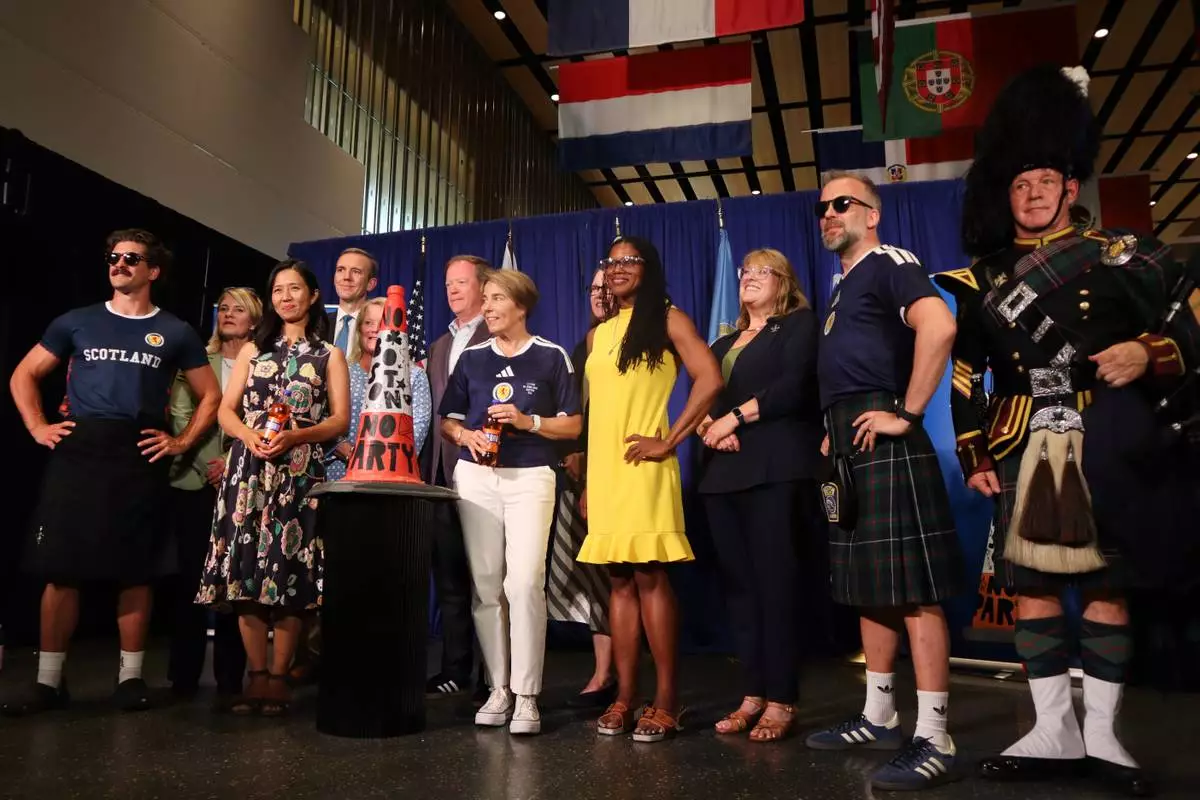
Boston Mayor Michelle Wu, center left, Massachusetts Gov. Maura Healey, center right, Scottish football fans and others pose with the commemorative Boston Cone during a welcoming ceremony at Boston Logan International Airport, Tuesday, July 14, 2026, in Boston. (AP Photo/Leah Willingham)
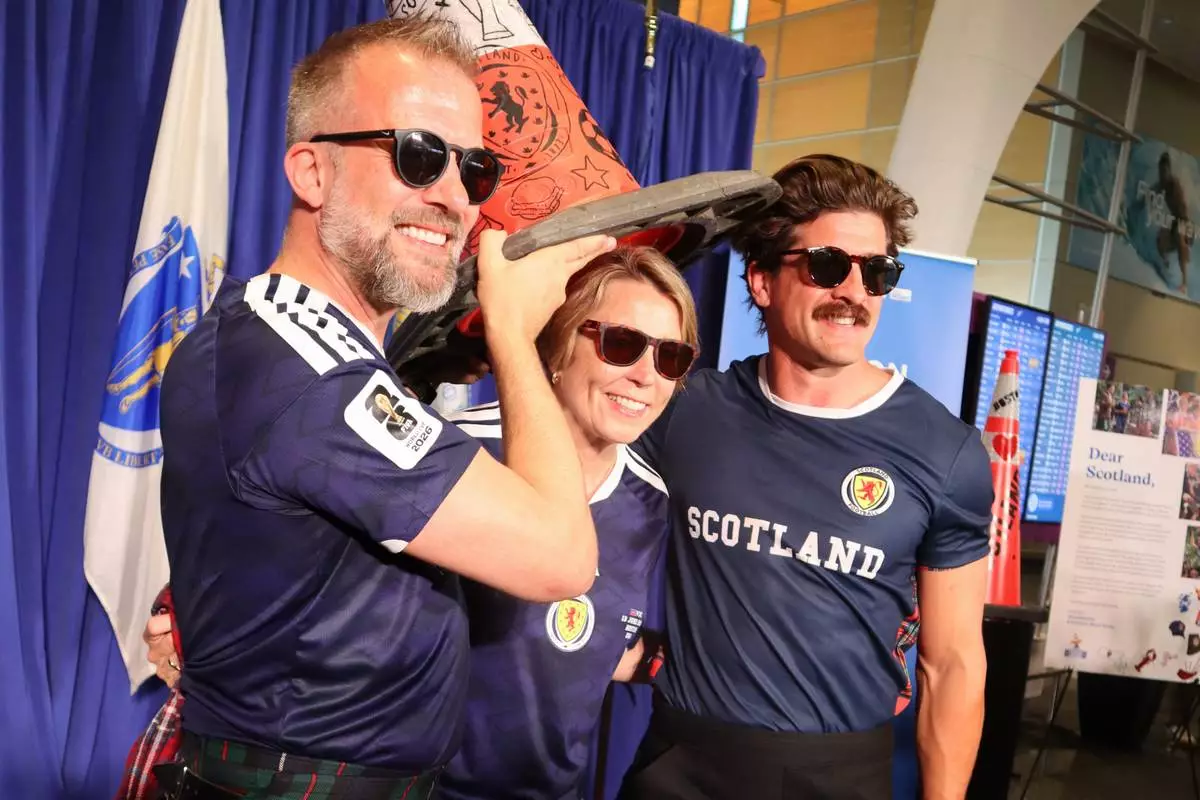
Massachusetts Gov. Maura Healey, center, poses with Scottish football fans Andrew Dobbie, left, and Danny Campbell while wearing the commemorative Boston Cone during a welcoming ceremony at Boston Logan International Airport, Tuesday, July 14, 2026, in Boston. (AP Photo/Leah Willingham)
MADRID (AP) — Thousands of people who travel every day between the southern tip of Spain and the British territory of Gibraltar will no longer have to cross a physical border, beginning on Wednesday.
The official opening at midnight on Tuesday — after a border fence was fully removed — allows a new freedom of movement under a historic treaty between the European Union and the United Kingdom. It came after years of post-Brexit wrangling.
The contested British Overseas Territory of 38,000 people is perched at the southern tip of the Iberian Peninsula, in a strategic location mere miles from Morocco where the Atlantic Ocean meets the Mediterranean Sea.
Throngs of people in Spain's La Línea de Concepción crossed into Gibraltar after midnight and vice-versa, many in Spanish soccer jerseys after Spain's team defeated France in the World Cup semi-finals on Tuesday.
“What you feel here is the brotherhood between the two people,” Gibraltar's Chief Minister Fabian Picardo told Spanish broadcaster RTVE.
When Britain left the EU in 2020, the relationship between Gibraltar and the bloc had been left unresolved.
Previous talks on a deal to ensure people and goods could keep flowing across the border had made halting progress. In 2025, the EU and U.K. announced an agreement on those issues, with the two sides and Gibraltar’s government signing a treaty Tuesday that eases border crossings.
The U.K.’s Foreign Office Minister Stephen Doughty said Tuesday that the agreement secured Gibraltar’s long-term economic future and interests.
Maroš Šefčovič, the EU’s trade representative, praised the agreement, too.
“It has taken four years of patient, complex negotiation, but the outcome speaks for itself,” Šefčovič said. “It is a very special feeling to see a fence come down.”
Without a deal, Gibraltar could have a faced a hard land border with full passport checks, posing economic risks for the territory deeply dependent on some 15,000 Spaniards — almost half of Gibraltar’s workforce — who cross the frontier every day for work.
Leisure visits by people crossing both sides of the border would have been affected, too.
“People who are visiting family in Spain, or whose Spanish family is visiting them in Gibraltar. Children who are going to football matches and extracurricular activities, either in Spain or in Gibraltar. They will be able to do that without having to worry about frontier queues,” Picardo told The Associated Press in an interview.
The deal in effect brings the territory into the EU’s Schengen free travel area. At Gibraltar’s airport and port, entry and exit checks will be conducted by both U.K. and Spanish border officials. The arrangement is similar to what’s in place at Eurostar train stations in London and Paris, where both British and French officials check passports.
Gibraltar was ceded to Britain in 1713, but Spain has maintained its sovereignty claim ever since. Relations between the two countries on the issue of Gibraltar have had their ups and downs over the centuries. The treaty that removed the border fence does not resolve the territory’s contested status.
In Britain’s 2016 Brexit referendum, 96% of voters in the Rock, as the territory is popularly known in English, supported remaining in the EU.
Travelers to Gibraltar from countries outside the Schengen area — including the U.K. — will have to contend with the EU Entry-Exit System, or EES, which was rolled out in Europe in April and replaced passport stamps with biometric data collected through photographs and digital fingerprints.
With the border fence gone, Gibraltar officials have set up live facial recognition cameras at entry points and throughout the territory.
Chief Minister Picardo said the territory will have many more CCTV cameras, and that it has increased its police presence as well as resources for customs and Coast Guard agencies.
“The fortress has become a digital fortress now,” Picardo said.
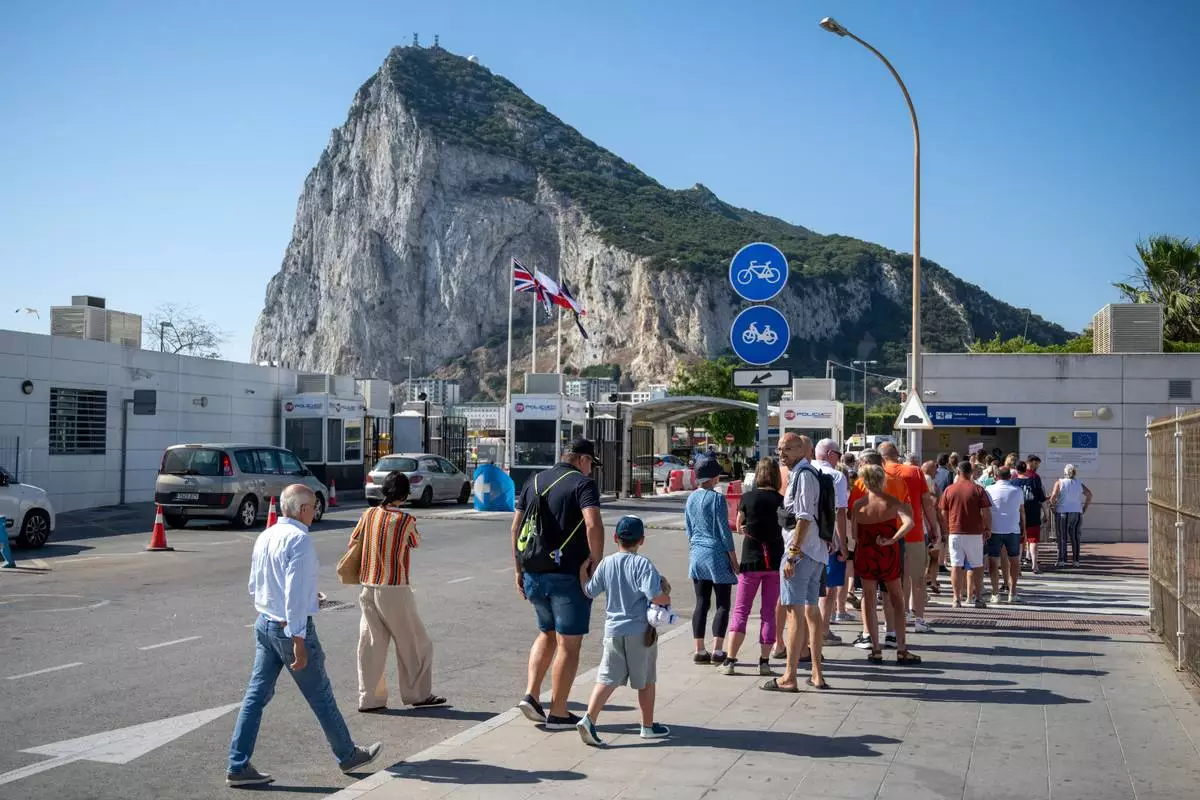
People queue to cross the border between Spain and Gibraltar, in La Linea de la Concepcion, Spain, Monday, July 6, 2026. (AP Photo/Marcos Moreno)
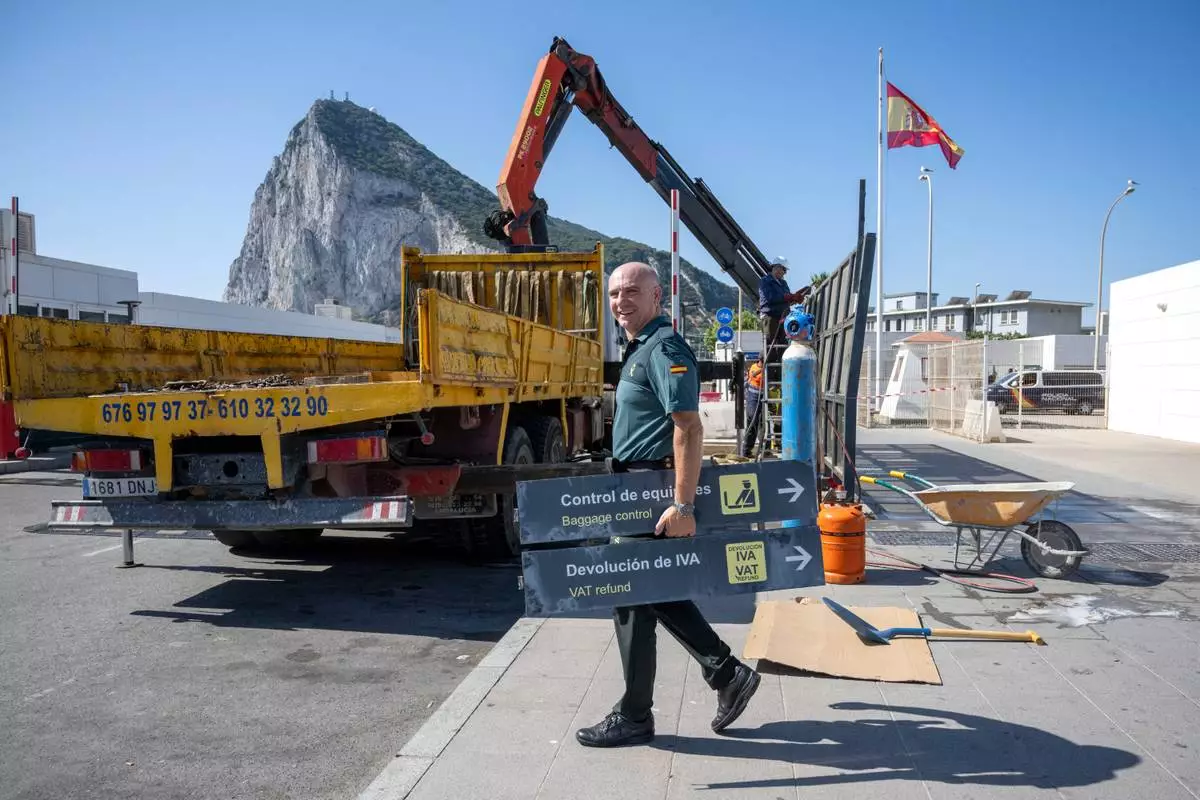
A Spanish Guardia Civil officer holds a sign during the dismantling of a border checkpoint that separated Spain from the disputed British overseas territory of Gibraltar in La Línea de la Concepción, Spain, Monday, July 6, 2026. (AP Photo/Marcos Moreno)
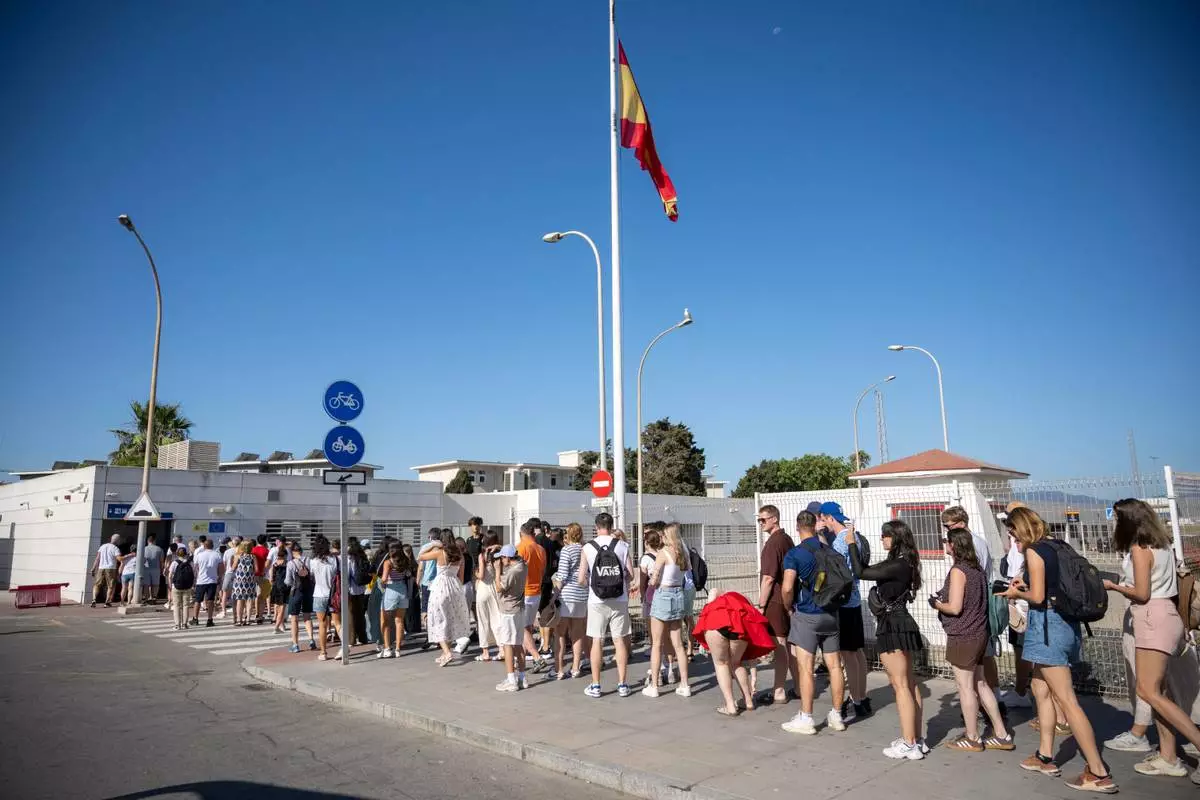
People queue to cross the border between Spain and Gibraltar, in La Linea de la Concepcion, Spain, Monday, July 6, 2026. (AP Photo/Marcos Moreno)
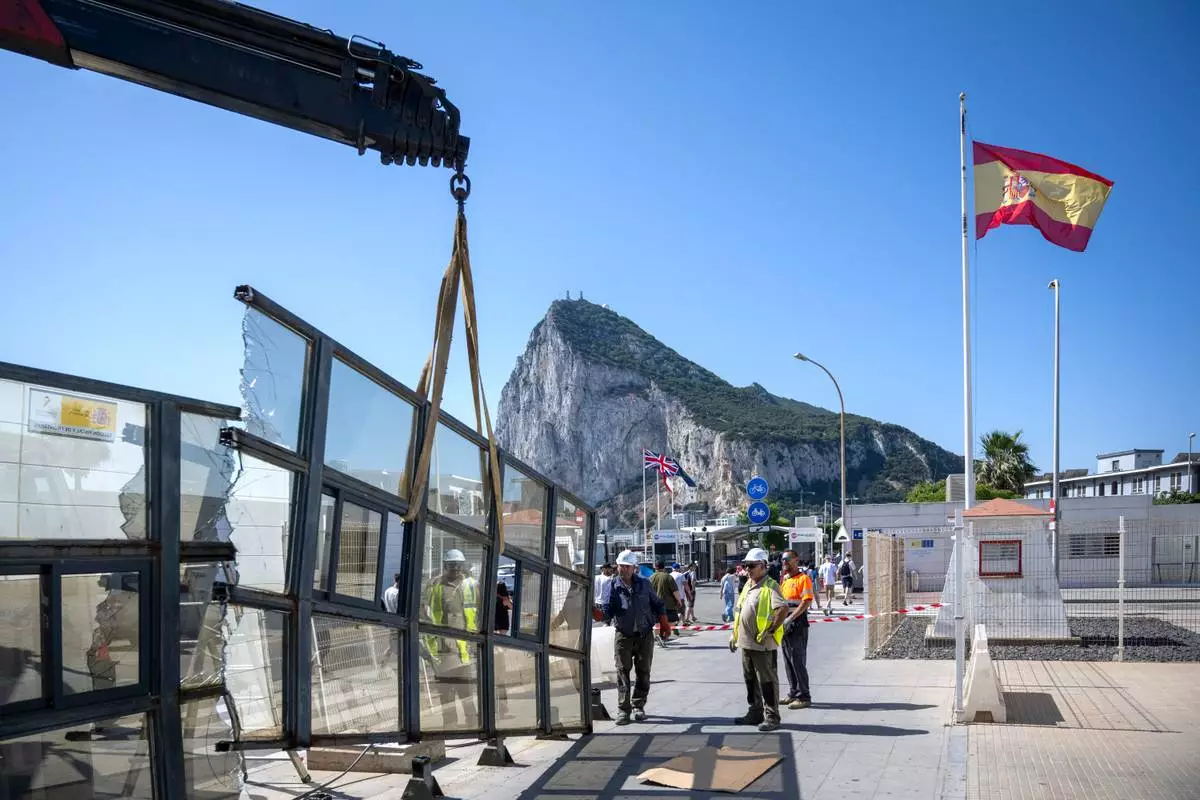
Against the backdrop of the Rock of Gibraltar, workers dismantle a Spanish border checkpoint that separated the disputed British overseas territory from Spain in La Línea de la Concepción, Spain, Monday, July 6, 2026. (AP Photo/Marcos Moreno)
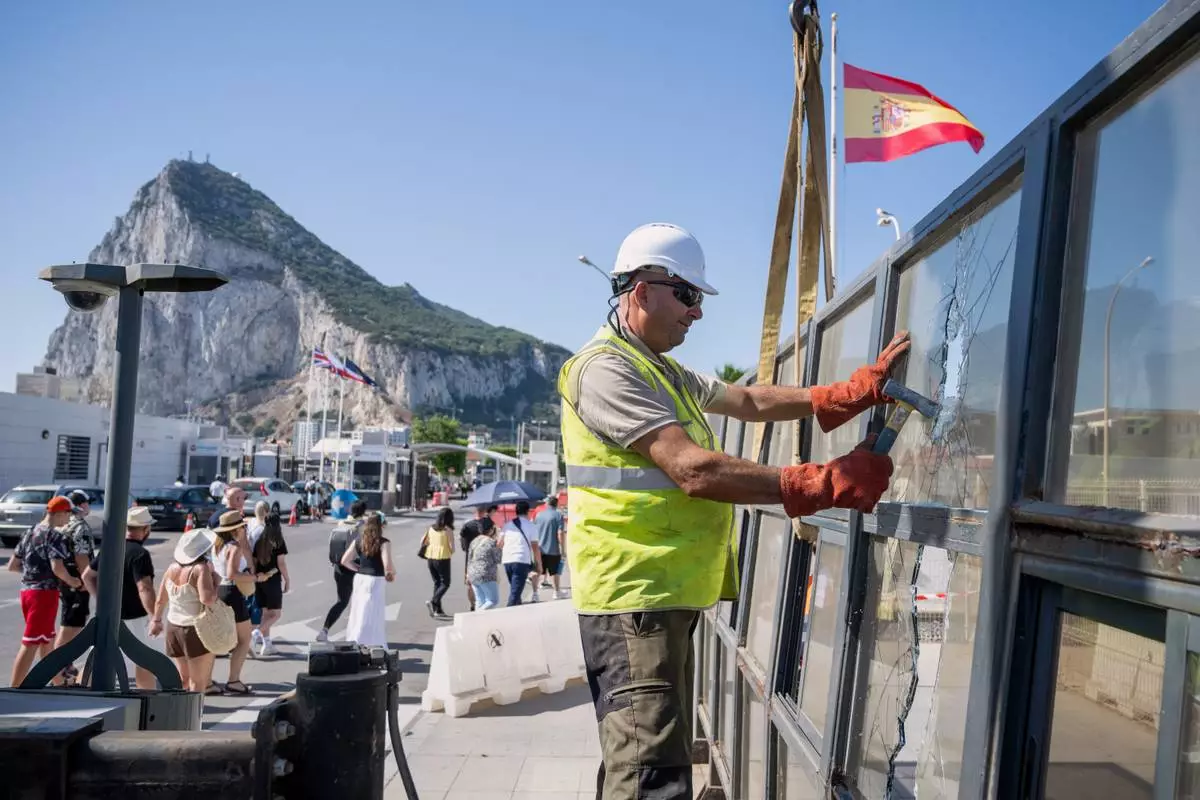
Against the backdrop of the Rock of Gibraltar, workers dismantle a Spanish border checkpoint that separated the disputed British overseas territory from Spain in La Línea de la Concepción, Spain, Monday, July 6, 2026. (AP Photo/Marcos Moreno)