Preparations for the 2026 World Artificial Intelligence Conference (WAIC) are in full swing in Shanghai, with more than 1,100 companies ready to showcase over 3,000 products, including 300 products making their global debut, at what organizers say will be China's largest ever AI event.
The WAIC and the High-Level Meeting on Global AI Governance will officially open on Friday.
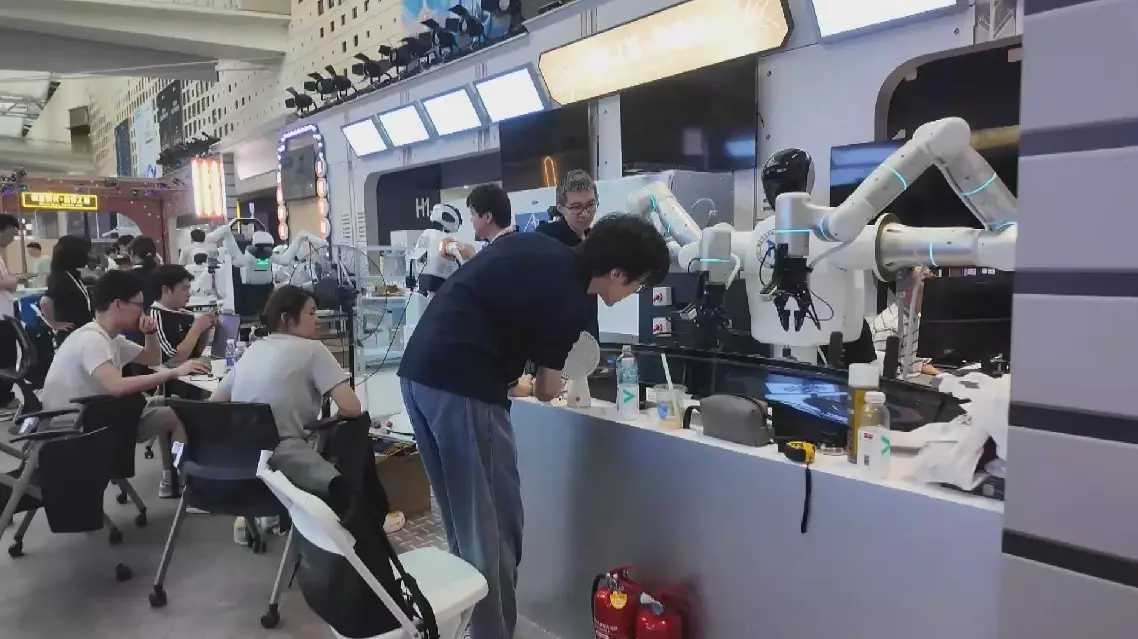
At the Shanghai World Expo Exhibition and Convention Center, the exhibition halls are bustling with activities with the four main exhibition halls all completed, and the digital exhibition system undergoing final testing.
Organizers say the 100,000-square-meter exhibition area -- equivalent to 14 standard soccer fields -- took only 12 days to set up, 40 percent quicker than at previous conferences.
Staff members have been meticulously fine-tuning every detail from lighting and sound systems to interactive screens and robotic arms.
This year's event is being held across three locations and four venues, the World Expo Exhibition and Convention Center, Zhangjiang Science City, and the West Bund.
Along Shanghai's iconic Bund, promotional billboards featuring the conference theme, "Intelligent Partners, Co-create the Future," drew passersby to stop and take photos.
"I think it's an amazing and great thing what China is doing. They're developing new things, technology which is improving our society," said a Norwegian tourist.
German professor Otthein Herzog, who has worked in China for 11 years and has been an AI researcher for 46 years, has attended many global AI conferences but says WAIC stands out for its scale and variety.
"That's what's really good about WAIC is that they have a lot of research on the one hand and a lot of applications on the other hand also, and that no other conference has to that amount as WAIC has it," said Herzog, who is also a member of the committee of experts at the China-BRICS Artificial Intelligence Development and Cooperation Center.
"If you are interested in AI, you are always curious in all the progress made. How we are progressing with LLMs (large language models), so we can make AI responses more reliable, more pertinent. Well, China is very open to new developments," said Max Muhlhauser, another German AI expert.
China's largest ever AI conference to open this week
Artificial intelligence is reshaping the world at an unprecedented pace, from production and office work to daily essentials. For young people, AI is not merely a tool but also a companion, though it carries hidden risks.
On the eve of the 2026 World Artificial Intelligence Conference (WAIC), voices from the streets reveal a generation grappling with where the red lines of AI development lie.
Many young people see AI as an invaluable partner in daily life. They praise its efficiency in handling repetitive tasks and its ability to deliver quick, reliable results.
"I think it's a best colleague, especially for some low-efficiency, repetitive things. It can help you achieve relatively high returns in a very short time. I think the current AI is already quite high-level, and it can be rated as a fairly outstanding colleague," said Xu Yuanchun, a Shanghai resident.
"I think it's a best workmate, because in my daily life now, the AI user experience is quite good. Sometimes, for example, when I travel, I'd ask it to make an itinerary. Also for medical matters that I don't understand, I ask and it gives feedback. It's much more convenient than before," said Jin Yichun, another Shanghai resident.
When asked about the most important red line that AI development must hold, Yuan Luming, a student at the School of International Relations and Public Affairs at Fudan University, emphasized that AI is ultimately a technology, and technology must serve humanity.
"I think AI is ultimately a technology, so technology must ultimately serve people. The connections, communication, and emotions between people are things that AI cannot replace. So I think technology cannot ultimately replace human beings, and people must not fade away amid technological development. I think we must firmly uphold the bottom line of putting people first," she said.
Regarding the governance cooperation outcomes expected from this year's WAIC, Zhao Tongyang, founder and chief executive officer of Yuanmeng Intelligence, expressed hope for two key results.
"For this artificial intelligence conference, regarding new global AI governance, the outcomes I most hope for are, first, how to achieve multilateral win-win and create a better co-creation and symbiotic ecosystem. The second is that the cross-border inclusive benefits of AI can be better realized under a cross-platform open-source governance structure, so that a new mechanism will be established to encourage innovation while developing new standards along the way," she said.
2026 World AI Conference and High-Level Meeting on Global AI Governance will be held in Shanghai from Friday to Monday.
Themed "AI Partnership for a Brighter Future," the event will include more than 140 forums, bringing together 1,400 guests from home and abroad, while featuring six sections: Conferences and Forums, Exhibitions and Showcases, Awards and Competitions, Application Experiences, Innovation Incubation, and Talent Attraction.
AI development should embrace future while holding bottom-line: young people