Capability and Resource Gaps Limit Growth Potential As Firms Explore the New Economy
HONG KONG SAR - Media OutReach Newswire - 15 July 2026 - Dah Sing Bank, Limited ("Dah Sing Bank") revealed in its latest SME Survey that Hong Kong SMEs are accelerating digital and business transformation, actively exploring opportunities arising from artificial intelligence (AI) and developments in the Northern Metropolis, and seeking new growth drivers in the evolving economic landscape.
Hong Kong SMEs Accelerate Transformation as AI and Northern Metropolis Unlock New Opportunities, Dah Sing Bank Survey
Dah Sing Bank remains committed to staying close to the needs of SMEs and understanding the challenges and directions of their business transformation journey. To gain deeper insights into these trends, the Bank commissioned a survey[1] in May 2026 through a major local media outlet, interviewing over 340 Hong Kong SMEs to understand how businesses are navigating current challenges and evolving strategies, while examining their plans and needs in areas such as AI adoption, Northern Metropolis opportunities and business upgrading.
Transformation Gains Momentum
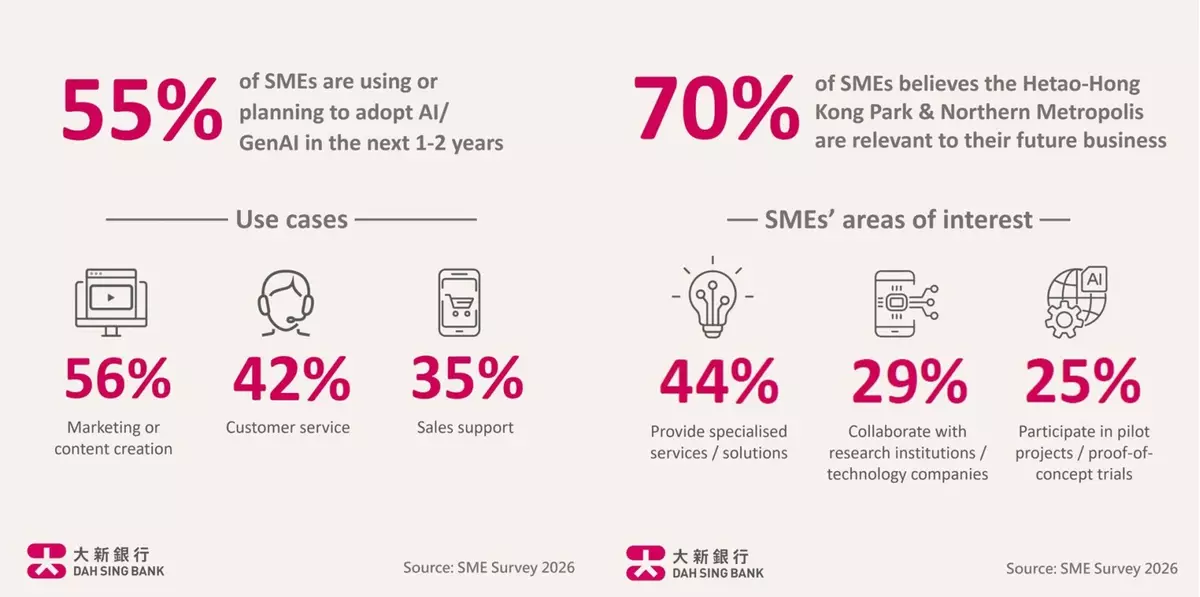
The Survey shows that around 23% of enterprises have already adopted AI or generative AI (GenAI) in their operations, while a further 32% plan to do so within the next one to two years, indicating a growing transformation momentum. At the same time, nearly 70% of respondents believe that developments in the Northern Metropolis and the Hetao-Hong Kong Science Park are relevant to their future businesses, reflecting strong interest in participating in the evolving new economy.
AI Adoption Still at an Early Stage
In terms of AI applications, SMEs are currently focusing on relatively accessible use cases such as marketing and content creation (56%) and customer service (42%), with some also applying AI in sales support (35%) and data analysis (30%).
In contrast, adoption remains limited in more advanced areas such as process automation or workflow improvement (14%), suggesting that overall AI usage among SMEs is still at an early stage and has yet to be fully integrated into core business operations.
Capability Gaps Limit Transformation
The Survey also highlights significant challenges in advancing AI adoption. Around 45% of SMEs have yet to implement AI technologies, with more than half citing a lack of relevant knowledge or skills (57%) as a key barrier. In addition, 38% pointed to unclear return on investment, while others indicated the absence of suitable use cases (29%) or insufficient time and resources to explore further (24%).
These findings suggest that gaps in capabilities, resource allocation and application planning remain major constraints on SMEs' ability to scale up transformation initiatives.
Business Models and Talent Needs Evolve
SMEs are also advancing their digitalisation efforts, with widespread adoption of social media marketing (51%), e-commerce platforms (43%) and electronic payment solutions (50%), reflecting a shift towards more flexible, multi-channel business models.
As AI adoption gradually expands, workforce requirements are also evolving. About one-quarter of respondents indicated that AI would shift employees towards higher value-added roles, while around one in five expect increased demand for new skills and talent. This suggests a gradual transition towards more knowledge- and technology-driven operating models.
Northern Metropolis Opens New Opportunities
Regarding developments in the Northern Metropolis and the Hetao-Hong Kong Park, SMEs generally prefer to participate as service providers and supporting partners within the broader ecosystem. This includes offering specialised services or solutions to companies in the area (44%), collaborating with research institutions or technology firms (29%), and participating in pilot projects or proof-of-concept programmes (25%).
In addition, some SMEs plan to provide products and services to future residents, businesses and workers in the district (51%), or take part in construction and infrastructure-related supply chains (36%). These responses indicate that SMEs are actively identifying entry points aligned with their strengths to integrate into emerging industry ecosystems.
Dah Sing Bank Supports SMEs Transformation
To address the challenges of transformation, Dah Sing Bank recognises that SMEs not only need financial support but also practical and clear directional guidance. The Bank adopts a holistic approach, offering flexible financing solutions to meet evolving business needs, while streamlining digital banking processes and enhancing cross-border financial services to improve SMEs' operational efficiency and agility.
In addition, Dah Sing Bank places strong emphasis on equipping SMEs with relevant market insights and practical knowledge. These initiatives include providing the latest market trends and business tips via the Bank's online educational platform, the "SME Info Hub". Additionally, the Bank organises tailored SME seminars through its "328 Business School" educational platform on various topics such as AI technology and digital marketing. Together, these efforts aim to help businesses deepen their understanding of emerging technologies and market developments, enabling them to navigate an increasingly dynamic economic landscape.
Dah Sing Bank Deputy Chief Executive, Senior Executive Director and Head of Group Personal Banking, Ms Phoebe Wong, said: "The Survey shows that Hong Kong SMEs are increasingly exploring AI applications and opportunities in the new economy. However, many businesses continue to face challenges in technology adoption and resource allocation. Dah Sing Bank has long been a trusted partner to SMEs on their transformation journey. Beyond providing flexible financing solutions, we are committed to offering market insights and a range of value-added services that help businesses strengthen their understanding of new technologies and market trends, equipping them with the relevant capabilities. By combining financial services with real-world support, we aim to empower SMEs to capture opportunities arising from AI and the Northern Metropolis, and to achieve sustainable growth."
# # #
To borrow or not to borrow? Borrow only if you can repay!
The service(s) / product(s) mentioned in this document are not targeted at customers in the European Union.
Risk Disclosure Statement
Foreign Exchange Transactions: Foreign exchange involves risk. Currency investments are subject to exchange rate fluctuations, which may result in gains or losses. Customers converting foreign currencies into HKD or other currencies may incur losses due to exchange rate movements. Investors should read and understand all offering documents, including risk disclosures and warnings, before making any investment decisions.
Currency Risk (RMB): Conversion of RMB into HKD or other currencies is subject to exchange rate fluctuations. Customers may experience gains or losses due to RMB exchange rate movements. RMB is currently subject to exchange controls imposed by the PRC government, and its exchange rate may be affected by policy changes.
Unless otherwise specified, this promotional material does not constitute an offer, solicitation, or recommendation to engage in any foreign exchange transaction, nor does it predict future exchange rate movements. This material has not been reviewed by the Securities and Futures Commission or any other regulatory authority in Hong Kong.
Hashtag: #DahSingBank
https://www.dahsing.com/html/en/index.html
The issuer is solely responsible for the content of this announcement.
About Dah Sing Bank
Dah Sing Bank, Limited (the "Bank") is a wholly-owned subsidiary of Dah Sing Banking Group, Limited (HKG:2356). Founded in Hong Kong over 75 years ago, the Bank has been providing quality banking products and services to its customers with a vision to be "The Local Bank with a Personal Touch". Over the years, the Bank has been rigorous in delivering on its brand tagline to grow with its customers in Hong Kong, the Greater Bay Area and beyond – "Together We Progress and Prosper". Building on our experience and solid foundation in the industry, our scope of professional services now spans retail banking, private banking, business and commercial banking. Meanwhile, the Bank is also making significant investments in its digital banking capabilities to stay abreast with smart banking developments in Hong Kong and to support financial inclusion at large.
In addition to its Hong Kong banking operations, the Bank has wholly-owned subsidiaries including Dah Sing Bank (China) Limited, Banco Comercial de Macau, S.A., and OK Finance Limited. It is also a strategic shareholder of Bank of Chongqing with a shareholding of about 13.5%. Dah Sing Bank and its subsidiaries now have 63 operating locations in Hong Kong, Macau and Chinese Mainland.
** This press release is distributed by Media OutReach Newswire through automated distribution system, for which the client assumes full responsibility. **